VLSI Korea
The Global Chip Talent War: Korea's 157% Hiring Surge, Taiwan's Drought, America's 157,000-Worker Gap
Experienced-hire postings at Korean chip giants surged 157% in Q3 2026. TSMC's CEO calls talent Taiwan's binding constraint; the US faces a 157,000-worker shortfall by 2030. Fabs are built with money, people with time — why talent is the memory supercycle's real bottleneck.


The 30-Second Version
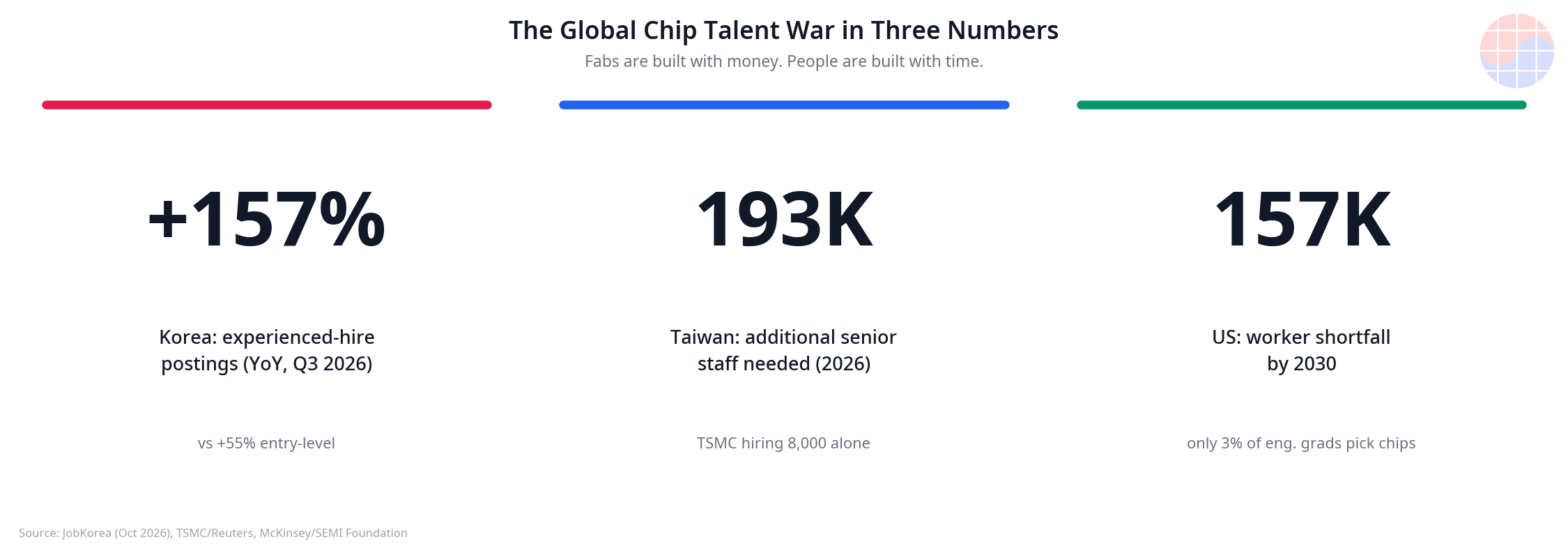
The real bottleneck in semiconductors isn't fabs. It's people. JobKorea's Q3 2026 analysis, published October 8, shows job postings from large semiconductor and display companies up 102% year over year — with experienced-hire postings up 157%. That's nearly triple the 55% growth in entry-level postings. Companies aren't hiring people; they're buying them. Meanwhile, TSMC CEO C.C. Wei says talent — not water, not power — is Taiwan's most serious constraint, and the US faces a shortfall of up to 157,000 semiconductor workers by 2030. In the memory supercycle, the winner won't be whoever builds fabs first. It'll be whoever staffs them first.
Background: Q3 2026 by the Numbers
JobKorea's Q3 2026 large-company posting analysis reads like a fever chart for the chip industry. While total postings across the job market grew 17% year over year, semiconductor engineer postings jumped 55% — more than triple the market average. AI/ML engineer postings rose 50%; process engineer postings, 39%. Figures via Seoul Economic Daily and Maeil Business Newspaper.
The divergence is the story. In the same quarter, postings for web developers, cloud engineers, and app developers fell year over year. Money is rotating out of generalist software roles and into silicon. Cumulative posting views climbed 64%, and newly written resumes in Q3 rose 13%. Demand and supply heating up together: the classic opening phase of a talent war.
But the most dramatic number stands apart: experienced-hire postings up 157%, versus 55% for entry-level — a 2.9x gap. Companies don't want people to train. They want people to deploy. That distinction is the thread running through this entire piece.
Korea: The Salary War and the Talent Drain, Simultaneously
Unpack what 157% means. The experienced-hire premium exists for a simple reason: you can build a fab with money, but you can only build an engineer who runs it at yield with time. HBM stacking, TSV etching, advanced packaging — these aren't learned from textbooks. They're learned on production lines, with your hands. When companies pay up for veterans, they're not buying labor. They're buying time.
The salary tables prove it. The Robert Walters 2026 salary survey puts senior circuit designers in semiconductors at up to KRW 130 million, senior software engineers at up to KRW 120 million, per Daum News. Samsung raised employee salaries 6.8% for 2026, with total payroll reaching roughly $19.21 billion. Per Android Headlines, the raise is widely read as defensive — a countermeasure against poaching.
The reason defense is needed surfaced at the October 12 parliamentary audit: at least 27 key personnel from Samsung and SK have moved to China's CXMT, with an average domestic tenure of 15.4 years — including HBM and TSV specialists. Via Newspim. When veterans who stayed 15 years start moving, the pay gap has crossed from "worth considering" to "impossible to ignore." Talent outflow is no longer a series of individual defections. It's structural.
Taiwan: Even the World's No. 1 Foundry Is Bottlenecked on People
Proof this isn't just a Korean story sits in Taiwan. On June 12, 2026, TSMC CEO C.C. Wei told Reuters that among Taiwan's constraints — water, power, land — "what we still lack most is talent." Via the Economic Times. Note what the CEO of the world's leading foundry named as the top risk to fab expansion: not equipment, not yield. People.
Taiwan's semiconductor industry needs 193,000 additional senior professionals in 2026. TSMC alone is hiring 8,000 this year, with master's-degree new hires averaging NT$2.2 million annually (about $68,000). Via the Taipei Times. What happens in a market this tight is predictable. JASM — the TSMC joint-venture fab in Kumamoto, Japan — is offering Kosen (technical college) graduates a starting salary of ¥290,000 per month, roughly 40% above the Kumamoto average, shaking Japan's seniority-based pay norms. Via Storm Media. A Taiwanese company is breaking Japanese wage conventions on Japanese soil. That's the era we're in.
America: The 157,000-Worker Hole — and AI Labs Join the Bidding
America's situation goes beyond "shortage" into "hole." Analysis from McKinsey and the SEMI Foundation projects the US will be short up to 157,000 semiconductor workers by 2030. Only 3% of US engineering graduates choose the chip industry; 73% of companies report hiring difficulty. Via WebProNews and Startup Fortune.
US semiconductor salaries run $127K–$187K, with senior roles above $238K. In that same market — where Samsung's $35B Taylor fab needs 3,500 workers and SK hynix's $4B Indiana packaging plant needs its own crew — AI labs have now entered the bidding. OpenAI, Anthropic, and peers building custom silicon teams mean chip designer compensation is no longer set inside the semiconductor industry alone. More bidders, higher prices. That's a demand-curve shift, not a temporary spike.
Chase's Take: Talent Is the Leading Indicator of the Supercycle
Fabs are built with money. People are built with time. That asymmetry explains everything. When memory companies raise experienced-hire postings 157%, it's not because they're short on people — it's because they're short on time. There's no room to hire juniors and train them for three years, which means management believes current demand lasts at least three years. Hiring data is the most honest leading indicator there is: faster than earnings, more candid than guidance.
Second, watch the experienced-versus-entry gap: 157% against 55%. What companies are buying isn't labor — it's proven yield. One engineer who lifts bonding yield a point on 12-high HBM is worth more than ten juniors at the same salary. That premium doesn't vanish when the cycle turns, because the time it takes to grow people is structurally fixed. That's why I read this talent war as structural, not cyclical.
Third is geopolitics. In a world where Korea, Taiwan, and America chase the same engineers, talent is now part of the supply chain. If the US can't staff its own fabs, Korean and Taiwanese veterans become the default hiring pool. The 27 engineers who moved to CXMT may be the beginning. The only thing blocking talent flows is visa friction — and money erodes that barrier faster than you'd think.
Implications: So What Do You Do
For engineers: negotiating leverage is near its peak — especially for skills with no substitutes: HBM, advanced packaging, STA signoff, PDK validation. If you're placing a skill bet, bet on the verification and yield domains that resist automation. Even as AI writes code, humans still sign off tapeouts.
For companies: raises are only the start of defense. Look at why 15.4-year veterans moved. Money alone doesn't do it. Interesting work, access to leading nodes, and equity upside have to come as a package. And above all: restart the junior pipeline now. It's the only way to be ready in three years.
For investors: labor-cost inflation is a structural margin pressure on chipmakers. At the same time, watch fab ramp execution risk: equipment can arrive on schedule, but ramps slip when there's nobody to run the tools. Asking about hiring attainment may be more accurate than asking about capex guidance.
FAQ
Why did experienced-hire postings grow nearly 3x faster than entry-level?
Companies are buying time, not labor. Production know-how in HBM and TSV can't be built through junior training within three years — and current demand won't wait three years. The 157%-versus-55% gap signals management is betting demand lasts years.
Why is even TSMC short on talent?
Foundry leadership doesn't guarantee talent supply. Taiwan's chip industry needs 193,000 more senior professionals in 2026, and CEO C.C. Wei named talent — over water, power, and land — as the binding constraint. Demand is structurally outrunning supply growth.
What does America's 157,000-worker gap mean for Korean engineers?
It opens the ceiling on global compensation. With only 3% of US engineering graduates choosing chips, proven Korean and Taiwanese engineers are the default hiring pool for American fabs. Visas are the variable — and local fabs like Samsung Taylor are lowering that barrier.
Which skills are most valuable for a chip engineer right now?
The verification and yield domains that resist automation: HBM stack bonding, advanced packaging, STA signoff, PDK validation. Premiums there are highest — and slowest to fade when the cycle turns.
Disclaimer: figures and quotes in this article are based on each source's published materials, as of October 2026. Salaries and hiring figures may change with market conditions.