VLSI Korea
Why Put the Laser Outside CPO? Heat, Optical Loss and Repair Costs
Moving the optical engine closer to compute and moving the laser outside solve different problems. Optical-loss and repair-exposure calculations reveal the trade-offs.


Putting optical circuitry beside a processor shortens the distance that high-speed electrical signals must travel. But must the laser that creates the light sit there too? In co-packaged optics, the location of the optical engine and the location of the laser are separate design decisions.
Ayar Labs connects its TeraPHY optical engine to an external SuperNova light source. Intel took a different approach in its optical I/O chiplet prototype disclosed in 2024, incorporating lasers in the photonic integrated circuit.[1][2] Both bring electrical-to-optical conversion close to compute. They draw different boundaries around heat, assembly and repair.
Ciena's 2026-09-16 ECOC announcement, which discussed optical engines alongside liquid cooling, illustrates why this is a system problem.[3] To understand the external-laser choice, first separate the path that supplies light from the path that carries data.
Making light and encoding data are different jobs
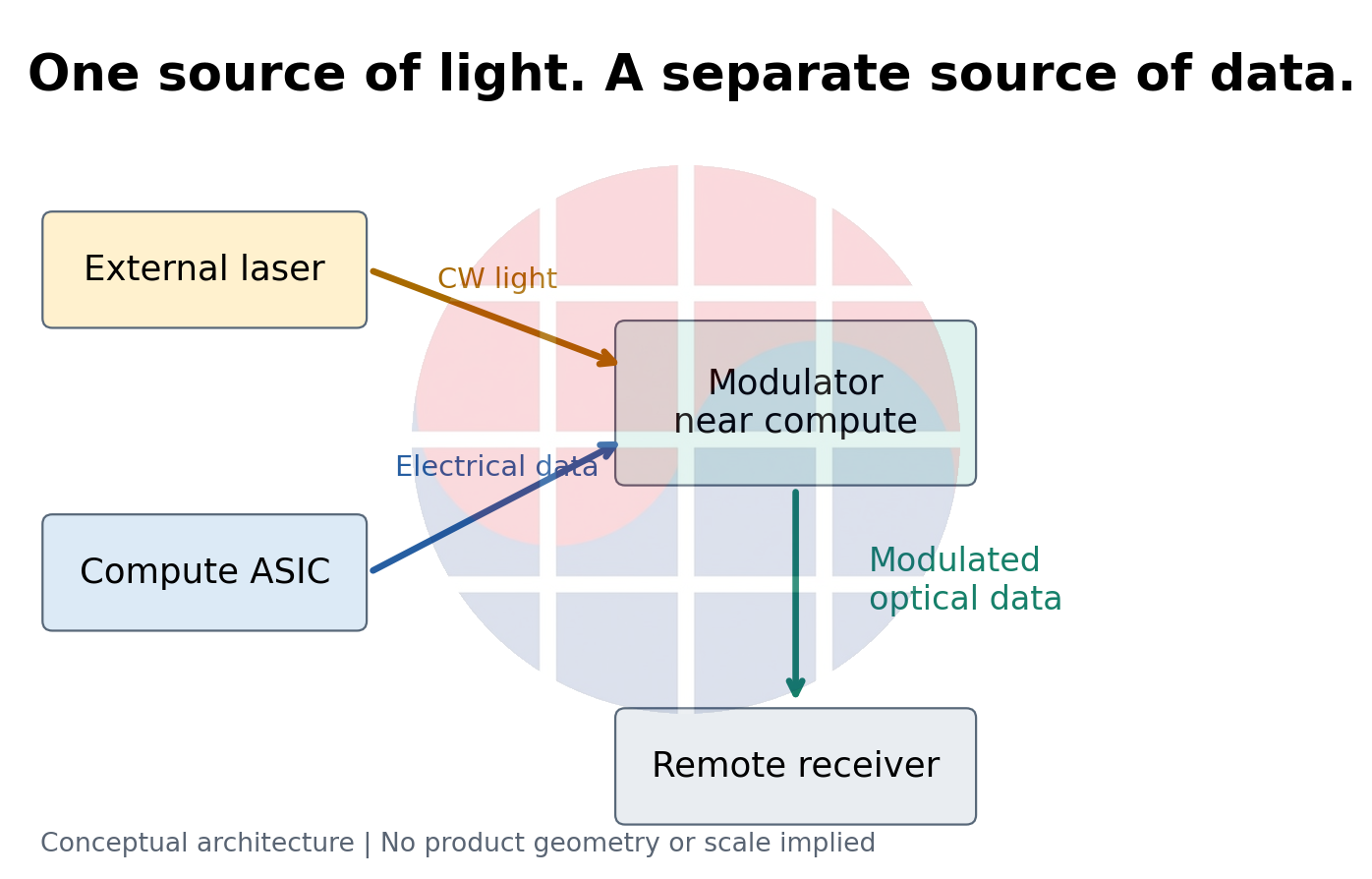
A processor produces electrical signals. An optical link converts those signals into changes in light; the receiver converts the changes back into electrical signals. A modulator encodes the data, and a photodetector reads the arriving light.
In an external-source architecture, the laser supplies continuous light. The modulator beside the package encodes data onto it. The fiber bringing light to the engine therefore has a different job from the fiber carrying the modulated signal to another device. This separation allows the optical engine to move closer to compute while the laser stays elsewhere.[4]
Conventional pluggable optical modules usually sit at the equipment's front panel. High-speed electrical signals must cross board traces to reach them. Increasing the signaling rate makes attenuation and interference harder to manage, increasing the burden on signal-conditioning circuits.
CPO shortens that electrical segment. Saying that light is always faster misses the engineering question: can conversion near the chip reduce the power and space needed to sustain the electrical connection? Copper can remain attractive over short distances, and optical conversion itself requires circuitry and energy.
VLSI Korea view: Moving the optical engine closer shortens the high-speed electrical path. Moving the laser outside separates light-source cooling and replacement. Treating these as one decision hides their different costs.
What does moving the laser outside buy?
The first benefit is a separate thermal environment. A large processor already imposes demanding power and cooling constraints. An external source makes laser placement less dependent on the processor's immediate surroundings. “External” does not necessarily mean outside the rack: the relevant questions are which components share a thermal environment and where replacement happens.
The second benefit is the repair boundary. If a weakened source can be replaced independently, healthy compute and optical-engine components need not be replaced with it. OIF's ELSFP agreement covers a pluggable external-laser module and its electrical and optical connection.[4] Replaceable does not mean uninterrupted service. Without a spare source and a switchover path, the links using that light can stop during replacement.
The third consideration is sharing light across transmit paths. NVIDIA describes a Quantum-X external-source module containing 8 lasers and supplying 32 transmit lanes.[5] A laser, a module and a data lane are different units. That example cannot be transferred unchanged to another vendor's package or to every CPO design.
Dividing 100Tb/s does not count lasers
Dividing aggregate capacity by a lane rate can produce an equivalent number of connections at that rate. It does not determine the number of fibers or lasers. Several wavelengths can share a fiber, and a source can distribute light to several modulators.
For example, 100Tb/s ÷ 200Gb/s = 500 is valid arithmetic. But the operands must first agree on direction and whether coding overhead is included. Wavelength count, optical distribution, fiber arrangement and redundant paths are still missing. The result does not establish 500 lasers or 500 fibers.
The OCI-MSA optical-interface specification published in 2026 describes an arrangement using 4 wavelengths at 53.125Gb/s each in one direction. They sum to a 212.5Gb/s line rate, not an equal quantity of user payload.[6] Even a “200G” label can conceal a mapping between electrical interfaces and optical wavelengths.
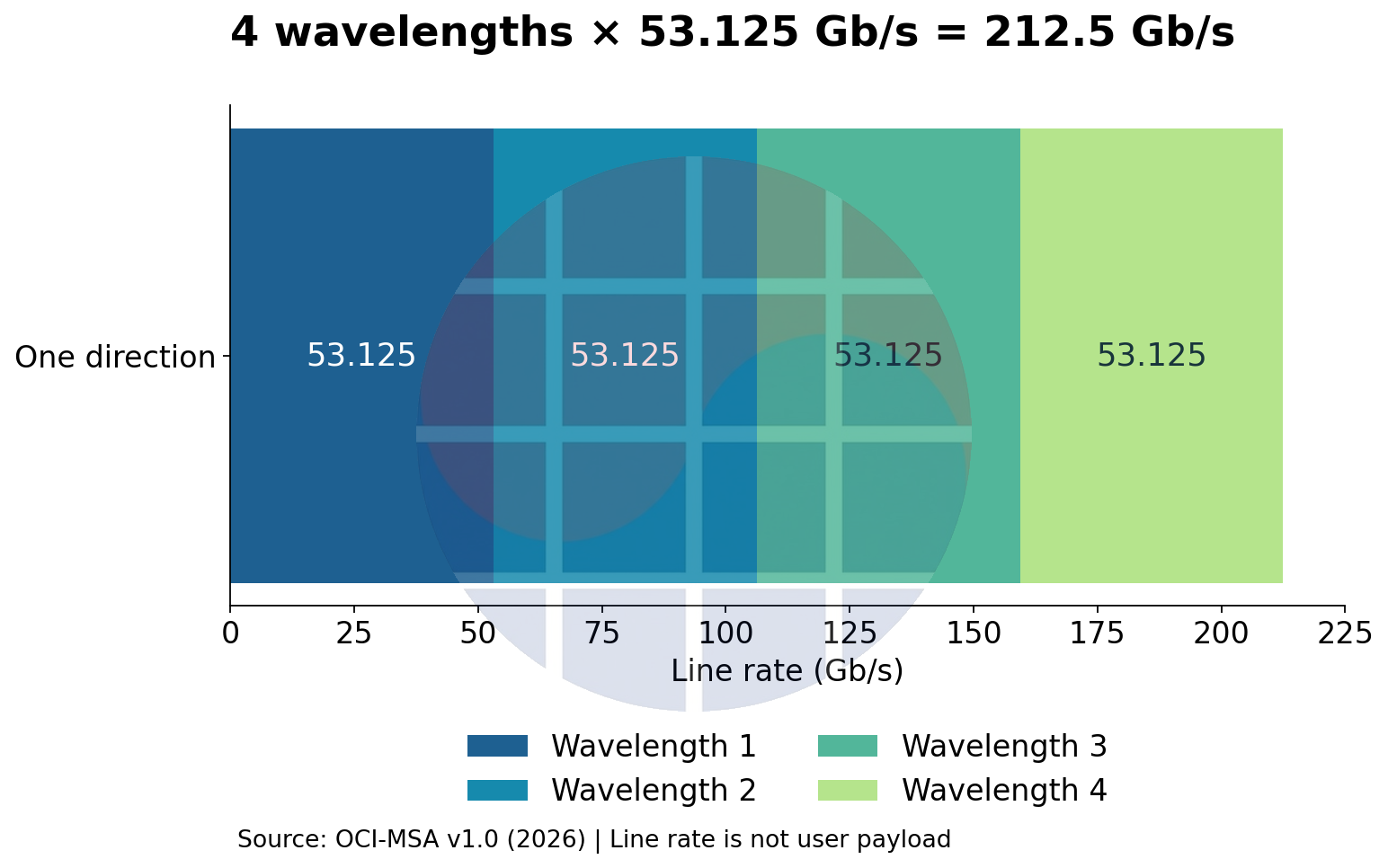
A useful design comparison therefore records the actual directional payload, wavelengths per fiber and transmit paths supplied by each source. Without those details, aggregate bandwidth cannot establish connector count, failure exposure or power. Matching the boundaries of the numbers matters more than making them large.
The price of distance is optical loss
Light generated outside the package still has to reach the engine. Connectors, fiber and distribution reduce the optical power available to each path. Thermal separation must be valuable enough to justify compensating for that loss.
Consider an illustrative design. Each modulator input needs 10mW of continuous light, one source feeds 4 inputs equally, and delivery loss other than ideal splitting is 3dB. These are assumed values, not product specifications or measurements.
Even without delivery loss, the 4 inputs require 40mW in total. Compensating for 3dB needs roughly 2 times the source power: 10mW × 4 × 10^(3/10) ≈ 80mW. The factor of 4 already accounts for distributing power among the inputs. Adding the ideal splitting loss again would double-count it.
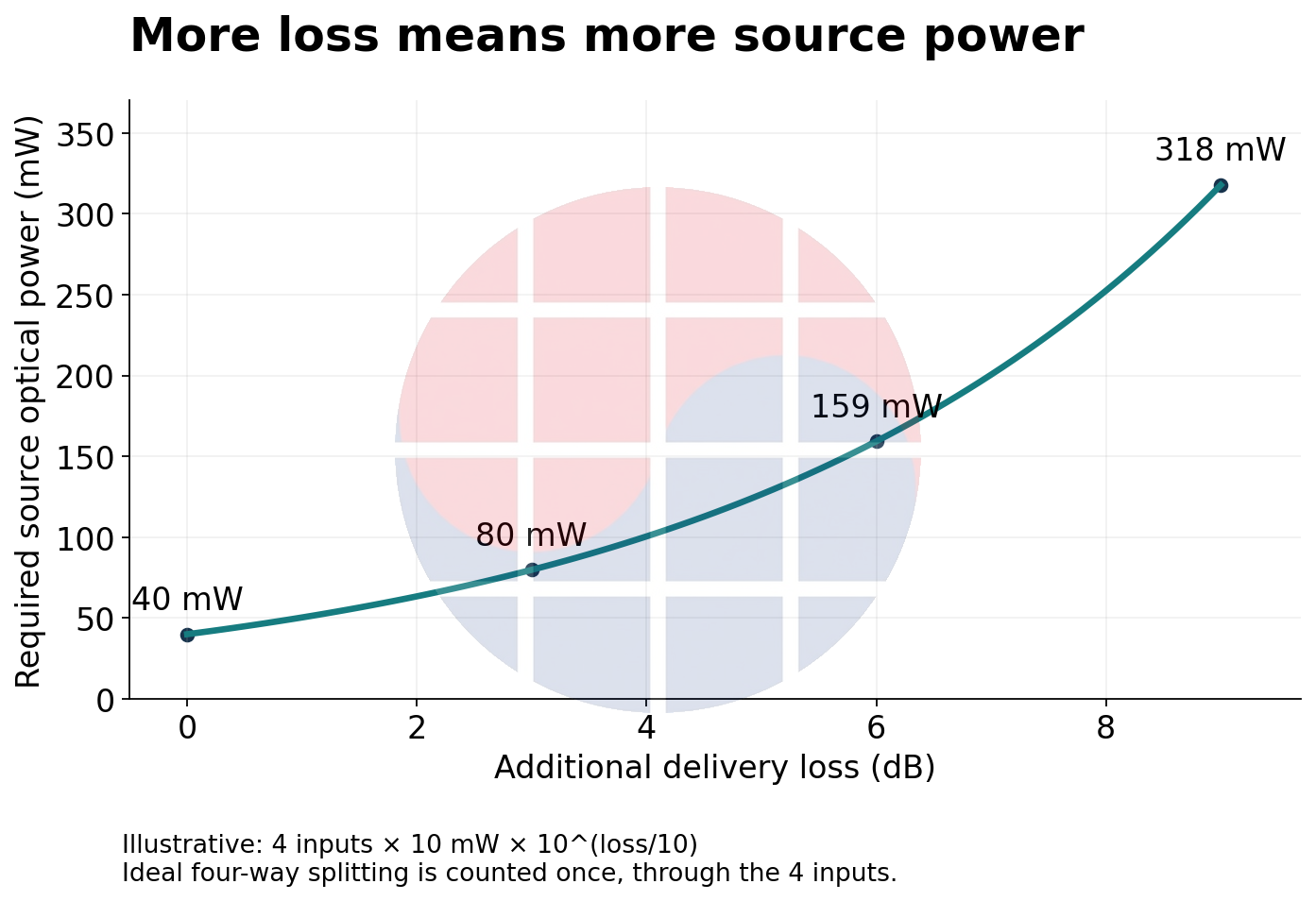
At 6dB of additional loss, the same inputs require approximately 159mW at the source. Another 3dB almost doubles the requirement. Increasing fan-out or adding connectors makes coupling efficiency as relevant as the laser's headline output.
Electrical consumption is a separate quantity. With an assumed electrical-to-optical conversion efficiency of 20%, producing 80mW requires approximately 400mW of conversion input power. That is not the complete module consumption, which also depends on drivers, temperature control and management electronics. Optical output in mW must not be confused with equipment power in W.
A real design also needs margin for aging, temperature and connector condition, while respecting component input limits. This example ends at the modulator input. The budget from the modulated transmitter output to the remote receiver must be calculated separately.
An external laser does not eliminate thermal control
Components inside the optical engine remain temperature-sensitive. A microring modulator uses a small ring-shaped optical path that responds strongly around a selected wavelength. A simplified resonance condition makes the optical distance around the ring an integer multiple of the wavelength. Changes in the material's optical properties can move that response.
A stable source alone is therefore insufficient: the modulator must remain aligned with its light. NVIDIA's technical discussion treats microring thermal sensitivity and control as separate engineering challenges.[5] Moving the laser separates the source's thermal conditions; it does not remove control requirements inside the package.
This distinction matters when diagnosing faults. Reduced source output, increased connector loss and a shifted modulator operating point require different remedies. Replacing the laser whenever receiver errors rise can replace a healthy component. Optical-power, temperature and error records must be examined together.
Fast replacement is not the same as limited disruption
A shared source may reduce component count while increasing the number of paths affected by a single failure. The benefit of replacing a module quickly must be assessed separately from the capacity lost while it is unavailable.
Assume 1 failure during the same observation period, equal-capacity paths and otherwise equal conditions. Interrupting 4 paths for 5 minutes creates 20 path-minutes of exposure. Interrupting 32 paths for only 2 minutes creates 64 path-minutes. The latter repair is faster, but its simple aggregate interruption exposure is larger.
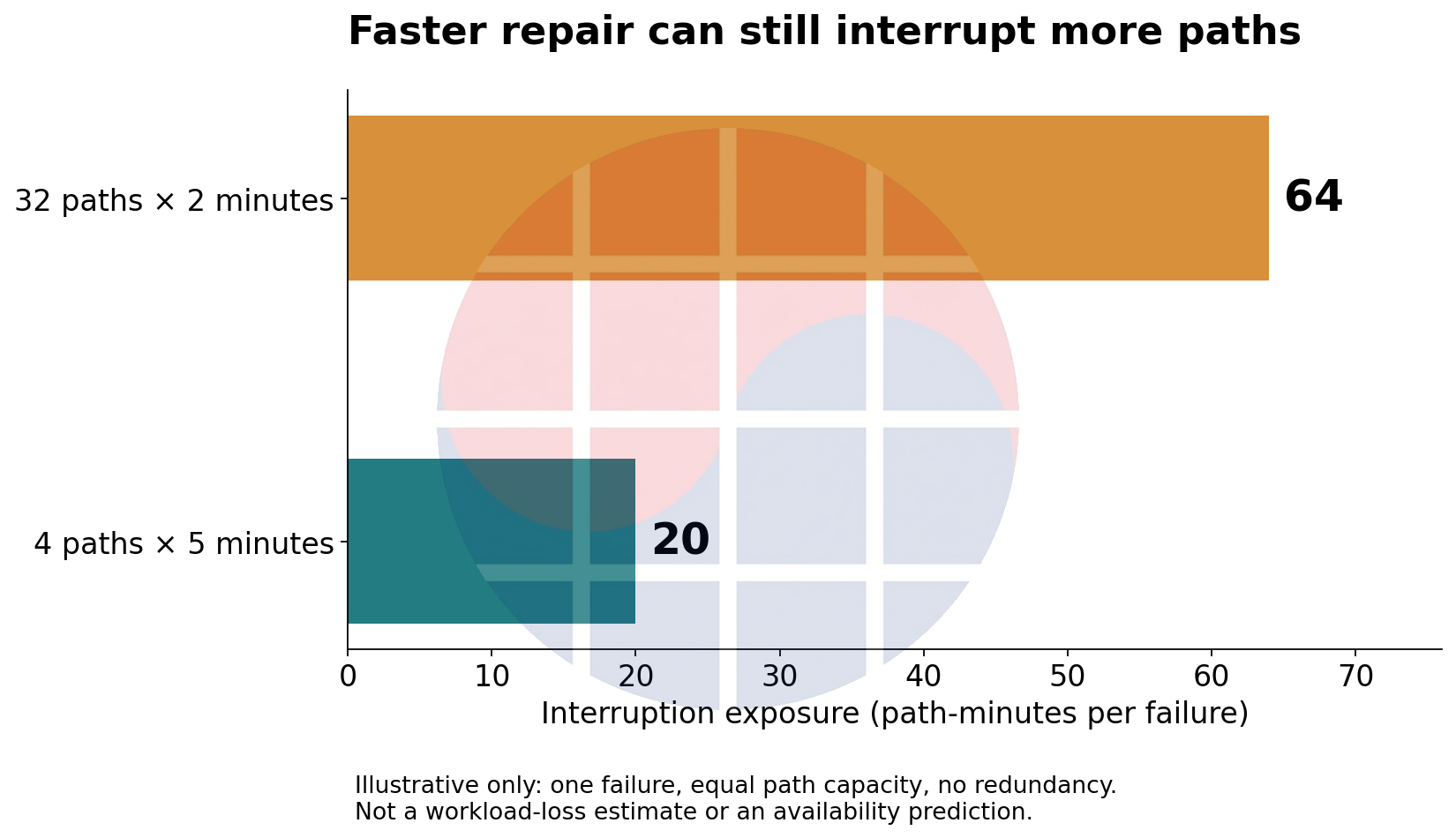
This calculation is not an availability prediction. Failure frequency, spare paths and the workload's ability to reroute remain essential. A simple sum can understate the impact if a critical connection stalls an entire job. Conversely, sufficient alternate capacity can make user-visible disruption much smaller.
Boundary condition: An external source must be judged by both how quickly it can be replaced and what stops during replacement. Field replaceability alone does not establish uninterrupted operation.
Integrating the laser is another legitimate choice
Intel's prototype included lasers and optical amplifiers in a photonic circuit combined with electronic circuitry. Its 2024 announcement explicitly identified it as a prototype.[2] It is a concrete counterexample to the idea that an external laser defines CPO. Intel's OCI product terminology must also not be confused with the OCI-MSA interface specification published in 2026.
Integration can reduce external light-delivery connections and assembly steps. It also requires the integrated design to solve laser-process, thermal and test requirements. External sourcing separates those boundaries but adds light-delivery fiber and connections. Yield, optical loss and repair procedures determine which implementation is less expensive or more reliable.
Likewise, NVIDIA's networking-switch example and Ayar's compute-interconnect approach are not the same system. Their light-source choices can be compared without treating their protocols, latency requirements and scale as interchangeable. Switch specifications do not predict the performance of an arbitrary GPU package.
Where does the economic value sit?
The scarce capability is not simply laser output. It includes delivering sufficient light with low loss, assembling package-to-fiber connections repeatably, and diagnosing failures accurately enough to repair them. A laser improvement can be consumed by connector losses; a capable optical engine can remain expensive to assemble and test.
The supply chain therefore needs to be read as a connected cost structure. How much does an improvement in one component reduce the burden on another? External-source vendors may gain opportunities, but customer specifications, spare-part requirements, testing and warranty costs influence profitability. CPO adoption alone does not guarantee higher earnings for a particular supplier.
Compare competing designs at the same useful throughput and operating conditions. Then examine source-to-modulator loss, complete module power, failure exposure and the actual replacement procedure. External sourcing is attractive where its cooling and repair benefits outweigh added optical losses and connection costs.
CPO does not require every light-generating component to be moved beside compute. It means shortening the electrical path while placing the source where it can be managed effectively, then accounting for the light lost and the failure boundaries created between them. Laser placement determines that balance.
Sources
- Ayar Labs products: TeraPHY and SuperNova
- Intel optical I/O chiplet prototype, 2024-06-26
- Ciena ECOC announcement, 2026-09-16
- OIF ELSFP 2.0, 2025-01-08
- NVIDIA CPO technical explanation, 2025-08-26
- OCI-MSA optical PHY v1.0, 2026-03-11
Update
Updated 2026-09-27: clarified that external lasers are not universal to CPO; distinguished lane equivalents from source counts; added optical-loss and repair-exposure calculations. Original publication date and URL retained.
Disclosure
This article is provided for informational purposes only and does not constitute a recommendation to buy or sell any security. Figures and factual statements are based on publicly available sources, including company filings, news reports, and market research, and may contain errors in the source material or in the preparation of this article. The author may own shares in companies mentioned. All investment decisions and their outcomes are the reader’s responsibility.