VLSI Korea
Germany's EU Blue Card Tech Tree for Chip Engineers: The Dresden Fab Cluster
30-Second Summary * EU Blue Card Germany 2026 salary thresholds: 50,700 euros per year for standard occupations, 45,934.20 euros for shortage occupations — the category chip engineers fall into. * Fastest permanent residence in the EU: 21 months with German B1, 27 months with A1. No other EU route for skilled workers is this fast. * Why Dresden, why now:


30-Second Summary
- EU Blue Card Germany 2026 salary thresholds: 50,700 euros per year for standard occupations, 45,934.20 euros for shortage occupations — the category chip engineers fall into.
- Fastest permanent residence in the EU: 21 months with German B1, 27 months with A1. No other EU route for skilled workers is this fast.
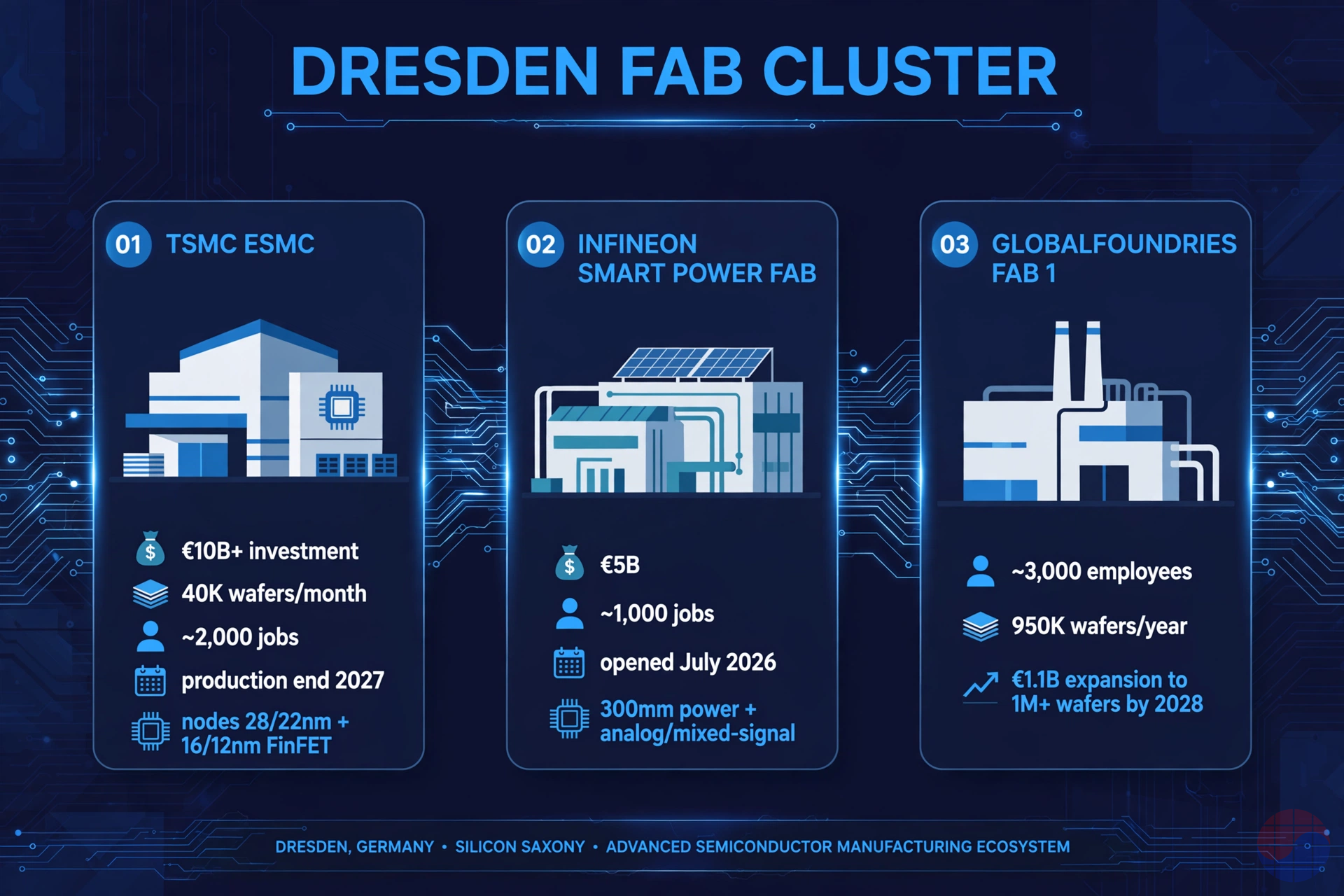
- Why Dresden, why now: TSMC ESMC (10B+ euros, ~2,000 hires, production targeted end of 2027), Infineon Smart Power Fab (5B euros, ~1,000 jobs, opened July 2026), GlobalFoundries Fab 1 (~3,000 employees, 1.1B euro expansion underway) — all in one city.
- No German required for the Blue Card itself — or for your spouse to join you. German only controls the speed of your permanent-residence clock.
- No job offer? The Chancenkarte: score 6 of 16 points and you can move to Germany first, then job-hunt on the ground. A Korean chip engineer with a master's, 5 years of experience, C1 English and under 35 already clears it.
Intro: The Country That Prints Its Entry Fee
Ask chip engineers about moving abroad and the conversation always stalls at the same point: the US has the H-1B lottery, Singapore has no seats, Taiwan has its own math. Plenty of variables, but almost no country prints its entry conditions as hard numbers. Germany does. 50,700 euros. 45,934.20 for shortage occupations. 21 months to permanent residence. These figures sit in the Federal Ministry of the Interior's gazette, down to the second decimal. It is a country you can calculate, not just feel.
And now there is a reason to run the calculation. Dresden, Saxony. TSMC is building its first European fab there. Infineon just executed the largest single investment in its history there. GlobalFoundries is expanding there. As of October 2026, the beating heart of European chip manufacturing is in Dresden. This is the tech tree for getting there.
Deep Dive
Episode 1. Dresden — "Silicon Saxony" Was Never Just Marketing
Calling Dresden "Europe's Silicon Valley" usually earns an eye-roll. The fab numbers make the eye-roll hard.
TSMC ESMC is a 10B+ euro project. Structure: TSMC 70%, Bosch, Infineon and NXP 10% each. Capacity: 40,000 300mm wafers per month on 28/22nm planar CMOS and 16/12nm FinFET. Direct employment: ~2,000 high-tech jobs. Construction began in the second half of 2024, production is targeted for the end of 2027, and the European Commission approved a 5B euro German support measure for it. The target market is automotive and industrial silicon — Europe's home turf. (Bosch press release, TechPowerUp)
Infineon Smart Power Fab: 5B euros, the largest single investment in the company's history. It opened on July 2, 2026, several months ahead of schedule — a 300mm power and analog/mixed-signal fab that doubles wafer output at the Dresden site and creates ~1,000 jobs. Infineon calls it the world's largest factory for intelligent power semiconductors. (Compound Semiconductor, Shepherd Gazette)
GlobalFoundries Fab 1 is already Europe's largest fab: ~3,000 employees, 60,000 square meters of cleanroom and lab space, up to 950,000 300mm wafers a year. The 1.1B euro SPRINT expansion announced in October 2025 targets more than one million wafers a year by the end of 2028. The company has invested 10B+ euros in Dresden since 2009. (GF official announcement)
Add the three together and Dresden alone needs thousands of new engineers through 2027-2028. Fabs eat people: process engineers, equipment engineers, yield and integration engineers, plus hundreds of supplier staff around them. That is the real reason the neighbor's rice cake looks bigger here — the rice cake genuinely is bigger.
Episode 2. The EU Blue Card, Dissected by the Numbers (2026)
The EU Blue Card is Germany's skilled-professional residence permit under Section 18g of the Residence Act. The 2026 figures were published by the Federal Ministry of the Interior on December 18, 2025.
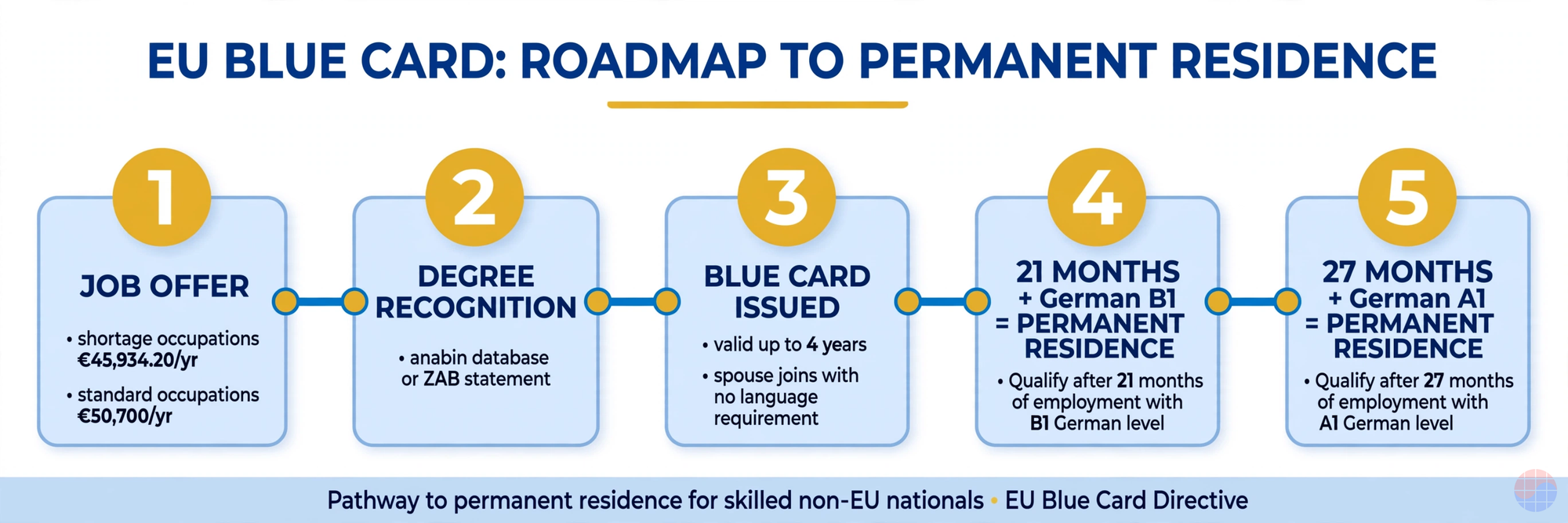
- Standard occupations: 50,700 euros gross per year (~4,225/month)
- Shortage occupations: 45,934.20 euros gross per year (~3,827.85/month)
Chip engineers land in the shortage bucket. The lower threshold also applies if you earned your degree within the last three years. One underappreciated detail: the reduced threshold requires Federal Employment Agency approval, but it is handled automatically inside the visa procedure — no separate pilgrimage to the labor office. Clear the standard 50,700 euro bar and even that approval is waived.
Three core conditions: (1) a university degree recognized as comparable to a German one — check the anabin database for an H+ institution rating, or get a ZAB statement of comparability; (2) an employment contract of at least six months; (3) fixed base salary above the threshold — bonuses and variable pay do not count.
The permanent-residence clock is the card's real weapon. With German B1: 21 months. With A1: 27 months — plus pension contributions for the period and the "Living in Germany" test. The standard skilled-worker route takes 36 months. Spouses join with no language requirement, EU mobility opens after 12 months, and job changes need no permission after the first year (during the first 12 months the foreigners' office may object, but that is it). (Playroll 2026 guide, Moving2Europe, GermanyTalent, MS in Germany)
A feel for the numbers: the 2026 thresholds rose roughly 5% over 2025, and they are re-indexed every year against the pension contribution ceiling — expect a similar step for 2027. Getting an offer this year is measurably cheaper than next year. Few immigration systems reward timing this literally.
Episode 3. The Chancenkarte — A Calculated Bet Without a Job Offer
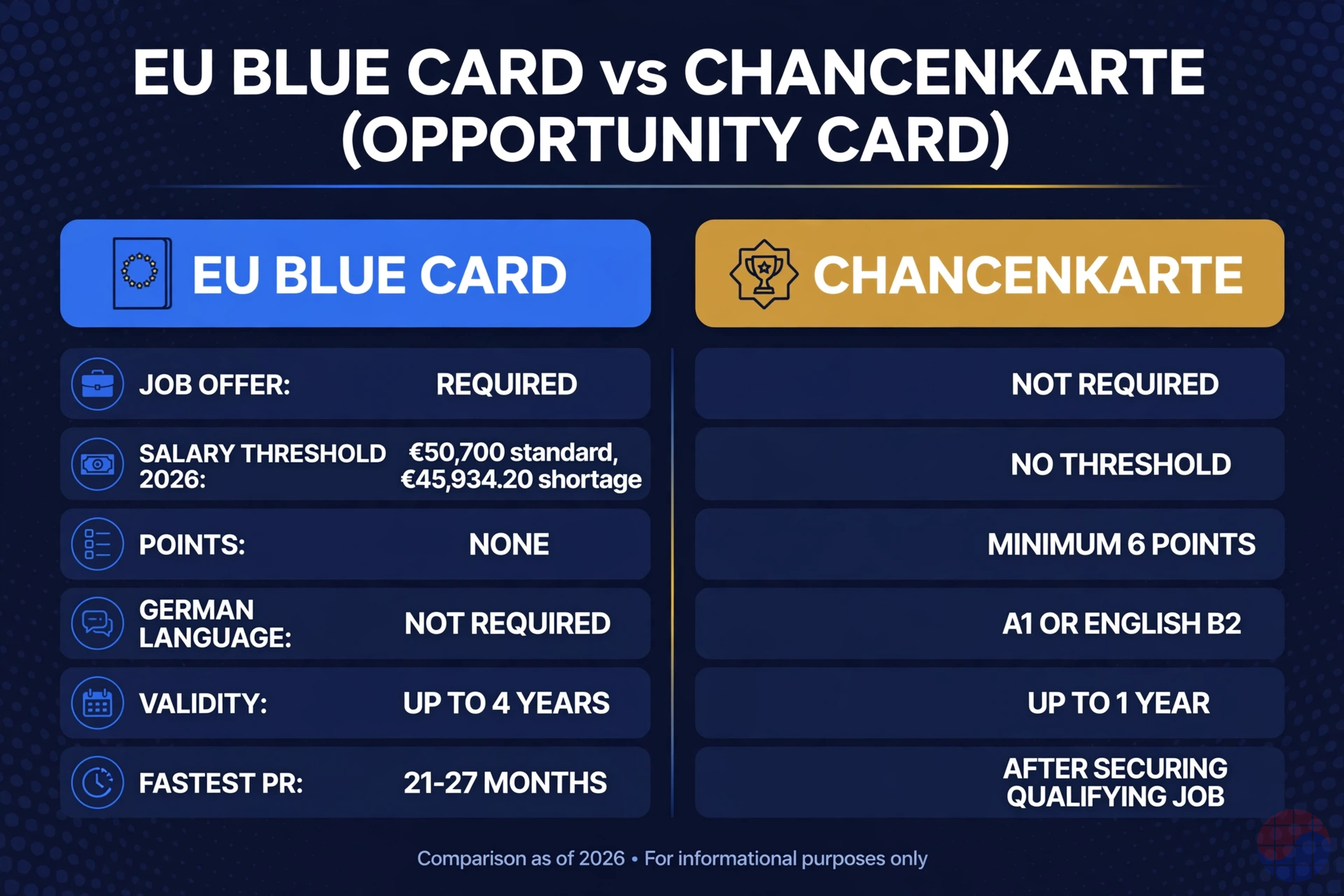
In force since June 1, 2024, the Chancenkarte (Opportunity Card) lets you live in Germany for up to a year (extendable to two) to look for work — no offer required. The mechanism is points: 6 out of 16 gets you in.
The points table (ImmigrationWorld, Migaku, VisaAtlas):
- Partial recognition of qualification: 4 points / shortage occupation: 1 point
- Experience: 2+ of the last 5 years = 2 points, 5+ of the last 7 years = 3 points (not cumulative)
- German A2/B1/B2: 1/2/3 points; English C1: +1 point
- Age: under 35 = 2 points, 35-40 = 1 point
- 6+ months legal stay in Germany in the last 5 years: 1 point
- Spouse who also qualifies: 1 point
Baseline requirements: a recognized degree (or 2-year vocational training), German A1 or English B2, and proof of funds — about 1,091 euros a month in a blocked account, 13,092 for the year. During the search you may work 20 hours a week part-time and do trial work of up to two weeks per employer. Land a qualifying job and you convert to a Blue Card or skilled-worker permit.
Run the typical Korean chip engineer hand: semiconductor master's + 5 of the last 7 years of experience (3 points) + C1 English (1 point) + under 35 (2 points) = 6 points. Shortage occupation adds one more. You clear the bar without a word of German. The catch is money: you are burning savings while you hunt. The Blue Card is "offer first"; the Chancenkarte is "me first." Choose by risk tolerance.
Episode 4. The Salary Math — Gross, Net, and Rent
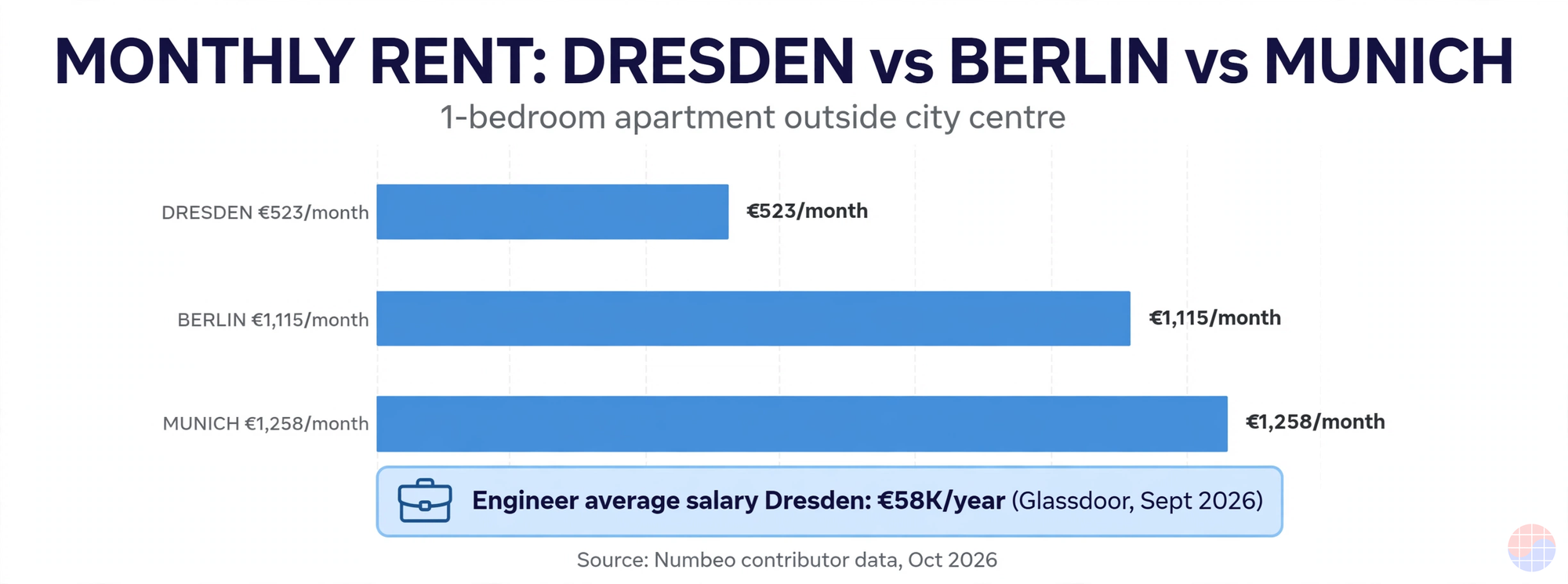
Glassdoor puts the average Dresden engineer salary at 58,000 euros a year, with the 25th-75th percentile band at 51,000-66,000 and the 90th percentile at 86,800 (48 salaries, September 2026). Roughly three-quarters report being satisfied with their pay. (Glassdoor)
But German salaries are quoted gross. On 60,000 euros gross (tax class I, single, no church tax) the 2026 take-home is 37,561 euros a year, about 3,130 a month: roughly 9,389 in income tax and 13,050 in social contributions. You keep 63 cents of every euro. The basic tax-free allowance is 12,348 euros. (lohntastik 2026, relocate.me)
"So you earn less than in Korea?" — that is where rent enters. Numbeo's October 2026 data for a 1-bedroom outside the city center: Dresden 523 euros, Berlin 1,115, Munich 1,258 a month. Dresden is less than half of Munich. Holding 3,130 a month and paying 523 in rent is a different life equation from Seoul, where the apartment eats the paycheck. German social contributions are also forced savings of a sort — pension, health, unemployment, long-term care. It is the inverse of the Korean structure: lower nominal pay, but the floor is concrete.
Episode 5. Can You Live Without German? — The Honest Answer
The Blue Card requires zero German. The fab floor does not either. At a multinational joint-venture fab like TSMC ESMC or a US-rooted fab like GlobalFoundries, the working language is English: process recipes, equipment manuals, yield reviews — all English. The international community around TU Dresden is English-friendly too.
But German sends its bill in two places. First, the residence clock: B1 gets you PR in 21 months, A1 in 27. That is a six-month difference you can study for. Second, the leadership track: senior engineer is fine in English, but the moment you run a team, German becomes the promotion key. Management meetings at German fabs still run in German.
The practical prescription: arrive in English, settle in German. B1 alongside fab shift work is a one-year project. Goethe-Institut and VHS evening classes exist in Dresden. Treat German as a promotion requirement rather than an entry requirement and the burden shrinks dramatically.
Tech Tree for Korean Chip Engineers
Route A. Blue Card Direct — Offer First (Difficulty ★★★ / Reward ★★★★★)
- Check degree equivalence free on anabin; H+ rating clears you, otherwise request a ZAB statement.
- Apply to the three Dresden fabs and the wider Silicon Saxony cluster. Process, equipment, yield and integration roles are the main targets.
- Land an offer above 45,934.20 euros/year and apply. Employment Agency approval is automatic inside the process.
- After arrival, push for German B1 — apply for permanent residence at month 21.
The fastest, most certain route. All three difficulty stars sit on "getting the offer." The visa itself is mechanical once the numbers line up.
Route B. Chancenkarte — You First (Difficulty ★★ / Reward ★★★★)
- Score yourself: 3 (experience) + 1 (C1 English) + 2 (under 35) = 6 points; shortage occupation makes 7.
- Park 13,092 euros in a blocked account; prove German A1 or English B2.
- Move and job-hunt for up to a year; part-time 20h/week covers part of the burn.
- Convert to a Blue Card on a qualifying offer.
Biggest upside: no offer needed to move. Biggest downside: you are spending savings. Only for those who can fund the year.
Route C. The Korea Detour — The Scenic Route (Difficulty ★ / Reward ★★★)
Build tenure at the Korean arm of a German/European semiconductor company, then transfer internally (ICT Card) or convert to a local hire. Least disruptive if you want to keep a Korean paycheck while preparing — but the slowest clock of the three.
Chase's Take
I am an engineer at Synopsys. I once reached the final round at a US big-tech company and got filtered on visa sponsorship. So I look at Germany's system with different eyes. The US H-1B is a lottery — luck, not skill, intervenes. Germany's Blue Card has no lottery. 45,934.20 euros. Clear the number and you are in. A system that converts uncertainty into arithmetic is the greatest gift an immigration regime can give an engineer.
The honest trade-off, though: America's compensation ceiling is genuinely higher than Germany's. But reaching it means surviving the lottery, clinging to sponsorship, and finding the next sponsor within 60 days of a layoff. Germany is the mirror image — a lower ceiling, a concrete floor, and a visible clock to permanent residence. 21 months. That is a career put option.
My read on Dresden timing: ESMC is hiring now toward end-of-2027 production, Infineon has already opened its doors, GF is expanding through 2028. The hiring wave peaks 2026-2028. The career of someone who paddles out before the wave and someone who arrives after it are different careers. If you have handled process, equipment or yield at Samsung, SK hynix or a foundry in Korea, your spec sheet overlaps exactly with what Dresden fabs are buying. That is not luck. That is matching.
FAQ
Q1. Do I need German for the EU Blue Card?
No. There is no language requirement for issuance. It only changes your permanent-residence timing: 21 months with B1, 27 months with A1.
Q2. Is my Korean university degree recognized?
If the anabin database rates your university H+ and your degree as equivalent, yes. If it is not listed, you can request a statement of comparability from ZAB.
Q3. Can I start a full-time job immediately on the Chancenkarte?
No. During the job-search period you may work 20 hours a week part-time and do trial work of up to two weeks per employer. Once you find a qualifying job, you convert to an EU Blue Card or similar permit.
Q4. Can my spouse come with me?
Yes. A Blue Card holder's spouse joins with no language requirement and receives labor-market access.
Disclaimer: This article is not investment or immigration advice. Figures are approximate; always verify against official sources before applying.