VLSI Korea
Goldman Sachs: "AI Capex Cycle Nearing an Inflection Point" — 2 of 3 Warning Signals Flashing, Buy Kept on Montage Technology Despite Target Cut
Goldman's top macro trader warns the AI capex cycle is nearing an inflection point — 2 of 3 signals flashing. Yet the same week's Montage Technology note keeps Buy despite a target cut. Inside the house that debates itself, the socket holders ride the cycle.


30-second summary
- Goldman Sachs senior macro trader Bobby Molavi warned in an Oct 12 note that the AI capex cycle is approaching an inflection point. Of his three signals — (1) the gap between stock prices and real earnings, (2) credit markets repricing AI financing risk, (3) an actual slowdown in the capex growth rate — the first two have already fired, and he expects the third to peak in Q3 2026.
- In the same week, Goldman maintained its Buy rating on Montage Technology (澜起科技, 688008.SS/6809.HK), the world's No. 1 memory interface chipmaker, while cutting its 12-month targets to A-share CNY 377 and H-share HK$500. Its 2026 net income estimate was lowered 6%, but 2027 and 2028 were raised 11% and 14% respectively — the near-term ramp is expected to be gentler, the medium-term demand outlook stronger.
- The contrast in the numbers is dramatic. Against the H-share close of HK$233.8 (as of Oct 14), the HK$500 target implies more than 100% upside; against the A-share's recent range of around CNY 180–200, the CNY 377 target carries a similar implication. The market is pricing in an AI capex peak, while Goldman's sell-side is saying the sell-off has gone too far.
- The structural backdrop is a three-way oligopoly in memory interface chips. Montage Technology at about 36.8%, Renesas at about 36.0%, Rambus at about 20.5% — a market where the top three exceed 93% combined (2024 revenue basis, market-research data via secondary coverage). The value per server of memory interface chips climbs in steps as the generation shifts from DDR5 to MRDIMM.
- The key point from a Korean perspective: server memory capacity growth is a structural demand stream partially decoupled from the AI capex cycle. That favors Samsung Electronics' and SK hynix's server DRAM franchises — but if the capex-inflection debate becomes real, reassessment will start with the back end of the value chain, the high-multiple stocks built on back-end-loaded 2027–2028 growth.
- Chase's Take: inside the Goldman house, the bull case (strategist: hyperscaler AI investment of $1.2T next year, "stronger for longer") and the caution case (macro trader: 2 of 3 signals already flashing) are colliding head-on. At the epicenter of that collision sits the memory interface chip — because even if capex rolls over, per-server memory capacity keeps growing.
Intro: "Sprinting in Place"
In the second week of October, U.S. equities set new highs. Hardly anyone was making money. In his weekly note dated Oct 12, Goldman Sachs senior macro trader Bobby Molavi diagnosed the market this way — "running hard but standing still."
Net exposure of U.S. fundamental long/short hedge funds has fallen to about 46%, near the lows of the April 2025 selloff — the index rises while the pros shrink their bets. The 10 core AI stocks account for about 40% of S&P 500 market capitalization — a higher concentration than the dot-com bubble peak of 2000. Year to date, AI bull stocks average 58% returns, versus 13% for the S&P 500 and 22% for the Nasdaq, yet the median S&P 500 constituent is down 15%. Just 5 stocks carry a market cap roughly equal to the other 434 combined.
But that is not what Molavi really wants to talk about. His point: the AI ecosystem is now a $25T–$30T asset mass whose value depends on the continued expansion of infrastructure investment. And he laid out three signals for identifying the AI capex cycle's inflection point: (1) the gap between stock prices and real earnings, (2) whether credit markets have started repricing AI financing risk, (3) whether the capex growth rate itself is decelerating. His verdict is cold — the first two have already fired, and the third should peak in Q3 2026.
Another Goldman research note out the same week confronts this warning head-on. It is an Oct 14 research report on Montage Technology, the world's No. 1 memory interface chipmaker. Buy was maintained, but the target was cut. Same house, same week, two voices pointing in opposite directions — this piece dissects the collision.
All report figures in this article are from secondary coverage. The original reports are client-only and could not be verified directly — "original not verified." Sources are linked for each figure, and target prices from low-confidence secondary sources were excluded.
The main story
Episode 1. Dissecting the numbers: why the target was cut but Buy was kept
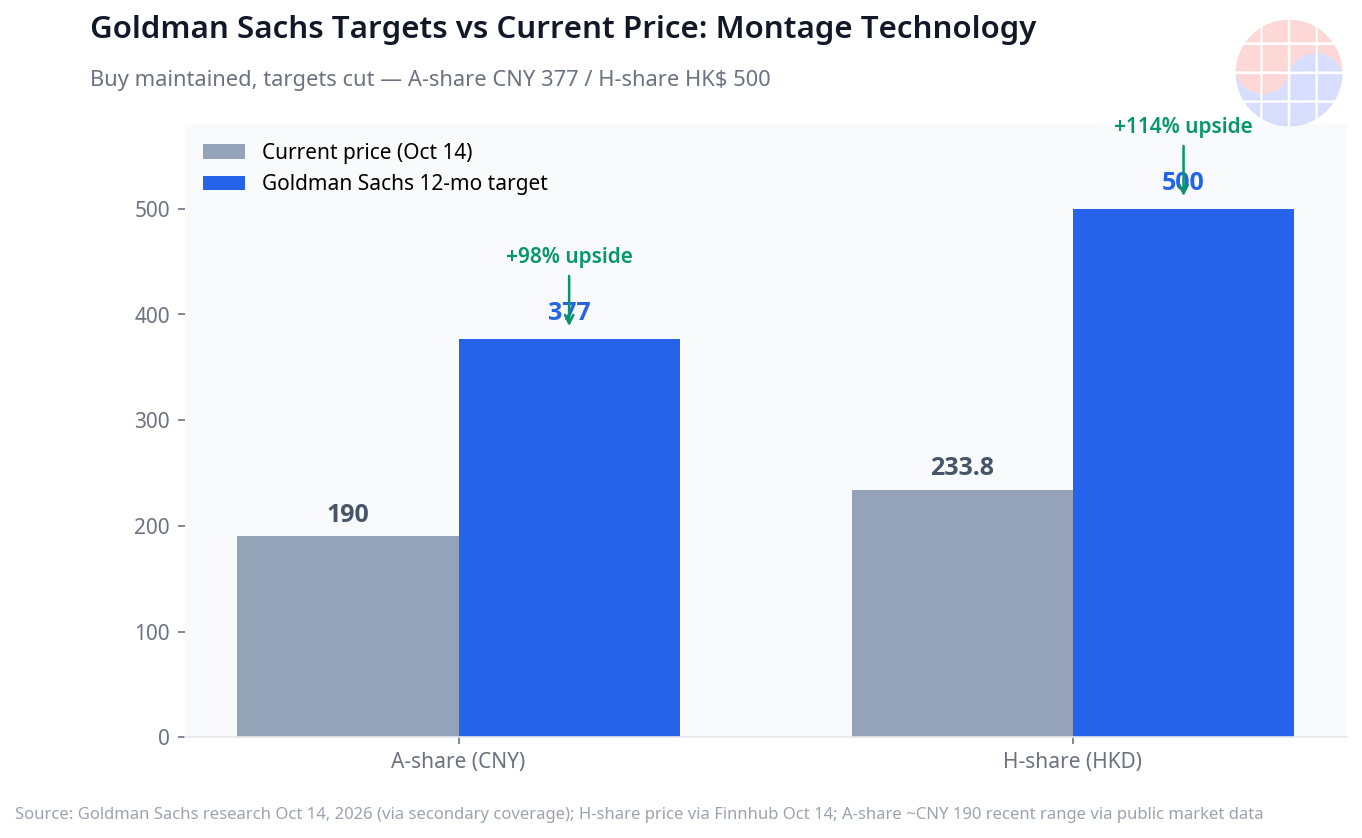
Start with the conclusion of Goldman's Montage Technology report (Oct 14). Buy maintained; 12-month targets cut to A-share CNY 377 / H-share HK$500. The estimate revisions tell the whole story — 2026–2028 net income estimates revised to -6%, +11%, and +14% respectively; revenue to -6%, +5%, and +4%; gross margin to -1.5pp, +0.8pp, and +1.7pp. The valuation anchors are a discounted 2030 P/E of 48.7x for the A-share and 59.3x for the H-share.
The interpretation is clear. The 2026 bar was lowered, but the slope from 2027 onward steepened. The reasoning is specific: server-use RCD05 and client-use CK01P entered mass production in September, and the ramp-up of high-generation DDR5 interface chips plus new MRCD/MDB and PCIe Retimer products is expected to contribute in earnest from 2027 — the near-term ramp is gentler than thought, but the direction of demand is intact.
The market's reaction is chilly: the H-share (6809.HK) traded at HK$233.8 on Oct 14, down 24.8% over five sessions, and the A-share (688008.SS) has traded recently around CNY 180–200 — more than 100% upside to target for the H-share, around 90% for the A-share. The market is already pricing an AI capex peak scenario, while Goldman's sell-side counters that "the pullback is overdone." For reference, Morgan Stanley also named CNY 377 as its A-share target back in July (per secondary coverage) — the two houses' numbers matching is worth more than coincidence.
Episode 2. The structural implication: a question Goldman asks itself
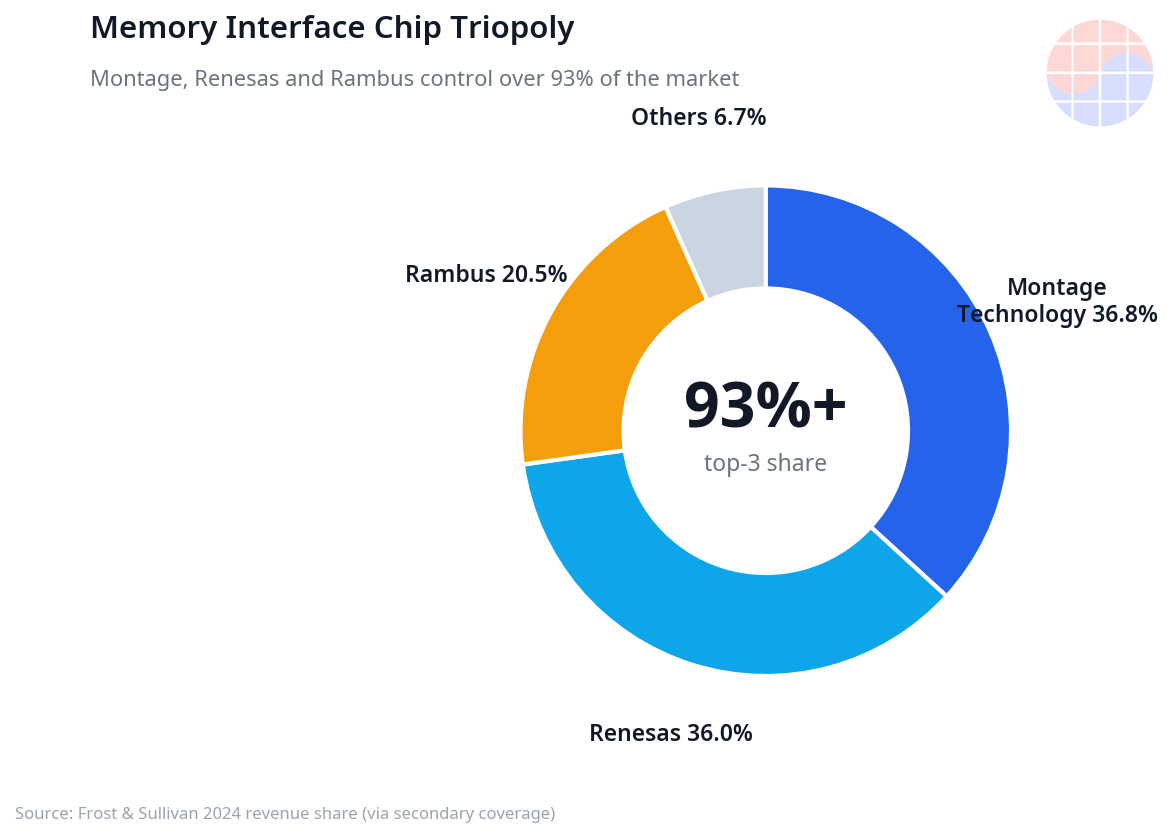
What makes this report special is where Montage Technology sits. It is a Shanghai-based fabless company and the world leader in memory interface chips — the chips that let server memory modules (RDIMMs) talk to the CPU. By 2024 revenue share: Montage Technology about 36.8%, Renesas about 36.0%, Rambus about 20.5%. An oligopoly where the three exceed 93% combined (market-research data, per secondary coverage).
The reason the oligopoly doesn't break is the validation wall. For a single memory interface chip to ship in a mainstream server, it must clear a multi-stage gauntlet: JEDEC standards, DRAM vendors, CPU platforms (Intel/AMD), cloud operators, and server OEMs. That typically takes 18–24 months. A memory-link failure is a whole-server reliability problem for server customers, so nobody swaps a qualified supplier to save a few dollars. That moat built the 93% oligopoly.
And right in the middle of that oligopoly, a step-function jump in "per-module value" is underway: the generational transition from DDR5 RDIMM to MRDIMM (Multiplexer Combined Ranks DIMM). MRDIMM raises per-module bandwidth and capacity but demands a new interface chip, the MRCD (Multiplexer Register Clock Driver). According to Bernstein's July analysis (per secondary coverage), MRDIMM penetration rises from about 3% in 2026 to 25% in 2030, the DDR module plus interface-chip TAM grows at about a 65% annual rate to about $20B in 2030, of which MRDIMM-related products account for about 73%. Recall that RCD made up 57.8% of DDR5 RDIMM interface-chip revenue in the 2025 tally (per secondary coverage) — the next protagonist after RCD is MRCD.
This is where Molavi's warning connects. Even if the capex cycle hits an inflection point, per-server memory capacity growth doesn't stop. Even if hyperscalers delay GPU purchases, memory capacity upgrades of already-deployed servers and the DDR5-to-MRDIMM generational transition follow the JEDEC roadmap. That is the real basis for Goldman's sell-side Buy: "even if the quantity of AI capex wobbles, the value per module of memory interface chips is defended by the generational transition."
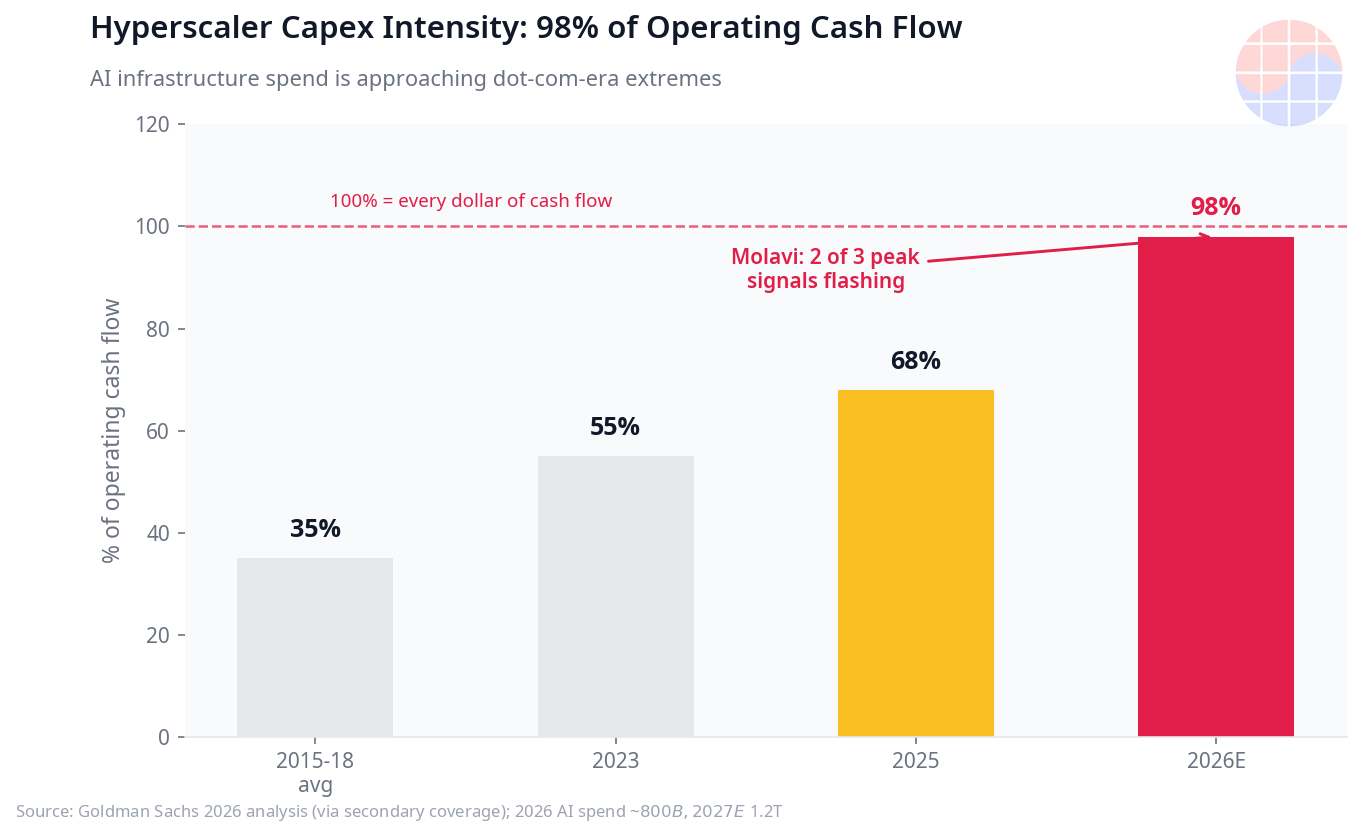
Of course, the other voice in the same house deserves to be on the record. On Sept 25, Goldman Asia-Pacific chief strategist Timothy Moe said hyperscaler AI investment would grow from about $800B this year to about $1.2T next year — "stronger for longer." A June analysis saw 2026 hyperscaler capex reaching about 98% of operating cash flow (a curve surging from 30–40% in 2015–2018, 55% in 2023, 68% in 2025). And an early-October analysis (per secondary coverage) found that from 2028, AI investment flips from a tailwind to a marginal drag on S&P 500 EPS, EPS growth slows to about 11%, and cumulative 2026–2031 hyperscaler capex reaches about $7.6T. The S&P 500 forward P/E of about 21x sits at the historical 88th percentile.
Inside one house, "next year $1.2T, stronger for longer" and "2 of 3 signals already flashing" coexist — the real temperature of Wall Street right now: not consensus, but argument.
Episode 3. Winners/losers, and the Korean angle
Winner candidate 1: the memory interface chip oligopoly trio. Regardless of the capex-cycle debate, per-server memory value rises through the MRDIMM generational transition. The 18–24 month validation moat blocks new entrants. That is the same reason Goldman kept the Buy while cutting the target.
Winner candidate 2: Korea's memory home turf. Server DRAM capacity growth is a structural demand stream partially decoupled from the quantity of AI capex. Favorable for Samsung Electronics' and SK hynix's server memory franchises. Goldman's note that DDR5 sub-generation migration lifts product mix points the same way.
Loser candidate 1: the high-multiple value chain betting its 2027–2028 back-end-loaded growth story. Goldman's reason for cutting Montage Technology's 2026 estimates — "the ramp of new interconnect products is gentler than expected" — reads as a warning for this whole segment. A structure that takes a 2030 discounted P/E of 48–59x on the promise of PCIe Retimer, CXL-related, and next-generation interconnect earnings from 2027 is the most vulnerable to the capex-inflection debate.
Loser candidate 2: leveraged AI infrastructure facing credit-market repricing. Molavi's signal No. 2 — credit markets have started repricing AI financing risk — arrives in bonds before stocks. Structures that stack AI infrastructure on leverage are directly exposed to rising funding costs.
Three checkpoints from the Korean angle. First, on July 15 the Fair Trade Investigation Division of the Seoul Central District Prosecutors' Office raided the Korean offices of Montage Technology, Renesas, and Rambus on suspicion of price-fixing in memory interface chips. The same year in January, the U.S. Department of Justice was also reported to have opened an investigation (per secondary coverage). The ones paying these three companies' prices are Samsung Electronics, SK hynix, and Micron. If the collusion is real, the victims are Korea's memory makers and the beneficiaries are the oligopoly trio — a variable you can't skip when discussing the oligopoly's pricing power. Second, Montage Technology is the symbolic stock of China's memory self-sufficiency. As the localization rate of server DDR5 interfaces in China rises, Korea's memory industry must redraw its positioning inside China too. Third, the H-share's five-session -24.8% drawdown is a barometer of "China AI value-chain risk-off" — a useful yardstick for the relative strength of Korean semiconductor stocks over the same period.
Chase's Take
As someone who works inside the industry, what caught my attention in this batch of Goldman reports is not the numbers themselves. It is the fact that one house is arguing with itself.
The strategist says "next year hyperscaler AI investment $1.2T, stronger for longer," while the macro trader in the same house says "2 of the 3 inflection signals have already fired." Usually one side is wrong. But this time both can be right at once. Even if gross capex dollars peak, the net value per box of memory interface chips keeps rising through the MRDIMM generational transition. We are exactly in the window where a peak in quantity and a rise in unit value overlap.
So I read this report not as a "buy or sell Montage Technology" note, but as a litmus test asking "where do we stand in the AI investment cycle." Working in EDA long enough teaches you this: the real moat is not in the spec sheet but in the validation timeline. A chip that has passed the 18–24 month qualification gate does not get pulled from its socket because capex dipped for one quarter. Those who hold the socket ride the cycle. That is why the memory interface chip trio keeps its 93% oligopoly, and why Goldman couldn't drop the Buy even while cutting the target.
One thing not to dismiss: Molavi's signal No. 2 — credit markets repricing AI financing risk becomes reality half a beat before the stock market's argument. Whether the $7.6T cumulative capex outlook for 2026–2031 remains a "plan" or proves itself as "cash flow" will be decided in next year's hyperscaler guidance. Until then, the rational move is to weight positions toward "those who hold the socket." That is how I see it.
FAQ
What kind of company is Montage Technology?
A Shanghai-based fabless semiconductor company (澜起科技) and the world leader in memory interface chips (RCD, MRCD, DB, PCIe Retimer, and others) that connect server memory modules to CPUs. By 2024 revenue it holds about 36.8% global share, forming a 93%+ three-way oligopoly with Renesas (about 36.0%) and Rambus (about 20.5%). It is dual-listed on the Shanghai Stock Exchange (688008.SS) and the Hong Kong Stock Exchange (6809.HK).
Why did Goldman cut the target while keeping Buy?
It lowered the 2026 earnings bar (-6%) but raised 2027 (+11%) and 2028 (+14%). Server-use RCD05 and client-use CK01P entered mass production in September, and high-generation DDR5 interface chips plus new MRCD/MDB and PCIe Retimer products are expected to contribute in earnest from 2027. The message: the near-term ramp is gentle, but the direction of demand is intact.
What are Molavi's "three AI capex inflection signals"?
The criteria Goldman senior macro trader Bobby Molavi laid out in his Oct 12 note: (1) the gap between stock prices and real earnings, (2) credit markets repricing AI financing risk, (3) an actual slowdown in the capex growth rate. His verdict: signals 1 and 2 have already fired, and signal 3 should peak in Q3 2026.
What does this imply for Korean semiconductor investors?
Separate two cycles. The cycle of total AI capex (under debate) and the structural growth of per-server memory capacity and unit value (DDR5 to MRDIMM, underway) run on different tracks. When the former wobbles, use this as a frame to check whether the pullbacks of companies holding the socket of the latter — Samsung Electronics and SK hynix on the memory home turf and the interface-chip oligopoly — become opportunities. Regulatory risk such as July's domestic raids (price-fixing suspicion) must be managed as a separate variable.
Disclaimer
This article is for information purposes only and is not investment advice. Cited figures are from secondary coverage; the originals were not verified directly. All investment decisions must be made at your own judgment and responsibility.