VLSI Korea
The Storage Supercycle Hiding Behind HBM: Why Hard Drives Are Back
AI data growth is driving a nearline HDD supercycle: supply discipline in NAND widens the $/TB gap, Seagate and WD are contracted out through 2028, and Toshiba's $380M expansion is a rounding error against a ~300EB shortfall.


The Storage Supercycle Hiding Behind HBM: Why Hard Drives Are Back
The 30-Second Version
AI is generating data faster than anyone can store it — and the biggest beneficiary isn't GPUs or HBM, it's the hard disk drive. Two mechanisms drive the story. First, Samsung, SK hynix, Kioxia and Micron have deliberately restrained NAND output ("supply discipline"), propping up SSD prices and widening the $/TB gap in HDD's favor. Second, Seagate and Western Digital have converted nearline capacity into a contract-first market, with capacity essentially allocated through 2028, while 44TB-class HAMR drives are in volume production as of October 2026. When Toshiba announced a $380M expansion of its Philippines HDD plant, the market barely flinched: the added ~75 exabytes are a rounding error against an industry shortfall near 300EB. Counterarguments exist — QLC NAND counterattack, an expansion domino, hyperscaler procurement shifts — but the 2026–2028 storage supercycle structurally favors the spinning disk.
Background: Return of the "Dead" Technology
In the early 2020s, the hard drive was widely considered a dying technology. Falling SSD prices fueled a consensus that every storage tier would eventually go flash. As of 2026, nearline HDD is instead the hottest market in storage.
The driver is AI data. Citing IDC's Global DataSphere forecast, industry coverage puts annual data creation at 274 zettabytes in 2026, rising to 718ZB per year by 2030 — roughly a 4x increase — with about 60% expected to land on HDDs. Coughlin Associates estimates AI-driven incremental demand at 18% of total HDD exabyte shipments this year, climbing to 58% by 2030. Seagate's own 2026 Data Infrastructure Readiness Report found 99% of IT leaders expect AI to increase storage requirements over the next three years.
Data gets stored the moment it is created: training corpora, inference logs, generated media, checkpoints. Fast tiers (SSD, HBM) handle hot access, but the bulk of the volume goes wherever $/TB is lowest. That is still the hard drive.
Memory makers' supply discipline added fuel. Samsung, SK hynix, Kioxia and Micron jointly scaled back NAND production starting in the second half of 2025. SK hynix reportedly cut output by around 10%; Samsung has been reported weighing 20–30% price increases in 2026 supply negotiations; a Kioxia executive said 2026 NAND output was already sold out. A rational move to defend memory profitability has unintentionally widened HDD's relative cost advantage. When SSDs climb the price ladder, HDDs quietly take over more territory below.
Deep Dive: The Structure in Numbers
1. Technology Roadmaps — The HAMR Era Opens
The technical enabler of the HDD revival is areal-density innovation, now a three-way race.
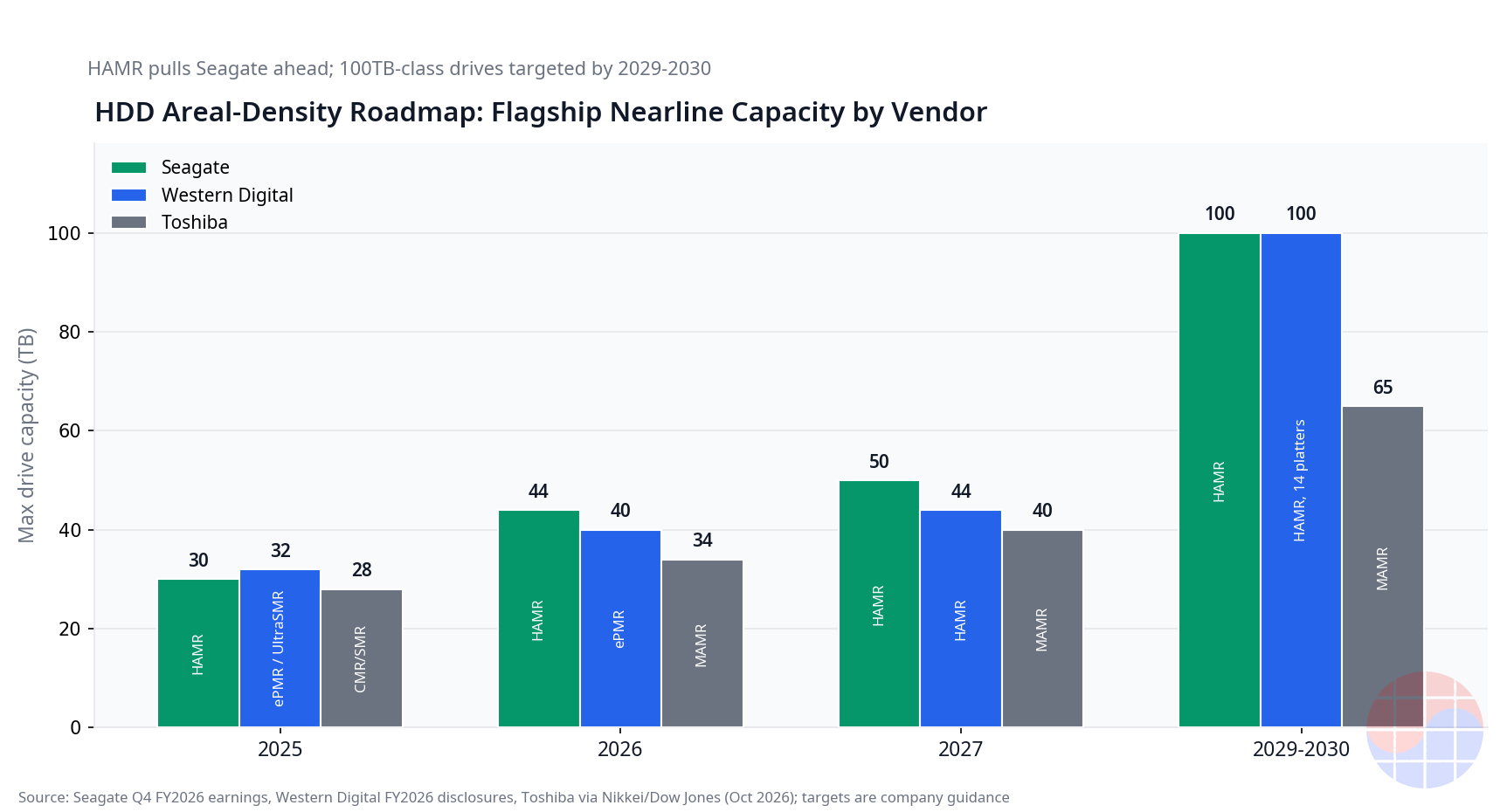
Seagate leads with HAMR (heat-assisted magnetic recording) under its Mozaic platform. As of October 2026, 30TB HAMR drives ship broadly across major cloud customers, and the second-generation 44TB platform (Mozaic 4+) is ramping with the two largest global cloud providers. HAMR products accounted for roughly 40% of nearline exabyte shipments in the June 2026 quarter, with Mozaic 4 expected to represent 50% of HAMR exabytes by end of calendar 2026. 50TB drives (Mozaic 5+) target customer qualification in late 2027; the long-term goal is 100TB.
Western Digital takes the conservative bridge path via ePMR and UltraSMR. 40TB ePMR drives began shipping in the June 2026 quarter and entered volume production with two customers; 44TB HAMR is planned for the first half of 2027, with 50TB-class products in the second half. The 2029 target is 100TB via 14-platter designs, with ePMR phased out before then. UltraSMR is expected to reach about 60% of nearline exabyte shipments by the end of fiscal 2027.
Toshiba bets on MAMR (microwave-assisted magnetic recording). Its 30–34TB M12 series (up to 11 platters) is sampling, with 40TB-class drives planned for 2027, 65TB-class around 2030, and 100TB-class beyond. Market share by exabytes sits just above 10%, with a medium-term target of 30%.
The key is capital efficiency per unit of density. Seagate guides to mid-20% nearline exabyte growth over the next few years without materially increasing unit output. Moving from 3TB to 4TB per platter lowers manufacturing cost per drive and customers' cost and power per terabyte. Technology transition is margin expansion.
2. Supply Structure — Contracts First, Units Later
What makes this cycle different from past ones is the procurement model. Seagate declared its 2026 nearline capacity sold out back in January 2026; current disclosures indicate the vast majority of nearline exabytes are allocated under long-term agreements into calendar 2028. Pricing and configurations for all of 2027 are set with major customers, and discussions now extend into 2029 and beyond. Purchase orders cover four to five quarters with specific mix, pricing and delivery dates. Data center demand represents roughly 90% of exabyte shipments.
Western Digital mirrors this: long-term agreements run through 2029–2031, most of 2027 output is already committed, and the June 2026 quarter delivered 231 exabytes (+22% YoY) with blended price per terabyte up 18–19% YoY. Non-GAAP gross margin reached the mid-50s.
The HDD market is no longer a spot market — it is a capacity-reservation market. Customers prioritize supply assurance over price, because a storage bottleneck idles thousands of GPUs. In that structure, supplier pricing power is unusually strong.
3. The $/TB Gap — The Paradox NAND Discipline Created
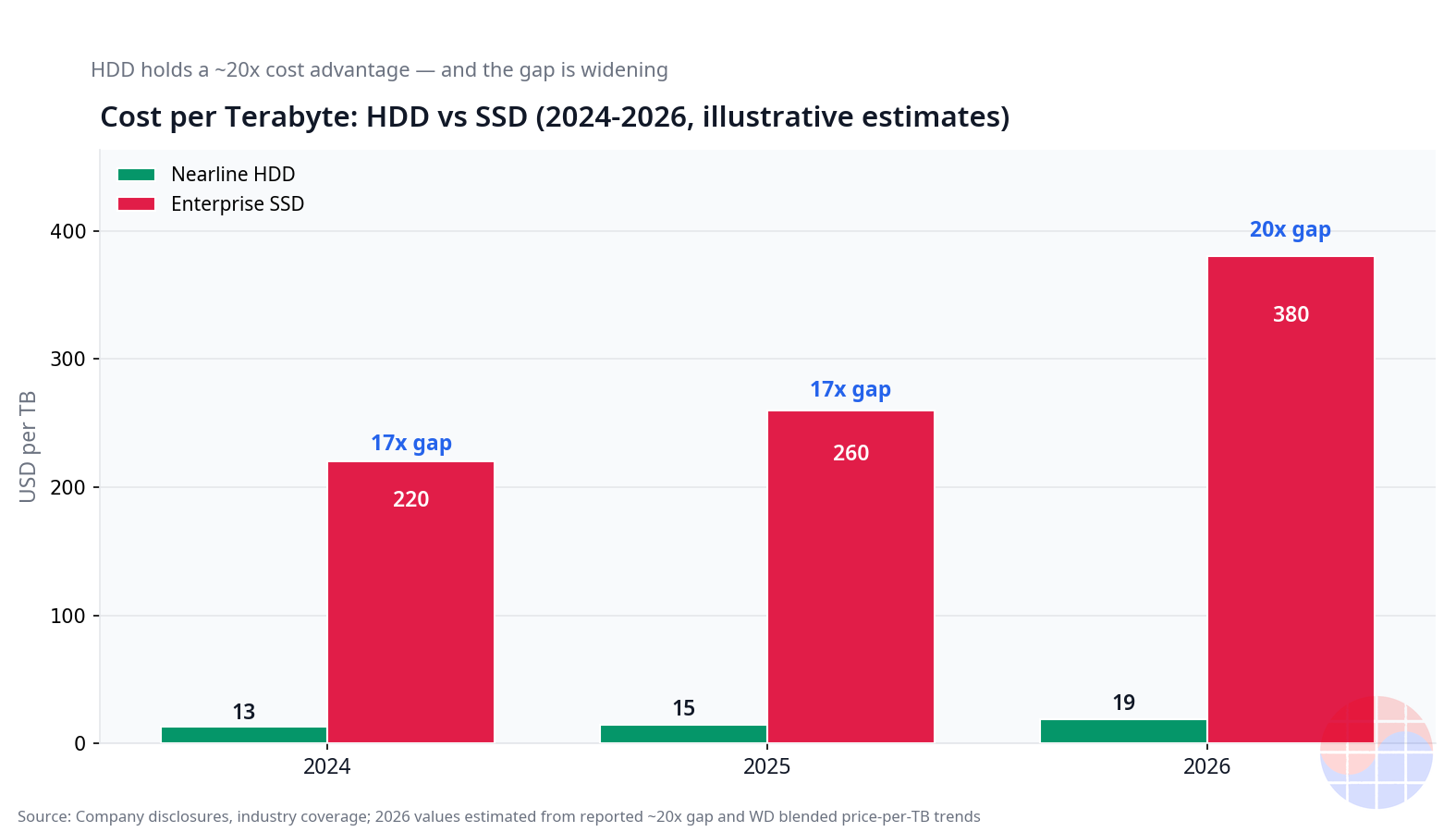
The SSD–HDD $/TB gap is widening, not narrowing. Enterprise SSDs cost roughly 20x per terabyte versus HDDs (October 2026 industry coverage). With NAND output restrained, enterprise and client SSD prices are rising together, weakening the economic case for moving bulk cold/warm data to flash.
Think in hyperscaler storage tiers: hot tier (HBM/DRAM for active training data) → warm tier (performance SSDs, inference caches) → cold/nearline tier (HDDs: training data originals, logs, backups). AI grows every tier, but the cold tier grows fastest in absolute terms. A 20x $/TB gap doesn't budge tier boundaries. Memory makers' supply discipline, by supporting SSD prices, has hardened this tier structure — the rational choice of Korea's memory industry underwriting a supercycle for America's HDD duopoly. A genuine paradox.
4. Toshiba's Expansion — Why the Market Called It a Rounding Error
On October 2, 2026, reports said Toshiba would invest about $380M (¥60B) in its Philippines plant to nearly double nearline HDD production capacity by fiscal 2027 versus fiscal 2025 — its first major HDD investment in roughly five years. Seagate and Western Digital shares each fell 10–12% that day.
The market recovered within days. TD Cowen's math: Toshiba's expansion adds roughly 75EB against an industry shortfall near 300EB. Morgan Stanley noted demand had accelerated in recent months and held that the market stays undersupplied through 2028. Bernstein called the selloff "a storm in a teacup."
The arithmetic is straightforward: 75EB is about a quarter of the shortfall, and it ramps gradually across fiscal 2027 (April 2027–March 2028). In a year when total HDD industry revenue is projected to top $30B for the first time since around 2014, 75 incremental exabytes don't change the slope of growth. The expansion is real, but it lacks the order of magnitude to reverse the cycle — a rounding error, literally.
5. The Component Bottleneck — Nitto Denko's 90%
The hidden chokepoint sits in components. Nitto Denko controls over 90% of the market for magnetic-head suspension assemblies — the precision parts that fly heads over disks. Drive makers can announce expansions, but exabytes don't grow unless suspensions, media and heads keep pace. Japanese component suppliers (TDK, Resonac and others) have announced their own capacity increases, yet precision-component ramp-ups trail drive assembly. Early-October volatility around TDK's head business showed how sensitive the market is to this bottleneck. Western Digital's planned ~$1B investment in Japan through 2030 (R&D, manufacturing, university partnerships) reads the same way: securing the supply chain is the competitive edge.
Pushback: Three Ways This Thesis Breaks
For balance, here are the three paths that could invalidate the story.
First, the QLC NAND counterattack. If enterprise QLC SSD $/TB drops sharply, the warm tier's lower boundary moves down. That requires NAND discipline to crack — aggressive capacity additions (e.g., from Chinese suppliers), a demand shock from macro slowdown, or next-gen QLC yields beating expectations. As of October 2026, discipline looks firm, with Kioxia guiding tightness into 2027.
Second, an expansion domino. Toshiba started it; Seagate and WD could follow with their own capacity builds. Every past HDD cycle ended in an overbuild race. The counter: HAMR tooling capex is heavy, component bottlenecks (Nitto Denko et al.) cap the speed of any ramp, and the LTA-based demand structure differs from the old spot-market crash pattern.
Third, hyperscaler procurement shifts. New demand sources (neoclouds, sovereign AI) are growing, but large customers could also reduce HDD dependence through better erasure coding, compression and dedup, or redesign tier architectures outright. If the quality of demand changes, exabyte forecasts wobble.
These pushbacks don't invalidate the thesis — they define the monitoring list. The two leading indicators: QLC $/TB trends and the actual ramp timeline of Toshiba's expansion.
Chase's Take: The Economics of Storage Tiering
A lesson from working in semiconductors: technologies win or lose on economic units, not performance. HBM or not — even an HBM3E 12-high stack at 288Gb per stack — the question is always "how much per gigabyte." AI-era storage has split into three economic units, each with its own winner: the hot tier belongs to HBM (Samsung, SK hynix, Micron), the warm tier to SSDs, the cold tier to HDDs. Data moves between tiers as a function of the $/TB gap, not of technological romance.
The MBA-angle insight: capex discipline is the moat. What Seagate and WD did was refuse to build factories indiscriminately while demand exploded. Instead they invested in density (HAMR) and locked in demand first via LTAs. The result: mid-50s gross margins and visibility into 2028. The memory industry learned this lesson through the 2010s chicken game; the HDD industry learned it earlier through early-2020s restructuring. Oligopoly (three players) + technology transition (HAMR) + contract-based procurement = pricing power. The formula has been validated repeatedly — in DRAM, in foundries.
From Korea's perspective there is an irony worth sitting with. Samsung's and SK hynix's NAND supply discipline defends their own profitability while widening HDD's relative cost advantage. For memory suppliers, storage tiering isn't "territory NAND failed to eat" — it's the buffer that supports NAND pricing. SSD ambitions to eat all data could, paradoxically, undermine the price umbrella NAND lives under. Accepting tiering and managing $/TB in each tier maximizes total memory-plus-storage portfolio profit. Korea should read this storage supercycle — hiding behind the HBM supercycle — through the eyes of a memory supplier.
Implications: For Investors and Operators
For investors. As of October 2026, consensus sees HDD value-chain pricing power holding through 2028. Watch three variables: (1) quarterly $/TB pricing (does the ~18% YoY climb persist?), (2) HAMR ramp cadence (customer qualification timelines for Seagate's 50TB and WD's 44TB), and (3) the actual production timeline and yields of Toshiba's expansion. At the component level, irreplaceable bottlenecks like suspensions (Nitto Denko) can move on margin before drive makers do.
For operators. The lesson for hyperscalers, neoclouds and sovereign-AI builders is blunt: storage is no longer a part you buy — it is a strategic resource you contract two years ahead. Procurement strategies relying on the spot market carry risk through 2028. For HDD makers, the mirror-image challenge is resisting the expansion temptation; every past cycle's grave was dug with excess capacity.
For Korea's supply chain. The HDD revival's benefits extend beyond the three drive makers — to suspensions, media, heads, precision motors. Japan dominates those component supply chains today, but new HAMR-era components (laser diodes, high-density media substrates) don't have entrenched suppliers yet. If you're hunting the post-memory storage opportunity, look at components, not drives.
This analysis is based on public company disclosures, industry coverage and market data. It is not investment advice. All figures reflect publicly available sources as of October 16, 2026.
FAQ
Q1: Why hasn't the SSD fully displaced the HDD? Because the $/TB gap at scale remains enormous. Enterprise SSDs cost roughly 20x per terabyte versus HDDs (as of October 2026), and most AI-generated data is infrequently accessed cold data where SSD speed advantages are diluted. In the tiered storage architecture, HDD remains the standard for the capacity layer.
Q2: What is the difference between HAMR, ePMR and MAMR? All three raise recording density per disk area. HAMR (Seagate) heats the recording spot with a laser to write more densely; ePMR (Western Digital) is an energy-assisted extension of conventional PMR; MAMR (Toshiba) uses microwaves. As of October 2026, commercialization speed ranks Seagate (44TB in volume) > WD (40TB ePMR in volume, 44TB HAMR in 2027) > Toshiba (30–34TB MAMR sampling).
Q3: Could Toshiba's expansion crash HDD prices? Unlikely in the near term. The ~75EB addition is about a quarter of the ~300EB industry shortfall and ramps gradually across fiscal 2027. Seagate's and WD's contracted volumes through 2028 also put a floor under pricing. A post-2028 expansion domino remains the key variable to monitor.
Q4: What should Korean companies and investors watch in this cycle? Three things. First, the structural irony that Samsung's and SK hynix's NAND supply discipline widens HDD's $/TB advantage. Second, supply-chain entry opportunities in new HAMR-era components (laser diodes, high-density media). Third, quarterly $/TB pricing and 50TB-class HAMR qualification timelines as leading indicators of any cycle turn.