VLSI Korea
Big Tech Circles Intel 14A: The Foundry Second-Source Race Has Begun
Oct 17, 2026 channel checks report Broadcom, Google, Microsoft and Nvidia wins for Intel 14A, with Apple and others evaluating. None is Intel-confirmed. PowerDirect, hedge economics, and the Oct 29 test.


30-Second Summary
- Analyst channel checks reported on October 17, 2026 describe strong interest in Intel Foundry — with volume centered on 14A, not 18A-P. The checks followed an analyst team's Asia trip. This is channel-check reporting, not an Intel confirmation. (Source)
- Reported as won: Broadcom (networking switch), Google and Microsoft (server CPUs), and Nvidia (gaming GPU) manufacturing.
- Still evaluating: Apple is reported to be evaluating a multi-generation M/A-series deal on 14A. Amazon, Anthropic and the SpaceX/Tesla Terafab project are evaluating 18A-P/14A, with many said to prefer 14A.
- The technology hook is PowerDirect: 14A is a 1.4nm-class node that delivers power from the wafer backside, freeing the front side for signal Routing, cutting resistance and lifting density.
- The verification date is October 29, 2026 — Intel's earnings call, where external foundry revenue and guidance will either support or puncture the channel-check story.
- The business story underneath: leading-edge capacity is concentrated and tight, so big customers are pricing the value of a credible second source. The contest is no longer only about yield charts. It is about who earns the first tape-outs.
Background: Why a Second Source Became a Board-Level Question
For a decade, the leading-edge foundry question had a default answer. If you needed the most advanced logic process, you queued at one dominant supplier, accepted its allocation, and planned your product calendar around its ramp. That model worked while capacity, however expensive, was available — and while geographic concentration was treated as an efficiency, not a risk.
Two things changed. First, AI demand made leading-edge capacity structurally tight: server CPUs, networking silicon and GPUs now compete for the same advanced wafers, and a missed allocation is a missed product generation. Second, concentration itself became a priced risk. When nearly all leading-edge supply sits in one region, customers must hedge not only price and capacity, but also disruption scenarios they cannot control.
That is the context in which the October 17 channel checks landed. After an Asia trip, analysts reported a notably positive read on Intel Foundry — and, crucially, reported that the volume conversation centers on 14A rather than 18A-P. In foundry, the node customers ask about tells you where they think the real product window is. 18A is the credibility test. 14A, on this reporting, is where customers are discussing actual volume.
Precision matters here, because foundry rumors are cheap and tape-outs are expensive. Everything in the customer lists below comes from analyst channel checks reported on October 17, 2026. Intel has not confirmed these contracts. Apple has not confirmed an evaluation outcome. The honest way to read this story is as a map of reported interest with a hard verification date attached: October 29.
Business Deep Dive
1. The Reported Customer Map: Won vs Evaluating
The single most important discipline in this story is separating "reported as won" from "evaluating." They are different commercial states with different revenue implications, and blurring them is how channel checks turn into hype.
| Customer | Product (as reported) | Status (channel checks, Oct 17, 2026) | Node focus |
|---|---|---|---|
| Broadcom | Networking switch | Reported won | 14A-centered volume discussion |
| Server CPU | Reported won | 14A-centered volume discussion | |
| Microsoft | Server CPU | Reported won | 14A-centered volume discussion |
| Nvidia | Gaming GPU | Reported won | 14A-centered volume discussion |
| Apple | M/A series, multi-generation | Evaluating | 14A |
| Amazon | Not specified | Evaluating | 18A-P / 14A, 14A preferred by many |
| Anthropic | Not specified | Evaluating | 18A-P / 14A, 14A preferred by many |
| Terafab (SpaceX/Tesla) | Not specified | Evaluating | 18A-P / 14A, 14A preferred by many |
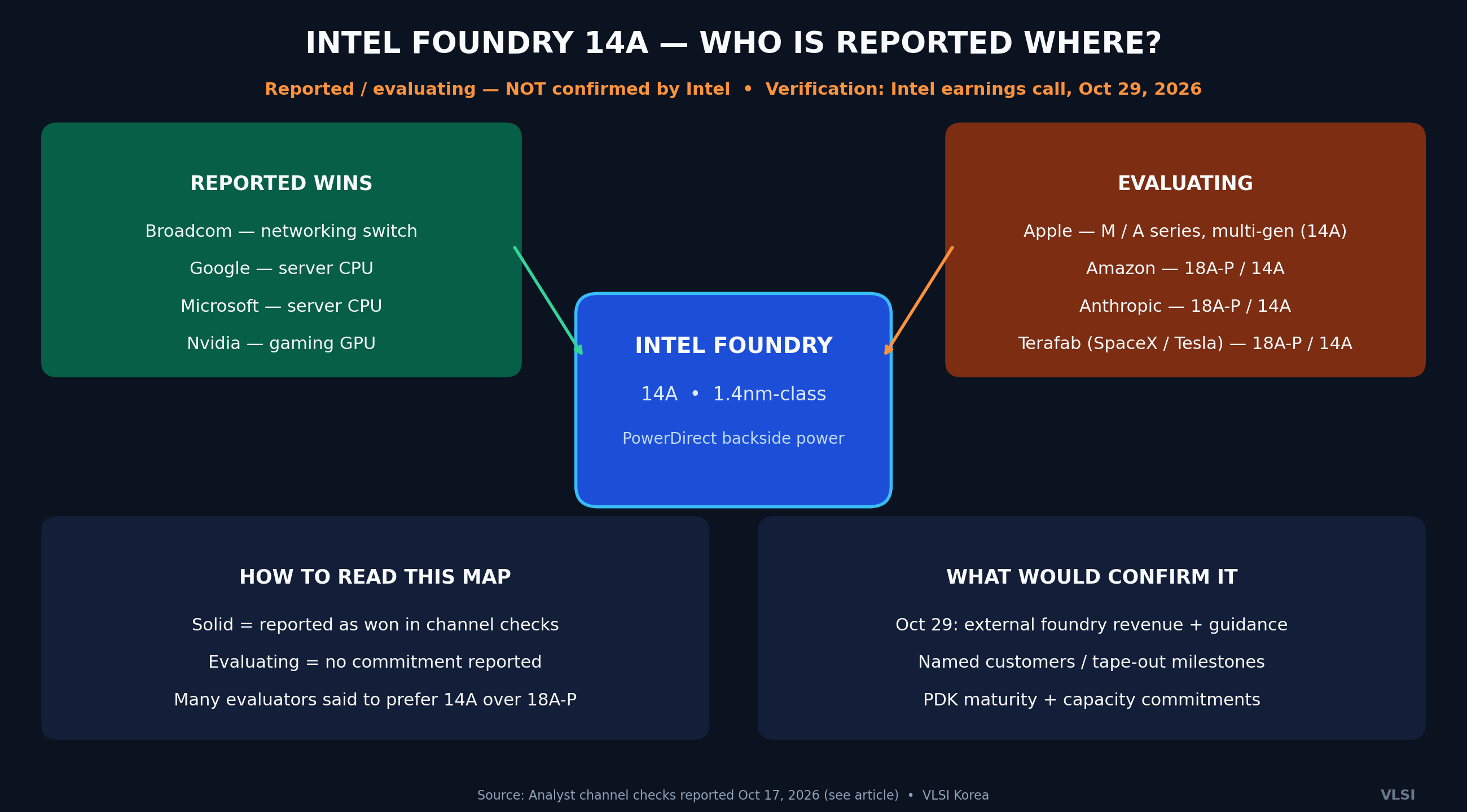
Read the shape of the reported-won column. These are not random logos. A networking switch, two hyperscaler server CPUs and a gaming GPU share a profile: large dies, power-delivery stress, and buyers who already multi-source other parts of their stack. They are exactly the products where a second source has strategic value beyond unit price — and where PowerDirect's backside power story is most relevant.
The evaluating column matters differently. Apple's reported interest is in a multi-generation M/A-series arrangement on 14A. Multi-generation language, if it ever becomes a contract, is the strongest signal in foundry: it means a customer is not buying wafers, it is buying a roadmap. Amazon, Anthropic and Terafab evaluating both 18A-P and 14A — with many reportedly preferring 14A — suggests customers are skipping the interim node in their heads and negotiating around the node they actually want.
2. Why 14A, Why PowerDirect
14A is Intel's 1.4nm-class node. Its headline feature in this reporting is PowerDirect: power is delivered through the backside of the wafer instead of competing with signals on the front side.
| Conventional front-side power | 14A PowerDirect (backside power) | |
|---|---|---|
| Power path | Power and signal share front-side metal | Power routed via wafer backside |
| Signal Routing | Competes with power for front-side space | Front side freed for signal Routing |
| Resistance / IR drop | Higher, worsens as nodes shrink | Lower resistance path for power |
| Density effect | Routing congestion limits scaling | More Routing room supports density |
| Best-fit products | General logic | Large, power-stressed AI/HPC, CPU, GPU, switch dies |
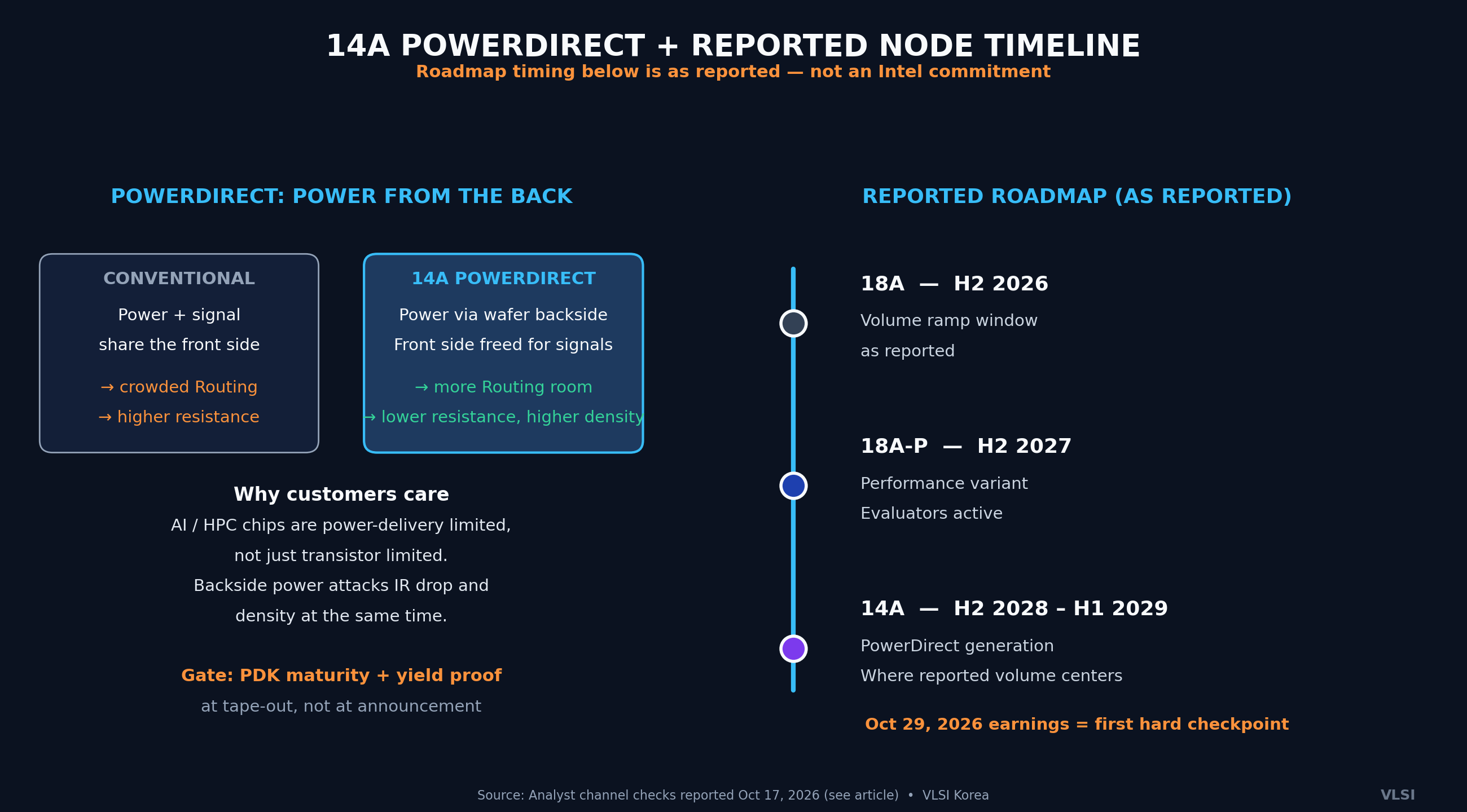
Why does this persuade customers? Because at advanced nodes, many flagship chips are no longer limited only by transistor count. They are limited by delivering power to those transistors without unacceptable voltage drop and heat. Backside power attacks that bottleneck directly: it separates the power and signal problems so each can be optimized. For a server CPU or a networking switch running at sustained high utilization, that is a product-level benefit, not a process brochure line.
But a feature is not a contract. The gate between interest and volume is unglamorous: PDK maturity, design enablement, and yield evidence a customer can tape out against. Customers do not commit multi-generation roadmaps to a slide. They commit after test chips, after PDK revisions stabilize, and after the foundry proves it can hold a schedule. That is why the reported preference for 14A cuts both ways — it validates the destination while pushing the proof burden onto a later node.
3. The Hedge Economics: What a Second Source Is Actually Worth
Customers are not shopping for charity diversification. They are running an MBA calculation with three terms:
- Risk premium of single-sourcing: capacity allocation risk plus geographic concentration risk. When supply is tight, the cost of having no alternative is not a slightly higher wafer price — it is a slipped product launch.
- Execution risk of the alternative: a second source only hedges if it ships. PDK immaturity, yield ramps and schedule slips are the discount applied to Intel's offer.
- Switching and qualification cost: porting a design, re-qualifying, and splitting volume across two processes costs real engineering time. Volume splits also sacrifice some scale leverage with the incumbent.
A second-source deal happens when the first term exceeds the other two. Tight capacity raises the first term. Every credible 18A milestone lowers the second. And anchor customers lower the third for everyone who follows, because early porting work matures the PDK and the ecosystem. This is why the anchor customer contest matters so much: the first few committed names do not just add revenue, they de-risk the platform for the next ten.
There is also a negotiation dividend that never appears in a press release. A customer with a credible second source negotiates differently with its primary supplier — on allocation, on pricing, on roadmap access. Part of what big tech is buying from Intel, even in evaluation, is option value. Intel's task is to convert option value into committed tape-outs before the option expires unexercised.
4. What October 29 Must Show
Channel checks set the hypothesis. Earnings set the evidence standard. On October 29, four things will matter more than any headline:
| Checkpoint (Oct 29) | Bullish signal | Bearish signal |
|---|---|---|
| External foundry revenue | Sequential growth with external-customer mix rising | Flat, internal-product-dominated mix |
| Foundry guidance | Forward commitments / capacity language firming | Vague, pushed-out timelines |
| Customer disclosure | Any named customer or tape-out milestone | Silence on all reported names |
| 18A execution | On-schedule ramp commentary | Slippage language, yield caveats |
Even a strong call will not "confirm" every name in the channel checks — companies rarely validate analyst lists line by line. What it can do is confirm the direction: external revenue inflecting, commitments hardening, execution holding. Silence, by contrast, would not disprove the checks either — foundry contracts are often disclosed by customers, on customer timing — but it would raise the discount rate on the whole story.
Chase's Take
The foundry contest has quietly changed its scoring system. It used to be scored on yield curves. It is now scored on who gets entrusted with a tape-out first — because a tape-out is where a customer's own product deadline becomes collateral for the foundry's promise.
My read of the October 17 checks is deliberately two-handed. The bull case is real: the reported-won list is coherent (power-stressed, strategically motivated products), the evaluating list is heavyweight, and the reported tilt toward 14A says customers are negotiating around Intel's best future node rather than politely sampling its present one. In a tight-capacity world, that is exactly how a second-source market forms.
The bear case is equally real, and it lives in one word: reported. None of this is Intel-confirmed. Channel checks have a known failure mode — they capture genuine enthusiasm at the evaluation stage and price it as if it were purchase orders. Foundry history is littered with "evaluating" customers who evaluated for years. The distance between evaluating and tape-out is measured in PDK revisions, test-chip yields and lawyers, and it is where second-source stories usually slow down.
So the trust asset in this story is the distinction itself. If you remember one thing, remember this: four reported wins, four evaluations, zero confirmations — and a dated test on October 29. Hold all four clauses at once and you understand the story better than either the hype or the dismissal.
The Korean angle deserves a note. A credible Intel second source reshapes bargaining power across the whole advanced-logic chain — including for Korean fabless and for the memory side, where HBM demand ultimately follows where AI silicon actually gets built. Second-source geography is never just one foundry's story.
Implications: Investment and Management Takeaways
For investors:
- Treat October 29 as a direction check, not a verdict. External foundry revenue trajectory and guidance language matter more than whether any single reported name is mentioned.
- Watch the conversion funnel in coming quarters: evaluation → test chip → tape-out → committed volume. Movement between stages is the real KPI; new logos at the top of the funnel are the weakest signal.
- Discount any retelling that drops the words "reported" or "evaluating." The premium in this story belongs to whoever respects the gap.
For chip executives and supply-chain managers:
- Price your own hedge honestly: allocation risk and concentration risk now have observable market evidence — customers are actively building alternatives. Single-source comfort is a depreciating asset.
- If you evaluate a second source, negotiate around the node you actually want (the reported 14A preference is the template) and contract for PDK maturity milestones, not announcements.
- Anchor economics cut both ways: early movers pay the highest porting costs but capture the most allocation priority and negotiation leverage if the platform succeeds.
For Intel watchers:
- The strategic question is no longer "can Intel build an advanced node?" It is "can Intel convert reported interest into tape-outs on a schedule customers can plan products against?" October 29 is the first dated answer.
Note: This analysis is based on analyst channel checks reported on October 17, 2026 and linked above. Customer contracts and evaluations described here have not been confirmed by Intel or the named customers as of publication. It is analysis, not investment advice.
📩 Subscribe to VLSI Korea
Get our daily semiconductor deep-dives delivered to your inbox first. Free to subscribe.