VLSI Korea
Boom Through 2027 or Glut by 2029? The Memory Capex Bet at the Cycle Peak
On Oct 18, Korea's finance minister said the chip boom lasts through 2027. A Maeil Business column warns of a 2029 memory glut. Yet Samsung and SK hynix are expanding capacity aggressively. The economics of the capex bet at the cycle peak — and the Oct 28/29 earnings that will judge it.


30-Second Summary
- On October 18, 2026, South Korean Finance Minister Lee Hyoung-il told CNBC the chip boom will run at least through 2027. Customer demand still outstrips supply, and 2026 tax revenue is expected to come in above projections. (Source)
- That same week, memory stocks cratered: Samsung fell 23.9% and SK hynix 31.5% over seven trading sessions, while the Kospi shed about 21%. KB Securities' research head called it an overreaction, blaming the absence of domestic buying support.
- On the other side, a Maeil Business Newspaper column warned the memory market could slide into oversupply by 2029 as new capacity comes online.
- Yet both chipmakers are expanding aggressively at the peak. Samsung is lifting production capacity by roughly 50% in 2026; SK hynix is quadrupling its infrastructure investment. Samsung's P5 (Pyeongtaek) targets 2028, SK hynix's M15X targets mid-2027. (Source)
- The floor under this bet is anchor demand: the October 2025 LOI among Samsung, SK hynix and OpenAI covering 900,000 DRAM wafers per month for the Stargate project.
- Judgment day is October 28 and 29. SK hynix reports Q3 results on the 28th, Samsung on the 29th; their guidance on memory pricing, HBM demand and capex will be the interim verdict.
- The core call: at a cycle peak, read the signals in contract structure, not price.
Background: The Same Cycle, Read Two Ways
Bank of Korea data reported in April showed first-quarter GDP grew 1.7% quarter-on-quarter — the fastest since 2020 — with chip manufacturing accounting for roughly 55% of that growth. Samsung and SK hynix both posted record quarterly operating profits. The memory boom had become the Korean economy itself.
Then came the seven trading sessions starting October 6. Samsung lost 23.9%, SK hynix 31.5%, and the Kospi gave up 1,449.52 points — about 21%. Intensifying competition from Chinese memory makers and rising rate worries crushed sentiment, dragging down Nvidia and global chip names alongside.
Friday brought relief. The Kospi climbed 2.05% to 5,668.05, snapping the streak; Samsung added 2.62% and SK hynix 0.79%. The won firmed to 1,331.4 per dollar, and foreign investors net-bought about 341 billion won of Korean shares. The sellers were domestic retail and institutions — the detail behind KB Securities' "overreaction" call: it wasn't fundamentals that widened the fall, it was the absence of a domestic bid.
That same weekend, on the sidelines of the IMF and World Bank annual meetings in Bangkok, the finance minister gave his interview: "For now, our view is that we can sustain this growth." The reasoning: customers still want more than producers can deliver. The same article carried the 2029 oversupply warning. Same data, opposite readings. What investors and managers need now isn't a prophecy of which camp is right — it's a framework for reading the structure of the bet.
Business Deep Dive
1. The Math of Oligopoly: Who Holds the Memory Market
Global DRAM and HBM are effectively a three-player oligopoly. In HBM, Q3 2025 industry estimates put SK hynix at 53%, Samsung at 35% and Micron at 11%. In December 2025, Micron exited consumer memory and storage to concentrate on AI datacenter customers. The direction of HBM now sits with the two Korean players.
| Player | HBM share (Q3 2025, industry estimates) | 2026 capacity move |
|---|---|---|
| SK hynix | 53% | 4x infrastructure investment; M15X online mid-2027 |
| Samsung | 35% | ~50% production capacity expansion; P5 online 2028 |
| Micron | 11% | Consumer memory exit (Dec 2025), AI datacenter focus |
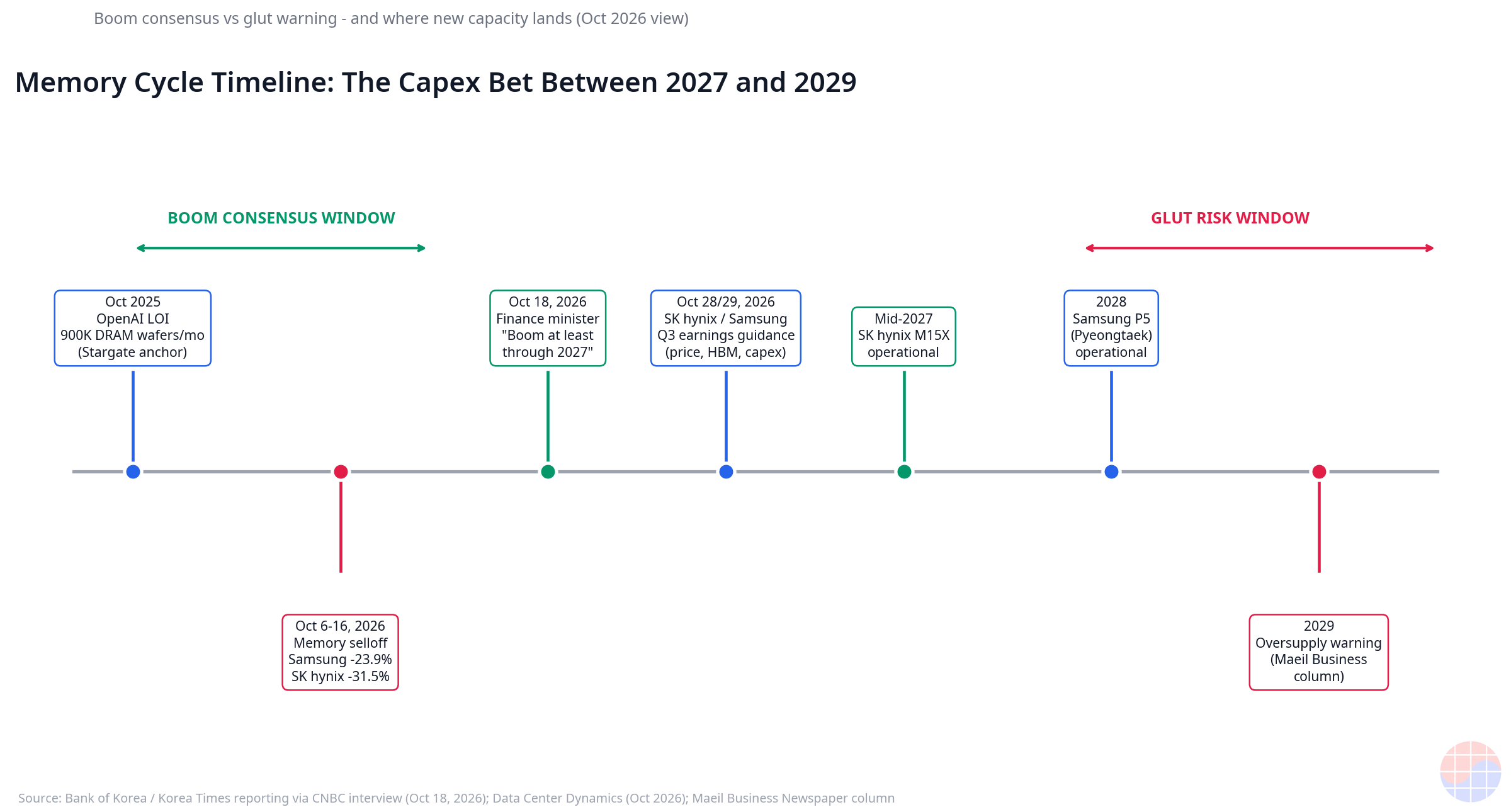
The essence of oligopoly is pricing power. The historical pattern of memory busts is always the same — supply expands before demand bends. So the "2029 oversupply" warning isn't mere pessimism; it's a conditional scenario this structure keeps reproducing. The conditions: when new capacity actually ramps, and whether demand to absorb it is locked in by contract.
2. Two Camps: 2027 Boom vs 2029 Glut
| 2027 boom camp | 2029 glut camp | |
|---|---|---|
| Voice | Finance minister (Oct 18, 2026, CNBC) | Maeil Business Newspaper column (Oct 2026) |
| Argument | Customer demand keeps outrunning supply; two years of AI datacenter demand are queued up | New capacity (P5, M15X) ramping 2027–2028 will push supply past demand |
| Evidence | 2026 tax revenue above projections; chips drove 55% of Q1 GDP growth | Memory capex has a 2–3 year lead time — today's builds are tomorrow's supply |
| Risk | Chinese catch-up, rates | Symmetric — stronger demand pushes the glut scenario back |
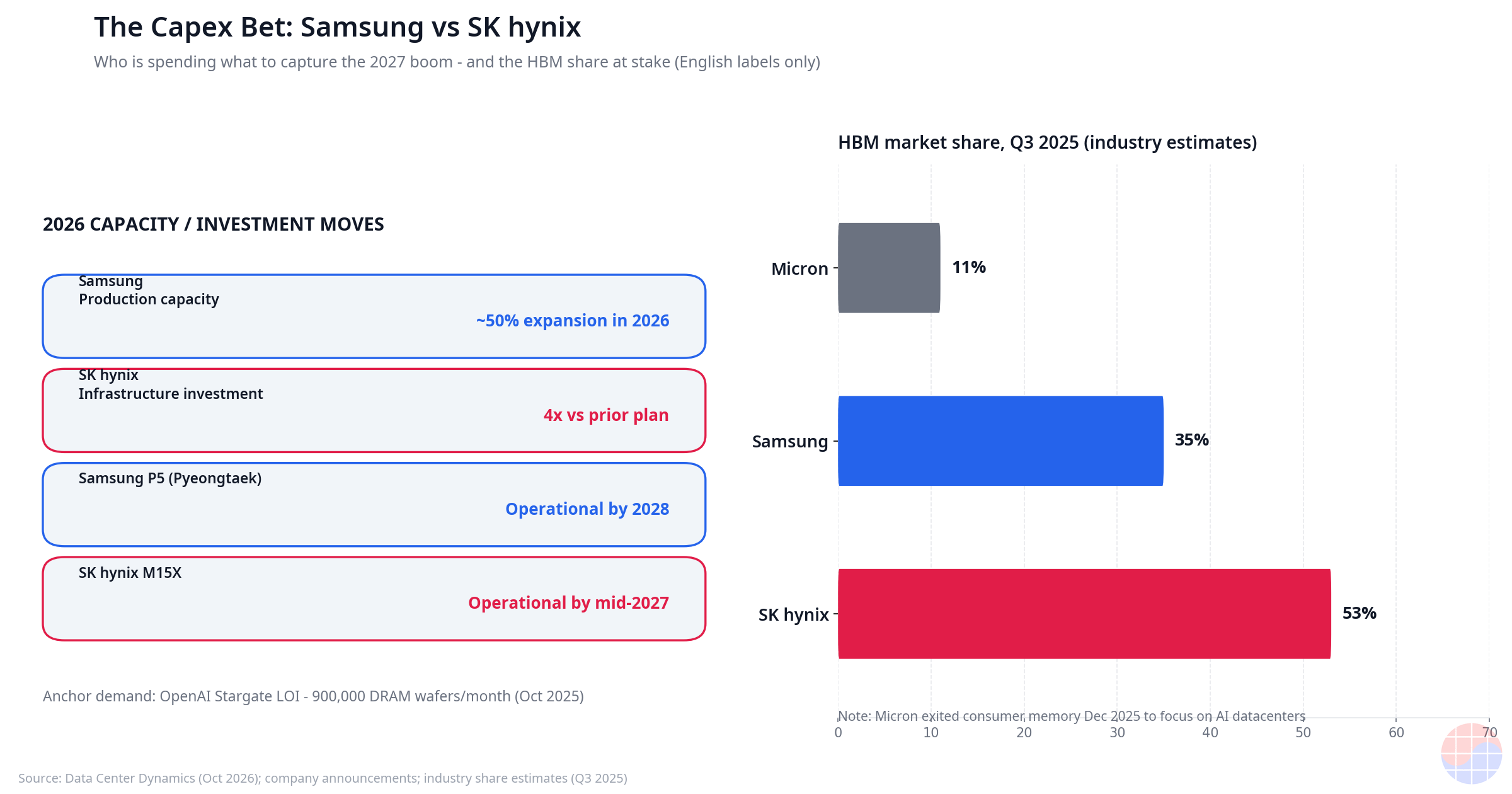
The two camps don't actually contradict. Both can be right: boom through 2027 and a glut warning for 2029. Memory capex takes 2–3 years from decision to volume. The fabs targeting mid-2027 to 2028 were decided in 2024–2025. Boom-time investment decisions returning as bust-time supply — that is the structural tragedy of cyclical industries.
3. The Economics of the Capex Bet: Why Invest More at the Peak
The textbook MBA dilemma applies verbatim.
- Invest at the peak: your added capacity grows market supply and triggers the glut. You pull the trigger on the price decline.
- Don't invest: competitors take your share with their added capacity. You lose the next cycle's leadership.
Under oligopoly this becomes a prisoner's dilemma. If Samsung expands while SK hynix sits still, Samsung wins the share game — and vice versa. Both expand, and they share the glut. Yet "expand" tends to be the dominant strategy for each: the worst outcome is standing still while the rival builds.
What makes this cycle different is a change in the nature of demand, not its duration. The October 2025 OpenAI LOI — 900,000 DRAM wafers a month for Stargate — symbolizes the structural shift. AI memory is no longer bought on spot price. HBM already sells through customer allocation, with long-term contracts locking in volume. The floor under the capex bet is no longer spot volatility but contracted volume.
Stated as a formula: expected value of the capex decision = (anchor-contracted volume × contract margin) + (option value of remaining capacity on spot) − capex. The bigger the anchor demand, the bigger the first term, the more rational the bet. OpenAI's 900,000 wafers a month is the number filling that first term.
4. Anatomy of the October Selloff: Overreaction or Early Signal?
| Metric | Value | Date / source |
|---|---|---|
| Samsung, 7 sessions | −23.9% | From Oct 6, Korea Times reporting |
| SK hynix, 7 sessions | −31.5% | From Oct 6, Korea Times reporting |
| Kospi, 7 sessions | ≈ −21% (1,449.52 pts) | From Oct 6 |
| Kospi, Friday | +2.05% → 5,668.05 | Oct 16 |
| Samsung, Friday | +2.62% | Oct 16 |
| SK hynix, Friday | +0.79% | Oct 16 |
| Foreign net buying | ≈ 341 billion won | Oct 16 |
KB Securities' research head was explicit: the fall was driven not by deteriorating fundamentals but by the absence of domestic buying support. Foreigners were net buyers. Chinese competition and rate fears pulled the trigger, but the price overshot.
The verdict on that judgment arrives October 28 and 29. In SK hynix's Q3 results (10/28) and Samsung's (10/29), three things matter:
- Memory price guidance: the direction of contract prices — still rising, or decelerating?
- HBM demand: allocation status and backlog for HBM4/HBM4E with AI customers.
- Capex guidance: 2027 investment plans — raised, held, or cut. The direct readout of how hard they're betting.
This article's argument: watch contract structure, not price. Lengthening fixed-price terms, a rising share of take-or-pay-style long-term contracts, and tightening customer allocation all point to a sustainable peak. Shortening contract terms and a rising spot share signal the peak is passing.
5. The Manager's Menu: Four Capex Strategies at the Peak
Four strategies are on the table at a cycle peak.
- Aggressive expansion (the Samsung path): ~50% capacity growth. Wins the share game but becomes the first casualty of a price downturn. The calculation: anchor demand (the OpenAI LOI) covers the downside.
- Front-loaded infrastructure (the SK hynix path): 4x investment, M15X ramping mid-2027. Cementing HBM leadership (53%) with capacity. Note the timing — mid-2027 ramp lands more than a year ahead of the 2029 glut warning, securing a payback window before oversupply.
- Disciplined capex (the Micron path): exit consumer memory, concentrate on high-margin AI datacenters. Opt out of the volume game, play the margin game.
- Node shrink instead of new shells: transition to 1c/1-gamma DRAM to cut cost per Gb. Absorb bit growth without adding wafer starts.
All four are rational. The difference is which cards you hold. The 53% HBM leader cements leadership with capacity; the IDM leans on vertical integration; the number three picks focus. At the peak there is no single right answer — only the bet that fits your position.
Chase's Take
The memory cycle dilemma is a first-semester MBA classic: invest at the peak and you create the glut; don't invest and you lose share. And yet companies invest at the peak, every time. Why? The textbook says "collective irrationality." The field answer is different: the side that doesn't invest dies first. In cyclical industries, share is a permanent asset and price is a temporary variable. A glut hurts everyone, but losing share kills you alone.
What is different this time: not the duration of demand, but its nature. Memory demand used to move on a single number — the spot price. AI memory demand now moves on contracts. OpenAI's 900,000-wafers-a-month LOI, customer-by-customer HBM allocation, take-or-pay long-term deals — this is no longer a demand-forecast problem, it's a demand-ownership problem. Whoever locks anchor demand under contract wins the capex bet.
So read the 2029 glut warning as a condition, not a date. M15X and P5 ramp timing, HBM long-term contract renewal windows, the Chinese yield curve — the glut arrives when all three align. If any one slips, the warning moves back. KB Securities' "overreaction" call is the same logic: the market sold on price, the outcome; the real read is contract structure, the cause.
The Korean angle matters too. Chips drove 55% of Q1 GDP growth — the memory cycle is the Korean economic cycle. When the minister says "through 2027," it's an industry forecast and a fiscal forecast at once. Tax revenue beating projections has a mirror image: if the memory boom bends, revenue bends with it. The capex bet at the cycle peak is a national game, not just a corporate one.
Verification comes October 28 and 29. Read the small print of the guidance decks then — contract duration, allocation ratios, capex numbers. If this article's frame is right, the signal won't be in the stock price. It'll be in the footnotes.
Implications: Investment and Management Takeaways
For investors — the October 28/29 checklist:
- Direction of contract-price guidance. Still rising favors the boom camp; decelerating favors the glut camp.
- HBM4/HBM4E allocation status and backlog by customer. How long does "sold out" last?
- 2027 capex guidance. Raised means management is betting on the boom; cut means they're guarding the peak.
- Changes in contract structure: long-term contract share, take-or-pay mentions, tightening customer allocation.
For managers — the capex timing checklist:
- Is anchor demand locked by contract — take-or-pay level, not LOI level?
- Does the ramp land at least 12 months ahead of the glut warning? (M15X: mid-2027 vs 2029 warning ≈ 18 months of payback runway.)
- Is there a parallel node-migration plan (1c, 1-gamma) to cut cost per Gb? Room to absorb bit growth without new wafer starts.
- Is there a dedicated tracker on Chinese makers' yield curves? The glut trigger may be Chinese yields, not Korean capacity.
The verdict frame (summary):
| Signal | Boom continues (2027) | Glut transition (2029) |
|---|---|---|
| Contract structure | Long-term contracts, allocation tighten | Shorter terms, spot share rises |
| Capex guidance | Raised / held | Cut |
| Inventory | Customer inventory normal | Channel inventory builds |
| Chinese yields | Stalled | Improving fast |
FAQ
Q1. Is the 2029 oversupply a settled forecast? No. The Maeil Business column laid out a conditional scenario. Oversupply arrives when new capacity (P5, M15X) ramps in 2027–2028 without demand locked in by contract to absorb it. All three conditions — ramp timing, HBM contract renewals, Chinese yields — must align.
Q2. Why expand capacity at the peak if a glut is coming? Oligopoly game theory. If your rival expands and you don't, you lose share. Share is a permanent asset; a price decline is a temporary variable. And this time, anchor demand like the OpenAI LOI (900,000 wafers/month) is locked in long-term contracts, so the bet's floor is firmer than in past spot-driven cycles.
Q3. What should I watch in the October 28/29 earnings? Three things: the direction of memory contract-price guidance, HBM4/HBM4E allocation status and backlog by customer, and whether 2027 capex guidance is raised, held or cut. Above all, watch for changes in contract duration and long-term contract share — that is the peak signal.
Q4. Was the recent memory-stock selloff a buying opportunity? KB Securities' research head diagnosed an overreaction: the −23.9% (Samsung) and −31.5% (SK hynix) falls over seven sessions were widened by absent domestic buying, while foreigners net-bought. That is an analytical view, not advice. It is reasonable to hold judgment until the October 28/29 guidance confirms the change in contract structure.
This article is analysis based on published press reports and company disclosures, not investment advice. Figures follow each source's reporting date (October 2026).