VLSI Korea
Memory Giants Compared: Samsung, SK hynix, Micron, Kioxia, CXMT, YMTC Strengths and Weaknesses (October 2026)
SK hynix holds 50% of HBM, Samsung leads overall DRAM at 39.4%, Micron sits on USD 18B of take-or-pay cash, and China's CXMT and YMTC keep climbing. A strengths-and-weaknesses breakdown of seven memory makers as of October 2026.


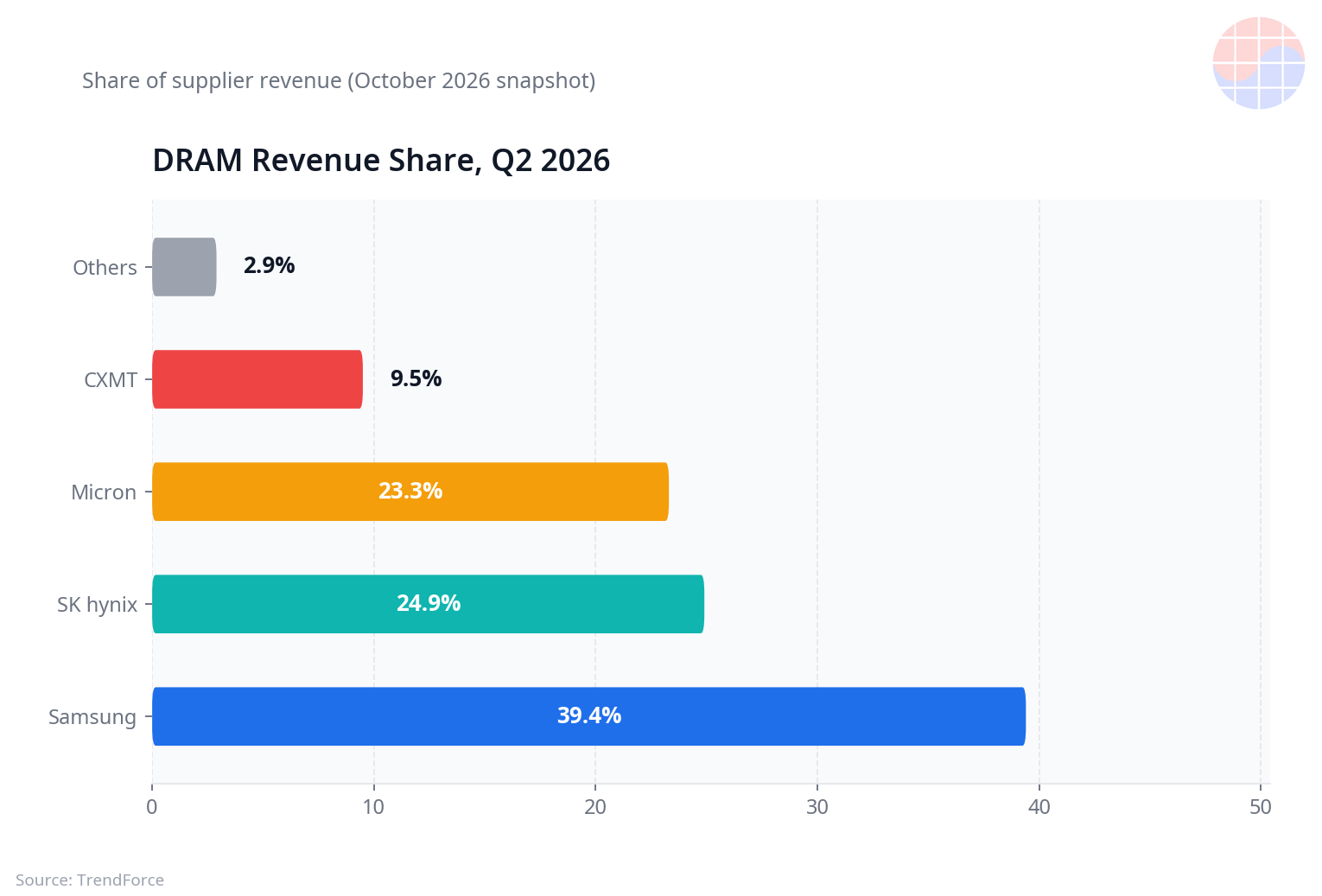
To put it plainly, the 2026 memory market is a three-way split: "Samsung in scale, SK hynix in AI, Micron in stability." Samsung Electronics kept the overall DRAM revenue crown (39.4%), but in HBM — the most expensive memory of the AI era — SK hynix holds a dominant 50%. Micron has built recession resilience on $18B in long-term contract cash, and China's CXMT and YMTC have climbed to 4th in DRAM and into the top 3 in NAND, respectively. Below is a strengths-and-weaknesses comparison of the 7 memory makers, based on the latest share, technology, and risk data as of October 13, 2026.
Market Snapshot: Numbers as of October 2026
Global DRAM revenue for Q2 2026 hit $154.73B, a 59.5% surge from the prior quarter. With AI server demand pulling everything from HBM to server DRAM and enterprise SSDs, Goldman Sachs calls this "the most severe shortage in 15 years." Shortage rates: DRAM 4.9%, NAND 4.2%, HBM 5.1%. Lead times have stretched past 40 weeks.
The price outlook is bullish too. TrendForce's September 30 outlook projects Q4 2026 conventional DRAM contract prices rising 10–15% quarter over quarter, and NAND up 15–20%. Enterprise SSDs are accelerating at 23–28%. HBM is priced separately: TrendForce expects average HBM prices to jump 121% in 2027. HBM4 is selling to NVIDIA at about $31–32 per GB (roughly $3.9–4.0 per Gb) — about double the $17–18/GB of the previous HBM3E generation.
1. Samsung Electronics — The Scale King, Counterattacking in HBM
Strengths
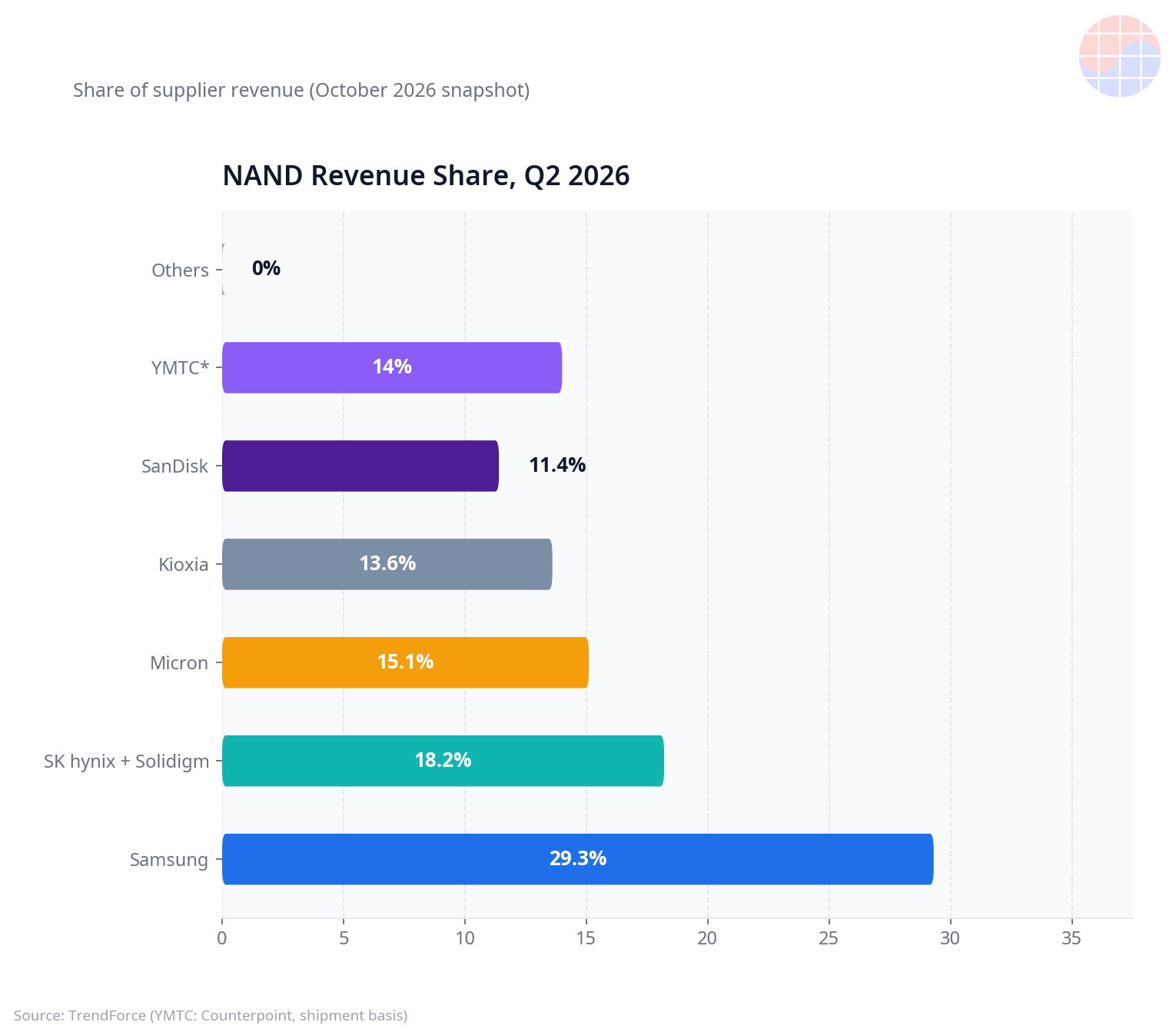
- #1 in both DRAM and NAND. Q2 2026 DRAM revenue of $60.98B (39.4% share, +63.4% QoQ) and NAND of $23.06B (29.3%) — world #1 in both. Samsung is the only company ranked first in both.
- The only turnkey HBM4. It builds HBM4 logic dies on its own 4nm foundry process and handles 3D packaging under one roof. A different structure from SK hynix, which outsources logic dies to TSMC.
- 1c DRAM mass production underway. TrendForce reports yields are approaching the 80% mass-production target — a signal of process leadership.
- Leading with HBM4E 12-high samples. Samples shipped at the end of May, and early-October industry reports say they passed NVIDIA qualification. 2026 HBM4 supply is effectively sold out.
Weaknesses
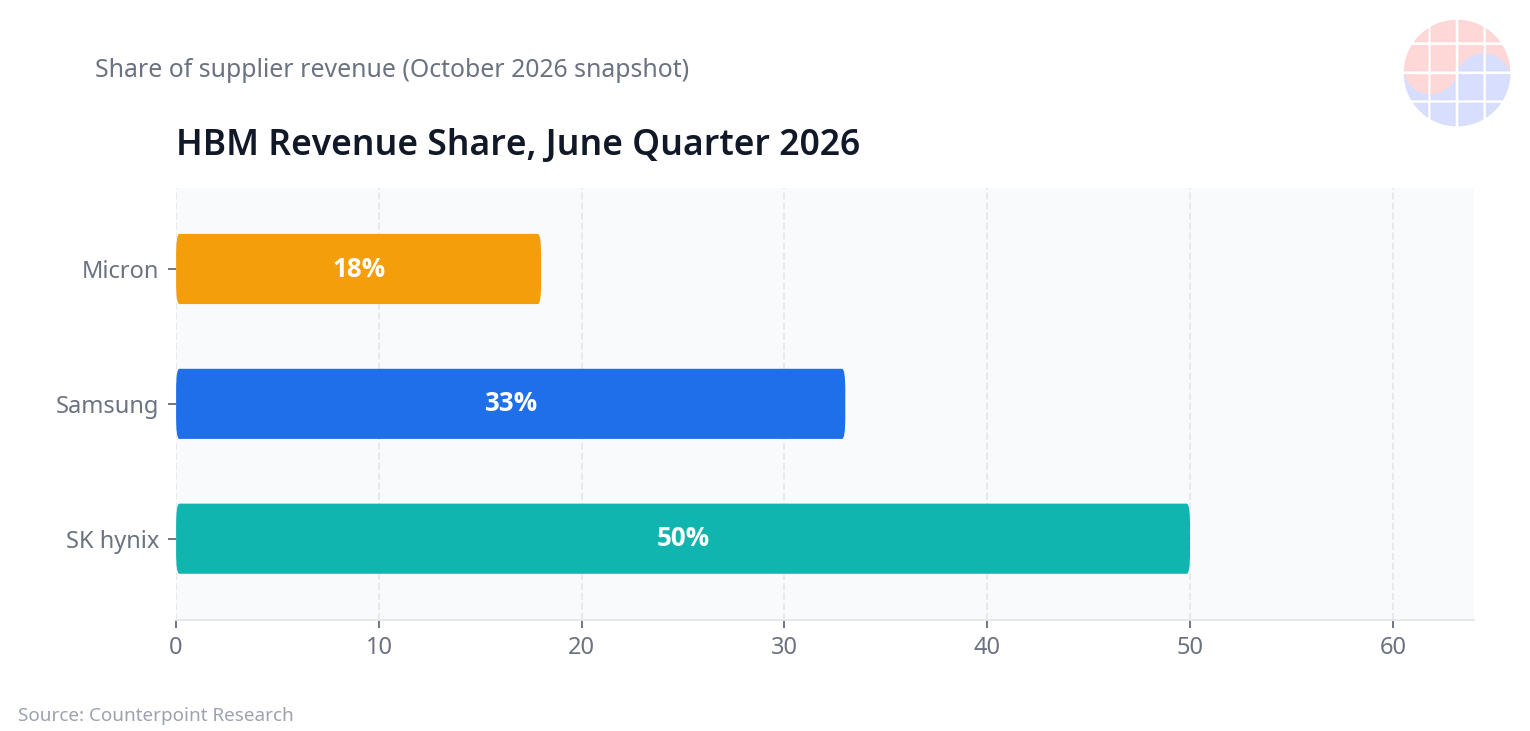
- HBM share of 33%, stuck at #2. SK hynix is taking the biggest slice of the AI windfall. The trauma of the delayed HBM3E qualification hasn't fully healed.
- The cost of a deprioritized NAND strategy. By shipment volume, NAND share fell from 32% in Q2 2024 to 25% in Q2 2026 — the result of pouring resources into DRAM and HBM.
- Resource allocation with the foundry. A structural handicap: the spoils of the memory supercycle must be shared with a loss-making foundry business.
2. SK hynix — The King of HBM
Strengths
- 50% HBM share. Counterpoint data for the June 2026 quarter shows it holding half the market. HBM is the priciest, highest-margin product in the memory industry.
- First into HBM4 mass production. Started mass production in Q2 2026, with yields reportedly "approaching mature-generation levels." In July it signed a supply and co-development deal with NVIDIA, securing priority access.
- TSMC 12nm logic die collaboration. The brains of the HBM4 base die are made on TSMC 12nm, with MR-MUF technology thinning wafers to 30um.
- Maximum price leverage for 2027. If the forecast of HBM prices rising 121% in 2027 materializes, the profit leverage goes to hynix, which has the highest HBM exposure.
Weaknesses
- The paradox of long-term fixed-price contracts. Because HBM is locked into annual contracts, price gains reach earnings with a lag. Q2 DRAM share slipped from 28.8% to 24.9%, with Micron (23.3%) closing in.
- Deepening HBM dependence. In conventional DRAM it's actually being chased. If the HBM cycle turns, the structure leaves it the most exposed.
- Reported struggles with next-gen hybrid bonding. October 7 industry reports say it is having difficulty developing the hybrid bonding technology that will define the next generation. (A single report — not a confirmed fact.)
- NAND depends on Solidigm. The acquired Solidigm's enterprise SSDs are the cash cow, but its own NAND technology leadership lags Samsung and Kioxia.
3. Micron — Geopolitical Premium and the Power of Cash
Strengths
- The American card. Its Taiwan fabs handle over 60% of global DRAM production, with U.S. onshore expansion underway. It carries a geopolitical premium amid U.S.–China tensions.
- $18B in take-or-pay cash. As of Q3 2026, customer deposits secured through multi-year long-term contracts reached $18B — a structure where cash holds up even in a downturn.
- 2026 HBM4 sold out. Long-term fixed-price contracts cleared the entire 2026 HBM4 allocation — proof that demand overwhelms supply.
- Fastest NAND growth. Q2 NAND revenue jumped 99.2% quarter over quarter, the fastest among the big three. Fiscal Q3 guidance: $33.5B revenue, gross margin above 81%.
Weaknesses
- Smallest HBM capacity. Roughly 40–50K wafers per month today, targeting 100K by end of 2026 — about half of the 150–200K range of the Korean players, leaving HBM share at 18% in 3rd place.
- HBM4E mass production in 2027. While Samsung and SK hynix ship HBM4E samples, Micron's next generation is a beat behind.
- Taiwan labor risk. In October 2026, the Taoyuan union passed a strike authorization vote with 99% in favor. Timing is undetermined, but it's a risk to fabs producing 60% of global DRAM.
4. Kioxia — A NAND Specialist, but Distant from AI
Strengths
- NAND technology house. Stacking expertise built on BiCS flash, with a shared production base through the Yokkaichi/Kitakami JV with SanDisk. Q2 NAND revenue of $10.72B (+79.9% QoQ), 13.6% share.
Weaknesses
- No DRAM or HBM. It misses the direct benefits of AI memory. This is a market HBM is driving right now.
- CEO's price ceiling declaration. Effectively declared it would refrain from further price increases, saying "prices have risen enough" — self-imposed limits on upcycle leverage.
- Shareholder structure constraints. SK hynix is a major shareholder, constraining strategic decisions. The 2023 merger attempt collapsed.
5. SanDisk — A Pure NAND Bet After the Spinoff
Strengths
- Pure-play NAND/storage company. Since the 2025 spinoff from WD, it focuses solely on NAND. Ten long-term supply agreements (NBM) guarantee a $93.9B floor price.
- The market's NAND betting window. The stock rose 3,192% in 2026 (as of September) — a conduit for capital betting on the NAND cycle.
Weaknesses
- Dependent on the Kioxia JV. A partner and competitor sharing the same 8 fabs. It pays Kioxia $1.2B for supply through 2026–2029.
- NAND-only business. No cycle diversification across DRAM or HBM. Exposed to China-driven price pressure from the likes of YMTC.
6. CXMT — China's #4 in DRAM, Knocking on the Server Market
Strengths
- 9.5% DRAM share, ranked 4th. Up from 7.6% the prior quarter in Q2 2026. No longer a negligible scale.
- G5 DRAM mass production. 50% more dies per wafer, shipping 24Gb LPDDR5X. Announced LPDDR6 mass production in August 2026.
- Server market entry declared. Aims to launch server DDR5 RDIMMs this year using 4F² + VSG technology — a challenge to the server DRAM monopoly of the Korea–U.S. big three.
- War chest secured. Raised roughly 66.6 billion yuan (~$10B) through a Shanghai IPO; the stock surged 466% on its first day of trading.
Weaknesses
- Entity List risk. In July 2026, the U.S. House sent a letter urging the Commerce Department to designate CXMT on the Entity List. Designation would hit equipment procurement and global orders directly.
- HBM still in development. Converting 20% of production lines to HBM3/HBM3E development, but with no EUV equipment, it's holding on with legacy DUV multi-patterning.
- NAND at the R&D stage. A Beijing NAND R&D line plan surfaced in Reuters reporting, but mass production status is unconfirmed.
7. YMTC — China's Challenger Into the NAND Top 3
Strengths
- ~14% NAND by shipment volume, into the top 3. Counterpoint puts it level with Kioxia, ahead of SanDisk (11%) and Micron (13%).
- Xtacking 4.0, 270+ layers. Mass-producing 267-layer 5th-gen QLC, with the technology gap to the Korea–Japan leaders assessed at roughly one year.
- Price competitiveness. 10–20% cheaper than Korea–Japan products. A price weapon in an era of surging enterprise SSD demand for AI inference.
- Most hybrid bonding patents. Industry reports put it at 119 core patents as of 2023, ahead of Samsung (83) and SK hynix (11).
Weaknesses
- On the Entity List since 2022. Advanced equipment procurement is blocked and overseas customer qualifications are constrained. Much of its volume is absorbed domestically in China.
- DRAM in pilot stage. Reports say LPDDR5 pilot production at Wuhan Fab 3 targets end of 2026, but this is unconfirmed.
Comparison Table at a Glance
| Company | DRAM Share | NAND Share | HBM Share | Key Strength | Key Risk |
|---|---|---|---|---|---|
| Samsung Electronics | 39.4% (#1) | 29.3% (#1) | 33% (#2) | Scale, turnkey HBM4, 1c DRAM | HBM #2, deprioritized NAND |
| SK hynix | 24.9% (#2) | 18.2% (#2) | 50% (#1) | HBM dominance, NVIDIA priority supply | Lagged pricing from long-term contracts, HBM dependence |
| Micron | 23.3% (#3) | 15.1% (#3) | 18% (#3) | Geopolitics, $18B long-term contract cash | Smallest HBM capacity, Taiwan union |
| Kioxia | - | 13.6% (#4) | - | NAND specialist, BiCS technology | Missing AI upside, price ceiling |
| SanDisk | - | ~11% (#5) | - | $93.9B floor-price contracts | Kioxia dependence, single business |
| CXMT | 9.5% (#4) | R&D stage | In development | G5 mass production, IPO war chest, server entry | Entity List risk |
| YMTC | Pilot stage | ~14% (top 3) | - | Xtacking 4.0, price competitiveness | Entity List, domestic focus |
Shares are Q2 2026 revenue-based (TrendForce; HBM from Counterpoint). YMTC NAND is shipment-volume based.
VLSI Commentary
Three points matter most in this comparison. First, if the forecast of 2027 HBM prices rising 121% materializes, SK hynix — with the highest HBM exposure — gains the largest profit leverage. Whether Samsung Electronics' counterattack cards — turnkey HBM4 and hybrid bonding — land on post-NVIDIA Rubin platforms will decide the 2027 landscape.
Second, NAND has a wild card: YMTC's entry into the top 3. While Samsung Electronics poured resources into DRAM and HBM and let NAND share slip from 32% to 25%, China slipped through the gap. Whether that bet stays valid beyond 2027 — in an era of exploding enterprise SSD demand in the AI inference age — remains to be seen.
Third, the China variable. Whether CXMT lands on the Entity List is the biggest variable in the 2027–2028 oversupply scenario. Designation would stall China's expansion and prolong the incumbents' boom; no designation would intensify price pressure after 2028. The next chapter of the memory cycle is more likely to be written by geopolitics than by technology.
Frequently Asked Questions
Who is the #1 HBM supplier in 2026?
SK hynix. It holds roughly 50% HBM revenue share in the June 2026 quarter, ahead of Samsung Electronics (33%) and Micron (18%). It started HBM4 mass production first and signed a priority supply agreement with NVIDIA.
How much have HBM4 prices risen?
HBM4 for NVIDIA trades at about $31–32 per GB (roughly $3.9–4.0 per Gb) — about double the $17–18/GB of the previous HBM3E generation. TrendForce forecasts average 2027 HBM prices rising 121%.
What is the memory price outlook for Q4 2026?
TrendForce (September 30, 2026) projects conventional DRAM contract prices rising 10–15% quarter over quarter and NAND up 15–20%. Enterprise SSDs climb the steepest at 23–28%.
What is the technology level of Chinese memory makers?
CXMT ranks 4th globally in DRAM with a 9.5% share and mass-produces G5 DRAM. YMTC is in the top 3 in NAND at 14% by shipment volume. The technology gap to the Korea–Japan leaders is assessed at roughly 1–3 years.
When will the memory supply shortage ease?
New capacity won't arrive until late 2027–2028. Goldman Sachs calls this the most severe shortage in 15 years. DRAM lead times have stretched past 40 weeks.
Why did Samsung Electronics fall behind SK hynix in HBM?
It comes down to qualification timing. Late customer qualification in the HBM3E generation pushed it out of the NVIDIA supply chain. For HBM4 it is counterattacking with a turnkey strategy — 4nm foundry logic dies plus packaging — and hybrid bonding.
Sources
- TrendForce: AI Server Demand Sustains Memory Contract Price Increases in 4Q26
- TrendForce: CXMT Accelerates 4F² DRAM Push
- TrendForce: CXMT Reportedly Plans NAND R&D Line
- Counterpoint Research via Club386: YMTC Overtakes SanDisk and Micron
- EETimes: The State of HBM4 Chronicled at CES 2026
- RCR Wireless: HBM4E: What Samsung and SK hynix's New AI Memory Does
- Autonai News: SK Hynix Hybrid Bonding Struggles While Micron Taiwan Strike Vote Looms
- TipRanks: CXMT Starts Mass Production
- TechNode: China's CXMT Eyes NAND Flash Push
- CoreWave Labs: Why RAM and SSD Prices Are Still Rising in 2026