VLSI Korea
Samsung vs SK hynix Average Pay: KRW 185M vs KRW 158M in 2025 — Why the Ranking Flipped in One Year
In 2025 SK hynix averaged KRW 185M vs Samsung's KRW 158M — a flip from Samsung's 2024 lead. The cause is bonus structure: SK hynix PS at 10% of operating profit with no cap vs Samsung DS OPI capped at 50% of salary. Company-wide averages.


30-Second Summary
- The answer first: in 2025, average pay was KRW 185 million at SK hynix and KRW 158 million at Samsung Electronics. SK hynix was higher by KRW 27 million, or 17.1%. (Company business reports, released March 2026.)
- One year earlier it was the reverse. In 2024, Samsung averaged KRW 130 million and SK hynix KRW 117 million — Samsung ahead by KRW 13 million (11.1%). The gap swung by KRW 40 million in one year.
- The growth rates explain it: SK hynix +58.1% year on year, Samsung +21.5%. Both are company records. One rose faster than the other.
- The cause is bonus structure. In its 2025 deal, SK hynix abolished the cap on PS (profit sharing) and fixed the pool at 10% of operating profit. Samsung's DS-division OPI recovered from 0% in 2023 to 14% in 2024 to 47% in 2025 — but OPI is capped at 50% of annual salary.
- Caution — these are not engineer salaries. The business-report average is a company-wide average for all employees in Korea: every division, every job family, performance pay included. Samsung's figure mixes DS (semiconductors) with DX (mobile, TV, appliances). SK hynix is almost purely memory. This is not a like-for-like job comparison.
- Micron is separate. No Korean-style percentage-of-profit formula was found. Below, Micron appears only as US job-posting base-salary ranges and H-1B base data — never as total compensation, and never as Korean pay.
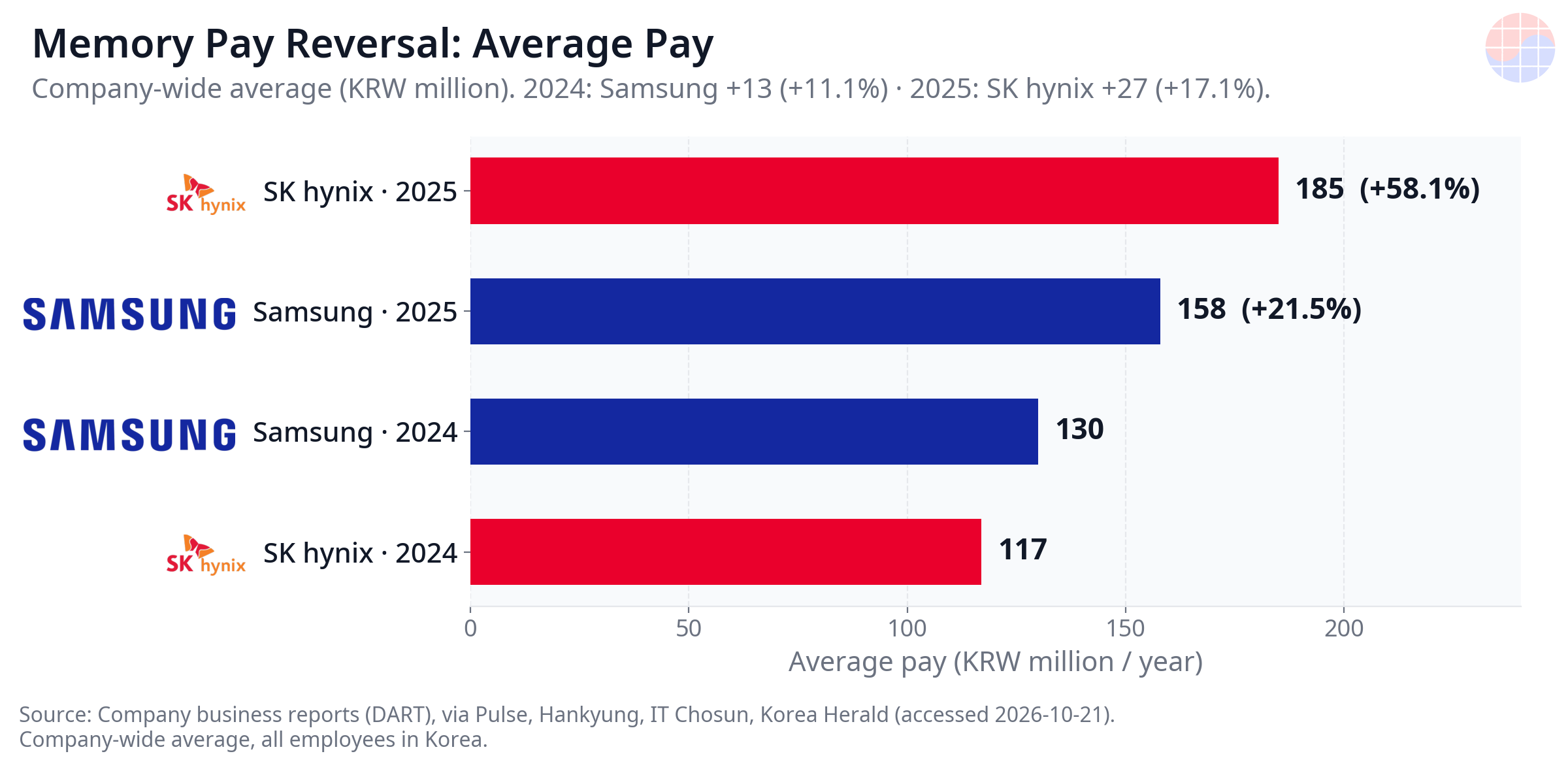
Figure: Company-wide average pay at Samsung Electronics and SK hynix, 2024 vs 2025 (KRW million). Source: Company business reports (DART), via Pulse, Hankyung, IT Chosun and Korea Herald, accessed 2026-10-21.
What One Chart Says: Rankings Can Flip in a Year
In an average-pay comparison, direction matters more than the level.
| 2024 | 2025 | Change | |
|---|---|---|---|
| Samsung Electronics (all employees) | KRW 130M | KRW 158M | +21.5% |
| SK hynix (all employees) | KRW 117M | KRW 185M | +58.1% |
| Gap | Samsung +KRW 13M (+11.1%) | SK hynix +KRW 27M (+17.1%) | KRW 40M swing |
Samsung's 2024 lead was KRW 13 million. SK hynix's 2025 lead is KRW 27 million. Both years are all-time highs for both companies. Neither company fell. One simply rose faster.
Headcount shows why the two averages are not the same kind of number. Samsung's average covers 128,881 employees in Korea at end-2025 (excluding registered directors). SK hynix's covers 34,466. The populations differ by almost 4x, and so does the business mix. This table answers "whose average pay bill grew faster" — not "whose engineers earn more."
Why It Flipped: Bonus Structure Moves the Average
Performance pay paid in a year is already included in that year's average. Adding the bonus rates below on top of the averages would double-count. Read the systems as the cause, not as an extra layer.
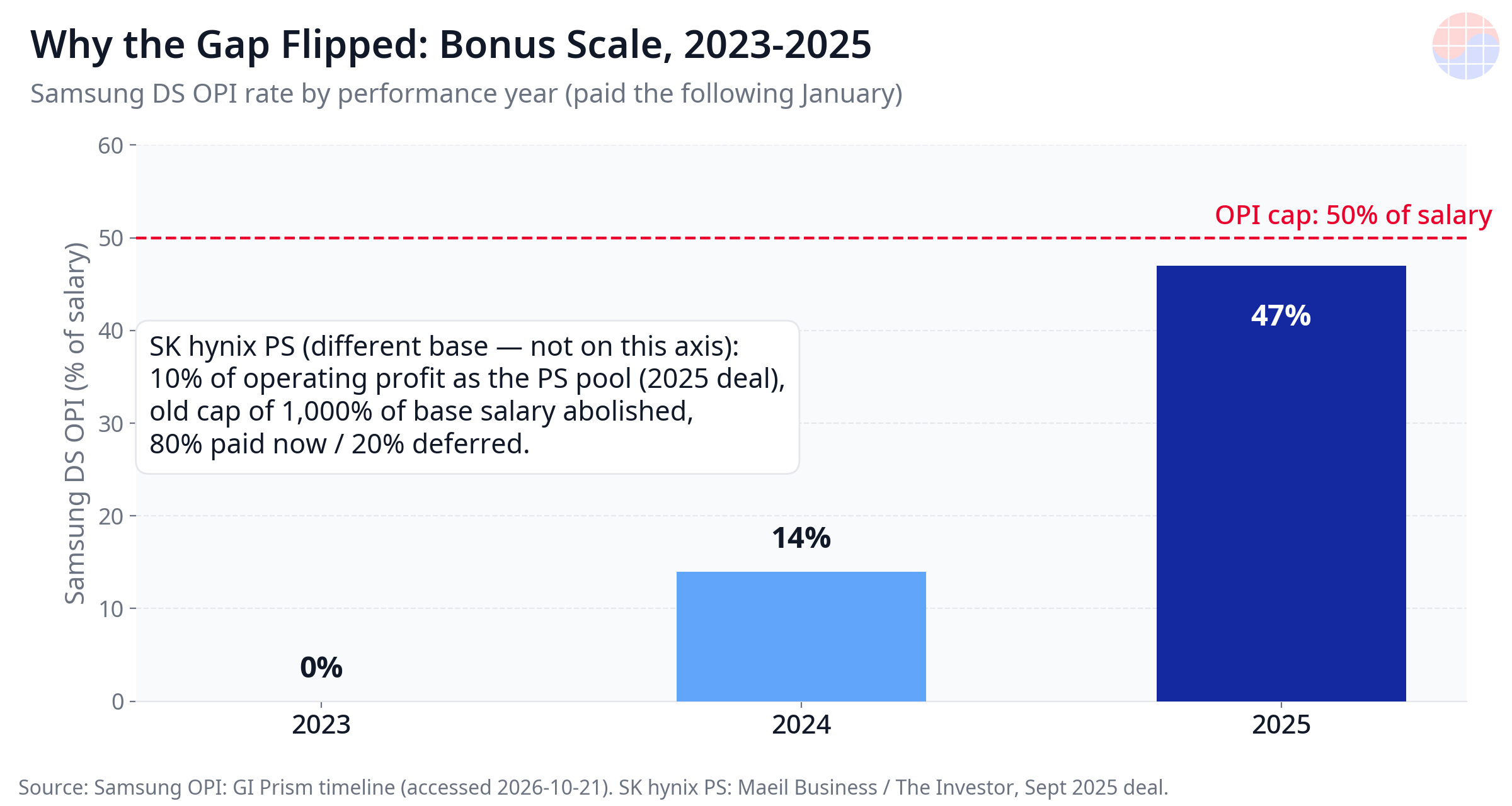
Figure: Samsung DS OPI rate by performance year. SK hynix PS uses a different base and is deliberately not plotted on the same axis. Source: GI Prism (OPI timeline); Maeil Business and The Investor (SK hynix 2025 deal), accessed 2026-10-21.
SK hynix — PS: cap abolished, pool fixed at 10% of operating profit
- The old PS was capped at 1,000% of base salary.
- The 2025 labour deal (provisional agreement, September 2025) abolished that cap.
- The pool is now fixed at 10% of annual operating profit, reported as a 10-year arrangement.
- Payment: 80% in the current year, the remaining 20% deferred over the following two years.
- The 2025 wage increase was +6.0%.
- A 2026 follow-on changed delivery to 50% cash / 50% stock by default, with the 10%-of-operating-profit pool retained. That is a 2026 delivery change, not a cause of the 2025 average.
Samsung — OPI: EVA-based, capped at 50% of salary
- OPI is paid within 20% of excess profit, up to 50% of annual salary, on an EVA basis (operating profit minus capital costs).
- DS-division rates by performance year: 0% for 2023, 14% for 2024, 47% for 2025. In 2023 the DS division posted an operating loss of about KRW 14.88 trillion.
- Samsung's average rose as OPI recovered. But the 50%-of-salary cap sets a structural limit on how fast the average can follow a very large profit year.
In one sentence: SK hynix PS is linked to operating profit with no cap; Samsung OPI is capped as a share of salary. In a year when operating profit rises sharply — the HBM upcycle — the first system's average moves faster.
Micron, Kept Separate (US / Taiwan)
No public formula paying a fixed percentage of operating profit to rank-and-file employees was found for Micron. US compensation is base salary plus an annual incentive, equity and benefits, varying by country and level. That is why none of the figures below belong in the Korean table.
US job-posting base salary (base only — bonus, equity and benefits excluded):
- Staff Firmware Engineer, Longmont: base USD 127,000–269,000 per year (Micron posting, via Swooped)
- Software Engineer, Longmont: base USD 146,000–297,000 per year (Levels.fyi job posting)
- Software Engineer, advanced DRAM/HBM ESD role, senior scope, Folsom: base USD 181,000–308,000 per year (Levels.fyi job posting)
H-1B / LCA base salary (visa filings, base only):
- Idaho worksites, FY2024: 210 LCAs, average proffered base salary USD 117,885 (MyVisaJobs). That is one state's sponsored-role average — not all of Micron US, not an engineer median, and not total compensation.
Taiwan (separate): Micron's Taiwan union has demanded institutionalised profit sharing of 15% of operating profit, paid quarterly. As of the access date it had not been adopted. A union demand is not a pay system, and it should not be compared line-by-line with the two Korean systems above.
So the strongest statement the data supports for Micron is: "US posting base ranges look like this." A Levels.fyi by-level total-compensation median for Micron was not verified in this pass, so none is presented.
How to Read These Numbers
Sources and limits: Korean figures are from each company's business report (filed on DART), as reported by Pulse/Maeil Business, Hankyung, IT Chosun, Korea Herald and FnNews, accessed 2026-10-21. The average is company-wide for all employees in Korea — not engineer-only, not DS-only, not memory-only. Bonus rates are already included in the averages; do not add them again. SK hynix's H1 2026 average of KRW 144 million is a half-year cumulative figure: never compare it directly with a full-year average and never annualise it by doubling. Micron figures are US posting and LCA base salary only, not total compensation.
Polishing your application: Once the pay data helps you pick a target company, the next step is the application itself. For global semiconductor roles, a clean English resume and cover letter matter — an English editing service such as Wordvice AI can help refine them. Purchases through this link may generate a commission.
FAQ
Q1. Who paid more on average in 2025, SK hynix or Samsung? SK hynix. KRW 185 million versus Samsung's KRW 158 million — a gap of KRW 27 million, or 17.1%. Both figures are all-employee averages, not engineer pay.
Q2. Why did the ranking flip in one year? Bonus scale. SK hynix abolished its PS cap and fixed the pool at 10% of operating profit, and its average rose 58.1%. Samsung's DS OPI recovered to 47%, but OPI is capped at 50% of salary, and its average rose 21.5%.
Q3. What is the average pay inside Samsung's DS (semiconductor) division alone? It is not disclosed. The business-report average covers all of Samsung Electronics (DS plus DX), so no DS-only or memory-only average can be stated.
Q4. What is Micron's average total compensation for engineers? It cannot be answered from the data verified in this pass. What was verified is US job-posting base ranges (for example, Staff Firmware Engineer at USD 127,000–269,000) and an Idaho LCA average base of USD 117,885 for FY2024 — neither of which is total compensation.
What about your company — which is fairer: a bonus linked directly to operating profit, or a bonus capped as a share of salary?
📩 Subscribe to VLSI Korea
Get our daily semiconductor deep-dives delivered to your inbox first. Free to subscribe.