VLSI Korea
The Memory Supercycle's Bill: Who Actually Pays for 400% DRAM Prices
DRAM prices rose 400% in two years, and HBM4 contracts will jump another 121% next year. Only the three memory makers are profiting — smartphone, PC, and GPU makers are watching margins melt. Xiaomi shipments down 30%, budget phones disappearing. Who actually pays the supercycle's bill?


DRAM prices have risen 400% in two years. HBM4 contract prices will jump another 121% next year alone. Only the three memory makers are making money — smartphone, PC, and GPU makers are watching their margins melt. Xiaomi shipments are down 30%, and budget phones are disappearing. So who actually pays the supercycle's bill?
The 30-Second Summary
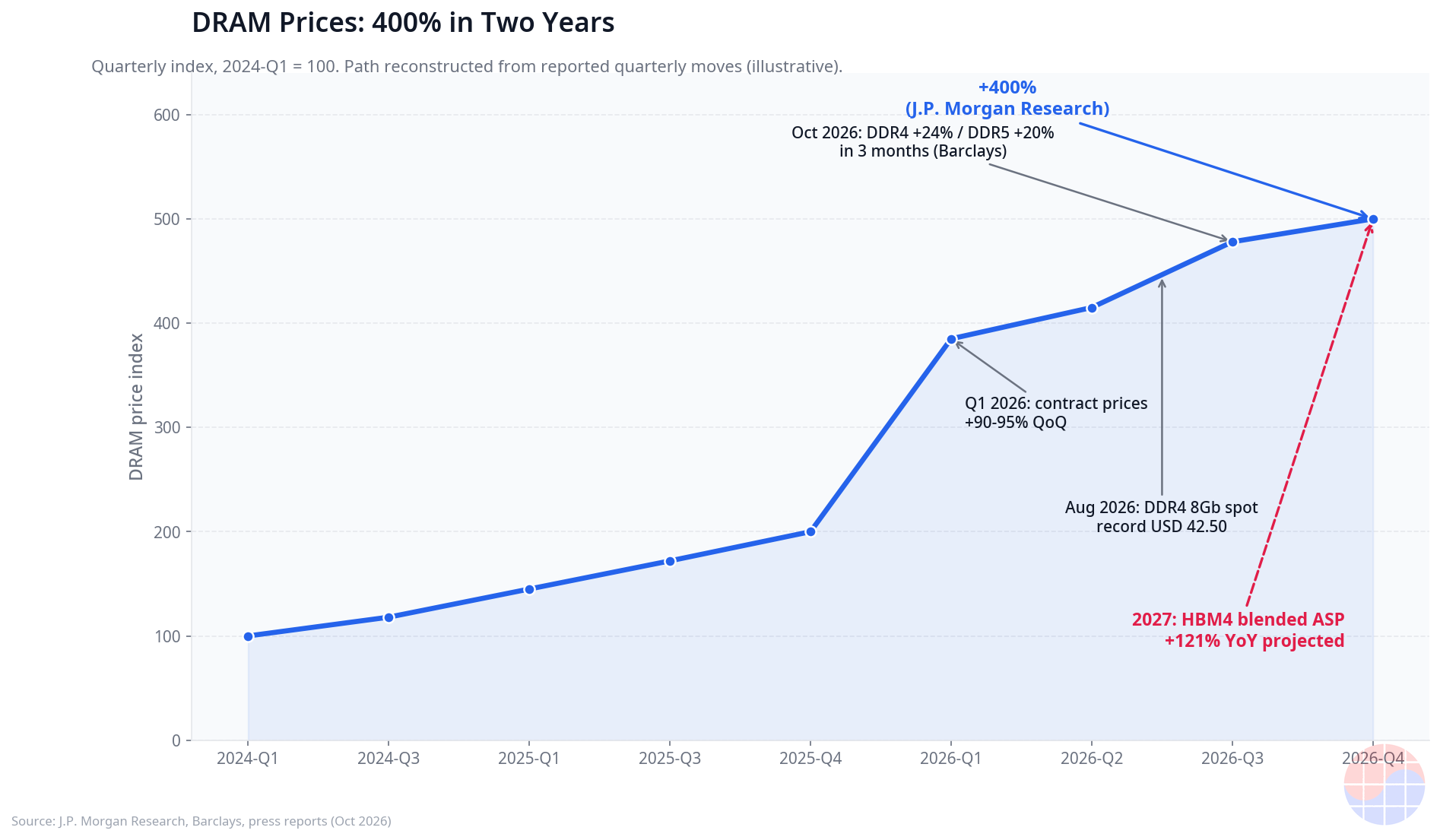
- J.P. Morgan Research estimates DRAM prices will have risen more than 400% from the start of 2024 to the end of 2026. This is not a normal price cycle — it is AI data centers structurally absorbing the world's memory wafers.
- The blended average selling price of HBM4 is projected to rise 121% year over year in 2027. Samsung has reportedly offered HBM4 at a mid-to-high USD 4 per gigabit for 2027 annual contracts — nearly triple the roughly USD 1.50 per gigabit of HBM3E.
- Three companies — Samsung Electronics, SK hynix, and Micron — control virtually all global memory supply, and HBM production cannibalizes the same wafer pool. Making 1 Gb of HBM consumes roughly three times the wafer area of standard DDR5.
- The bill flows downstream. Global smartphone shipments fell 20% year over year in Q3 2026, the weakest third quarter since 2012. Xiaomi is down more than 30%; Oppo and Vivo each fell over 20%. In Japan, an RTX 5060 Ti 8GB sells for 41% more than in the US.
- The key variable is the pass-through rate. How much of the memory cost increase a device maker can push into final prices decides who survives. Companies most exposed to budget devices face the steepest downside.
Background — AI Started Eating the Wafers
By October 2026, the memory market had entered the most extreme seller's market in its history. J.P. Morgan Global Research estimates DRAM prices will have risen more than 400% between the start of 2024 and the end of 2026. Source Retail numbers are even starker. A 32GB DDR5 kit that sold for under USD 90 in early 2025 now trades at USD 409–529. A 2x16GB DDR5 kit climbed from USD 108 to USD 572 in a year — up 429%. In August 2026, the spot price of a single DDR4 8 Gb chip hit a record USD 42.50 — for a chip class the industry had largely written off. Source
What makes this shortage different from previous ones is the cause. It is not shuttered factories. The fabs are running at full tilt — they are just making something else. Industry analysis projects data centers will consume roughly 70% of all memory chips produced worldwide in 2026, up from 20–30% as recently as 2022. In four years, consumer electronics went from the main customer to whoever gets the leftovers. Source
AMD CEO Lisa Su flew to Seoul twice in seven months — signing an HBM4 supply MOU with Samsung in March 2026, then meeting Samsung's DS chief and SK hynix's CEO on October 7. Her public message: "memory supply is very tight." When the CEO of an AI accelerator company personally flies in to secure memory, memory has become the tightest link in the AI supply chain. Source
Business Deep Dive
1. Market structure: the pricing power of the big three
More than 95% of the global DRAM market is controlled by Samsung Electronics, SK hynix, and Micron. In HBM, SK hynix leads with roughly 54–58% of global HBM revenue. Source The oligopoly itself is not the problem. The problem is that all three are simultaneously, and in the same direction, shifting wafers to HBM.
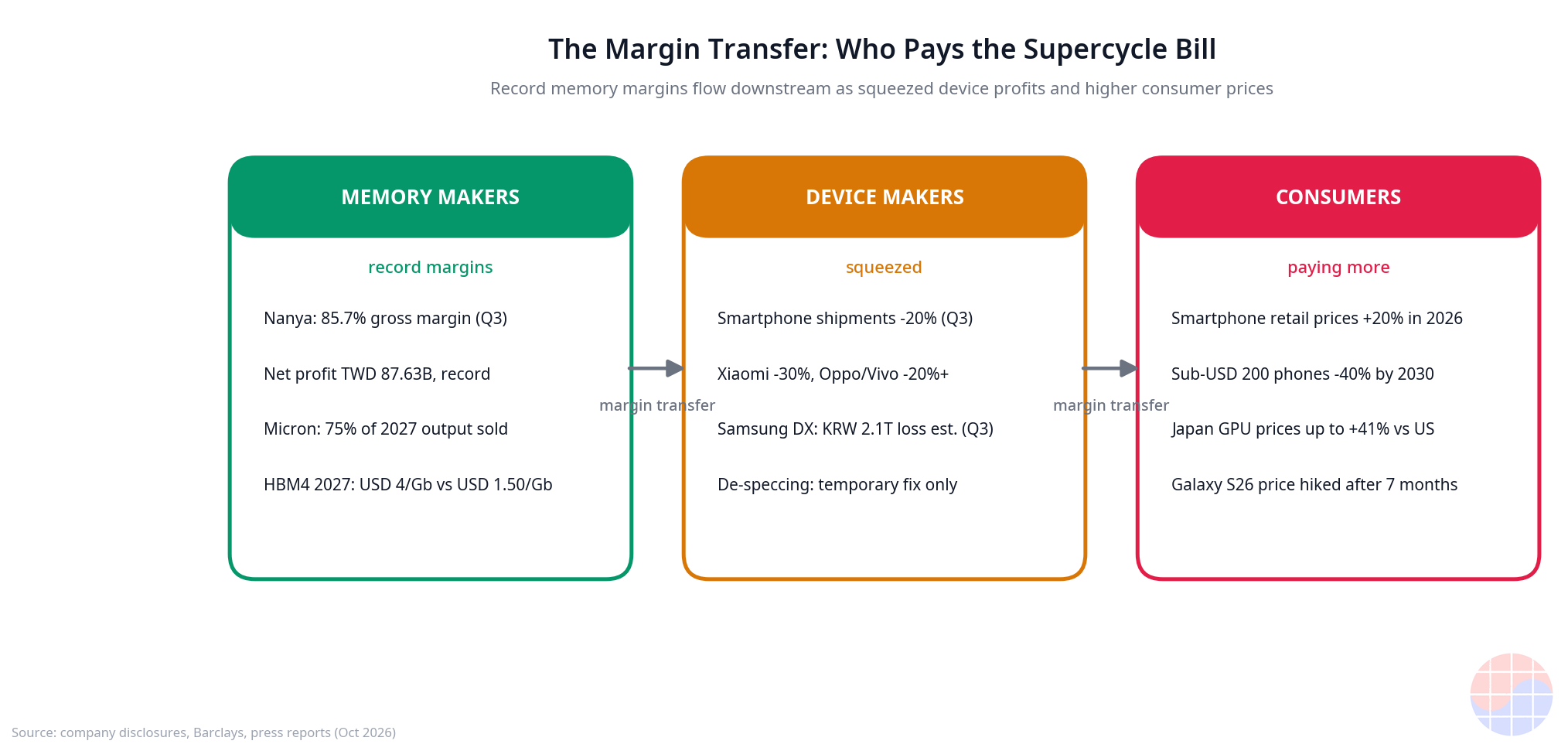
In Q3 2026, Taiwan's Nanya Technology posted a record gross margin of 85.7%. Quarterly revenue hit TWD 133.65 billion (up 61.9% quarter over quarter), DRAM average selling prices rose more than 60% from Q2, and net profit reached TWD 87.63 billion with EPS of TWD 25.4 — all all-time highs. Shipments actually fell 4–6%. The company sold fewer chips and made more money — a textbook case of pricing power. Source Nanya's president guided for further price and margin gains in Q4, with double-digit contract price increases still possible for 2027. Source
Micron's CEO told investors that 75% of the company's 2027 memory output is already sold. Source In the 2026 memory market, it is the sold volume that gets confirmed first — not the unsold.
2. Cost structure: one HBM stack eats three DRAMs' worth of wafers
The technical mechanism behind the price explosion is simple. HBM and conventional DRAM compete for the same advanced wafer capacity. Producing 1 Gb of HBM consumes roughly three times the wafer area of standard DDR5. Every HBM stack produced erases roughly three conventional DRAMs' worth of wafers. Source
The numbers: Samsung has reportedly offered HBM4 at a mid-to-high USD 4 per gigabit in negotiations for 2027 annual supply contracts — nearly triple the roughly USD 1.50 per gigabit of HBM3E. On a 12-high, 36 GB stack basis, that translates to roughly USD 600 in 2026 rising to about USD 1,300 in 2027. Source The forecast of a 121% year-over-year rise in blended HBM ASP for 2027 tells the same story. Source
Conventional DRAM is no exception. Barclays reports DDR4 contract prices rose 4% month over month in October alone, up 24% over the preceding three months. DDR5 rose about 20% over the same period. The older DDR4 is now rising faster than DDR5 — the large installed base of DDR4-based PCs, servers, and industrial equipment still needs supply, while makers concentrate investment on newer generations, tightening legacy supply first. DDR5 spot prices jumped 8% in October alone. Source
Barclays sees Micron's memory supply constraints running through 2028; Citi projects the DRAM shortage peaking in Q4 2027. Intel's CEO recently warned of "another two to three years of this." Source
3. The downstream squeeze: where the bill lands
Behind the memory makers' record margins lies bleeding across the downstream value chain. Global smartphone shipments plunged 20% year over year in Q3 2026 — the weakest third quarter since 2012. Passing higher memory costs to consumers pushed global smartphone retail prices up roughly 20% this year. Source
The pain concentrates on budget brands. Xiaomi shipments collapsed more than 30%, its market share falling from 14% to 10%. Oppo and Vivo each dropped over 20%. Samsung (-3%) and Apple held up relatively better through premium-focused strategies, at 23% and 22% share respectively. Source
The most dramatic scene plays out inside Samsung Electronics itself. The DS division (memory) posted KRW 89.2 trillion in Q2 operating profit, while the DX division (smartphones, appliances) recorded a KRW 800 billion operating loss. Analysts estimate the DX loss widened to KRW 2.1 trillion in Q3. Under one roof, the memory division earns money while the device division bleeds it — margin transfer, visible in real time on a single income statement. Source
Consumer price hikes have already begun. On October 1, Samsung raised Galaxy S26 prices just seven months after launch — the entry 256GB model up about KRW 150,000 to KRW 1.404 million, the 1TB Ultra roughly KRW 270,000 more expensive. Apple set higher launch prices for the iPhone 18 Pro series than its predecessor. Source
GPUs suffer the same disease. A pricing survey published October 14 found a Tokyo retailer's RTX 5060 Ti 8GB selling 41.1% above Amazon US listings on a pre-tax basis. The RTX 5080 averaged a 12.71% premium. NVIDIA is reportedly scaling back RTX 5090 production for the consumer channel in favor of AI data center GPUs. GDDR competes for the same DRAM wafer pool. Source
4. Strategic options: four cards for device makers
Device makers facing memory inflation hold four cards.
First, pass-through. Samsung and Apple chose this path — accepting demand destruction risk and pushing costs onto premium customers. Only brands with pricing power can play it.
Second, margin absorption. Thin-margin, high-volume players that freeze prices watch margins evaporate. Honor's CEO stated publicly: "No matter how much costs rise, we cannot pass all of it on to users." Source Companies that can neither pass through nor absorb reach for the third card.
Third, de-speccing. Cutting fitted memory to hit BOM targets — a temporary fix. Tesla halved then restored AI5 chip memory to 96GB in a visible game of chicken. Barclays notes de-speccing is "merely a temporary fix." Source
Fourth, abandoning budget, going premium. Xiaomi's choice — pulling back from low-price segments and non-core overseas markets, raising ASPs to defend margins. The whole market is moving that way: annual shipments of sub-USD 200 smartphones are forecast to fall about 40% by 2030 from 2025 levels, while the premium segment grows at a 7% annual rate. Source
Chase's Take
The market's question about the memory supercycle is usually "who's making money?" That is the wrong question. The real question is who pays.
The moment the big three rotate wafers into HBM, memory prices stop being a function of "cost plus margin." They become a function of "who wins the wafers." When AI data centers win the auction, the losers — smartphone, PC, and GPU makers — get the bill. Nanya's 85.7% margin and Xiaomi's -30% shipments are two sides of the same coin: one is the oligopoly's pricing power, the other is the tax on that power.
The paradox: the longer the memory makers' boom lasts, the faster device makers restructure. Budget phones vanish; only premium remains. Consumers buy more expensive devices, delay upgrades, or turn to refurbished. The memory supercycle is ultimately a mechanism that forces the premiumization of the device market.
Samsung's DS-DX divergence is this era in miniature. The memory division earns KRW 89 trillion; the device division loses trillions. Asking whether rising memory prices are good or bad "for Samsung Electronics" is meaningless. Which division's stock you hold decides the answer.
For investors, one metric matters: the pass-through rate. What share of memory cost inflation can be reflected in final prices? Companies with premium brands and B2B contract structures defend; thin-margin, high-volume models face downside. As long as the big three's pricing power holds through 2027, this equation does not change.
Implications
For investors
- The big three keep pricing power through 2027. 75% of 2027 output already sold (Micron), HBM4 contract prices seen up 121%, and both Barclays and Citi see shortages running into late 2027–2028. Near-term earnings momentum sits with memory makers.
- Screen device makers by pass-through rate. Premium-heavy, brand-strong players (the Samsung/Apple type) are relatively defensive. Companies heavily exposed to budget, high-volume models face earnings downside. Xiaomi -30% and Oppo/Vivo -20%+ are the evidence.
- Consumer electronics demand itself is shrinking. Global smartphone shipments are projected down 16.7% in 2026 — the largest annual decline on record — with Q3 down 20%. Shrinking device volumes ripple back into component supply chains (displays, cameras, substrates).
For operators
- Long-term agreements (LTAs) are now a survival condition. Nanya has locked 70% of its capacity into LTAs, with three-year contracts alone exceeding 20% of output. Buyers now seek long-term contracts first — negotiating power has fully tilted to suppliers.
- Shift memory procurement strategy from 'price' to 'securing supply.' That is why Lisa Su flew to Seoul twice in seven months. Without locking in 2027–2028 volumes now, there may be no volume at any price.
- De-speccing only buys time. The structural fix is premiumizing the product mix and redesigning BOM memory content.
FAQ
Q1. Why did DRAM prices really rise 400% in two years? Because what fabs make changed, not because they stopped. Samsung, SK hynix, and Micron concentrated wafers on HBM for AI data centers, structurally shrinking conventional DRAM supply for phones and PCs. Data centers are projected to consume roughly 70% of all memory produced in 2026. Demand stayed; supply got sucked into AI. That is the essence of the price explosion.
Q2. Why do HBM prices affect regular DRAM and smartphone prices? HBM and conventional DRAM compete for the same advanced wafer capacity. Making 1 Gb of HBM consumes roughly three times the wafer area of standard DDR5, so more HBM means less conventional DRAM. Less supply means higher prices, and that cost increase flows into smartphone, PC, and GPU bills of materials.
Q3. When will the memory price surge cool down? The consensus view sees shortages running into late 2027–2028. Barclays expects Micron's supply constraints to continue through 2028; Citi projects the DRAM shortage peaking in Q4 2027. New fab capacity takes three to five years to build, so there is no near-term supply relief mechanism.
Q4. What is the single most important metric for investors? The pass-through rate — how much of memory cost inflation can be reflected in final consumer prices. Premium brands and B2B contract structures are defensive; budget, high-volume models face earnings downside. On the memory maker side, HBM mix and long-term agreement (LTA) coverage indicate margin sustainability.
Disclaimer: Figures and outlooks in this article are compiled from public press reports, investment bank research, and company disclosures as of October 15, 2026, and do not constitute investment advice. Market conditions may change.