VLSI Korea
Micron's AATT2 in Taichung: 2027 HBM Packaging Capacity Sold Out — Why Advanced Packaging Is AI's New Bottleneck
Micron opened HBM packaging plant AATT2 in Taichung on Oct 15, 2026, declaring 2027 capacity sold out — evidence the AI chip bottleneck moved from wafers to advanced packaging. VLSI+MBA analysis: demand vs execution risks, the $600M patent settlement, Taiwan concentration paradox.


30-Second Summary
Bottom line: the AI semiconductor supply chain's bottleneck has moved from front-end wafer processing to advanced back-end packaging. On October 15, 2026, Micron opened AATT2 (Advanced Assembly and Test Taiwan 2) in Houli, Taichung — its second HBM packaging and test plant in Taiwan. COO Manish Bhatia said planned 2027 capacity is already sold out; Taiwan President Lai Ching-te attended. (Source: Micron press release, 2026-10-15)
- September 30 earnings: customer agreements cover the vast majority of calendar-2027 HBM bit supply, with substantial YoY price increases; HBM growth to outpace traditional DRAM through 2028. (Source: Micron earnings, 2026-09-30)
- Early October 2026: Micron settled with Netlist for $600 million ($30M quarterly, five years) — a hidden tax on scaling becoming a fixed cost line.
- Labor caveat: Taoyuan union authorized strike action October 7 (vote Oct 1–6); Taichung union (~11,000/12,300) returns to mediation October 22; the October 19 rally is explicitly not a strike. No walkout has begun. (Source: wire reports, 2026-10-07)
- Denominator check: planned-2027-AATT2 sellout and the company-wide order book differ; Micron noted some AATT2 output sits outside finalized contracts. An opening is a construction milestone, not qualified output.
Key Figures at a Glance
| Metric | Figure | As of |
|---|---|---|
| AATT2 planned 2027 capacity bookings | Sold out (per COO) | 2026-10-15 |
| Calendar-2027 HBM bit supply under contract | Vast majority | 2026-09-30 earnings |
| 2027 HBM pricing | Substantial YoY increase | 2026-09-30 earnings |
| HBM growth outlook | Outpacing traditional DRAM through 2028 | 2026-09-30 earnings |
| Micron Taiwan headcount | ~15,000 employees | 2026-10-15 |
| Micron cumulative Taiwan investment | >NT$1.6T (~$49.4B) | 2026-10-15 |
| Netlist patent settlement | $600M ($30M/quarter, 5 years) | Early Oct 2026 |
| Taichung union membership | ~11,000 of 12,300 employees | Oct 2026 reports |
| Next labor milestone | Mediation resumes Oct 22 | Scheduled |

Background: The Bottleneck Moved to the Back End
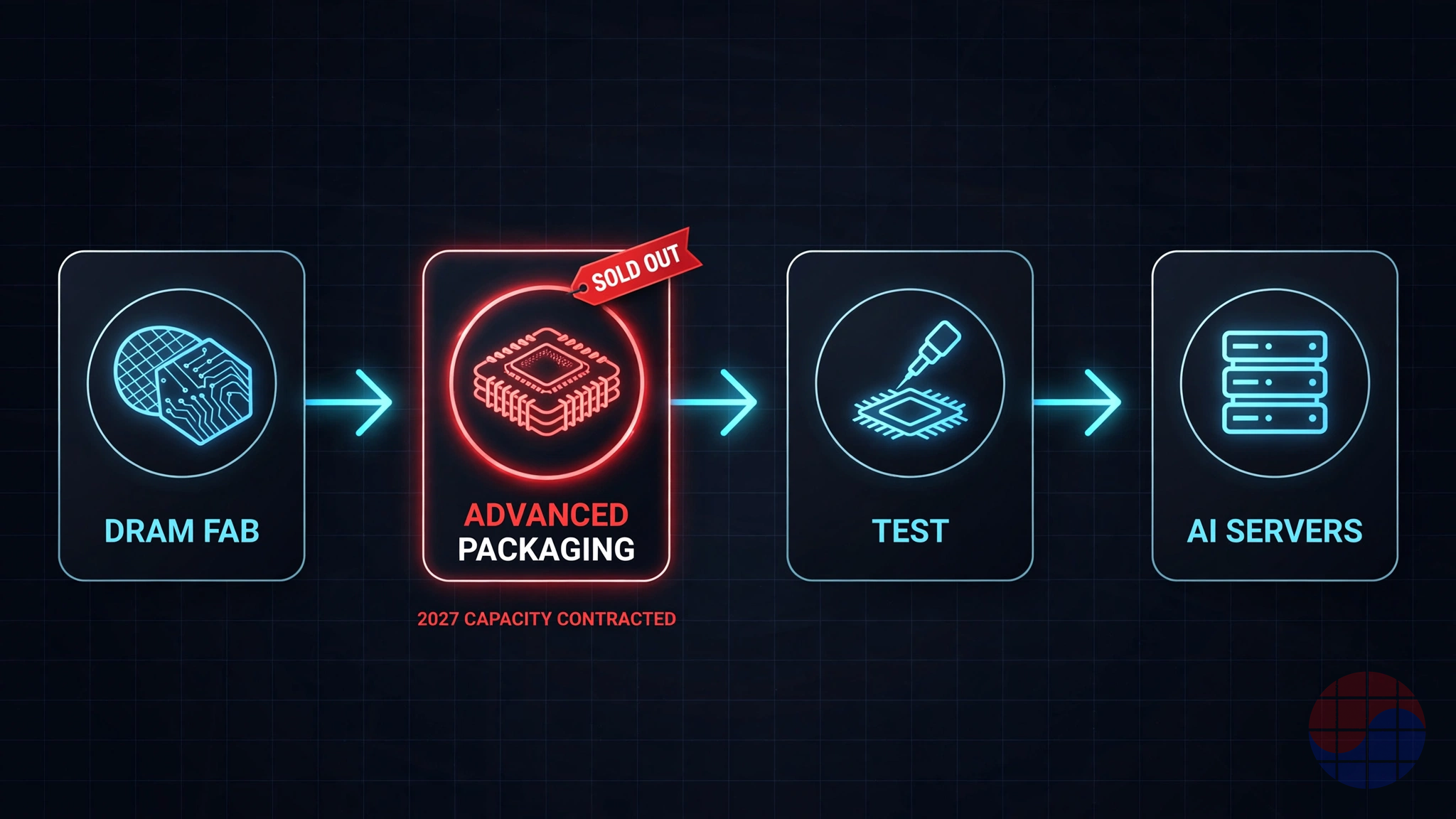
For forty years the industry watched the front end — scaling, yield, wafer starts. The AI-era supply chain chokes elsewhere: advanced packaging — stacking HBM with TSVs, mounting it on interposers beside logic dies, testing the finished assembly — is now the most constrained step in AI chip production. Front-end capacity is a money problem; packaging is not. It demands precision bonding, thermal control, and a punishing yield ramp, with scarce equipment, scarcer labor, and scarcest recipes. Hence years-ahead bookings — and a "sold out" 2027 declared in October 2026. Micron's answer: buy out of the bottleneck by vertically integrating packaging and test in-house, in Taiwan. AATT2 is plant number two.
AATT2 is plant number two — and HBM is packaging-intensive by nature: dies stacked vertically with TSVs over a logic base die, GPU-linked via interposer, where one bad die scraps a whole stack and yield curves take quarters to climb. Sold is not shippable.
Why Customers Book Years Ahead
AI accelerator roadmaps run in two-to-three-year increments: once a GPU's memory configuration is set, makers commit capex and customers book supply two years out. Interlocking lead times hardened years-ahead reservation into the norm, and custom HBM (hyperscalers' tuned specs) makes it increasingly made-to-order — longer lead times, harder switching, same supplier for the chip's life. Most-2027-supply-contracted is structural.
Business Deep Dive
Micron's Taiwan Bet, in Numbers
| Date | Event | Source |
|---|---|---|
| November 2023 | AATT1 opens — HBM3E and DRAM packaging | Micron press release |
| October 15, 2026 | AATT2 opens — Houli, Taichung; second HBM packaging/test plant; President Lai attends | Micron press release, 2026-10-15 |
| Present | ~15,000 Taiwan employees; cumulative investment >NT$1.6T (~$49.4B) | Micron announcement |
NT$1.6 trillion is an exceptional cumulative commitment by a foreign memory maker in Taiwan. AATT1 was the HBM3E beachhead; AATT2 becomes the core hub for post-2027 HBM supply. The plant was effectively full before its doors opened.
2027 Supply-Demand: Anatomy of a Seller's Market
| Indicator | Detail | Source |
|---|---|---|
| Share of 2027 HBM bits contracted | Vast majority under customer agreements | Micron earnings, 2026-09-30 |
| 2027 HBM pricing | Substantial YoY increases locked in | Micron earnings, 2026-09-30 |
| HBM vs. DRAM growth | HBM to outpace through 2028 | Micron earnings, 2026-09-30 |
| AATT2 planned 2027 capacity | Sold out (COO statement) | 2026-10-15 |
Demand contracted, prices rising, growth outpacing commodity DRAM, the new plant pre-sold — a textbook seller's market. The old saying ("capacity sold in the boom returns in the bust") applies less here: HBM demand rides AI infrastructure investment locked in multi-year contracts — closer to structural undersupply than a cyclical spike. The nuance: sold-out planned AATT2 capacity and the company-wide order book are different denominators, and some AATT2 output sits outside finalized contracts. "Sold out" is a strong signal, not a fully locked book. And openings are construction milestones — supply follows only after ramp, yield stabilization, and qualification.
Bottleneck Map: Which of Five Steps Binds?
| Step | Content | Severity | Why |
|---|---|---|---|
| 1. Front end | DRAM/logic wafer production | Medium | Capex-heavy, slow, but path is clear |
| 2. HBM stacking & packaging | TSV bonding, stacking, interposer attach | Very high | Precision, yield, labor all constrained |
| 3. Final test | Bandwidth/signal/thermal validation | High | Test time is a major cost; equipment tight |
| 4. Substrates & materials | ABF substrates etc. | Medium-high | Past bottleneck; expanding |
| 5. System integration | Server/rack assembly | Low | Relatively flexible |
Some bottlenecks yield to money (front-end fabs, substrates); others do not (packaging know-how, the yield curve). "Sold out for 2027" means step 2's slots are full — wafers from step 1 cannot ship regardless. The classic theorem holds: the bottleneck resource's throughput sets the system's. And whoever holds packaging capacity becomes the supply chain's gatekeeper. Micron's insourcing bid is for gatekeeper status, not just cost reduction — customers buy finished HBM, and its leash sits in the packaging plant.
Taiwan Labor Risk: A Clock on Execution
| Date | Event | Status |
|---|---|---|
| Oct 1–6, 2026 | Taoyuan union strike-authorization vote | Passed |
| Oct 7, 2026 | Strike action authorized | Wire reports |
| Oct 19, 2026 | Union rally | Explicitly not a strike |
| Oct 22, 2026 | Taichung union (~11,000/12,300) returns to mediation | Scheduled |
Reported demand: bonuses around 15% of profits. No walkout has begun — the vote is bargaining leverage, and the union drew a bright line on October 19. But the timing is exquisitely bad: labor unrest right after the opening and the "sold out" declaration stamps "demand fine, people the problem" on the market. October 22 is the near-term fulcrum. A strike would hit the HBM packaging ramp directly. Execution risk, not demand risk — where forward-sold capacity turns from asset to liability.
The $600M Patent Settlement: A Hidden Tax on Scale
Early October 2026: Micron settles with Netlist for $600 million, $30 million quarterly over five years. Absorbable at $120M/year — but the amount is not the point. The memory industry stands on a patent thicket; the bigger the scale, the bigger the patent-risk surface, since damages scale with volumes. The hidden tax on building big is now a fixed line item, and higher value-add means bigger disputes: patents nobody fought over in commodity DRAM become targets once HBM margins are in play. If $600M becomes precedent, similar holders gain leverage — watch for cascades. It also hardens the oligopoly: few firms can absorb nine-figure patent fights.
The Taiwan Paradox: Geopolitics vs. Ecosystem Economics
A US memory maker siting its most advanced back-end hub in Taiwan looks paradoxical in the onshoring era. But packaging economics are unsparing: equipment, materials, skilled labor, and proven OSAT partners must co-locate, and the densest such ecosystem on earth is Taiwan. Everything HBM packaging needs sits within a few dozen kilometers — Taiwan's real moat.
| Hub | Ecosystem density | Ramp speed | Policy support | Geopolitical risk |
|---|---|---|---|---|
| Taiwan | Very high | Fastest | Moderate | High |
| US (Arizona etc.) | Building (subsidy-driven) | Slow | Strong (CHIPS Act) | Low |
| Japan | Medium; back-end expanding | Medium | Medium | Low |
| Southeast Asia | Low-medium; HBM-grade unproven | Slow | Varies | Medium |
Geopolitics says avoid Taiwan; delivery dates say only Taiwan can pull 2027 volumes. AATT2 is that math, not slogans. The map is static, though — if US subsidy bets bear fruit late this decade, it changes; until then, Taiwan collects the premium. Note the policy paradox: CHIPS Act billions flow mostly to front-end fabs, while packaging support lags — risking a hardened "fabs in America, packaging in Taiwan" split. Japan leverages materials/equipment strengths for a quiet back-end revival; Southeast Asia remains commodity back-end. Investors should still carry the tail risk: low probability, absolute impact.
How Packaging Rewrites Memory Economics
Three structural shifts. Margins: HBM's value-add concentrates at the packaging step; insourcing memory makers capture it whole — a different era from OSAT outsourcing. Lock-in: HBM is customized per customer; once designed in, switching is hard. Pre-sold packaging capacity embeds the supplier deep in customer roadmaps — contracted 2027 volumes mean customer AI roadmaps are lashed to Micron's packaging. Capacity character: from "build it, then sell it" to "sell it, then build it." Forward-sold. Demand risk shrinks; execution risk — ramp, yield, labor, geopolitics — takes its place.
Competitive Landscape: Three Strategies
SK hynix, the HBM first-mover, internalized packaging around Icheon, Korea — deep domestic vertical integration, front and back end in one country and time zone; distance from demand's geographic center (Taiwan's AI ecosystem, US hyperscalers) is the variable. Samsung, the only foundry-plus-memory player, links its 2.5D/3D packaging portfolio (I-Cube, H-Cube, X-Cube) with foundry to offer turnkey solutions — memory packaging on the same platform as foundry packaging, plus Taylor, Texas back-end expansion. Micron has no foundry; its integration motive is purest, since packaging is product competitiveness itself. Front-end fabs spread across the US, Japan, Singapore, and Taiwan; the HBM packaging hub concentrates in Taiwan — "put the most important thing where it's done best." Also the biggest bet: if Taiwan risk materializes, Micron takes the most direct hit. Common thread: nobody treats HBM packaging as outsourceable commodity anymore.
Three Scenarios for 2027
A — Smooth sailing (medium). Mediation settles Oct 22; AATT2 ramps on plan; contracted volumes ship; price hikes flow to earnings. Attention pivots to 2028 capacity; equipment/materials vendors benefit. B — Execution stumble (medium). Short strike or soft yield ramp; volumes slip quarters. Contracts cushion earnings but trust cracks; multi-sourcing accelerates, eroding pricing power. C — Demand re-acceleration (low-medium). AI capex beats expectations; capacity already sold; prices escalate; allocation fights intensify. Common denominator: 2027 is about buildability, not demand — from demand risk to execution risk.
Chase's Take: The Back End Beats the Front End
Packaging — not front-end scaling, the strategic center of forty years — is now the key strategic variable. First, vertical integration reversed: conventional wisdom said outsource the back end; Micron holds it directly, because whoever holds the scarce asset sets the price. Second, "sold out" is a strategic weapon — demand signal plus customer lock-in ("everyone else booked, did we?"); if execution stumbles, it cuts both ways into a trust problem. Third, the Korean question: HBM packaging geography tilting to Taiwan asks Korea's memory industry where its next battlefield is — packaging's rising strategic value makes its geography matter, for corporate strategy and industrial policy alike. Fourth, the $600M is a tax: patent portfolios are tolls now, and "legal-risk premium" belongs as a constant in cost structures — another oligopoly hardener. Fifth, the steelman: is "sold out" demand or double-booking? The boom-time over-reservation pattern can't be dismissed, and Micron's "outside finalized contracts" note leaves the door open — but public hyperscaler capex underwrites demand visibly, and prices don't rise like this on phantom bookings. Sixth, time asymmetry: plants take 2–3 years to build; demand can turn in 2–3 quarters. "This time is different" has always been the most dangerous phrase in memory history. Structural AI demand genuinely differs — but cycle amplitude hasn't vanished. Hold optimism and caution together.
2027 in one sentence: demand is locked through 2027; the question is buildability. Whether AATT2 is the textbook success of the HBM era gets decided in H2 2027 — on yields, labor peace, and qualification pace. One question for readers: where does the back end rank in your supply-chain analysis? The bottleneck moved; redraw the map.
Implications
For Investors
Add packaging capacity to cycle indicators. Wafer starts, inventory weeks, contract prices no longer suffice. HBM packaging utilization and booking rates are the new leading indicators — AATT2's ramp speed is supply-growth speed, feeding pricing power. Wafers without packaging don't ship. Duration of the seller's market: contracted 2027 volumes plus rising prices mean unusually high earnings visibility and structurally lower volatility — but distinguish planned-capacity sellout from confirmed contracts; conversion rates and yield ramp are the real variables. Three monitors: Oct 22 mediation outcome; H1-2027 yield/qualification progress; recurrence of Netlist-style disputes. Valuation trap: forward-sold capacity bakes in "already-priced expectations" — strong 2027 earnings are known; stocks will trade on post-2028 plans, next-gen HBM transition speed, and packaging-margin sustainability. Spillover: the packaging race benefits back-end equipment and materials — bonding tools, testers, ABF substrates, underfill. Whoever wins among the big three, picks-and-shovels get paid.
For Managers
Customers (hyperscalers, AI chip designers): packaging capacity is the new allocation battleground — fight over HBM packaging slots, not wafer capacity. Multi-sourcing must include geographic dispersion of packaging hubs; single-hub dependence kills leverage. Missed 2027 volumes mean redrawing 2028 plans. Memory makers: back-end capex is strategic now, not a cost center. Redesign the insource-vs.-OSAT portfolio — the answer is hybrid: insource core HBM packaging, absorb swing through OSATs. AATT2 bets toward heavier insourcing. Policymakers: ecosystem density can't be subsidized into existence quickly — workforce, equipment, materials, and validation must grow as a package. For Korea, extending front-end memory leadership into packaging is urgent: as HBM value migrates to packaging, packaging geography becomes industry geography. Ceding the priciest value-chain segment is an economic-security issue.
FAQ
Q1. Does the AATT2 opening immediately mean more HBM supply? No — it is a construction milestone. Real contribution needs ramp, yield stabilization, and customer qualification, typically several quarters for HBM packaging. "Sold out for 2027" means demand secured, not volumes producible. Watch H1-2027 yield progress, not ceremony dates. The gap between sold and shippable is execution risk itself.
Q2. How should "sold out for 2027" be read? Strong demand signal, distinguished denominator. Planned-capacity sellout at one plant differs from the company-wide order book; Micron noted some output sits outside finalized contracts. Read alongside the September 30 datapoint — vast majority of 2027 HBM bits under contract. Both point the same way, but "sold out" suggests "nothing left to buy" while contract structure is more nuanced.
Q3. How serious is the Taiwan strike risk? No walkout has begun. Taoyuan passed its Oct 1–6 vote, winning authorization Oct 7; Taichung (~11,000/12,300) returns to mediation Oct 22; the Oct 19 rally is explicitly not a strike. Reported demand: ~15% of profits as bonuses. Authorization is leverage, not a walkout — mediated settlement is the normal play. Oct 22 is the fulcrum: a deal dissolves execution risk but leaves higher labor costs; breakdown raises strike odds, directly threatening the AATT2 ramp.
Q4. What does the $600M Netlist settlement mean financially? $30M quarterly over five years — $120M/year, well under 1% of revenue; near-term stock impact limited. Structurally: patent risk is now a fixed cost of scale-up, growing with value-add — HBM margins make it a target commodity DRAM never was. Precedent risk: similar holders gain leverage; model patent-risk provisioning as a constant. It hardens entry barriers, entrenching the oligopoly.
Figures and timelines are as of each source's publication date: Micron press release (2026-10-15), Micron earnings (2026-09-30), wire reports (2026-10-01–22). Management statements such as "sold out" reflect plans at announcement and may shift with ramp and contracting.