VLSI Korea
Morgan Stanley's "memory valuation trap" warning — the 3–4x P/E trap and the question facing Samsung and SK Hynix
Morgan Stanley: the easy money is past for memory. Samsung and SK Hynix at 3-4x forward P/E may be a valuation trap — after a 9x rally and +432% EPS revisions, further upside needs DRAM prices +70%. New capacity from 2H27 is the swing variable. Based on secondary coverage.


30-Second Summary
- Morgan Stanley analyst Shawn Kim wrote in a weekend note: "We think the easy money is past." The AI memory supercycle is acknowledged, but stock prices have already priced in most of the optimism (per October 13 secondary coverage).
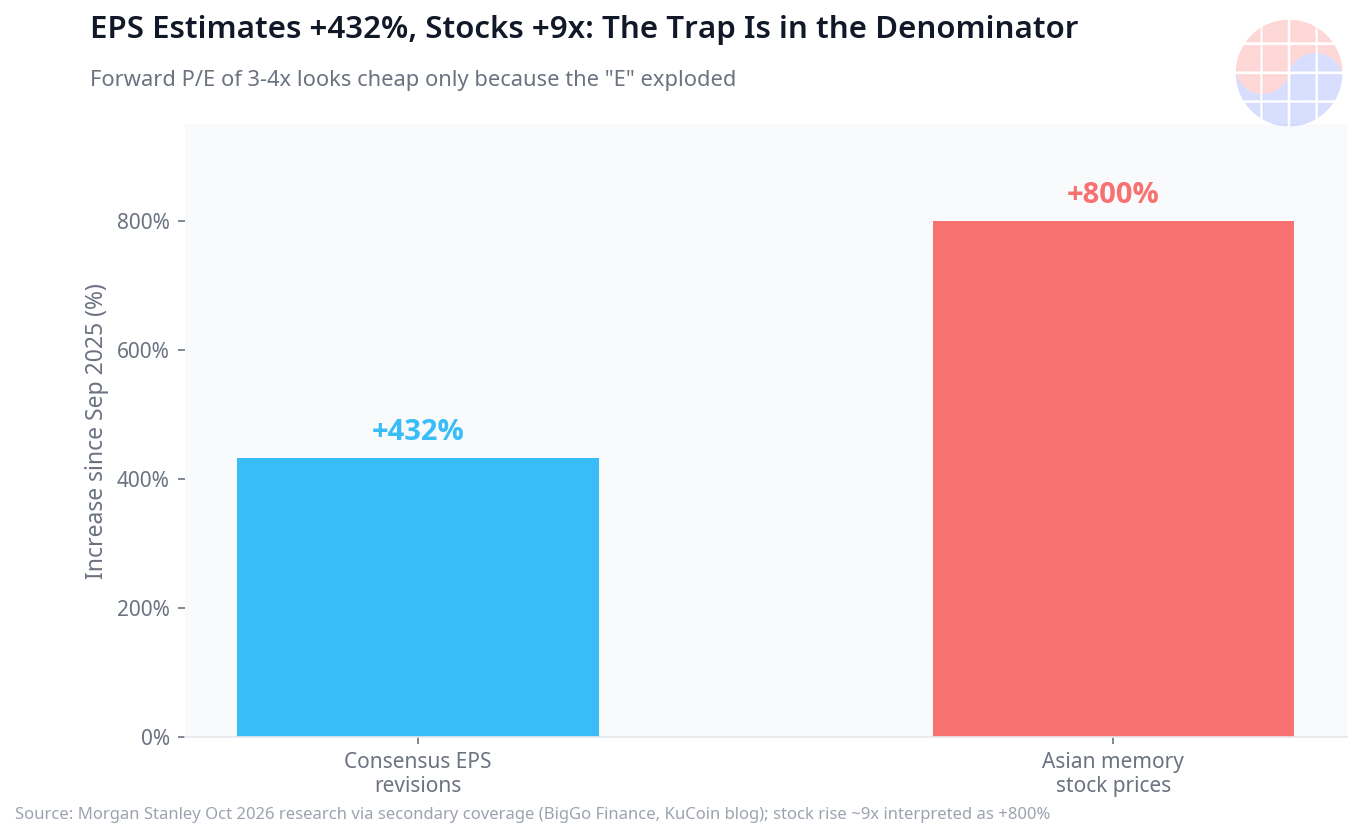
- The contrast of numbers is the entire debate. Samsung Electronics and SK Hynix trade at forward P/Es of 3–4x — they look cheap. Yet since this cycle began in September 2025, Asia memory stocks have risen about 9x, and consensus EPS estimates have been raised an average of 432%. Morgan Stanley argues DRAM contract prices would need to rise about 70% further from current levels to justify current stock-price levels — a difficult hurdle to clear.
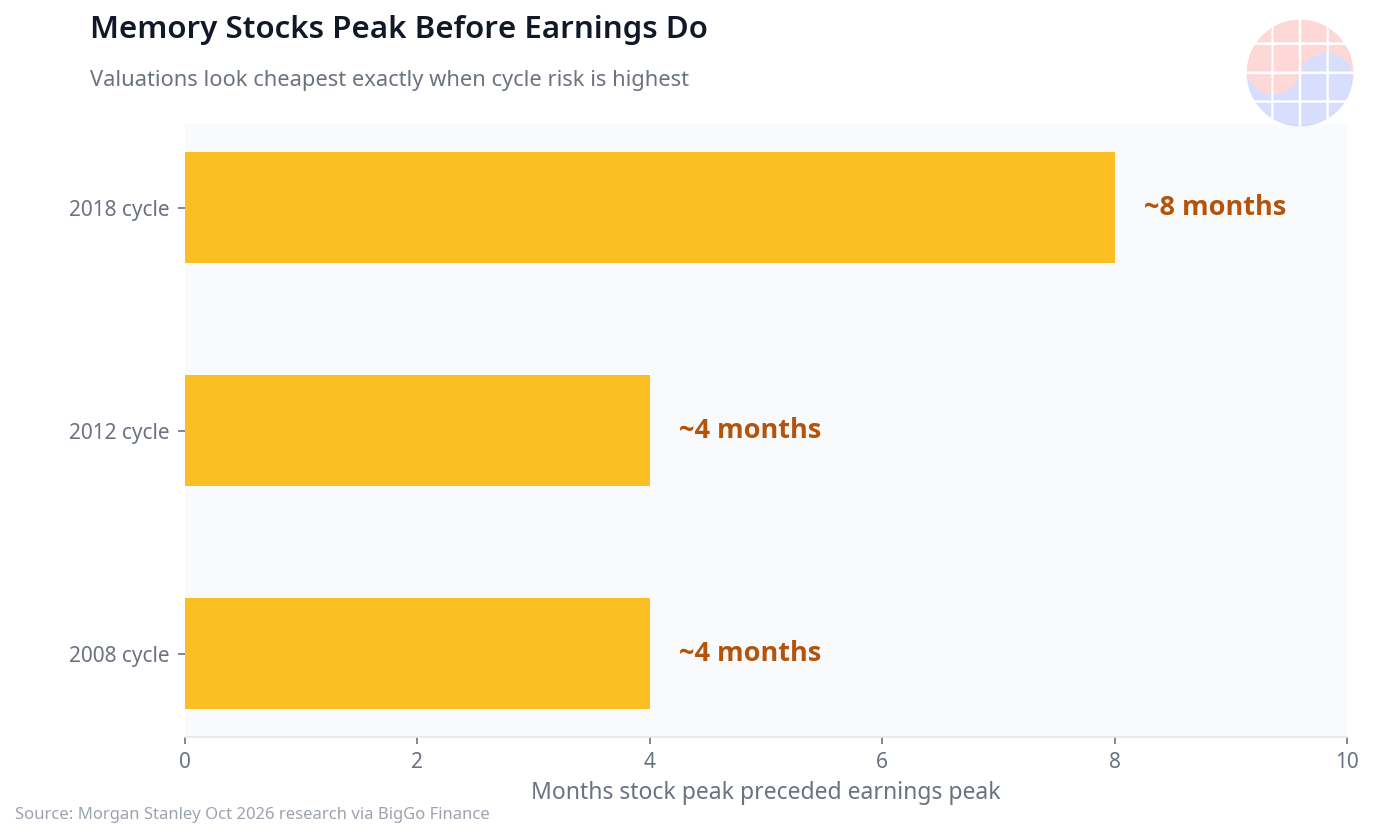
- The warning rests on historical pattern. Memory stock prices have always peaked before earnings peaked — about 4 months ahead in 2008, about 4 months in 2012, about 8 months in 2018 (Morgan Stanley's count, via secondary coverage).
- Two structural variables: new capacity comes online in earnest from the second half of 2027, bringing supply with it; and as AI clusters scale, networking hardware takes up a growing share of total system cost relative to memory.
- Morgan Stanley's conclusion is portfolio reallocation. Selectively underweight memory, and overweight AI compute (Nvidia, TSMC) and the networking supply chain. The key point from a Korean perspective: the earnings peak and the stock-price peak may sit at different points.
- Chase's Take: the money memory makers are earning is real. The question is how many times that money has already been multiplied into the stock price. Stocks look cheapest at the cycle peak — that paradox is the whole debate right now.
All report figures in this piece are based on secondary coverage. The original report is client-only and could not be verified directly — "original not verified." Every figure carries a source link, and target-price or rating-change figures from low-confidence secondary sources are excluded.
Intro: the moment that looks cheapest is the most dangerous
On Tuesday of the second week of October, Asian equities shook. The Kospi fell 6.5%, and at the epicenter were the two memory leaders — Samsung Electronics and SK Hynix. Earnings forecasts released the same day were record-breaking. Samsung's Q3 2026 operating profit forecast reached 107.4 trillion won, about USD 7.99 billion ([SCMP](https://www.scmp.com/tech/tech-trends/article/3370739/why-samsung-sk-hynix-and-cxmt-shares-are-under-pressure-despite-strong-ai-demand)). Companies on track for their best results ever were falling 7–10% in a single day.
The direct trigger for the shakeout was a Morgan Stanley note that began circulating over the weekend. Analyst Shawn Kim wrote: "We think the easy money is past." He did not deny the AI-led memory supercycle itself. What he denied was the assumption that it is still fine to buy now. According to SCMP, at Tuesday's close Samsung fell 7.4% and SK Hynix 10.1%, with five-day declines reaching about 16% and 22% respectively. Over the same period, China's DRAM maker CXMT also fell about 14%.
This piece dissects the numbers in that note. Record earnings and record-looking cheapness appearing at the same time — Morgan Stanley calls this paradox a "valuation trap."
Episode 1: dissecting the report's numbers — the problem is that it looks cheap
The Morgan Stanley note rests on five key numbers. Let's take them apart one by one.
First, forward P/E of 3–4x. Samsung Electronics and SK Hynix are now trading at 3–4 times their expected earnings for the next 12 months. By value-investing textbook standards, that is "historic cheapness." ([KuCoin summary](https://www.kucoin.com/blog/samsung-sk-hynix-valuation-trap), [BigGo Finance summary](https://finance.biggo.com/news/c5c5d66b-7577-4eb0-bd06-5dfa568ceb7a))
Second, a 9x stock rally. Since this cycle began in September 2025, Asia memory stocks have risen about 9x. Their combined market capitalization has entered the trillion-dollar range. The P/E looks low not because stocks are cheap, but because the denominator (earnings, not the stock price) has exploded.
Third, 432% consensus EPS upgrades. Per Morgan Stanley's count, consensus EPS estimates for Asia memory companies have been raised an average of 432% over the same period. Analysts had to mark up earnings forecasts more than fourfold before a 3–4x P/E could emerge. In other words, this "cheapness" is cheapness only relative to an already-raised bar.
Fourth, the 70% hurdle. Morgan Stanley calculates that to justify the implied upside at current stock-price levels, DRAM contract prices would need to rise about 70% further from where they stand now. After the steep price increases already seen, another 70% is a very demanding hurdle.
Fifth, the history of peaking early. The table below shows the record Morgan Stanley cited from past cycles — memory stock prices always peaked before earnings peaked.
| Cycle | How far the stock-price peak preceded the earnings peak |
|---|---|
| 2008 | About 4 months |
| 2012 | About 4 months |
| 2018 | About 8 months |
Valuations look cheapest exactly when earnings are at their best — the note argues that the classic cyclical-stock pattern is repeating right now ([HTX summary](https://www.htx.com/news/morgan-stanley-memory-stocks-often-look-cheapest-at-cycle-pe-XW5kPIit/)).
Episode 2: structural implications — a supercycle is not the end of the cycle
Morgan Stanley does not deny the substance of the AI memory supercycle. Supply is tight, prices are rising, and near-term earnings are solid. The reason for calling for an underweight anyway lies in structural variables.
Variable 1: supply is coming, in the second half of 2027. Today's record profits are calling forth record capacity expansions. Morgan Stanley expects new capacity to start coming online in earnest from the second half of 2027, shifting the supply-demand balance. The very fact that the cycle's inflection point "could come later" is itself why stock prices turn before the earnings peak.
Variable 2: memory's share of system cost is being diluted. As AI clusters scale up, networking hardware accounts for a growing share of total system cost relative to memory. Even as infrastructure investment keeps growing, the money does not flow to memory makers in proportion — a structural shift. This is not inconsistent with the projection that HBM grows 3x to a USD 100 billion market by 2028 ([HTX summary](https://www.htx.com/news/morgan-stanley-report-interpretation-samsungs-profit-ranks-f-gk7TjUtt/)) — the pie gets bigger, but the way the pie is split changes.
Variable 3: the China variable. China's YMTC and CXMT are cited as variables in the global supply landscape. One reading is that CXMT's demonstration of server memory products built on a 4F structure at a Shanghai event was one of the triggers for this week's selloff.
That is why Morgan Stanley's conclusion is not "sell" but "reallocate" — trim memory selectively and shift the weight toward AI compute (Nvidia, TSMC) and the networking supply chain. A supercycle does not mean the cycle is over. That is the coldest sentence in this note.
Episode 3: winners, losers, and the Korean perspective
The near-term winners are "AI compute + networking." The axes Morgan Stanley explicitly proposed overweighting are AI compute like Nvidia and TSMC, and the networking supply chain. The judgment is that relative attractiveness migrates as memory earnings crest. Indeed, amid this week's selloff the market's gaze has already moved from "memory is broken" to "where is the next leadership?"
The near-term losers are "pure memory beta." Especially names where the 432% earnings-upgrade cycle is already fully reflected in the stock price. SK Hynix, down about 22% in five trading days, stands at the epicenter of this debate. Samsung Electronics has foundry and System LSI beyond memory, so its beta is somewhat diversified, but with memory such a large share of its market capitalization, it faces pressure in the same direction.
The Korean perspective comes down to two things. First, when the two stocks that account for about half of the Kospi's market capitalization shake at the same time, the volatility of the entire index rises — Tuesday's Kospi decline of 6.5% is the evidence ([Morningstar](https://www.morningstar.com/news/dow-jones/20261013358/asia-stocks-battered-as-semiconductor-stocks-dive-update)). Second, the proposition that "the earnings peak is not the stock-price peak" stings Korean memory investors in particular. Investors who remember the 2018 cycle will remember the pattern — the stock price turning about 8 months before earnings.
Still, the counterarguments are clear too. HBM traces a different demand curve than conventional DRAM, and the price-floor structure of long-term supply contracts creates a different kind of downside rigidity than past cycles. Memory prices are still rising in 2026, and growing token throughput of AI models is structurally pushing memory demand higher. Morgan Stanley itself concedes that "the inflection point could come later." The verdict on this debate rests on the 2027 supply clock.
Chase's Take
As someone who works inside the semiconductor industry, what strikes me most about this note is that nothing in it is wrong. The 3–4x P/E is correct, the 432% EPS upgrade is correct, the 70% hurdle is correct. But the way these numbers get read splits completely.
The bull read: "Earnings grew more than fourfold and the P/E is 3–4x, so it's simply cheap until earnings turn. HBM is different from past cycles."
The Morgan Stanley read: "That exact spot is the trap. Cyclical stocks look cheapest when earnings are at their best, and stock prices turn before earnings do. It was true in 2008, in 2012, and in 2018."
What I am watching is that both reads are staring at the second half of 2027. Bulls and bears alike see the moment when new supply arrives in volume as the inflection point. So the debate right now is not "is the cycle over" but "how far ahead of the peak do we price in the peak." And history speaks with one voice — the market leans toward pricing it in ahead.
Investment decisions are each investor's own. But one thing is clear. "The P/E is 3x, so it's cheap" is the sentence heard most often at the peak of a cycle. Not that the sentence is wrong — it is that historically, the times the sentence was right have not lasted long.
FAQ
Did Morgan Stanley say to "sell" memory stocks?
No. The note's conclusion is "selective underweight + reallocation toward AI compute and networking." It acknowledges the substance of the memory supercycle — tight supply, rising prices, solid near-term earnings — while arguing that optimism is already reflected in stock prices. The original is client-only, so this summary is based on secondary coverage.
Why is a 3–4x P/E a trap?
Because the denominator — earnings (E) — has exploded. Since September 2025, consensus EPS has been raised an average of 432%, and stock prices have risen about 9x. Cyclical stocks always "look cheap" around the earnings peak, and historically stock prices have turned 4–8 months before earnings did.
What does the 70% DRAM price hurdle mean?
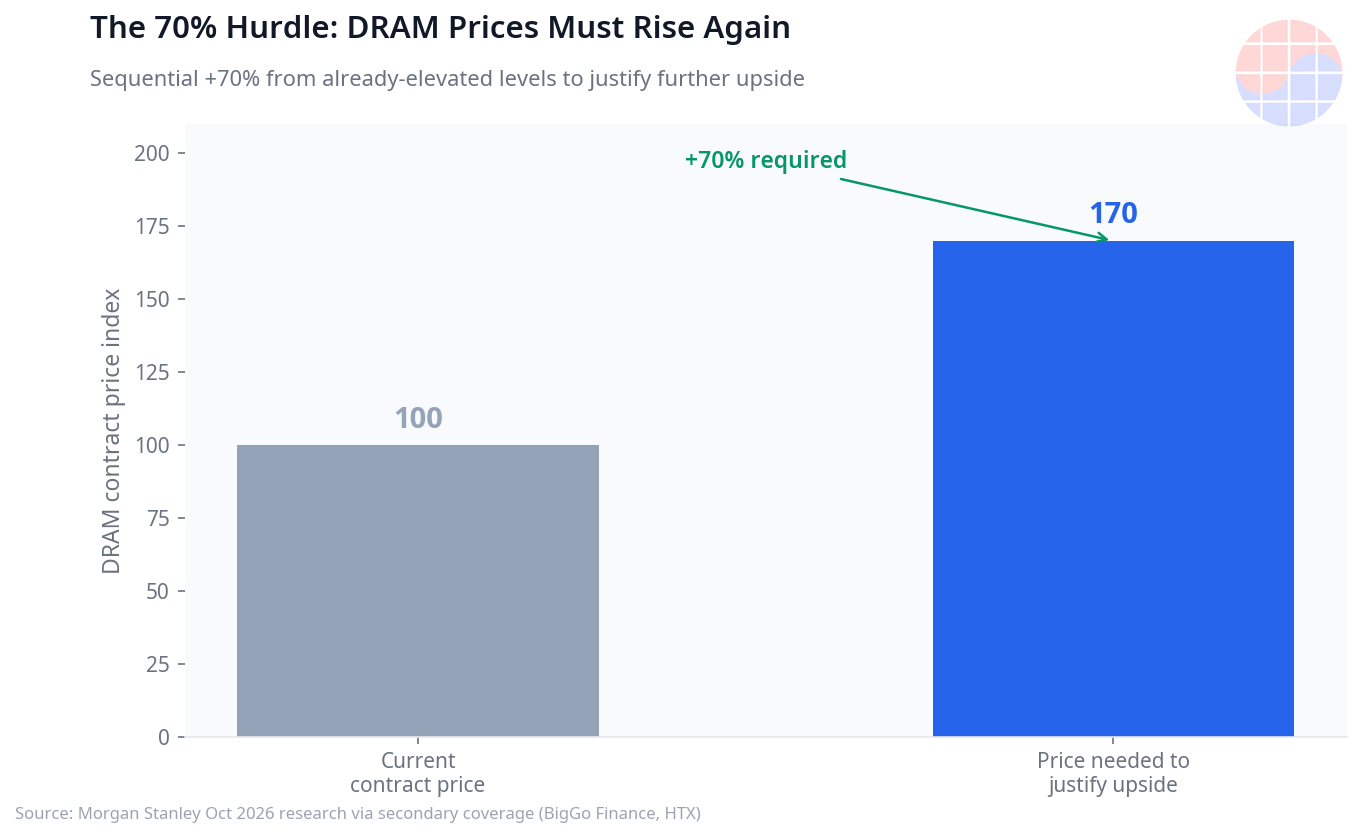
It quantifies the expectations embedded in current stock-price levels. For prices to go higher, DRAM contract prices would need to rise about 70% further from current levels — and Morgan Stanley judges that, after the steep increases already seen, another 70% is a demanding hurdle.
What should Korean investors watch?
Two things. First, the second-half-2027 clock, when new capacity comes online — the timing of the supply-demand inflection. Second, the shifting value split between networking and memory inside AI clusters. Since Samsung Electronics and SK Hynix account for about half of the Kospi, this debate feeds straight into index-level volatility.
---
*This article is for informational purposes only and is not investment advice. Cited report figures are based on secondary coverage and the original was not verified directly. Investment decisions are your own judgment and responsibility.*