VLSI Korea
AI Factories in 14 Days, Not 6 Months: Vera Rubin Production and the DSX POD Speed Play (HBM4)
Vera Rubin is in full production, and the DSX POD cuts on-site deployment at a prepared site from about 6 months to as little as 14 days. One container: 7 NVL72 racks, 504 GPUs. Speed is now revenue.


The bottleneck in AI infrastructure is no longer the chip. It is the construction site — and NVIDIA just moved the factory into the factory.
30-Second Summary
- Vera Rubin is in full production. At GTC Berlin on October 21, 2026, CEO Jensen Huang announced that NVIDIA's next AI platform has entered full production.
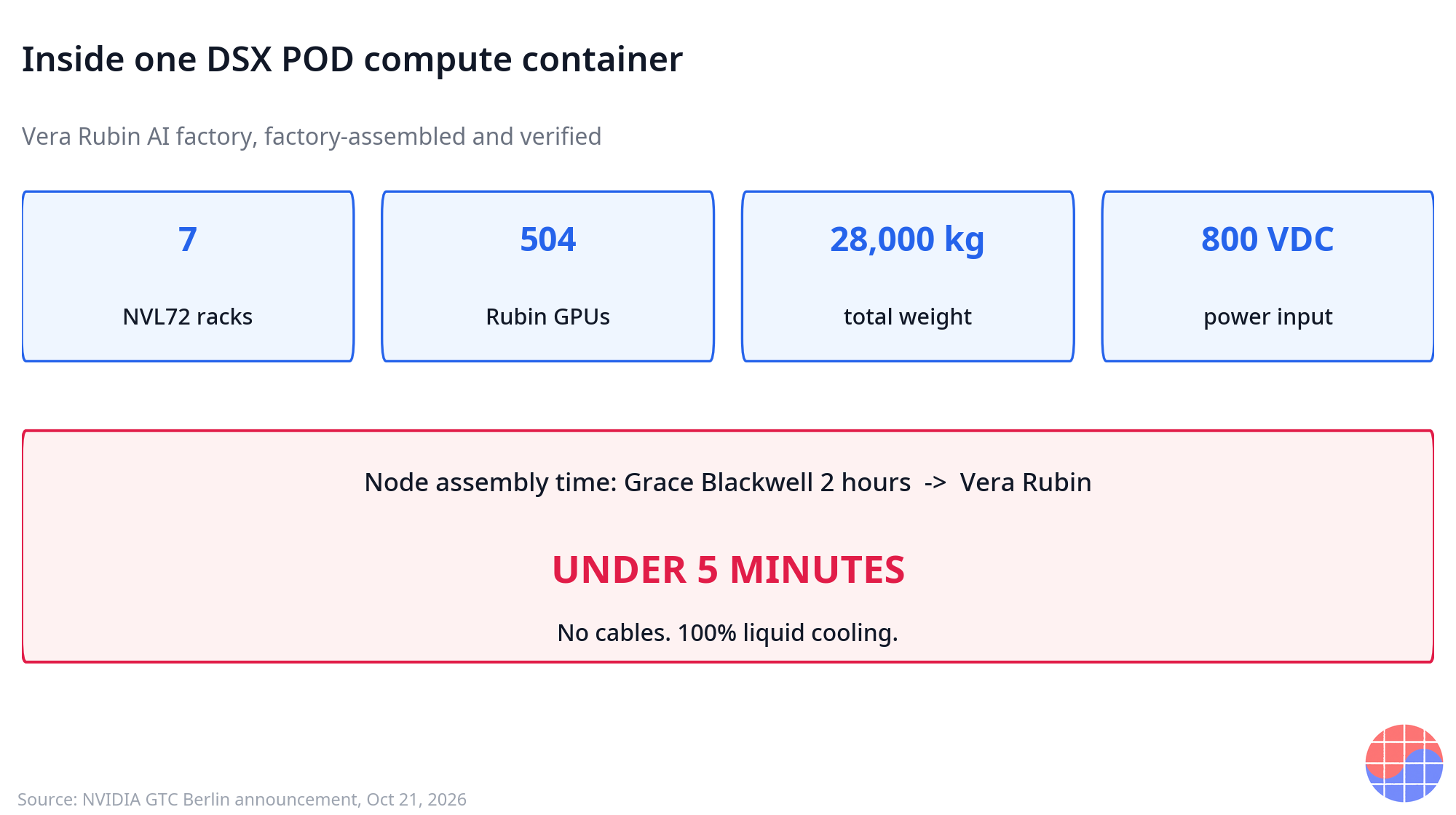
- The DSX POD turns an AI factory into a shipping product. The reference design assembles and tests an entire Vera Rubin AI factory inside modular containers at the factory, then ships it. On-site deployment at a prepared site drops from roughly 6 months to as little as 14 days.
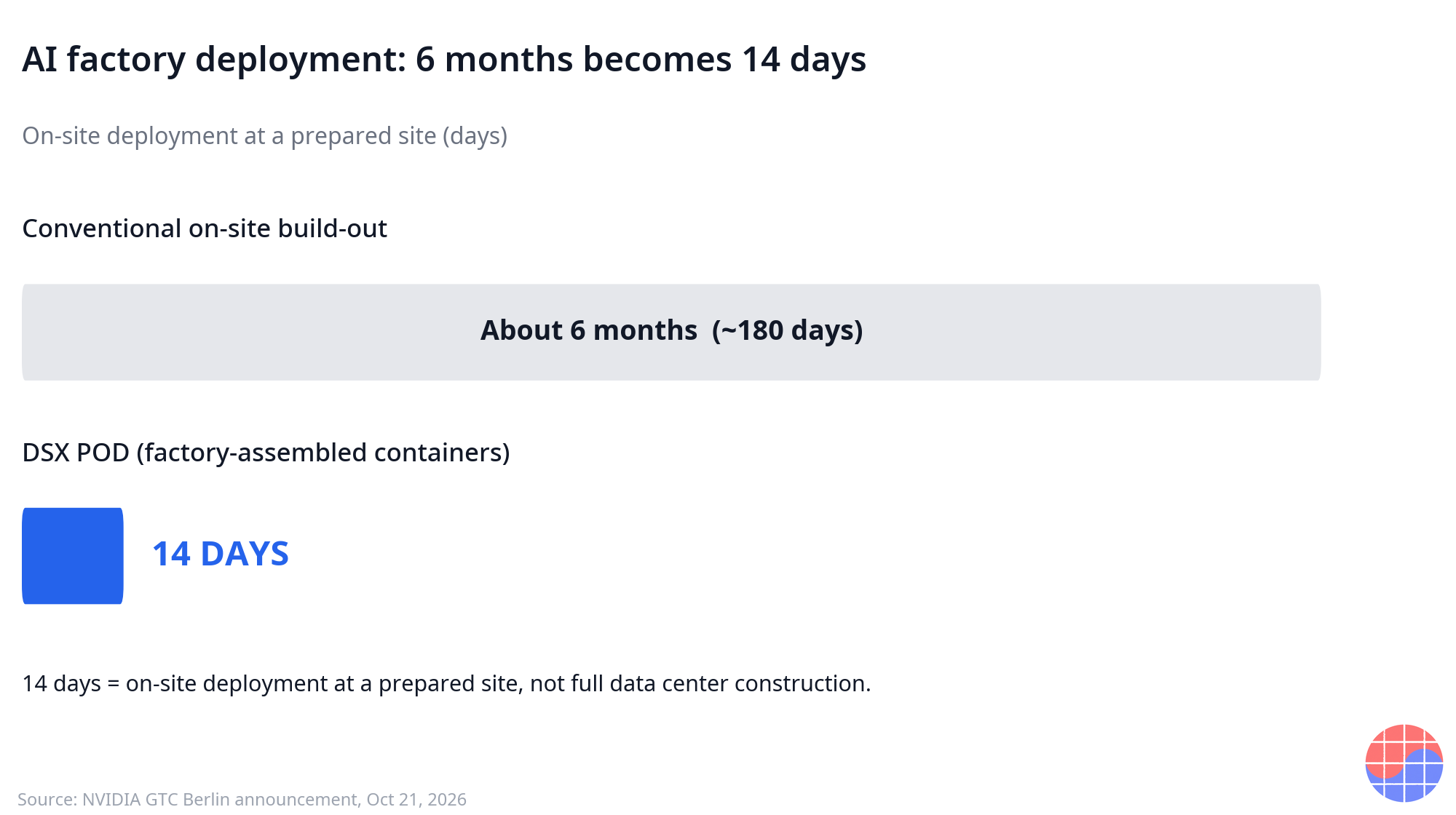
- One compute container is a serious machine: 7 Vera Rubin NVL72 racks, 504 Rubin GPUs, about 28,000 kg, fed by 800 VDC power. One container is no longer a box. It is a building block of a data center.
- The node itself was redesigned for assembly speed. Vera Rubin nodes have no cables, are 100% liquid-cooled, and cut node assembly time from 2 hours on Grace Blackwell to under 5 minutes.
- 17 partners are behind the design, including Dell, HPE, Lenovo, Schneider Electric, Vertiv, Eaton, and Foxconn (Ingrasys), with shipments planned to start in early 2027. Read the 14 days carefully: it is on-site deployment at a site where power and cooling infrastructure is already prepared — not the construction period for an entire data center.
Background
The queue moved from the fab to the field
For three years, the AI infrastructure story was a story about chip supply. GPUs were scarce, HBM was scarce, advanced packaging was scarce, and whoever secured wafers and memory secured revenue. That scarcity has not disappeared, but a second queue has formed behind it: the physical work of turning delivered hardware into a running AI factory. Racks arrive, and then months of on-site integration begin — power distribution, cooling loops, networking, node-by-node assembly, testing, and debugging, much of it done by scarce field engineers in buildings that are themselves still being finished.
NVIDIA's October 21, 2026 announcements at GTC Berlin attack that second queue directly. The headline platform news is that Vera Rubin, the successor architecture to Grace Blackwell, is in full production, in the words of CEO Jensen Huang. The headline business news is the DSX POD: a reference design in which the entire Vera Rubin AI factory is assembled and verified in modular containers before it leaves the factory, so that the site receives a tested system rather than a pile of parts.
What a DSX POD actually is
The DSX POD is best understood as a change in where integration happens. In the conventional model, integration happens at the destination, under construction-site conditions, with construction-site variability. In the POD model, integration happens at the origin, under factory conditions, where the same task is repeated, measured, and improved. The container is the unit of delivery: compute containers carry the racks, and the design is specified tightly enough that a container's contents are known to the kilogram and the volt before it ships.
| DSX POD compute container | Specification |
|---|---|
| Racks per container | 7 Vera Rubin NVL72 racks |
| GPUs per container | 504 Rubin GPUs |
| Weight | About 28,000 kg |
| Power input | 800 VDC |
| Node design | No cables, 100% liquid cooling |
| Node assembly time | Under 5 minutes (Grace Blackwell: 2 hours) |
Source: NVIDIA announcements at GTC Berlin, October 21, 2026. Links in the footnote.
The node assembly number deserves a pause. Cutting assembly from 2 hours to under 5 minutes is not a convenience feature. It is what happens when a platform is designed backwards from the deployment process: cabling, historically a large share of both assembly time and field errors, is engineered out of the node entirely, and cooling moves fully to liquid. A node that takes minutes to assemble is also a node that takes minutes to replace, which changes the maintenance economics of the installed base for a decade.
The 14 days, stated precisely
The most quoted number from the announcement — deployment in as little as 14 days, against roughly 6 months for conventional on-site build-out — needs its condition attached, because the condition is where the business model lives. The 14 days is the on-site deployment period at a prepared site: a site where the power, cooling, and building infrastructure are already in place. It is not the construction period of an entire data center. Land, permits, grid connection, and the building shell still take as long as they take.
That distinction does not weaken the announcement. It clarifies who captures the value. The POD compresses the segment of the schedule that sits between "infrastructure ready" and "AI factory producing tokens" — the segment that determines when a customer's capital starts earning. Everything upstream of the prepared site remains a construction and utilities problem, which is precisely why the partner list matters as much as the container.
Business Deep Dive
Speed is revenue recognition
In AI infrastructure, deployment speed is not an operational nicety. It is the slope of the revenue curve. A hyperscaler or AI factory operator that brings capacity online months earlier starts selling tokens, training runs, and cloud instances months earlier, on hardware whose competitive half-life is measured in quarters. When a platform generation lasts roughly a year at the frontier, a 6-month integration tail can consume half the economic life of the asset before it earns its first dollar at full utilization.
This is the lens for the DSX POD. Shortening the prepared-site deployment from about 6 months to as little as 14 days pulls revenue forward by months per site, and it does so at the exact moment when demand for AI compute is queueing. The customer is not buying containers. The customer is buying calendar time — the scarcest input in the entire AI build-out, scarcer than chips, because chips can be expedited and calendars cannot.
| Deployment model | On-site deployment at a prepared site | Where the time goes |
|---|---|---|
| Conventional build-out | About 6 months (about 180 days) | On-site rack integration, cabling, cooling hookup, node assembly, staged testing |
| DSX POD | As little as 14 days | Positioning pre-assembled, pre-verified containers and final commissioning |
Source: NVIDIA announcements at GTC Berlin, October 21, 2026. Links in the footnote.
NVIDIA's stack climbs one more level
The strategic pattern is familiar by now, but the POD extends it. NVIDIA climbed from chips to boards, from boards to racks (NVL72), from racks to networked systems — and now, with the DSX POD reference design, from systems to the factory itself. Each climb enlarges the revenue NVIDIA and its ecosystem can attach to a gigawatt of AI capacity, and each climb deepens the customer's dependence on the reference design that defines the level.
A reference design is a particular kind of power. NVIDIA does not need to manufacture containers to control the container layer; it needs the industry to build to its specification, so that the specification becomes the interface everyone else must meet. The 17 launch partners — Dell, HPE, and Lenovo on systems; Schneider Electric, Vertiv, and Eaton on power and cooling infrastructure; Foxconn (through Ingrasys), Delta, GIGABYTE, Pegatron, QCT, Wistron, and others across the ODM and component base — are not just suppliers. They are the distribution of the standard. Shipments are planned to begin in early 2027.
Factory integration moves the bottleneck, it does not delete it
Pre-integration is a manufacturing strategy applied to a construction problem, and its economics follow manufacturing logic. Factory assembly converts variable field labor into repeatable line work: quality is checked where the test equipment lives, errors are found where the engineers who designed the node sit, and the learning curve compounds across every container built rather than resetting at every site. The node redesign — cable-free, fully liquid-cooled, under 5 minutes to assemble — is the platform being shaped to fit that line.
But the bottleneck moves rather than vanishes. If containers can be deployed in 14 days at a prepared site, then the prepared site becomes the constraint: grid interconnection, power equipment lead times, cooling infrastructure, and permitting. The presence of Schneider Electric, Vertiv, and Eaton in the partner list is an acknowledgment of exactly that — the next queue is electrical. It is also why the honest reading of the announcement pairs the 14-day figure with its condition. The winners of the next phase include whoever can deliver prepared sites at the pace containers can now be filled.
The software layer: DSX MaxLPS and the efficiency claim
NVIDIA also announced DSX MaxLPS software, which the company says delivers the same AI output with up to 30% less power. In an industry where the binding constraint is increasingly the megawatt rather than the rack, a software-level efficiency claim of that size is strategically loaded: if output per watt rises, the same grid connection supports more saleable compute, and the effective capacity of every prepared site rises without new construction. The claim is NVIDIA's, stated as an announcement figure, and the market will verify it in deployment — but even the direction matters, because power efficiency compounds with deployment speed: faster to install, and more output per installed megawatt.
The ecosystem signal extended to the cloud layer as well: Google Cloud's A5X, built on Vera Rubin, is scheduled for general availability in November. Frontier platforms now launch simultaneously as products you buy, containers you deploy, and cloud instances you rent — three channels, one supply chain, and one allocation queue behind all of them.
The HBM4 connection
Every Vera Rubin rack that ships is also an HBM4 shipment. The platform's memory is HBM4, which means the Vera Rubin production ramp and the early-2027 POD shipments translate directly into HBM4 volume for the memory makers qualified into the platform. This is the quiet link between a deployment-speed announcement in Berlin and the memory industry's order books: deployment speed determines how fast racks convert into running systems, and running systems are what pull the next tranche of GPU and HBM orders. A faster deployment model does not just move NVIDIA's revenue forward. It tightens the cadence of the entire chain — packaging, HBM, substrates, and power equipment — that feeds the factory.
Chase's Take
The lazy reading of the DSX POD is "NVIDIA invented a faster data center." The correct reading is about which segment of the AI build-out still had months of slack in it — and who just claimed it.
Chips got the headlines for three years because chips were the constraint. But a delivered rack that spends months in field integration is inventory, not capacity, and the industry has been quietly carrying an enormous amount of both. The POD attacks that inventory position. Factory verification, a cable-free node that assembles in under 5 minutes, a container specified to the kilogram — every element is aimed at the gap between "hardware delivered" and "hardware earning." NVIDIA looked at the build-out calendar, found the largest remaining block of dead time it could plausibly own, and productized it.
Two implications are underappreciated. First, reference designs redistribute margin without redistributing control. The 17 partners gain a real market — containerized AI factories shipping from early 2027 — but they gain it inside a specification NVIDIA owns, which means the ecosystem's growth and NVIDIA's platform lock-in are the same event viewed from two sides. Second, the announcement quietly redefines what "prepared" means as a competitive asset. When deployment takes 6 months, a ready site and an unready site differ by a construction phase. When deployment takes 14 days, they differ by almost the entire schedule — and sites, power positions, and permits become tradeable strategic assets in a way they were not before.
The open question is execution cadence. A reference design is a promise until containers ship in volume, and early 2027 is when the promise gets its first hard test: how many PODs, at what yield, into how many genuinely prepared sites. Watch the partner shipment reports, not the keynotes. If the 14-day deployment holds in the field even approximately, every competing platform will be forced to answer a question it has not had to answer before: not how fast its chips are, but how fast its factories assemble.
Implications
- For hyperscalers and AI factory operators: Deployment speed is now a procurement criterion on par with performance per watt. A platform that reaches production months earlier monetizes months earlier — evaluate the prepared-site-to-production interval, not just the silicon.
- For NVIDIA's partners: The POD creates a container-layer market from early 2027, inside NVIDIA's specification. The opportunity is real; so is the dependency. Partners with power and cooling positions (the prepared-site layer) hold the scarcest cards as the bottleneck moves electrical.
- For memory makers: Vera Rubin in full production, plus POD shipments from early 2027, is an HBM4 volume signal. Deployment speed upstream determines order cadence downstream.
- For competing platform vendors: The contest has expanded from chips to deployment systems. A rival rack now competes not only on compute but on time-to-production at a prepared site.
- For investors: Track three verification points — partner POD shipments in early 2027, field reports on the 14-day deployment claim, and measured results for the DSX MaxLPS up-to-30% power claim. Announcements set the narrative; shipments set the numbers.
FAQ
What exactly is the NVIDIA DSX POD?
It is a reference design that turns an entire Vera Rubin AI factory into modular containers: the factory is assembled and verified at the factory, then shipped. One compute container holds 7 Vera Rubin NVL72 racks with 504 Rubin GPUs, weighs about 28,000 kg, and takes 800 VDC power input. NVIDIA announced it at GTC Berlin on October 21, 2026, with 17 partners and shipments planned from early 2027.
Does the 14-day figure mean a data center can be built in 14 days?
No. The 14 days is the on-site deployment period at a prepared site — one where power, cooling, and building infrastructure are already in place — down from roughly 6 months for conventional on-site build-out. Building the site itself, including grid connection and permits, still takes far longer. The POD compresses the segment between "site ready" and "AI factory running."
What changed in the Vera Rubin node to make assembly so fast?
NVIDIA says Vera Rubin nodes have no cables, are 100% liquid-cooled, and cut node assembly time from 2 hours on Grace Blackwell to under 5 minutes. Removing cabling removes both assembly time and a major source of field errors, and it makes nodes fast to replace in service as well as fast to install.
Why does Vera Rubin production matter for HBM4?
Vera Rubin systems use HBM4 memory, so the platform's full production ramp — and DSX POD shipments planned from early 2027 — translate directly into HBM4 demand. Deployment speed matters to memory makers because faster deployment pulls the next round of GPU and HBM orders forward.
Sources: NVIDIA DSX POD deployment announcement coverage; GTC Berlin Vera Rubin and DSX POD report; DSX POD 14-day deployment report (all reporting NVIDIA's October 21, 2026 GTC Berlin announcements). This article is analysis, not investment advice.
📩 Subscribe to VLSI Korea
Get our daily semiconductor deep-dives delivered to your inbox first. Free to subscribe.