VLSI Korea
OpenAI's $50B Run-Rate Reality Check: Who Actually Pays for the AI Buildout
OpenAI's annualized revenue is ~$50B, not the ~$70B the market expected — as it seeks to raise $30B at a $1.4T valuation. The AI infrastructure bottleneck is no longer chips or power, but the labs' payment capacity. We trace why Broadcom's CEO called investors casino gamblers.


title: "OpenAI's $50B Run-Rate Reality Check: Who Actually Pays for the AI Buildout" slug: "openai-50b-run-rate-ai-payment-capacity-en" excerpt: "OpenAI's annualized revenue is ~$50B, not the ~$70B the market expected — as it seeks to raise $30B at a $1.4T valuation. The AI infrastructure bottleneck is no longer chips or power, but the labs' payment capacity. We trace why Broadcom's CEO called investors casino gamblers." tags: [deep-dive, ai-capex, openai, fundraising, english]
30-Second Summary
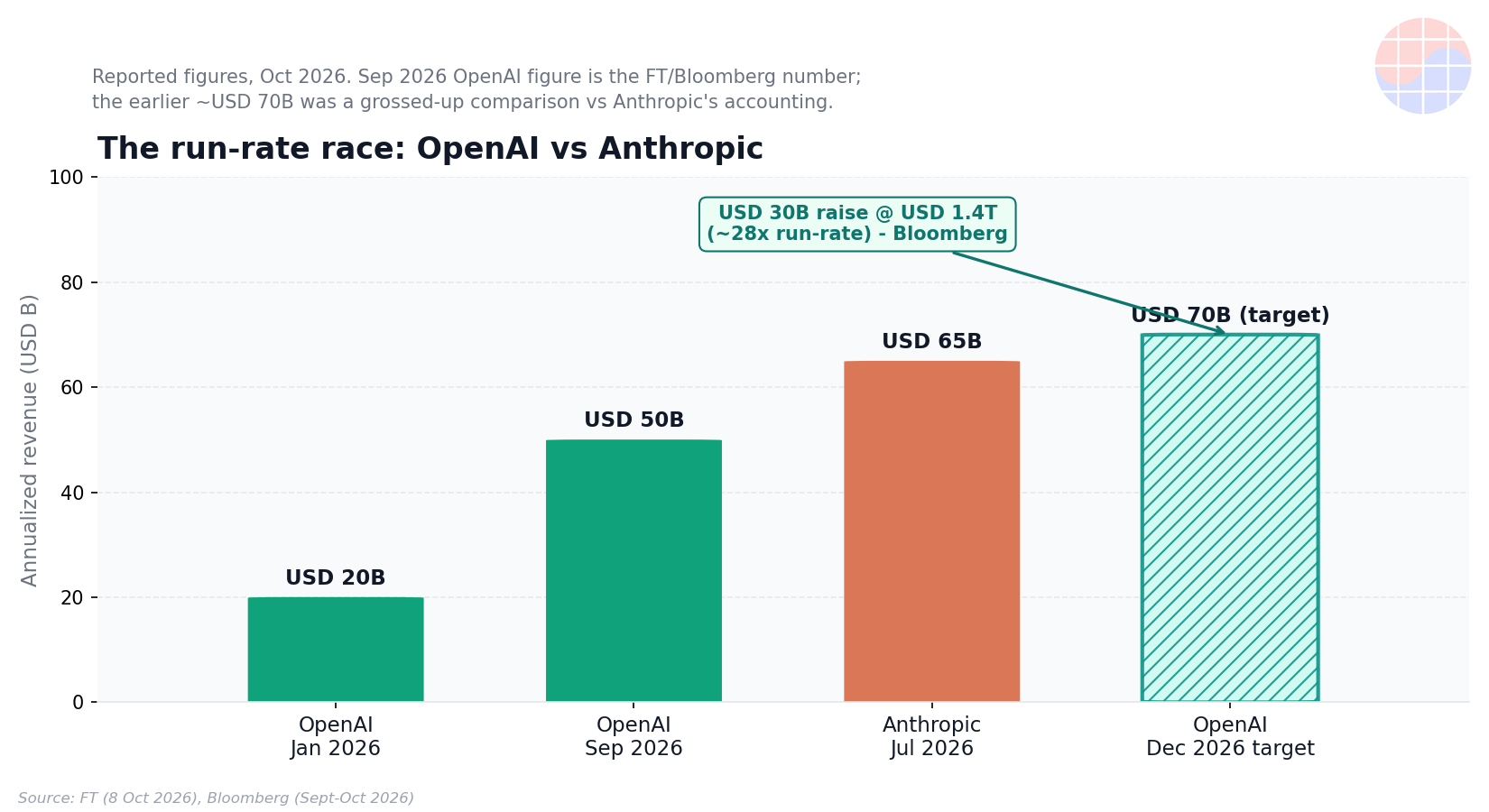
OpenAI's annualized revenue run rate is approaching $50B at the end of September 2026 — roughly $20B below the headline number that circulated in late September. The gap is an accounting difference, not lost sales: the ~$70B figure was "grossed up" to match Anthropic's revenue-recognition method, which books the full customer payment flowing through cloud partners as revenue, while OpenAI records only its own share on certain partner deals. (Source)
Meanwhile OpenAI is in talks to raise $30B+ at a ~$1.4T pre-money valuation — about 28x its current run rate — while Anthropic, at ~$65B annualized revenue, is pushing toward a November IPO. (Source) (Source)
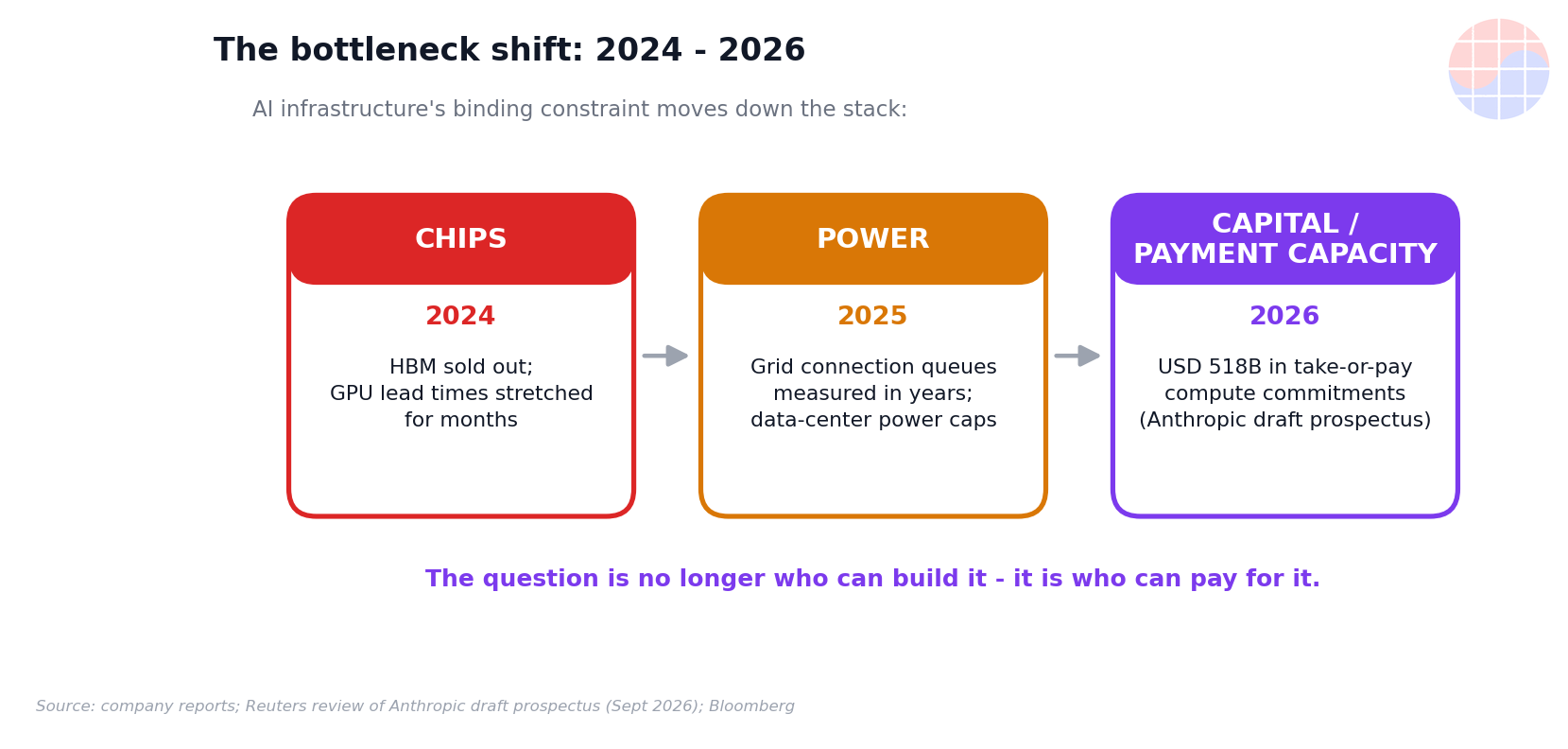
The deeper story: the AI buildout's bottleneck has shifted — chips → power → capital/payment capacity. Broadcom's CEO said this week that access to capital may become the main constraint on AI infrastructure growth, calling speculative AI investors casino gamblers. Yet Broadcom's own AI chip forecast doubles every year through 2028. (Source)
Bottom line: chip demand is contract-confirmed for 2+ years, but the entire foundry/memory/equipment order chain now trades on one variable — how fast the labs convert revenue into GPU-buying cash. That is a financing question, not a technology question.
Background
The controversy started with two numbers. On 29 September, reports circulated that OpenAI's revenue run rate had hit ~$70B. A week later, the Financial Times reported the real figure from investor documents: annualized revenue approaching $50B at end-September — a jump of roughly $20B in one quarter, on top of a start-of-year base of ~$20B. (Source) (Source)
Why did the ~$70B number exist at all? Because comparability matters to investors, and the labs recognize revenue differently. Anthropic books the full customer payment that flows through cloud partners (AWS, Google Cloud) as its revenue. OpenAI, on certain partner deals, records only its own share. Both treatments are GAAP-compliant; the ~$70B was the FT's investor document figure re-stated under Anthropic's method. (Source)
OpenAI's internal target, meanwhile, is $70B+ annualized by year-end 2026, driven by enterprise. Q3 run-rate growth was +77%, enterprise revenue grew +107% — a credible trajectory if enterprise budgets keep opening. (Source)
The stakes around the number are enormous because the fundraising math is enormous. OpenAI is negotiating $30B+ at roughly $1.4T pre-money — about 28 times its current run rate. For context, its March 2026 round raised $122B at an $852B valuation. (Source) Anthropic sits at $65B annualized revenue (end of July, per Bloomberg), has pushed its IPO to November, and is reported to be seeking a ~$2T valuation against a $965B May round. OpenAI's own IPO has been pushed to at least 2027. (Source) (Source
Anthropic's leaked draft prospectus (reviewed by Reuters) reveals the scale of the commitment on the other side of the revenue: 2025 revenue of $4.6B (12x growth), a net loss of $42B including roughly $34B in non-cash charges, and $518B in future compute commitments — about 80% of them non-cancelable. (Source)
| Lab | Annualized revenue (run rate) | Fundraising / valuation signal | Key commitment |
|---|---|---|---|
| OpenAI | ~$50B (end-Sep 2026) | $30B+ round at ~$1.4T pre-money (in talks) | Target $70B+ run rate by year-end |
| Anthropic | ~$65B (end-Jul 2026) | IPO Nov 2026, ~$2T reported valuation | $518B future compute commitments (~80% non-cancelable) |
| Market cap of the round math | — | OpenAI ~28x run-rate multiple | Enterprise revenue +107% in Q3 (OpenAI) |
Business Deep Dive
Market size: the $230B chip pipeline behind the argument
Consider the number that makes the whole debate concrete. Broadcom's September company forecast put its AI chip sales at ~$58B in FY2026, ~$115B in FY2027, and ~$230B in FY2028 — roughly doubling every year — with demand expected to exceed supply for at least two more years. (Source) Intel's CEO, at the same event, put the hardware shortage at 2–3 years. (Source)
These are not aspirational TAM slides. They are order-book and supply-chain-guided figures. The foundry/memory/equipment chain — TSMC's CoWoS capacity, HBM allocation (measured in Gb), and lithography lead times — can see this demand in signed contracts and purchase orders. That is the supply side: real, booked, capacity-constrained.

Competitive positioning: two labs, two cash-conversion machines
The $50B vs $65B comparison hides a deeper business-model divergence. Reported third-party estimates put Anthropic's API inference gross margins above 80%, with blended inference gross margins in the mid-60% range. Roughly 75–85% of Anthropic's revenue comes from the API; subscriptions are only ~10% of revenue yet consume more than 40% of inference compute. Morningstar goes further: incremental inference margins around 80%, and Anthropic reached operating profitability in Q1 2026 — a 5% operating margin on $11B in quarterly sales. (Source) (Source)
The model is usage-based, API-first, developer-centric: tokens are sold to enterprises at a markup over inference cost, and cash converts almost immediately. OpenAI, by contrast, carries a vast free-user base whose serving cost is a drag, while its enterprise push — the +107% growth line — is racing to become the dominant mix. Same revenue tier, different cash-conversion speed. That difference is exactly what matters when $518B in future compute commitments sits on one balance sheet.
Unit economics: why the accounting footnote matters to chip buyers
The revenue-recognition gap (~$50B vs a "grossed up" ~$70B) is not a footnote for accountants. When a lab books the full customer payment through a cloud partner as its revenue, its run-rate multiple looks lower and its growth looks more partner-leveraged. When it books only its own share, the number looks smaller but the margin structure is cleaner. An investor pricing a ~$2T IPO versus a ~$1.4T private round needs to know which dollars are actually the lab's dollars — because only the lab's dollars can be pledged to a GPU purchase order. Partner-passthrough revenue cannot pay NVIDIA or fund a data-center buildout; it belongs to AWS or Google Cloud.
Value-chain implications: the bottleneck has moved downstream
This is where the foundry/memory/equipment order books enter the frame. For three years, the constraint chain was upstream: chips (GPU allocation) → power (data-center grid connections). Both are still tight — Intel's CEO says the hardware shortage lasts 2–3 years, Broadcom says demand outruns supply for at least two more. (Source)
But Broadcom's CEO Hock Tan said something new at the DBS Asia Future Forward Conference in Singapore on 12 October: many AI investors "have no clue what they are investing in," expectations are so extreme "it's like they are in a casino," and enterprise AI token spending is like "kids at an arcade burning through tokens." His substantive point: access to capital may become the main constraint on AI infrastructure growth — more than chips or power. (Source) (Source) (Source)
Counter-perspective matters here. Goldman Sachs' Rich Privorotsky said the remarks were "taken wildly out of context," and both Broadcom and Intel reaffirmed exceptionally strong demand for another 2–3 years; the HKEJ framed the comments as aimed at short-term-data sellers, not at the AI buildout itself. (Source)
The two claims are not contradictory. Tan is saying: the physical demand is real (hence his own $230B FY2028 forecast), but the financing layer that converts that demand into paid invoices is the new fragile link. The bottleneck has moved downstream — from the fab to the lab's treasury. If a lab's revenue recognition inflates the top line, if its enterprise ramp stalls, or if the IPO window closes, the payment capacity behind $518B in compute commitments reprices. And when labs can't pay, foundry utilization forecasts, HBM contract prices, and equipment lead times reprice with them — not because demand was fake, but because demand without payment capacity is just a backlog entry.

Chase's Take
Here's the VLSI+MBA synthesis — the thesis in plain terms.
The AI trade has three layers, and only two are priced as hardware. Layer one is the silicon: foundry wafers, HBM in Gb, packaging. Layer two is the infrastructure: data centers, power grids. Layer three — the one nobody modeled until this week — is the financing layer: the labs' ability to convert revenue into cash that actually settles GPU invoices. Tan's "casino" comment is really a comment about layer three.
The paradox of Tan's week — warning about gambler-investors while forecasting his own AI revenue to quadruple in two years — resolves cleanly once you separate contract-confirmed demand from payment-confirmed demand. His $58B→$115B→$230B pipeline is backlog-visible; his warning is about whether the buyers' treasuries hold up. Both can be true. This is the standard industrial-cycle lesson: in every capex supercycle (DRAM in 2017, telecom in 2000), the constraint migrated downstream to the weakest balance sheet in the chain. The weakest balance sheet here is not TSMC or NVIDIA — it's the lab carrying $518B in non-cancelable compute commitments against a $65B run rate.
The business-model divergence is the real leading indicator. Anthropic's API-first, usage-based machine converts enterprise tokens into cash with 80%+ gross margins and reached operating profitability; ~75–85% of its revenue is API-driven. OpenAI is running the harder playbook: monetizing a massive free-user base while ramping enterprise at +107% to carry a $70B+ year-end target. The lab that converts cash faster can fund more of its own compute, depend less on the financing layer, and pose less counterparty risk to the semiconductor order chain. Watch the enterprise mix, not the headline run rate.
The multiple is the tell. ~28x run rate for OpenAI's prospective round, and ~30x for Anthropic's reported IPO valuation (~$2T on $65B), are venture multiples, not infrastructure multiples. They price in a future where payment capacity scales as fast as compute commitments. Tan's question — reasonable, not bearish — is simply: at these multiples, how much of the chip order book is backed by cash the labs have, versus cash they must still raise?
Implications
Three leading indicators will tell you whether the payment-capacity thesis holds or breaks — in order of arrival:
- Anthropic's November IPO window. The offering was pushed from October to before Thanksgiving. A clean listing at or near the reported ~$2T valuation validates the API-first cash machine and keeps the financing layer wide open. A cut, a delay, or weak aftermarket trading reprices every lab's cost of capital — and, downstream, the semiconductor backlog. (Source)
- OpenAI's $30B round closure. Signing at ~$1.4T pre-money confirms that private capital still underwrites the enterprise-ramp story ($70B+ run rate by year-end). A smaller round, a lower valuation, or heavy structure (warrants, ratchets) signals that payment capacity is being rationed — the first real data point on Tan's constraint thesis. (Source)
- Q4 enterprise revenue ramp. OpenAI's +107% enterprise growth in Q3 has to continue; Anthropic's Q1 2026 operating profitability has to hold. Enterprise contracts are the only revenue line that converts to GPU-buying cash at scale. If the ramp stalls, the $518B commitment stack becomes a solvency question — and foundry/memory/equipment guidance for 2027–2028 gets quietly rewritten. (Source)
Investment takeaway: stay long the contract-confirmed portion of the semiconductor chain (foundry utilization, HBM allocation, lithography backlog — visible 2+ years out), but discount any valuation that assumes the labs' financing layer is frictionless. The constraint moved downstream; price accordingly. Management takeaway for semiconductor operators: build counterparty diversification into your largest-lab exposure the way banks do — because the risk is no longer whether the chips work, it's whether the invoice clears.
FAQ
Q: Is OpenAI's revenue actually $50B or $70B? A: Both figures describe the same business, stated under different revenue-recognition methods. ~$50B is OpenAI's own annualized revenue as reported to investors; ~$70B re-states it under Anthropic's method, which books the full customer payment flowing through cloud partners as revenue. The gap is accounting, not missing sales — both methods are GAAP-compliant. (Source)
Q: Why does the accounting difference matter to the semiconductor industry? A: Because only the lab's own revenue can pay for GPUs and data-center buildouts. Partner-passthrough dollars counted under Anthropic's method belong economically to AWS or Google Cloud, not the lab. Investors pricing 28–30x run-rate multiples — and chip suppliers sizing order books — need to know which dollars are actually available to settle invoices. (Source)
Q: What did Broadcom's CEO actually mean by calling AI investors "casino gamblers"? A: At a 12 October Singapore conference, Hock Tan said many AI investors "have no clue what they are investing in" and that enterprise token spending is like "kids at an arcade burning through tokens." His substantive claim: access to capital may become the main constraint on AI infrastructure growth, ahead of chips or power. Goldman Sachs' Rich Privorotsky countered that the remarks were "taken wildly out of context" — both Broadcom and Intel reaffirmed strong demand for 2–3 more years. (Source)
Q: How do OpenAI and Anthropic's business models differ, and why does it matter? A: Anthropic is API-first and usage-based: ~75–85% of revenue from API sales, with third-party estimates of API inference gross margins above 80%, and it reached operating profitability in Q1 2026. OpenAI carries a large free-user base while ramping enterprise revenue (+107% in Q3) toward a $70B+ year-end run-rate target. The API-first model converts revenue into GPU-buying cash faster — which matters when Anthropic carries $518B in future compute commitments, ~80% non-cancelable. (Source) (Source)
Affiliate links: omitted — no book was genuinely relevant to this topic, so no links were included.
Disclaimer: Figures are drawn from cited third-party reporting and investor documents as of October 2026; run-rate and fundraising figures are subject to revision and this analysis is not investment advice.