VLSI Korea
Why the PC Downturn Can't Save AI Memory Supply: The Three-Layer Structure of the 2026 Memory Market
PC shipments fell 22% in Q3 2026, yet DRAM prices keep rising. The 'freed' wafers are the wrong silicon for AI — and HBM expansion is structurally capping commodity supply. A three-layer deep dive on crowding-out, supplier discipline, and who pays the trillion-dollar AI bill.


<!-- slugs: pc-downturn-ai-supply-paradox-en | reference date: 2026-10-14 -->
The 30-Second Summary
PC shipments are collapsing, yet memory prices keep rising. Global PC shipments fell 22.4% year over year in Q3 2026 (Gartner, published 2026-10-13), while conventional DRAM contract prices rose another 13–18% quarter over quarter (TrendForce, as of 2026-10). It looks like a contradiction — it is one structural story in three layers. First, the legacy wafers "freed up" by the PC downturn cannot become AI memory: wrong nodes, wrong specs. Second, HBM expansion consumes a disproportionate share of wafer and fab resources, structurally capping commodity DRAM and NAND supply growth. Third, memory vendors are converting that scarcity into supplier discipline — long-term agreements, customer tiering, price increases. And with AI infrastructure capex racing toward roughly $730 billion in 2026, the question of who pays is migrating into credit markets. Bottom line: the PC downturn is not the AI supply chain's savior. It is the catalyst accelerating the HBM-centric reshaping of memory supply.
Background: The Paradox of a PC Crash and Expensive Memory
By the numbers, the Q3 2026 PC market looks shocking. Gartner's preliminary data, published October 13, 2026, puts worldwide PC shipments at 55.35 million units, down 22.4% year over year — the lowest level since early 2023. IDC tells a similar story: 62.7 million units, down 20.1% year over year, with HP falling 30.9%. IDC has cut its full-year outlook and now expects an 11.3% decline for 2026.
Memory prices moved in the opposite direction. DRAM contract prices surged roughly 60% quarter over quarter in Q2 2026, then rose another 13–18% in Q3 (TrendForce, as of 2026-10). Another 10–15% is forecast for DRAM and 15–20% for NAND in Q4. Memory's share of PC bill-of-materials has ballooned, and those costs pass straight through to consumers, further depressing demand. Gartner had forecast in February 2026 that memory prices could rise about 130% by end-2026, adding roughly 17% to PC prices.
By traditional semiconductor-cycle logic, this makes no sense. If demand (PCs) collapses, wafer demand should fall, and idle capacity should push prices down. Instead, the opposite happened. The reason: the "freed-up wafers" are not the wafers AI needs at all.
Deep Dive: Reading the 2026 Memory Supply Chain in Three Layers
Layer 1 — Crowding-Out: HBM Eats Not Wafers, but "Future Commodity Bits"
On a bits-per-wafer basis, HBM is an inefficient product. The same DRAM wafer routed to HBM goes through TSV (through-silicon via) processing, die stacking, and advanced testing, with yield losses and extra process steps cutting effective bit output well below commodity DRAM. Suppliers are piling capacity into it anyway, for a simple reason: it sells at a premium, and 2026 production is already sold out.
The numbers: SK hynix dedicated roughly 30% of its total DRAM capacity to HBM in 2026, with analysts expecting that figure to approach 40% by 2027 (Meritz Securities, as of 2026-09). Estimated 2026 HBM capacity, in 12-high-stack-equivalent wafers per month: SK hynix ~150k–170k, Samsung ~110k–130k, Micron ~50k–60k (TrendForce composite estimates, 2026). Samsung is targeting roughly 250,000 wafers per month by year-end, a ~47% increase concentrated at its Pyeongtaek P4 line (TrendForce modeling, as of 2026-09).
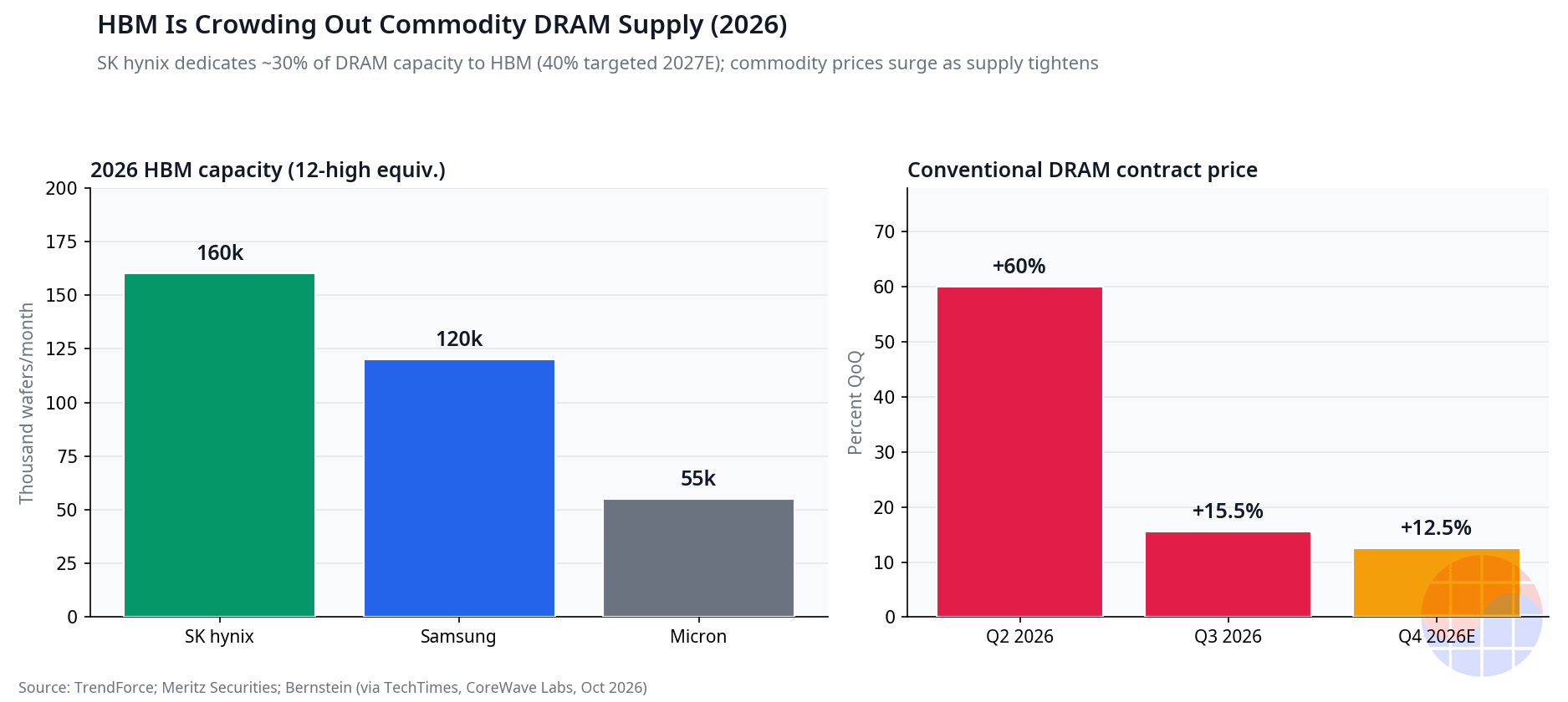
The crowding-out shows up directly in commodity-side numbers. Meritz Securities estimates DRAM suppliers are meeting only 75–80% of demand in H2 2026, with the fulfillment rate potentially falling to around 60% in 2027 (as of 2026-09). TrendForce projects that from 2026 through 2027, the three major suppliers will focus on accelerating process-node migrations rather than increasing raw wafer starts — meaning bit-supply growth stays modest even as capex rises. HBM4 is effectively sold out for 2026, with major customers having pre-allocated the year's output (cumulative reporting, 2026-01 through 2026-10).
On October 10, 2026, at a Shanghai conference, the president of CXMT (ChangXin Memory Technologies) disclosed progress on a 4F² DRAM cell architecture — roughly 30–50% denser than the mainstream 6F² design — and announced plans for DDR5 server RDIMMs before end-2026 (Reuters/TradingKey reporting, as of 2026-10-12). But what was announced is R&D progress: no speeds, no capacities, no named customers, no volume commitments. Cantor Fitzgerald called it "the headline is worse than reality" (as of 2026-10-13). CXMT holds about 9.5–10% of global DRAM revenue, ranking fourth (Counterpoint, Q2 2026) — and it is expanding in DDR4/DDR5 commodity, precisely the segment the Big Three are de-emphasizing.
Stress-Testing the Claim: "Freed Wafers Help AI"
Now let's stress-test the central contrarian claim head-on. If PC demand decline frees up mature-node DRAM capacity, why not redirect it to HBM?
You can't. Three precise reasons.
First, the process nodes are different. HBM3E/HBM4 base dies are built on leading-edge DRAM nodes (1a/1b/1c-class). A mature-node fab that printed PC DDR4 or legacy DDR5 cannot make HBM dies. Node conversion is not a matter of "filling empty space" — it requires EUV lithography, new recipes, and a multi-year yield ramp.
Second, TSV and stacking infrastructure is separate. HBM is fundamentally a packaging story: dies thinned to tens of micrometers, vertically connected through TSVs, then stacked. That needs dedicated equipment like TC bonders and advanced-packaging fabs, and that capacity is itself the current bottleneck. Empty space in a wafer fab does not create packaging capacity.
Third, testing and qualification are different: HBM needs months of system-level qualification with accelerator vendors that commodity test infrastructure cannot perform.
The silicon the PC downturn "frees" is therefore unusable to AI — and its declining value only accelerates suppliers' commodity-line conversions. That is the heart of the paradox.
Layer 2 — Supplier Discipline: Turning Scarcity into Pricing Power
The Big Three are behaving differently this cycle. In July 2026, Samsung announced it was targeting long-term supply agreements (LTAs) covering approximately two-thirds of its memory output. LTAs typically include ceiling-price mechanisms that cap upside in a surge — but they guarantee volume and a price floor. SK Securities expects Samsung's Q3 2026 memory operating margin to hold flat at about 76% versus Q2 (as of 2026-10), citing those LTA ceilings and won strength as caps: the won appreciated roughly 14.3% against the dollar in Q3, with USD/KRW falling from about 1,562 in early June 2026 to about 1,338 by September 9, 2026.
The structure is clear. AI server demand and LTAs lock up advanced-node capacity, while mature-node capacity keeps migrating to higher-value products, draining spot supply of legacy SKUs (Sigmaintell, as of 2026-09). Suppliers are executing "disciplined" price increases — raising prices without destroying end demand. TrendForce SVP Avril Wu noted suppliers are wary of pricing at levels that would meaningfully destroy consumer-electronics demand (as of 2026-10): prices rising, demand bending but not breaking.
The beneficiaries show up in the numbers. Nanya posted record quarterly margins on a 17% Q3 2026 DRAM price surge (TechTimes, 2026-10-12), with another ~10% ASP increase expected in Q4 (TrendForce, 2026-10-06). Winbond's September revenue jumped 256.67% year over year, with institutional investors expecting another 8–13% memory price increase in Q4 (Commercial Times-cited reporting, as of 2026-10).
Layer 3 — Who Pays the Bill: The Trillion-Dollar Capex Run and Credit Markets
The scale of AI infrastructure capex is no longer a fab problem. It is a finance problem. Combined 2026 hyperscaler capex guidance totals roughly $730 billion. Per-company 2026 guidance (Q2 2026 earnings calls): Amazon ~$220 billion, Alphabet $195–205 billion, Microsoft ~$175 billion, Meta $130–145 billion (midpoint ~$138 billion). That's more than 5x the four companies' combined $141 billion in 2023. Add Oracle's ~$55.7 billion FY2026 capex and the total grows further. Goldman Sachs projected in September 2026 that combined hyperscaler capex would approach $1.14 trillion in 2027.
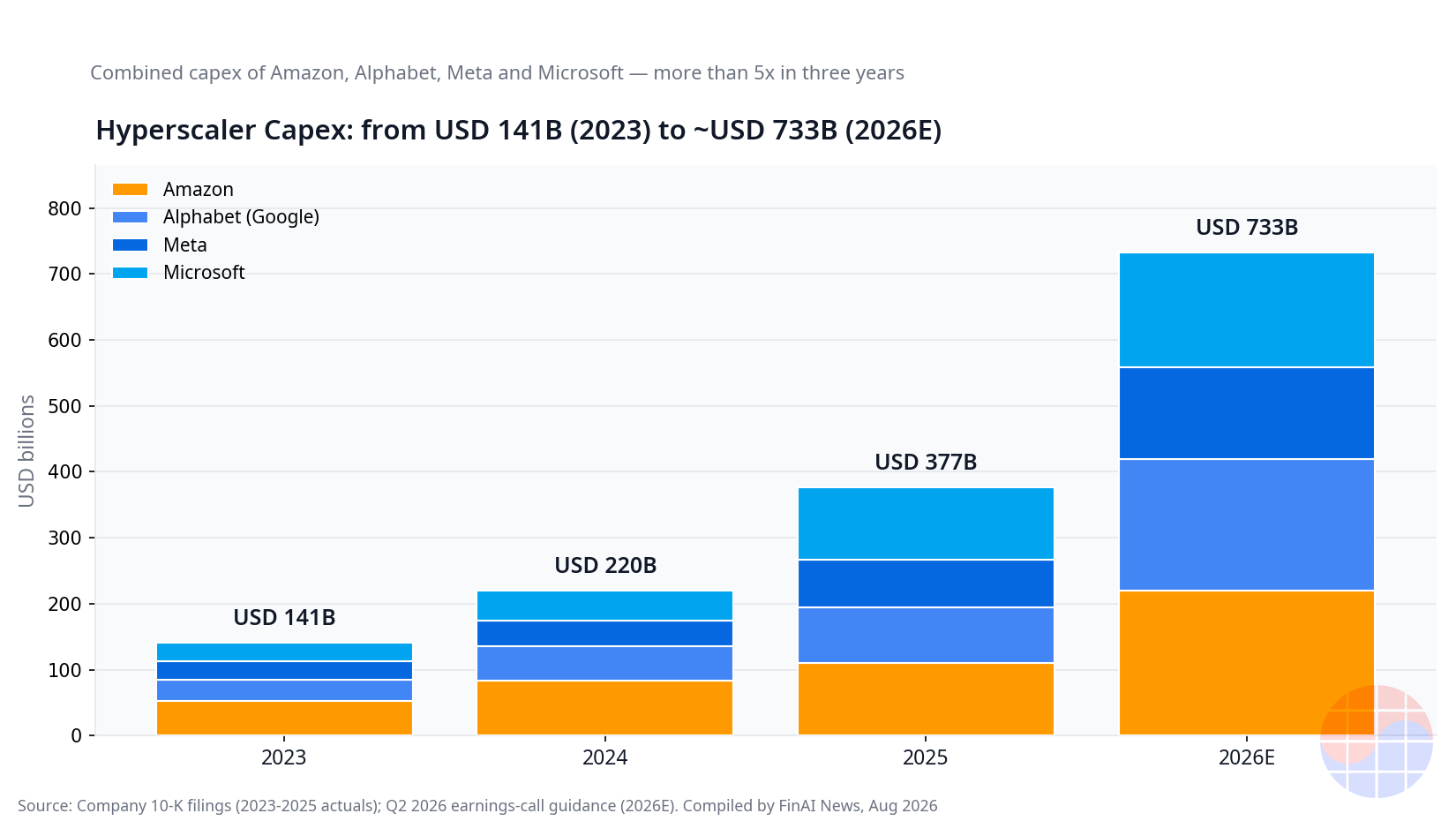
Where the money comes from is 2026's new story. The five largest hyperscalers issued about $114.5 billion in corporate bonds in 2025 — roughly 5x the prior three-year average — and by mid-September 2026 cumulative issuance had already reached $186.1 billion (as of 2026-09). Morgan Stanley projects AI-related debt issuance above $570 billion in 2026. The more structural shift is off-balance-sheet: in October 2025, Meta structured its Louisiana megacampus with Blue Owl as a ~$27 billion debt + ~$2.5 billion equity vehicle — Meta holding 20%, debt maturing in 2049, designed to sit outside Meta's financial statements. The BIS stated in its 2026 quarterly review that hyperscalers are using off-balance-sheet arrangements, often with private-credit partners.
Credit markets are now pricing not "does AI compute make money" but "who bears the cost." Debt stacked in SPVs doesn't appear on sponsor balance sheets, but the obligation survives if demand softens or projects slip — it is serviced by lease cash flows. UBP's September 2026 analysis estimated the five hyperscalers' 2026 capex at ~$820 billion against ~$750 billion of operating cash flow, forecasting $1.0–1.3 trillion in 2027 spending. The word "unprecedented" appears in the report verbatim.
Layered on top is the Jevons paradox for tokens. As token prices keep falling, compute doesn't get less valuable — it gets more valuable. Cheaper inference explodes demand and grows total compute consumption, and HBM sits at the center of that compute. The cheaper tokens get, the more durable HBM demand becomes. That is the demand-side logic behind suppliers' aggressive HBM bets.
What It Means for Korean Players
Samsung and SK hynix sit at the center of this three-layer structure. Counterpoint's Q2 2026 global HBM revenue shares: SK hynix 50%, Samsung 33%, Micron 18%. A year earlier it was SK hynix 64% and Samsung 15% — the gap collapsed from 49 to 17 percentage points. Samsung's HBM4 chase (hybrid-bonded samples, reported 2026-10) and SK hynix's Cheongju M15X fab (wafer production began Q1 2026, EUV-based) plus the Yongin cluster expansion mean Korea controls over 80% of HBM supply.
Korea's PC and module ecosystem sits on the other side. Surging memory prices hit the low-end PC market directly, and Gartner warned the sub-$500 entry segment could vanish by 2028 (forecast, 2026-02). Domestic small and mid-size module and distribution firms — with no LTAs and no pricing power — absorb spot-market volatility in full. TrendForce projects the share of notebook production outside China will slip from 24% in 2025 to 21% in 2026 and below 20% in 2027 (as of 2026-10).
The investor take for Korea: first, the earnings driver is now HBM conversion speed and HBM4 qualification, not the PC cycle. Second, in Samsung's Q3 results (due mid-October 2026), watch whether the ~76% memory margin holds and how fast LTA coverage expands. Third, the risks sit on the supply side — "China headline" shocks and the HBM profitability debate: Bernstein warned HBM could turn less profitable than conventional DRAM by 2027 (as of 2026-10).
Chase's Take: This Is a Balance-Sheet Game, Not a Supply-Chain Story
Rewritten through a VLSI+MBA lens, 2026 memory is a capital-allocation story, not a supply-chain story.
First, memory vendors are playing the airline game. Just as airlines shrink economy cabins and grow premium ones (upgauging), the Big Three are shrinking commodity bits and growing HBM bits. Wafer starts (seats) stay flat while the revenue mix transforms. The PC downturn is economy demand disappearing — which only justifies the premium conversion. Anyone who knows airline loyalty programs knows how this game ends: capacity that moves up to premium never comes back down.
Second, the "wrong silicon" problem is a classic industry trap. Capacity is not a number; it is "capacity to make what." The same netlist targeting a different node is a completely different timing-closure job — and the same wafers, on a different node with different packaging infrastructure, are a different product. "Converting" a mature DRAM fab into an HBM fab is effectively the same investment as building a new fab. That is why the HBM4 bottleneck sits at TC bonders and advanced packaging, and why SK hynix is pouring tens of trillions of won into Cheongju.
Third, the credit layer is this cycle's genuinely new variable. In past cycles, the constraint was fabs. This time fabs are still a constraint, but the bigger one may be the financial structure underwriting the compute demand that fills them. SPVs, private credit, and securitization turn into "invisible leverage" the moment demand bends. The implication for memory investors: don't just watch the DRAM price chart — watch hyperscaler free cash flow and bond issuance alongside it. Memory's next downcycle may start not with demand collapse but with a repricing of the money behind it.
Implications: For Investors and Operators
For investors
- Move the valuation anchor from the PC cycle to HBM conversion rates. Q2 2026 HBM revenue shares (SK hynix 50%, Samsung 33%, Micron 18%, per Counterpoint) shift quarterly. Samsung's HBM4 qualification progress and SK hynix's yield stability are direct stock-price variables.
- Don't mistake price-momentum "deceleration" for decline. DRAM contract-price growth slowing from +60% in Q2 to ~+15% in Q3 and a +10–15% Q4 forecast is evidence that supplier discipline is working. Bernstein expects prices to keep rising into 2027, normalizing only gradually from H2 2027 into 2028 (as of 2026-10).
- Two risk scenarios: (a) China-led commodity supply (e.g., CXMT's 4F²) arrives faster than expected, capping conventional DRAM upside — though as of 2026-10-14 this is at the R&D-announcement stage; (b) as Bernstein flagged, if HBM turns less profitable than conventional DRAM by 2027, the "HBM conversion = margin expansion" formula breaks.
For operators (OEMs, datacenters, PC makers)
- Shift memory procurement from spot to LTAs. With Samsung locking two-thirds of output into long-term agreements, staying on spot means paying for volatility plus a premium. Nanya's and Winbond's Q4 outlooks (further increases of ~10% and 8–13%) show the spot market's direction.
- PC makers must rewrite low-end assumptions. With the sub-$500 segment potentially disappearing (Gartner, 2026-02) and consumers keeping devices ~20% longer, BOM planning has to assume sustained memory costs.
- AI infrastructure buyers must design compute procurement together with financing structure. In a Jevons world where falling token prices grow total compute demand, securing HBM is a survival problem, not a pricing problem. Sold-out 2026 HBM4 proves it.
FAQ
Q1. If PC demand falls and frees DRAM wafer capacity, won't AI memory prices come down? No. Mature-node DRAM capacity for PCs is the "wrong silicon" for HBM. HBM requires leading-edge nodes (1a/1b/1c-class), TSV and stacking packaging, and system-level qualification — none of which can be substituted with idle space in a mature fab. As of 2026-10-14, HBM4's 2026 production is sold out, so the premise of commodity-driven price relief doesn't hold.
Q2. With supply this tight, why do memory vendors talk about "discipline" instead of raising prices further? To avoid destroying demand. Per TrendForce (as of 2026-10), suppliers are wary of pricing at levels that would damage consumer-electronics demand. Instead they lock volume through LTAs (Samsung targets ~two-thirds of output, announced 2026-07) and charge premiums on spot. Decelerating price growth (+60% in Q2 → +10–15% forecast for Q4) shows the discipline is working, not weakening.
Q3. What does this mean for Korea (Samsung, SK hynix)? Korea holds over 80% of HBM supply (Q2 2026 revenue: SK hynix 50% + Samsung 33%, per Counterpoint) and anchors the conversion buildout across Pyeongtaek, Cheongju, and Yongin. For investors, the earnings variable is HBM4 qualification and conversion speed, not the PC cycle. Korea's PC and module ecosystem faces the other side: no LTA leverage, full exposure to spot-price spikes — polarization is deepening.
Q4. If AI capex is a bubble, does HBM demand collapse with it? Possibly, but through a different mechanism. Combined 2026 hyperscaler capex of ~$730 billion (Q2 2026 guidance) is heavily funded by bonds, private credit, and SPVs, so a demand slowdown could turn "invisible leverage" into the problem. But the Jevons structure — falling token prices growing total compute demand — and sold-out 2026 HBM4 support near-term demand. The indicator to watch isn't the DRAM price; it's hyperscaler free cash flow and financing volumes.
Market figures cited here are estimates from research firms and brokerages (Gartner, IDC, TrendForce, Counterpoint, Bernstein, Meritz Securities) and press reporting — not confirmed results. Check primary sources before making investment decisions. (Reference date: 2026-10-14)