VLSI Korea
Why Physical Design Engineers Must Read RTL
Why Physical Design Engineers Must Read RTL 30-Second Summary * Most physical design pain starts in RTL. No amount of clever routing fixes a broken microarchitecture. * Synthesis and P&R tools are optimizers, not magicians. Huge muxes, deep combinational chains, and botched clock gating are structural problems tools cannot fix. * PD engineers don't need to write RTL.


Why Physical Design Engineers Must Read RTL
30-Second Summary
- Most physical design pain starts in RTL. No amount of clever routing fixes a broken microarchitecture.
- Synthesis and P&R tools are optimizers, not magicians. Huge muxes, deep combinational chains, and botched clock gating are structural problems tools cannot fix.
- PD engineers don't need to write RTL. But they must read it, smell danger in it, and argue with front-end engineers in their own language.
- The minimum: reading
always_ff/always_comb, blocking vs non-blocking,case/generate, spotting inferred latches, and a working sense of fanout and mux depth. - The cost of a late RTL change grows exponentially with each stage. In an era when a mask set costs millions to tens of millions of dollars, an ECO caused by "not knowing RTL" is a sin.
- Chase's conclusion: touch the whole flow, front to back. Start with RTL, then verification, synthesis/PD, then STA/signoff. PD-only careers have a low ceiling.
Intro: What Happens When Back-End Engineers Can't Read RTL
There is an old joke among physical design (PD) engineers: "RTL is the front-end team's problem; we just need the netlist." Engineers who believe it and live on netlists alone eventually meet their fate: all-night congestion debugging, inexplicable timing violations, and an RTL ECO landing one week before tapeout.
I am a Staff Product Engineer at Synopsys working on PrimeTime — STA and signoff tools, the very end of the flow, where a chip is one step from becoming silicon. Before that, at SiFive Korea, I owned full RTL-to-GDS flows across Samsung 5nm to 14nm and taped out more than five chips. Having lived at both ends of the flow, I can say this plainly: a PD engineer who can't read RTL is driving without a map. You can see the destination (the netlist), but you have no idea why the road is blocked or where to detour.
This isn't a sermon. First, four war stories that actually happened. Then, the minimum RTL knowledge a PD engineer genuinely needs. Not designer-level skill — just enough to read, to sense risk, and to talk to front-end engineers as a peer.
Episode 1. The Congestion Hell Built by One Giant Mux
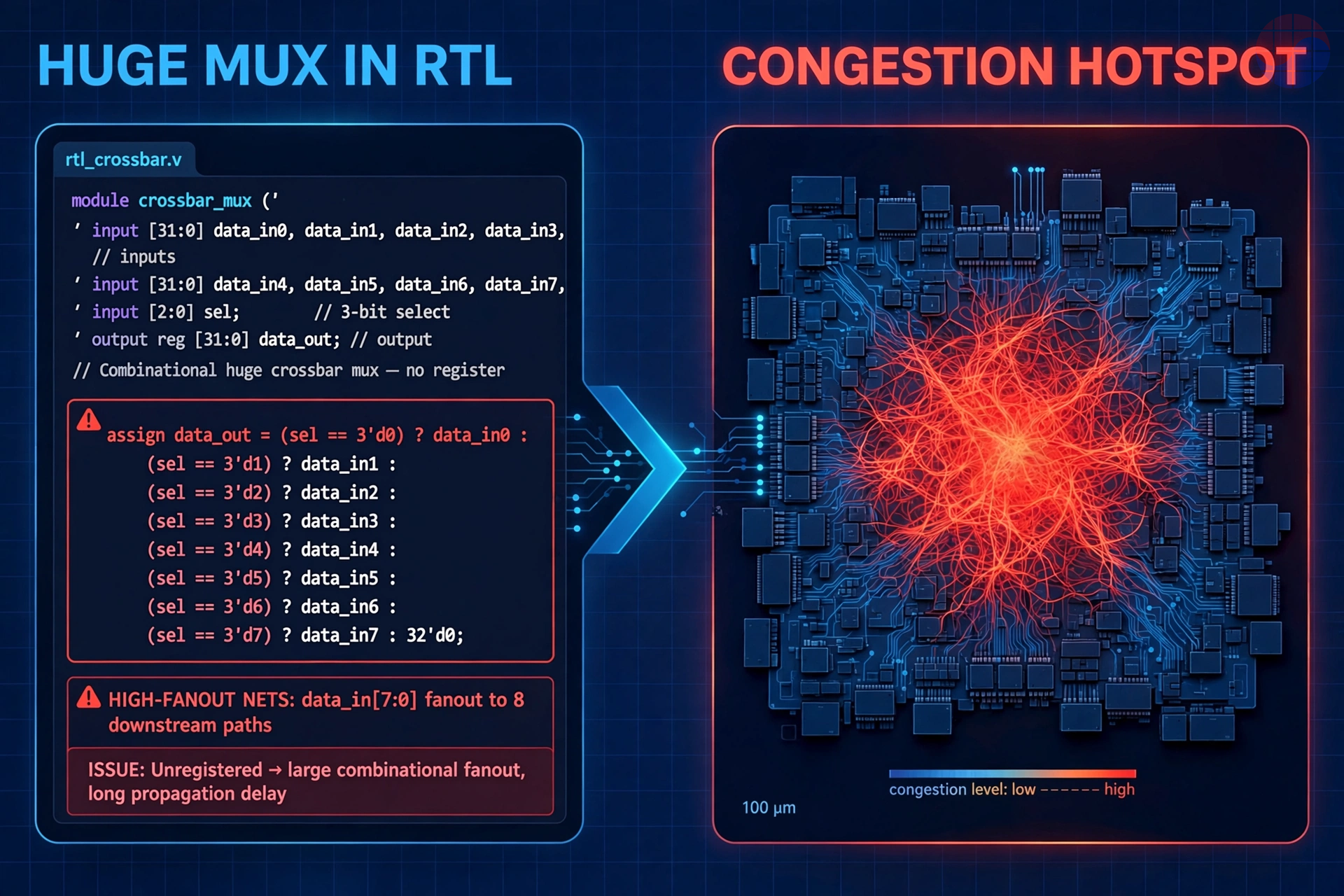
On one project, a single crossbar swallowed the routing of an entire block. I opened the RTL and found this:
// Combinational, unregistered crossbar — no pipeline register
assign data_out = (sel == 3'd0) ? data_in0 :
                  (sel == 3'd1) ? data_in1 :
                  (sel == 3'd2) ? data_in2 :
                  (sel == 3'd3) ? data_in3 :
                  (sel == 3'd4) ? data_in4 :
                  (sel == 3'd5) ? data_in5 :
                  (sel == 3'd6) ? data_in6 :
                  (sel == 3'd7) ? data_in7 : 32'd0;
Perfectly legal RTL. Passes simulation. But synthesis explodes it into thousands of gates scattered across the die. Eight 32-bit inputs converging on a single point means placement must drag every input bus to one spot — and the result is a routing congestion hotspot. Industry veterans have documented cases like a 4,000-to-1 mux turning into a "routing and timing nightmare." Legal RTL, legal disaster.
A PD engineer who reads RTL catches this at the RTL handoff review, not at the netlist stage. One sentence — "Why is this crossbar unregistered? One pipeline stage would halve the congestion" — turns three weeks of P&R iterations into three days.
Episode 2. Timing That Synthesis Can't Fix — It's the Microarchitecture
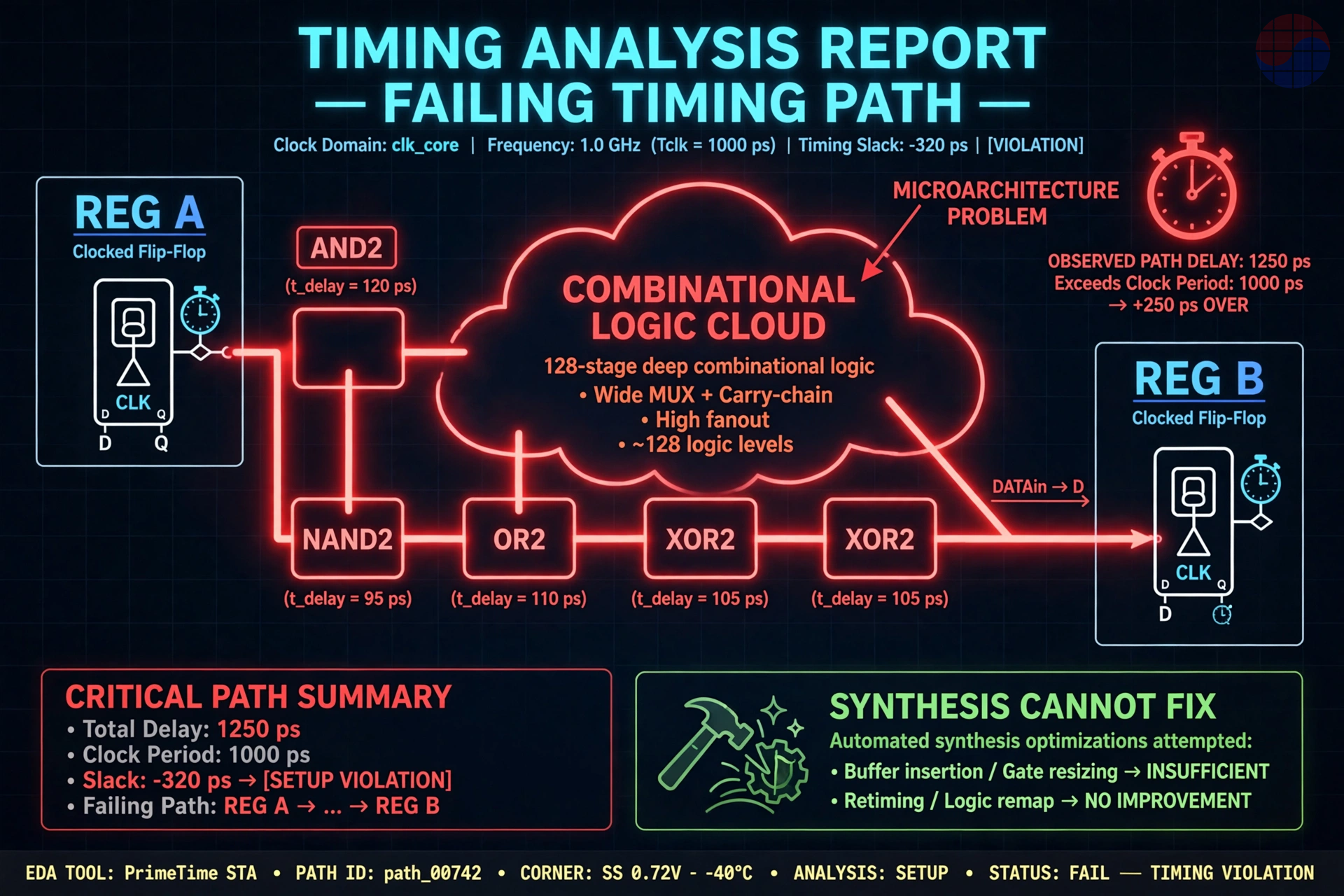
A PD engineer's daily bread: an STA report full of -320ps setup violations. You insert buffers, upsize gates, run retiming — nothing moves. Because the problem is structural.
The classic pattern: 128 stages of combinational logic packed into one clock cycle. A wide mux feeding a carry chain, plus high-fanout nets. Synthesis optimizers get stuck in local minima. Buffer insertion, gate resizing, retiming — all useless. There is mathematically too much logic for that clock period.
What you need isn't a tool setting; it's a microarchitecture change. Add a pipeline stage, split the mux, redraw the datapath. But a PD engineer who can't read RTL can't even make that call. You need to tell the front-end team "this is structural, fix the RTL," but without RTL literacy you can't produce the evidence. So you burn weeks spinning tool options, then watch the RTL team add one pipeline stage and solve it in an hour.
From the PrimeTime side of the world, one observation: the violations that are hardest to fix at signoff almost always trace back to RTL. STA tools tell the truth; they don't change it.
Episode 3. The Economics of Late RTL Changes and ECO Hell
In chip development, the cost of fixing a bug rises exponentially the later you catch it. Changing one line at the RTL stage, fixing it with an ECO after P&R, and remaking masks are different universes of cost.
Public estimates give the scale: mask sets ran about $1M at 90nm and $1.5M at 65nm, and at 5nm and below a full mask set is widely reported at well over ten million dollars. When an RTL change lands a week before tapeout, you have two options: survive on metal-layer ECOs or swallow a full respin. Both are expensive, and both break the schedule.
This is where a PD engineer's RTL literacy converts directly into money. During an ECO, you must judge whether the changed RTL actually demands that much change. Sometimes the ECO RTL from front-end is functionally identical with only the coding style changed. Without RTL literacy, the answer is "it changed, so let's rerun everything." With it, the answer can be "this is functionally equivalent — absorb it with spare cells." That one-line judgment separates millions of dollars and a schedule from a disaster.
Episode 4. The Power-Grid Nightmare From One Bad Clock Gate
RTL-level clock gating mistakes are among the hardest bugs to find at the PD stage. Consider a hand-rolled gated clock:
// DANGEROUS: hand-rolled clock gating — glitch risk
assign gclk = clk & en;
A glitch creates an unwanted edge on a net used as a clock, and downstream flops misbehave. You expect synthesis to convert it to an integrated clock gating cell, but depending on coding style the tool may not recognize it. Then the clock tree synthesizes strangely at the PD stage, CTS suffers, dynamic power spikes, and IR-drop analysis shows hotspots in the wrong places.
A PD engineer who reads RTL asks the right questions the moment they see the clock structure: "Is this enable glitch-free? Did synthesis infer ICG? Are clock-gating checks covered in STA?" The difference is asking before P&R versus debugging it in silicon.
The Minimum RTL a PD Engineer Actually Needs
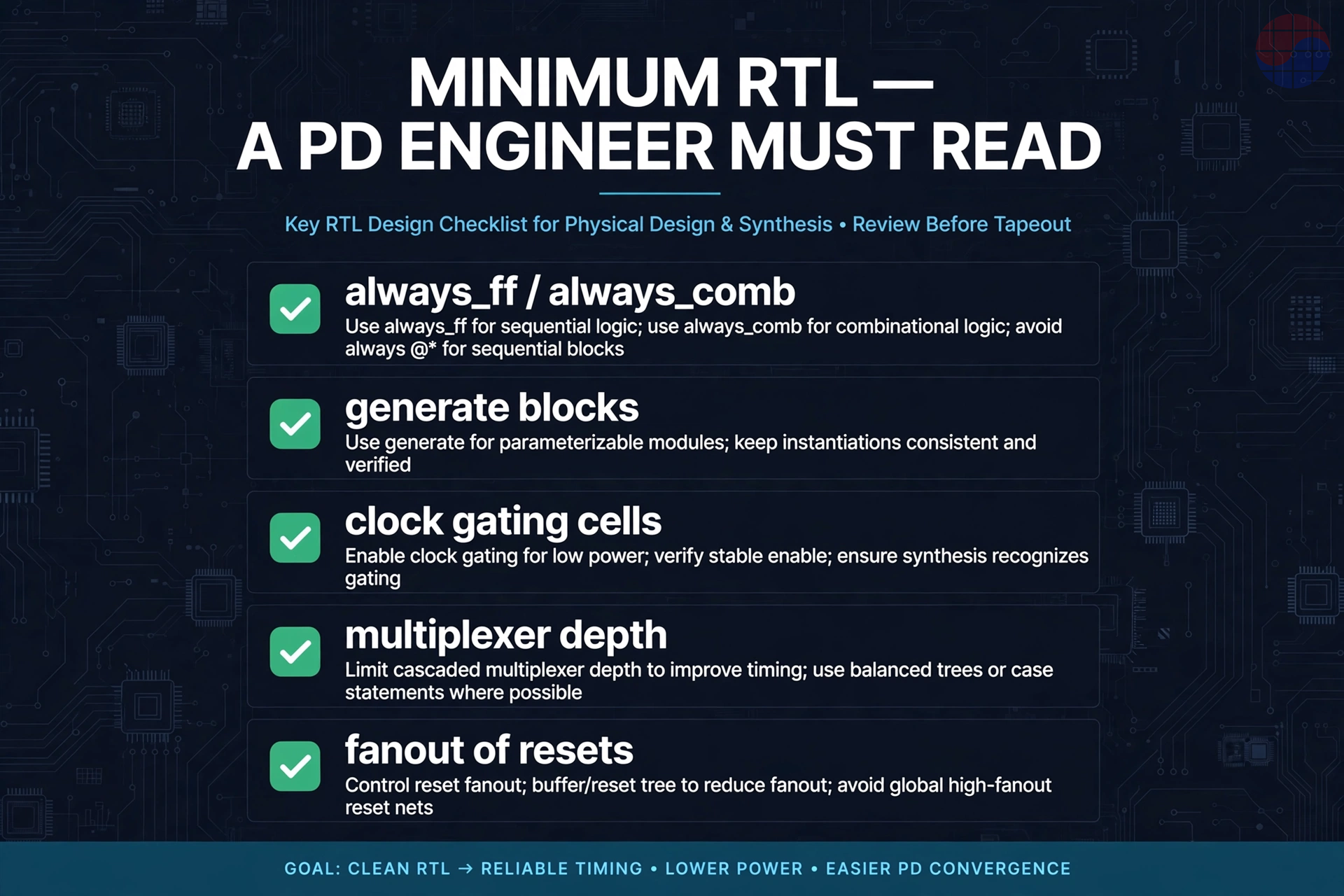
To repeat: nobody is asking you to design. Read, sense danger, converse. The scope:
1. Constructs to read (Verilog/SystemVerilog)
always_ff/always_comb/assign— the sequential vs combinational distinction is the timing-structure distinction.- Blocking (
=) vs non-blocking (<=) — the classic source of sim-vs-synthesis mismatch. The first thing to check in someone else's RTL. if-else/case— priority encoder vs parallel mux. Acasewithoutdefaultinfers a latch.generate/parameter— you need an intuitive sense of how many instances a parameterized module expands into, or area/congestion estimation is impossible.interface/modport(SystemVerilog) — modern RTL bundles hundred-pin ports into interfaces. Can't read them, can't trace hierarchy.- Reset styles — synchronous vs asynchronous, how many reset domains. Resets are the prime suspects behind high-fanout nets in PD.
2. Synthesis-hostile patterns to recognize
- Giant unregistered muxes / crossbars (Episode 1)
- Deep combinational chains — tens of logic levels in one cycle means a microarchitecture problem (Episode 2)
- Manual clock gating (
clk & en) — ICG non-recognition, glitch risk (Episode 4) - Inferred latches —
ifwithoutelse,casewithoutdefault. The dark matter of timing analysis. - High-fanout reset/enable — global nets hitting tens of thousands of flops. Direct hit on CTS and power.
- Large arrays inferred as flops — memory that should be SRAM exploding into thousands of flops kills area and congestion. You must read memory inference in RTL.
- Clock domain crossings — signals crossing without synchronizers. Mis-cut them as false paths in STA and the chip dies in silicon.
3. How to talk to front-end
Once you read RTL, the conversation changes. Not "timing isn't closing" but "this path has 6 levels of mux depth and won't fit 1GHz — add a pipeline stage or split the mux." The first is complaining; the second is engineering. Front-end engineers respond to the second. It speaks their language.
Next Step: Follow the Front-to-Back Roadmap on edu.vlsi.kr
RTL literacy isn't learned by suffering alone. There is an order. The RTL2GDS roadmap on VLSI Edu organizes the full flow from RTL to GDS as career paths — a solid starting point. If you're heading into PD, walk it in order: RTL → verification → synthesis → PD → STA/signoff.
The full career-path map is available in the 44 semiconductor career paths overview, organized into categories like Architecture & RTL, Verification, and Implementation & Signoff, with staged skills and learning resources per role. (Note: as of 2026-10-11 that page renders in the Vietnamese locale; the Korean (/ko/roadmaps) and English (/en/roadmaps) pages currently return 404/rendering errors. The site still needs a Korean-language RTL-to-PD career path detail page and a deep-dive STA/signoff tutorial page.)
Chase's Take
Honestly, I didn't read RTL well from the start either. When I owned RTL-to-GDS at SiFive Korea, the first few months I just stared at netlists and ran P&R. Then a Samsung 5nm project burned three weeks on congestion. The cause was exactly Episode 1 — an unregistered crossbar. The RTL team lead walked over, opened the code, and said: "One pipeline stage here and it's done." Three weeks, evaporated in one sentence. Since that day, I read the RTL first.
Now I build PrimeTime at Synopsys. What I see every day are timing violation reports. And here's the thing: the harder a violation is to fix at signoff, the more likely its root cause sits in RTL. Tools are honest — they show you the numbers. Changing the numbers is a human design judgment, and the raw material of that judgment is RTL.
So I always tell juniors the same thing: touch the whole flow. Start with RTL. Then verification, then synthesis and PD, then STA and signoff. PD-only is comfortable at first — you only need to know how to run the tools. But the ceiling is low. Real problems always live at the boundaries, and crossing boundaries requires speaking both languages.
It may sound ironic that someone working at the very end of the flow, on PrimeTime, tells you to start from RTL. But the further downstream you work, the clearer the upstream looks. Every pain has its root in RTL. So start there.
FAQ
Q1. Does a PD engineer need to be able to write RTL?
No. The goal is readability. Read someone else's RTL, spot structurally risky constructs from a timing/congestion/power perspective, and explain them concretely to front-end engineers. Writing your own modules is a bonus.
Q2. How long does it take to learn RTL?
Two to three months to reading level. One month for Verilog/SystemVerilog basics, one month for how synthesis interprets RTL (latch inference, mux structures, resource sharing), one month sitting in on real project RTL reviews. Bring this article's checklist to reviews and you'll learn fastest.
Q3. Won't better synthesis tools make RTL knowledge unnecessary?
The opposite. The better tools get, the only problems left are the structural ones tools can't fix. As AI-driven tools absorb routine optimization, human judgment on microarchitecture matters more. RTL literacy is a non-depreciating asset.
Q4. Do STA/signoff engineers need RTL knowledge too?
Even more so. STA judges timing, so you must distinguish whether a violation's root cause is RTL structure or a tool/constraint issue. The most valuable STA engineer is the one who reads a PrimeTime report and says "this isn't an SDC problem, it's a pipeline problem."
This article reflects the author's hands-on experience and is written as career perspective. Project figures are simplified for illustration.