VLSI Korea
What Is a Post-CMP Cleaner? The Defect Contract Between Particle Removal and Metal Corrosion
Post-CMP cleaner value depends on material-specific patterned-wafer qualification, not liters alone.


A post-CMP cleaner is a formulated chemistry used after chemical mechanical planarization to remove abrasive particles, organic residues, and trace metals while preserving the exposed metal and dielectric surfaces. The production unit, however, is larger than the liquid in the bottle. PVA brush action, rinse, dry, queue time, patterned-wafer metrology, and release ownership form one sequence. The hard part is therefore not simply cleaning more aggressively. It is closing particle removal and corrosion, re-adsorption, and surface-loss control at the same time.
On August 21, 2026, Fujifilm said a new post-CMP cleaner building at its Oita Factory had begun operating in August and would raise site capacity to roughly three times the previous level. The 3,600 m² building, approximately ¥7 billion investment, automated manufacturing, and quality-evaluation equipment constitute a concrete supply signal. Yet nameplate capacity is not the same as good-wafer capacity. Cu, Co, W, SiC, and emerging interconnect surfaces have different residues, surface charges, galvanic couples, inhibitors, and downstream processes. Until a customer-specific patterned-wafer qualification closes, each liter does not carry the same production value.
This article serves two reader jobs. A CMP or integration engineer can turn a cleaner claim into a material-specific qualification matrix. A materials, equipment, or sourcing owner can separate announced supply from qualified supply. It improves two decisions: what removal, corrosion, roughness, and downstream-defect evidence must close before release, and whether new capacity removes a yield bottleneck or is still waiting in a qualification queue.
1. What it is not, and where it sits in the flow
A post-CMP cleaner is not the CMP slurry. A slurry uses abrasives, oxidizers, complexants, inhibitors, and other components to remove material and planarize a wafer. The cleaner must remove what polishing leaves behind without continuing uncontrolled material loss. A supplier may propose the slurry and cleaner together, but the two formulations do not share one acceptance criterion.
It is not simply a generic RCA clean either. RCA-family chemistry remains an important baseline, but the acceptable pH and complexant depend on whether the polished surface is Cu, W, or SiC, whether BTA-type inhibitor residue remains, and whether a barrier metal creates a galvanic couple. IBM's 2024 tungsten study makes the boundary concrete. Higher pH can favor charge repulsion between W and oxide or silica while increasing W dissolution. Lower pH can protect W yet make particle attraction less favorable.
The flow position is immediately after CMP. In practice, wafer unload, brush or megasonic action, cleaner chemistry, rinse, dry, inspection, and the next deposition, lithography, or epitaxy step form a chain. Queue time is not neutral waiting. Extending the exposure of a fresh metal surface and residues to chemistry or even DI water can change the corrosion and re-adsorption window. Recipe, hardware, transport, and metrology therefore belong in one control plan.
The consensus is that post-CMP cleaning matters for defects and yield. The VLSI Korea view is narrower: the scarce asset is not cleaner volume by itself, but the qualification package that proves removal and surface protection together on the target patterned stack. The disagreement is whether a capacity announcement should be read as demand fulfillment or as potential capacity until recipe-specific release evidence closes. Why now: Fujifilm's threefold expansion arrives alongside 2024-2026 material-specific studies that reveal sharper cleaning boundaries.
2. The Coupled Removal-Protection Framework
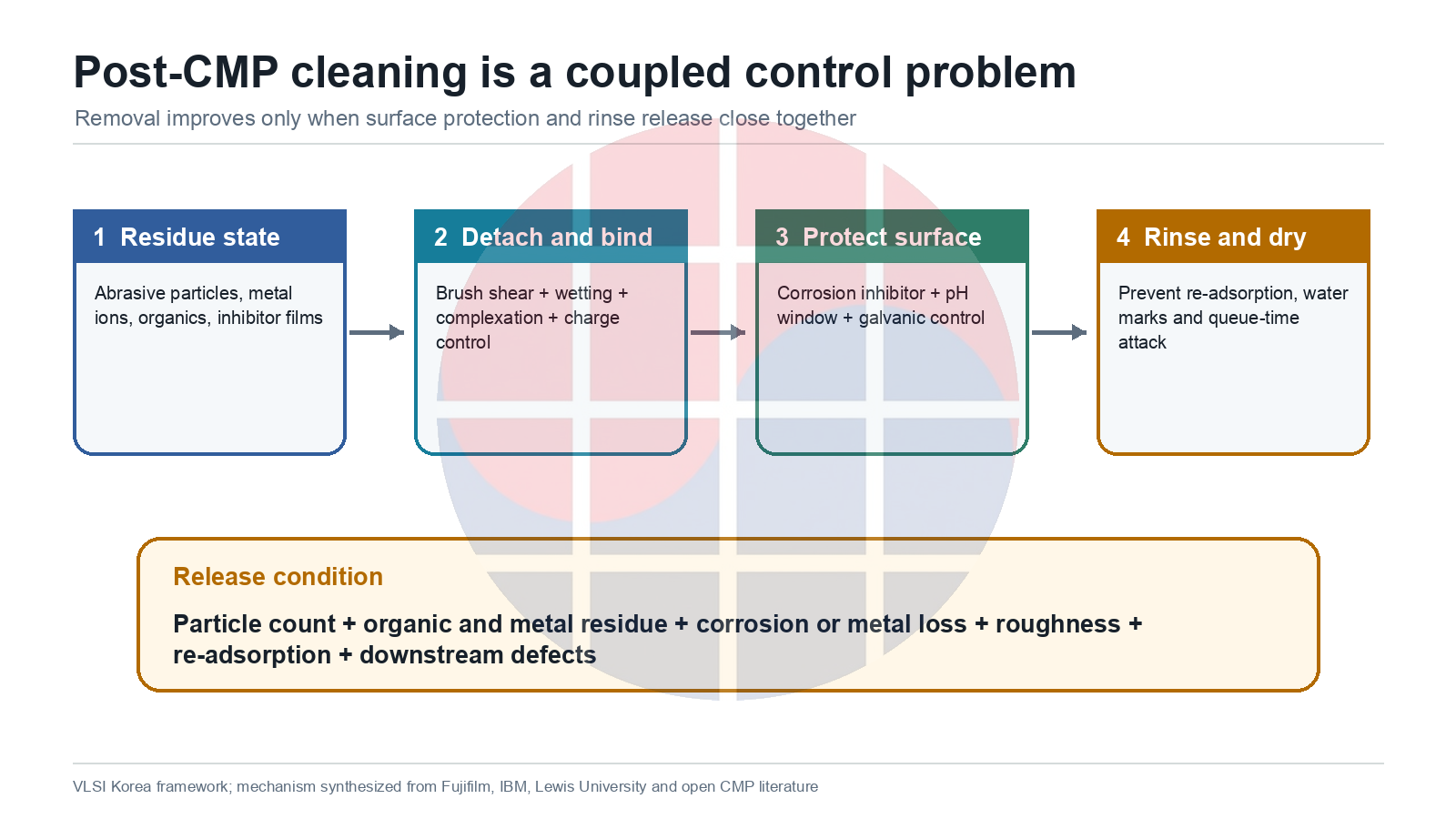
This article evaluates qualification through a Coupled Removal-Protection Framework. It has four steps. First, define the residue state: silica or ceria abrasive, pad debris, organic inhibitor, dissolved metal, and native oxide are not interchangeable. Second, detach particles and complex or dissolve residues. Third, protect the exposed surface against corrosion and galvanic attack. Fourth, prevent re-adsorption and water-mark defects through rinse and dry.
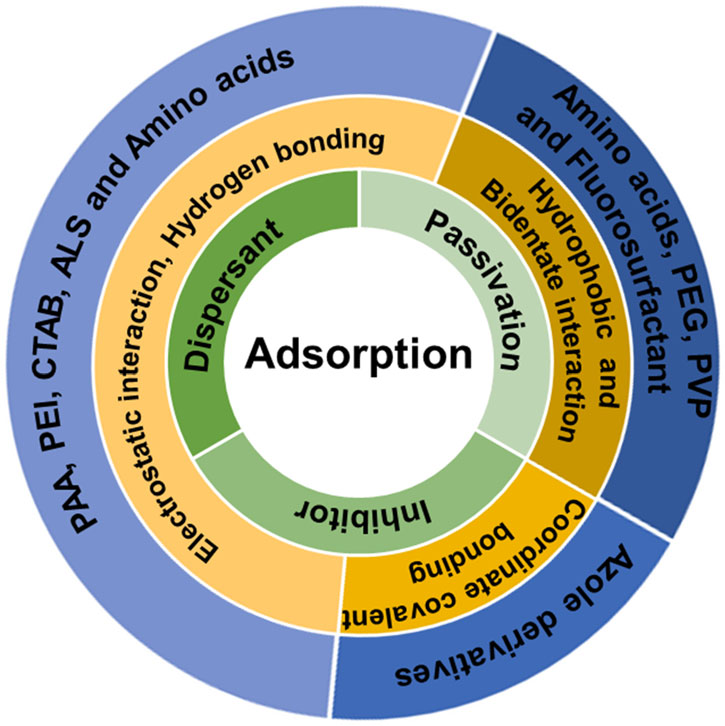
A complexant may bind a metal ion or residue into a soluble species. A surfactant changes wetting and particle-surface interaction. pH moves zeta potential and dissolution together. An inhibitor protects a surface but can itself become an organic residue. A PVA brush adds particle-removing shear, while compression, porosity, water uptake, and chemical diffusion alter both force and surface reaction. Moving one variable in an apparently favorable direction does not prove that total defects fell.
A 2021 study from Lewis University, IBM, EMD Electronics, and Araca connected PVA scrubbing marathon results from a high-volume fab with controlled tests. It reported a strong inverse correlation between wafer-level defects and shear force. More solution availability reduced shear while increasing electrochemical activity, measured as corrosion current. The result breaks the intuition that supplying more cleaning fluid is always better. Mechanical removal and chemical attack can move in opposite directions under the same knob.
A 2024 ACM Research and Fudan University study quantified brush compression and particle removal. Under one specific brush and test condition, 0.5 mm compression at 35.11 g stress reduced the count of 26 nm particles to fewer than 10. That is useful mechanism evidence, not a universal recipe. Change brush material, pore structure, wafer, slurry residue, or tool motion, and the optimum may move. The exact experimental boundary must survive any translation into a production specification.
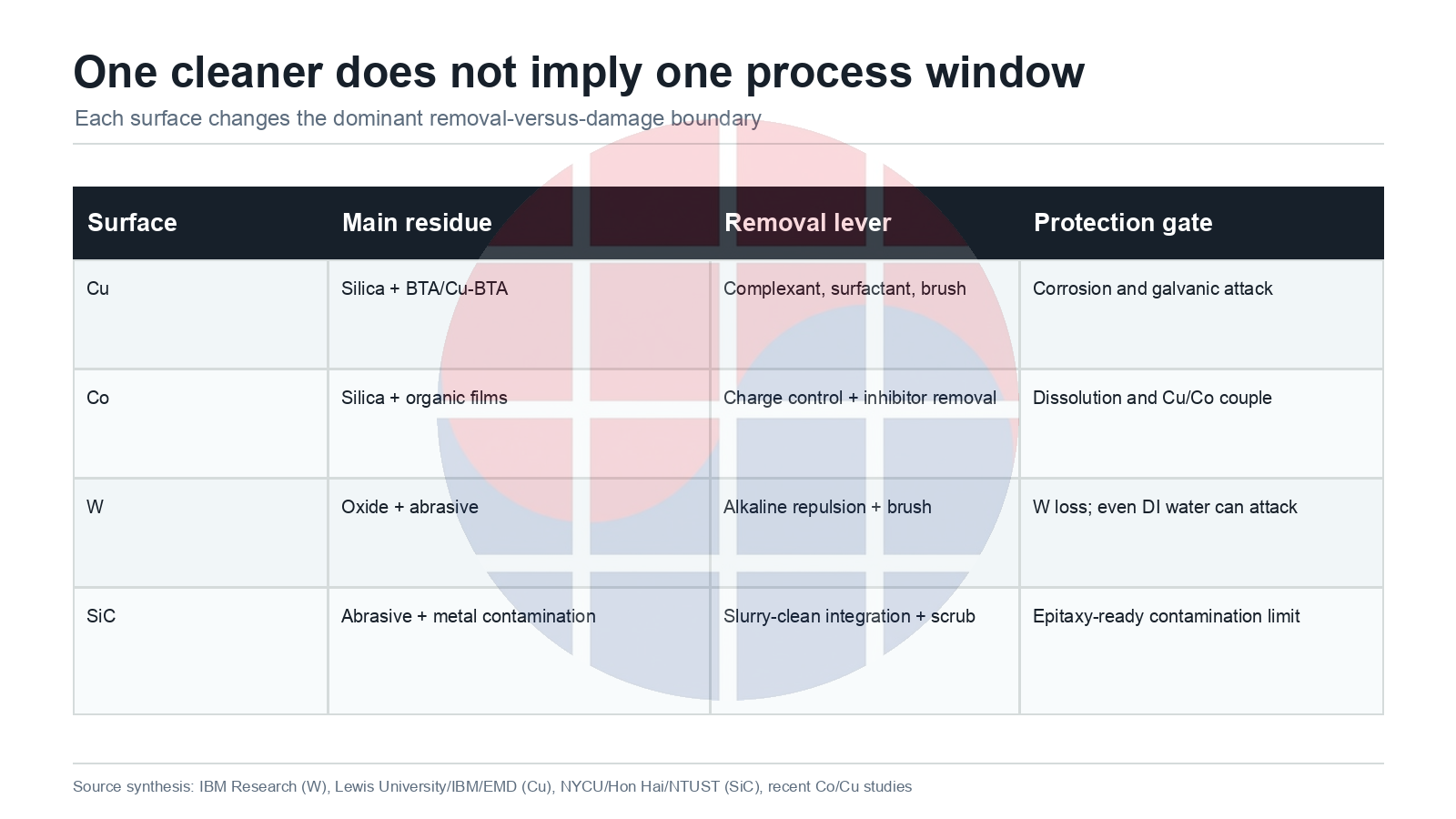
3. Cu, Co, W, and SiC are not one cleaner market
For Cu, silica particles and BTA or Cu-BTA residue are central, but corrosion at exposed Cu and barrier couples must be measured at the same time. A 2024 citric-acid and surfactant study reported 99.5% particle-removal efficiency for a specific formulation and test condition. That number is mechanism evidence. It is not a production-yield promise for another Cu pattern, slurry, queue time, or downstream stack.
Co is attractive for newer interconnect and contact uses, but its cleaning window is not simpler. Silica and organic residues must be removed while controlling Co dissolution, galvanic effects, and surface energy. Because functional groups and inhibitors act in material-specific ways, passing on Cu is not a qualification shortcut for Co. A good blanket-sample surface also does not close patterned-feature resistance and reliability.
W presents the pH dilemma highlighted by IBM. The researchers reported that an alkaline cleaner with corrosion inhibitor at approximately pH 9.78 delivered high cleaning efficiency and lower W loss than citric acid at about pH 2.66, DI water, and diluted NH4OH. Including patterned-wafer evidence is important. The report that DI water alone can induce severe W dissolution in fine geometry also blocks the assumption that rinse is inert.
For SiC, the target is a surface acceptable to subsequent epitaxy. Research involving National Yang Ming Chiao Tung University, Hon Hai Research Institute, and National Taiwan University of Science and Technology integrated CMP slurry selection with post-CMP cleaning and added a scrubber step before conventional RCA cleaning to reduce metal and particle contamination. Here the denominator is not a Cu-line defect but an epitaxy-ready substrate. The same phrase, particle count, maps to a different downstream failure mechanism.
4. Capacity economics: qualified good-wafer output, not liters
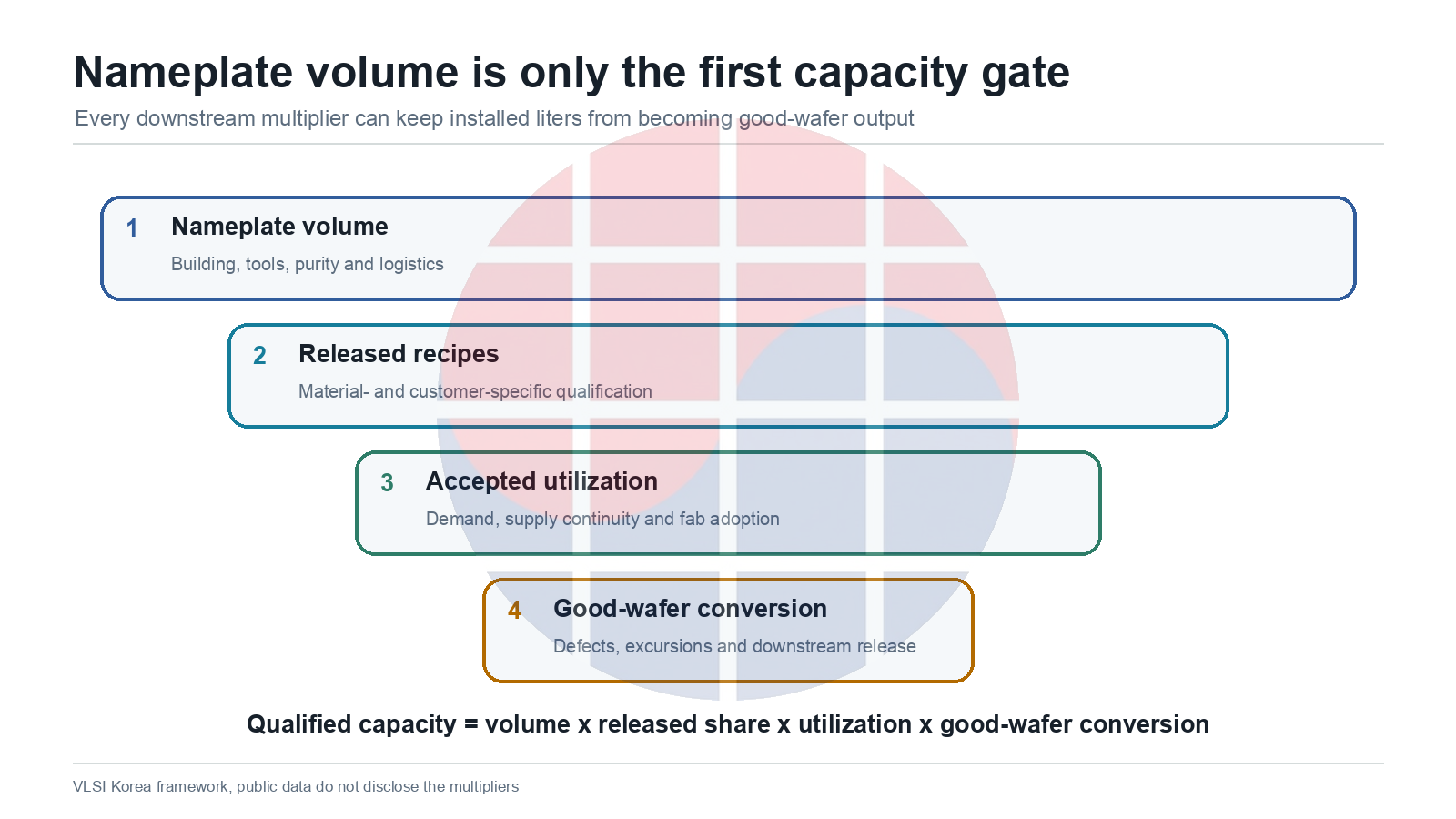
Fujifilm's announcement is a real supply signal. The company says the new building handles post-CMP cleaner production and quality inspection and contains automated manufacturing and evaluation equipment for the purity requirements of leading-edge materials. Oita capacity rises to about three times the prior level, and the investment is approximately ¥7 billion. Fujifilm also expects post-CMP cleaner sales in FY2030 to exceed twice the FY2024 level. That last number is a company expectation, not an observed outcome.
A useful first equation is: Qualified capacity = nameplate volume × released recipe share × accepted utilization × good-wafer conversion. Public data cannot populate the four terms, so this article does not invent them. The structure still identifies the bottleneck. The building expands the first term. Customer qualification governs the second. Demand and logistics affect the third. Defects and excursions determine the fourth.
An integrated slurry-plus-cleaner proposal could shorten qualification. A supplier that understands slurry residue and cleaner response together may narrow the experiment space and reduce root-cause handoffs. There is an opposing risk. A coupled formulation can increase tool, metrology, or fab-specific lock-in, and a slurry change can reopen cleaner qualification simultaneously. The value of a one-stop solution should be measured in change-control evidence, not bundle language.
A capital owner should track customer-approved recipes, material-specific qualification lead time, first-pass release, excursion rate, change-notification closure, and regional dual-source readiness rather than gross cleaner capacity alone. A fab engineer should place particle count beside corrosion, metal loss, roughness, and downstream defects. If one metric improves while another deteriorates, the process did not remove a defect. It moved the defect class.
5. The qualification evidence ladder
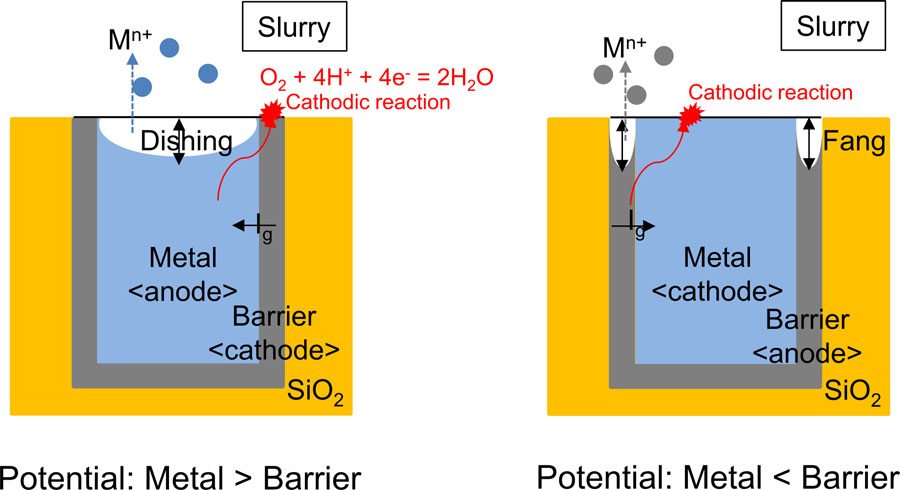
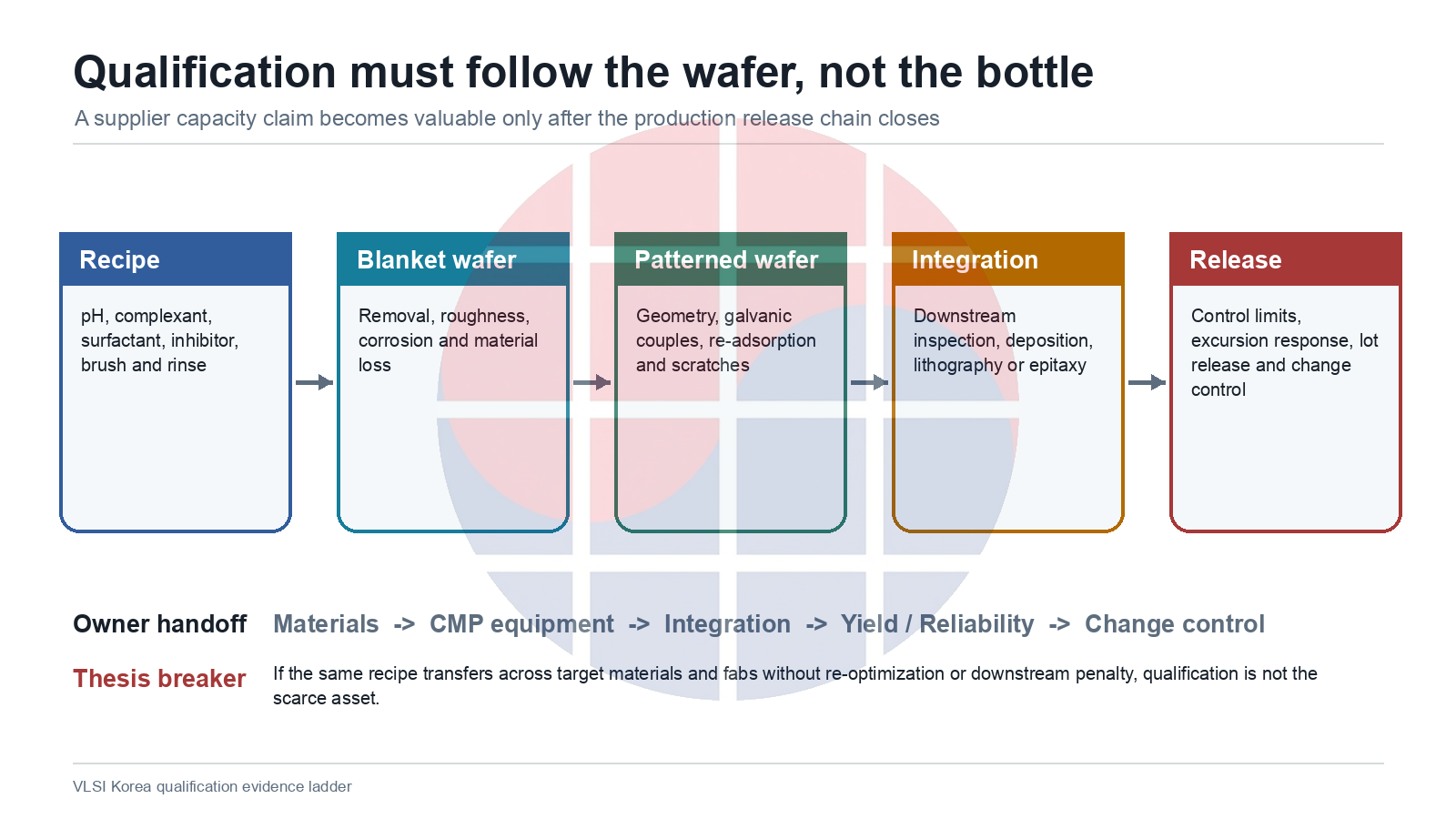
The first gate is recipe evidence: pH, complexant, surfactant, inhibitor, concentration, temperature, brush type, compression, flow, rinse, and dry. The second is blanket-wafer evidence: removal efficiency, surface roughness, corrosion current, and material loss. The third is patterned-wafer evidence: line width, barrier couple, recess, dishing, fang, scratches, and re-adsorption.
The fourth gate is integration evidence. The defect must not reappear in downstream inspection, deposition, lithography, or epitaxy. The fifth is production control: incoming material lot, filter, bath age, brush life, queue time, tool maintenance, and supplier changes must remain within control limits. The sixth is release ownership. Materials, CMP equipment, process integration, yield and reliability, and change-control owners must approve named gates.
The most dangerous shortcut is copying a source-backed laboratory result directly into a fab recipe. A paper can establish a mechanism; it cannot replace the confidential boundary of a customer stack. The opposite mistake is dismissing all public evidence because customer data are proprietary. Public originals identify the variables that must be measured, the tradeoffs that exist, and the company claims that remain unverified.
6. The strongest counterargument and thesis breakers
The strongest counterargument is that advanced cleaner suppliers already perform customer qualification routinely, so this article overstates obvious process discipline. That is partly correct. Leading fabs and materials suppliers do not release from one blanket result. Fujifilm's decision to add quality-evaluation equipment alongside production capacity also shows that the project is more than volume expansion.
The public capacity narrative, however, often omits the qualification burden. The statement that AI-semiconductor demand drove a threefold cleaner expansion describes business direction. It does not identify the materials, customers, or recipes already released. Calling out that gap is not a judgment that supplier capability is weak. It is a way to choose the right leading indicator for capacity-to-yield conversion.
The first thesis breaker is patterned-wafer evidence that the same recipe transfers across the target Cu, Co, W, SiC, or emerging surfaces without material-specific re-optimization and without a downstream penalty. The second is independent production data showing that higher particle removal leaves corrosion, roughness, re-adsorption, resistance, and reliability distributions unchanged. If both repeat, qualification is not scarce and nameplate volume becomes a more direct KPI.
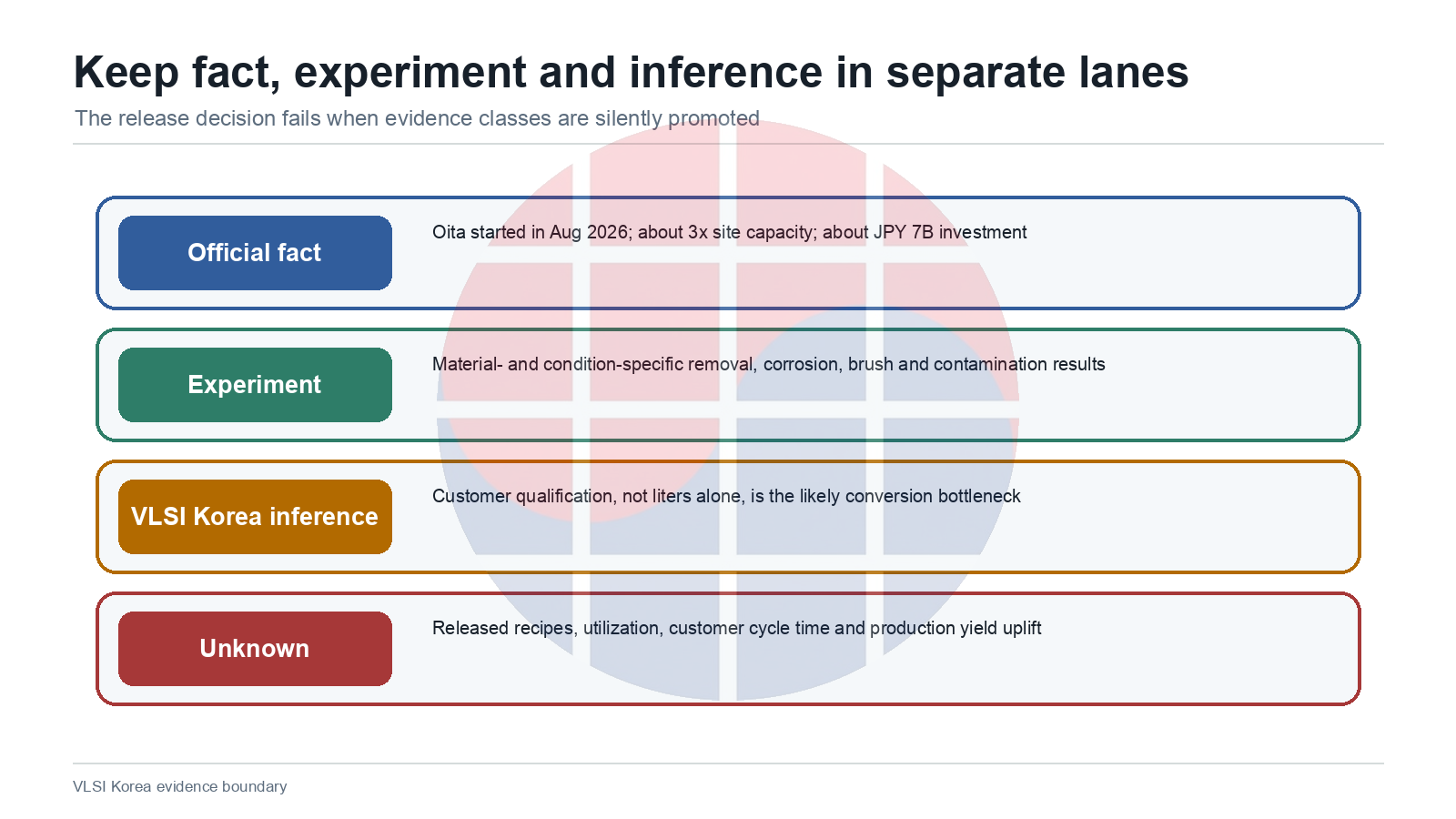
If cleaner volume rises while customer-approved recipes, utilization, and good-wafer conversion remain invisible, the thesis strengthens. Company claim and VLSI Korea inference must stay separate. The threefold capacity and ¥7 billion investment are official facts. The claim that qualification is the scarce asset is an inference from material-specific experiments. Customer cycle time and yield uplift remain unknown.
7. Korea Lens and the 6-12 month checklist
Korea's ecosystem places memory, advanced packaging, materials, and CMP or wet-clean equipment close together. Fab owners such as Samsung Electronics and SK hynix hold product, layer, and tool-specific defect distributions. Equipment suppliers control brush, flow, and rinse. Chemical suppliers control formulation and purity. Each holds a different truth, so a release contract and change-control interface matter before a centralized data lake.
A fab team should choose one high-cost layer and build a removal-protection matrix. Particle, organic residue, trace metal, metal loss, roughness, sheet resistance, and downstream defects should share one lot genealogy. The team should define in advance which subset requalifies after a supplier or brush change. Procurement should add released-recipe count, regional redundancy, notification lead time, on-site failure analysis, and audit trail beside price per liter.
A materials supplier should prove integrated slurry-plus-cleaner value with cycle-time evidence rather than the phrase one-stop. It can design split experiments on the same wafer and show root-cause ownership and recipe rollback time to the extent public disclosure permits. An equipment supplier should expose brush compression, solution availability, and drain-rinse dynamics as control parameters tied to the electrochemical boundary.
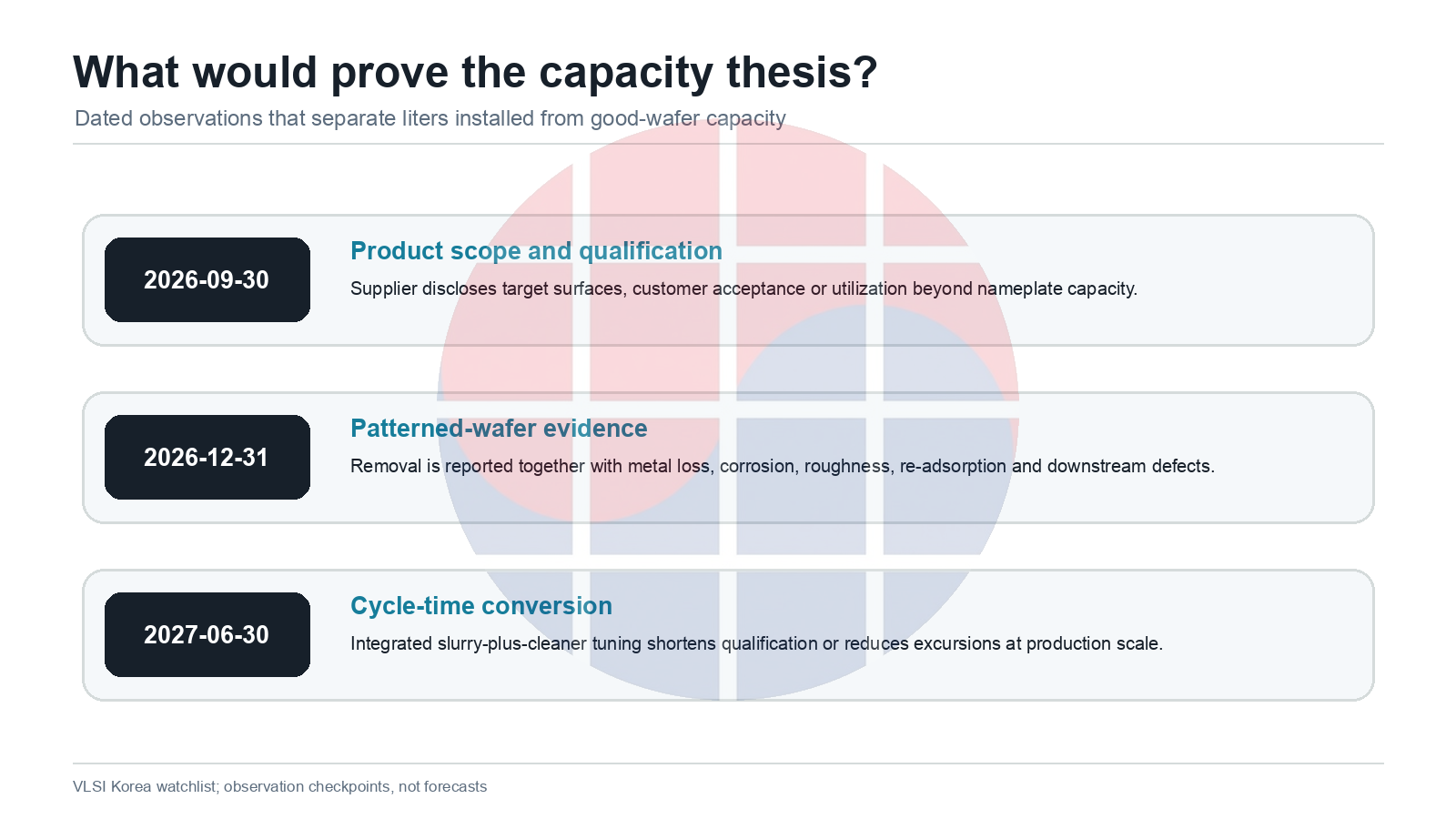
September 30, 2026: Look for Oita utilization, target surfaces, released product scope, or customer-facing qualification evidence from Fujifilm or related material records. Repeating the capacity number is not new evidence.
December 31, 2026: Check whether new patterned-wafer studies report removal together with corrosion, material loss, roughness, re-adsorption, and downstream defects. A blanket sample and one metric do not open the production gate.
June 30, 2027: Look for production-scale evidence that integrated slurry-plus-cleaner tuning shortened qualification lead time or reduced excursions. Without it, one-stop remains portfolio breadth rather than conversion evidence.
The decision rule today is clear. Buy and qualify a cleaner by asking which patterned stack it can release against which downstream limits, not simply how much can be produced. Many chemistries may lower particle count. The production asset is the process window that closes removal, protection, rinse, metrology, and change control together.
Sources and method
- Fujifilm, Oita post-CMP cleaner production building, August 21, 2026. Primary source for capacity, investment, operation, and company outlook.
- IBM Research, Post Tungsten CMP Cleaning, November 13, 2024.
- ACM Research and Fudan University, PVA brush compression and particle removal, September 30, 2024.
- Lewis University, IBM, EMD Electronics, and Araca, PVA brush and chemistry defect study, June 28, 2021.
- NYCU, Hon Hai Research Institute, and NTUST, integrated SiC CMP and post-CMP cleaning, 2023.
- Cleaning mechanisms using citric acid and surfactants on Cu, September 20, 2024.
- Jihoon Seo, wafer-interface CMP review, 2020, CC BY 4.0. Rights source for Figures 4 and 6.
AI assistance note: AI tools supported public-source discovery, bilingual consistency checks, visual-layout production, and sentence editing. VLSI Korea reviewed source interpretation, claim boundaries, figure rights, the thesis, and the publication decision. This article does not estimate undisclosed customer recipes, yield, or utilization.
This article is provided for informational purposes only and does not constitute a recommendation to buy or sell any security. Figures and factual statements are based on publicly available sources, including company filings, news reports, and market research, and may contain errors in the source material or in the preparation of this article. The author may own shares in companies mentioned. All investment decisions and their outcomes are the reader's responsibility.