VLSI Korea
80% of Samsung's 2027 Memory Is Already Sold: Pricing Power Returns (HBM4, Long-Term Contracts)
An estimated 80% of Samsung's 2027 memory output is already secured under long-term contracts: 70% of commodity DRAM and NAND on five-year deals, 100% of HBM. With HBM prices forecast to rise 100-150%, pricing power is back with memory makers.


A year before it is produced, most of Samsung Electronics' 2027 memory output is already spoken for — and when supply is sold out in advance, the seller sets the price.
30-Second Summary
- An estimated 80% of Samsung Electronics' 2027 memory production is already secured under long-term supply contracts. The figure comes from a KB Securities report dated October 20, 2026, and it is an estimate, not a company disclosure.
- The coverage is deepest where it matters most. Commodity DRAM and NAND output is about 70% committed under five-year contracts with global big tech buyers, and annual HBM output is estimated to be 100% contracted.
- Pricing follows the bookings. The 2027 HBM average selling price is forecast to rise 100–150% year on year, and HBM4 is expected to grow from 40% of HBM revenue in 2026 to 80% in 2027.
- Reported asking prices for HBM4 sit in the mid-to-high USD 4 range per Gb — more than three times the roughly USD 1.50 per Gb of today's HBM3E. These are reported asking prices; confirmed contract prices have not been disclosed.
- Samsung is not an outlier. Micron said on its September 30 earnings call that more than 75% of its 2027 output is already committed, and SK hynix announced in July that it had completed long-term contracts with about ten major customers.
- KB Securities estimates Samsung's operating profit at KRW 367 trillion in 2026 and KRW 555 trillion in 2027 — estimates that only work if memory pricing power has genuinely changed hands.
Background
Memory was the industry's most cyclical business — because buyers held the pen
For decades, memory was the segment of semiconductors where the seller had the least power. DRAM and NAND are standardized products made by a handful of suppliers and bought by everyone. Prices were set in spot and quarterly contract markets that swung violently with supply additions, and the structural advantage sat with large buyers who could play suppliers against each other. Memory makers earned spectacular profits in shortage years and gave much of them back in gluts. The 2017 supercycle — when tight supply let memory makers dictate terms — was the exception that proved the rule.
Long-term supply agreements existed at the edges, but they rarely covered the bulk of a maker's output years in advance. Committing most of a future year's production, at the scale now being reported for 2027, is a different commercial structure — one that looks less like the old memory market and more like the capacity reservation markets that have formed around advanced logic wafers and advanced packaging.
AI changed who the buyer is, and what the buyer fears
The demand side explains the shift. The marginal memory buyer is now a hyperscaler building AI data centers on multi-year plans. For that buyer, the binding fear is not paying 10% too much for DRAM; it is a data center that cannot be completed because HBM or server DRAM allocations fell short. HBM in particular is not a spot commodity: stacks are qualified into specific accelerator platforms, volumes are planned quarters ahead, and switching suppliers mid-generation is not realistic. When the cost of missing supply is a delayed AI build-out, buyers rationally trade price flexibility for allocation certainty — and they sign long, large contracts to get it.
That is the backdrop to the October 20, 2026 KB Securities report on Samsung Electronics, reported in the press the same week. Its central claim is not a price forecast. It is a coverage claim: that most of Samsung's 2027 memory book is already written.
Business Deep Dive
The coverage: 80% overall, 100% in HBM
The report's estimates describe a 2027 order book that is largely closed more than a year before the year begins.
| 2027 production segment | Share under contract (estimate) | Contract structure |
|---|---|---|
| All memory output | About 80% | Long-term supply contracts |
| Commodity DRAM and NAND | About 70% | Five-year contracts with global big tech |
| HBM (annual output) | 100% | Supply contracts completed (estimate) |
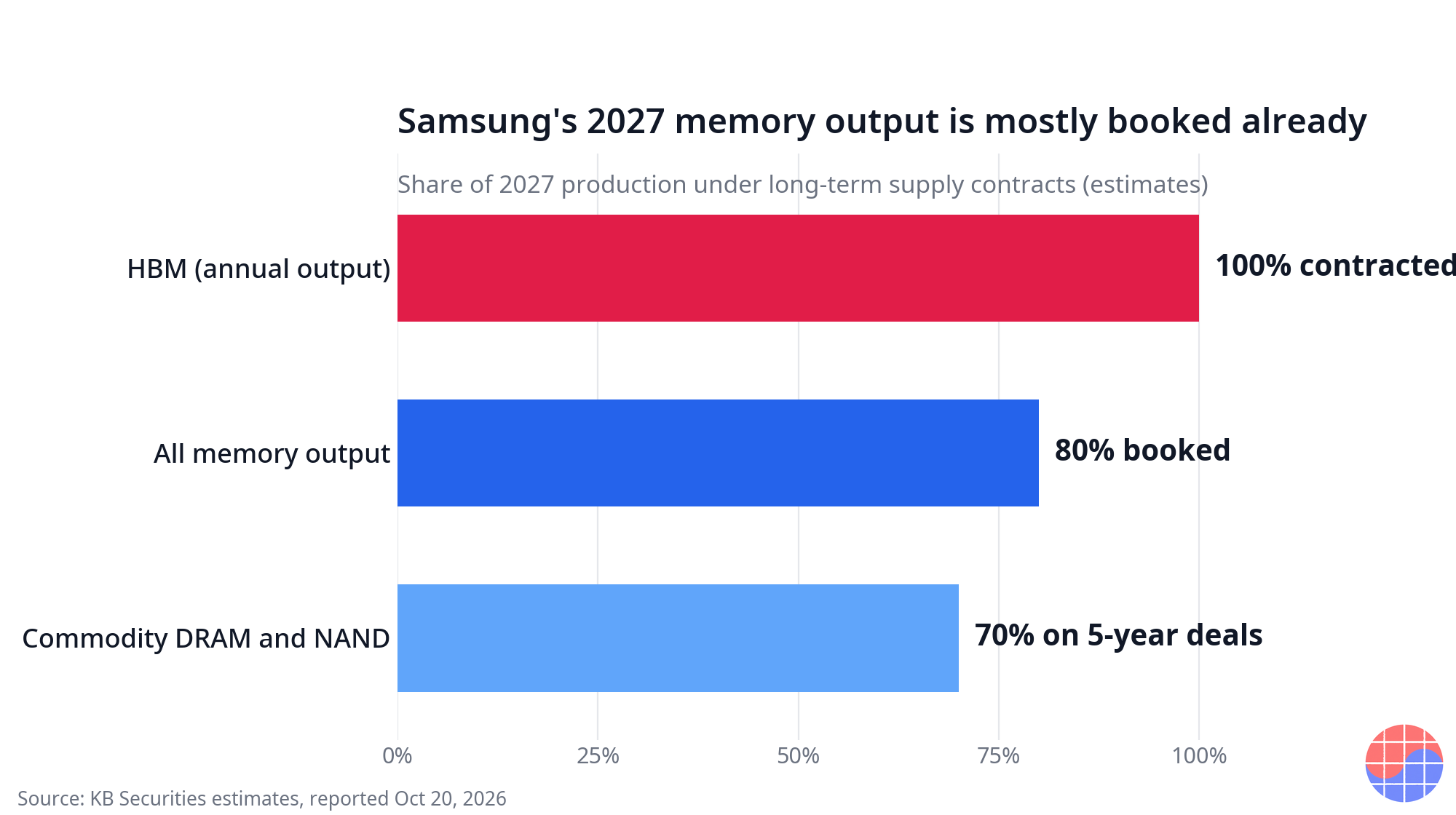
Source: KB Securities report dated October 20, 2026, as reported in the press. Figures are analyst estimates, not Samsung disclosures. Links in the footnote.
Read the three rows as a gradient of scarcity. Commodity memory — the most fungible, most cyclical part of the business — is 70% committed on five-year terms, a duration that would have been remarkable in any previous cycle. HBM, the scarce AI input, is fully committed for the year. The blended 80% figure is what turns a strong order book into a market-structure story: only about a fifth of 2027 output remains uncommitted, and that residual is what the rest of the market must compete for.
The remaining 20% is where the price gets set
A market in which 80% of supply is pre-sold does not clear at the average contract price. It clears at the margin — in the uncommitted 20%, plus whatever spot volume exists. Every hyperscaler, server maker, and device company that did not lock in 2027 supply is bidding for that shrinking residual, against competitors doing the same. That is the mechanism by which long-term coverage transfers pricing power: the contracts themselves lock in volume and priority, and the scarcity they create prices everything left over.
The spillover runs downstream. Buyers of consumer and client memory — PC, smartphone, and consumer device makers — historically buy closer to spot and short-term contract markets. If the industry's committed share stays this high, the residual market they buy from is thinner and more contested, and the price of being uncommitted rises. The KB Securities outlook already points that way for the near term: first-quarter 2027 DRAM prices are expected to rise by a double-digit percentage quarter on quarter.
HBM economics: price doubles while the mix upgrades
The HBM numbers in the report describe two reinforcing effects — the price of each bit rising, and the mix shifting toward the newest, most expensive generation.
| HBM metric | Figure | Note |
|---|---|---|
| 2027 HBM average selling price | +100% to +150% year on year | Forecast |
| HBM4 share of HBM revenue | 40% (2026) → 80% (2027) | Mix shift to the new generation |
| HBM4 reported asking price | Mid-to-high USD 4 range per Gb | Reported asks, not confirmed contract prices |
| HBM3E current price | About USD 1.50 per Gb | Reference point — HBM4 ask is 3x or more |
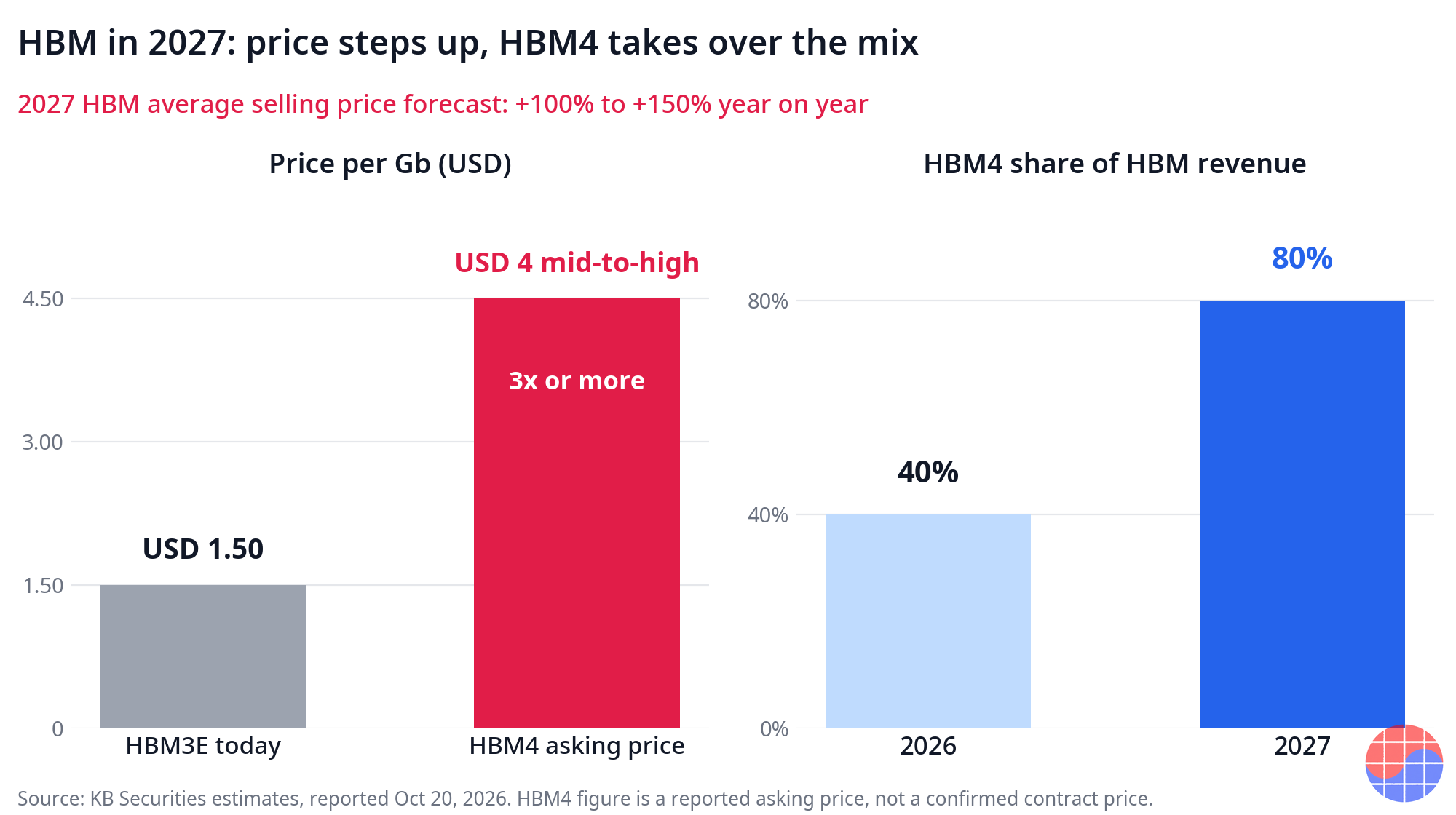
Source: KB Securities report dated October 20, 2026, as reported in the press. Estimates and reported asking prices; confirmed contract prices are undisclosed. Links in the footnote.
The per-Gb comparison is the sharpest single number in the story. A reported HBM4 asking range in the mid-to-high USD 4s per Gb, against roughly USD 1.50 per Gb for HBM3E today, is a generational price step of more than three times — before the mix effect, in which HBM4 doubles its share of HBM revenue to 80% in 2027. Two cautions belong with it, and both are in the sourcing: the USD 4-range figure is a reported asking price, and actual contracted prices are not public; and the ASP and mix figures are analyst forecasts, not company guidance. Even discounted for both cautions, the direction is consistent with the coverage data — a fully booked HBM year is a year in which the seller opens the negotiation.
What the profit estimates imply
KB Securities' operating profit estimates for Samsung Electronics — KRW 367 trillion for 2026 and KRW 555 trillion for 2027 — are the financial translation of the same thesis. A step-up of that size in a single year cannot be produced by volume growth alone in a business of Samsung's scale; it requires the pricing and mix effects described above to land roughly as forecast. Treat the numbers as the analyst's model of the contract story, not as a promise: if 2027 contract prices reset materially lower at renewal points, or AI capital spending pauses, the same leverage works in reverse. The estimates are best used as a measure of how much pricing power the market is now willing to underwrite.
Cross-check: the whole industry pre-sold 2027
If the Samsung figures were idiosyncratic — one company's aggressive contracting — the pricing-power conclusion would be weaker. The cross-checks say otherwise. Micron told investors on its September 30 earnings call that more than 75% of its 2027 production was already committed. SK hynix announced in July that it had completed long-term contracts with around ten major customers. All three major memory makers, in other words, entered the final quarter of 2026 with the majority of their 2027 books written. Buyers did not sign those contracts because memory was cheap. They signed because, across the industry, the remaining uncommitted supply was visibly shrinking.
Chase's Take
The lazy reading of this story is "memory prices are going up." The correct reading is about who holds the pen when the contract is written.
The essence of a long-term agreement at 80% coverage is not volume security — it is the allocation of price and priority. In the old memory market, the quarterly negotiation was where power lived, and buyers usually held it. When four-fifths of next year's output is allocated before the year starts, the negotiation that matters has already happened, and it happened on the seller's timetable. The residual 20% does not soften that conclusion; it sharpens it, because the uncommitted fringe is where desperate buyers set headline prices.
This is the closest the memory industry has come to seller-set pricing since the 2017 supercycle, with one structural improvement from the sellers' point of view: 2017 was a shortage, and shortages end when supply arrives. A book of five-year contracts is a shortage that has been institutionalized. Even if spot conditions soften in a given quarter, the contracted core of the business does not reprice with them.
Two things would break the thesis, and both are observable. The first is renewal behavior: if the 2027 contracts turn out to carry price-reset clauses that hand the upside back to buyers, coverage is a volume story, not a pricing story. The second is the demand side's discipline: hyperscaler capital spending plans for 2028 are the collateral behind every one of these contracts. The nearest verification points are days away — SK hynix reports on October 28 and Samsung Electronics on October 29, and their commentary on contract pricing will either confirm the KB Securities picture or qualify it. That is where to look next, not at spot prices.
Implications
- For hyperscalers and AI platform owners: The 2027 allocation game is effectively over; the competition has moved to 2028 and to the uncommitted fringe. Expect the fringe to be expensive — that is what a residual market in a pre-sold industry looks like.
- For Samsung Electronics: A contracted 2027 book converts the memory cycle from a price bet into an execution task — HBM4 ramp and yield. The forecast mix shift, HBM4 to 80% of HBM revenue, is where the estimate risk now sits.
- For SK hynix and Micron: Parallel coverage (about ten major customers at SK hynix; more than 75% committed at Micron) means no major maker has an incentive to break ranks on price. Discipline is being enforced by contract structure, not by coordination.
- For device and consumer electronics makers: The spillover lands here. Buyers who purchase closer to spot face a thinner residual market and a forecast double-digit DRAM price rise in the first quarter of 2027 alone.
- For investors: The KRW 555 trillion 2027 operating profit estimate is a pricing-power claim wearing a financial model's clothes. The October 28–29 earnings commentary on contract pricing is the cheapest due diligence available on whether to believe it.
FAQ
How much of Samsung's 2027 memory output is already under contract?
About 80% of total 2027 memory production is estimated to be secured under long-term supply contracts, according to a KB Securities report dated October 20, 2026. Within that, commodity DRAM and NAND output is about 70% committed under five-year contracts with global big tech buyers, and annual HBM output is estimated to be 100% contracted. These are analyst estimates, not Samsung disclosures.
How much will HBM prices rise in 2027?
The 2027 HBM average selling price is forecast to rise 100–150% year on year, with HBM4 growing from 40% of HBM revenue in 2026 to 80% in 2027. Reported asking prices for HBM4 are in the mid-to-high USD 4 range per Gb, more than three times the roughly USD 1.50 per Gb of current HBM3E — but those are reported asking prices, and confirmed contract prices have not been disclosed.
Why do long-term contracts move pricing power to memory makers?
Because they shrink the market that clears at negotiated prices. When about 80% of a year's output is allocated in advance, buyers who are not covered must compete for the remaining 20% and spot volume, which prices the fringe upward. The contracts themselves are less about volume than about price and allocation priority — and the next verification point is contract-pricing commentary in the October 28–29 earnings reports.
Is Samsung the only memory maker with 2027 output pre-sold?
No. Micron said on its September 30 earnings call that more than 75% of its 2027 production was already committed, and SK hynix announced in July that it had completed long-term contracts with about ten major customers. The pre-selling of 2027 is an industry-wide structure, which is what makes the pricing-power shift durable rather than company-specific.
Sources: Press report of the KB Securities analysis dated October 20, 2026; Coverage of Samsung's 2027 memory bookings. Contract coverage, price, and profit figures are analyst estimates or reported asking prices as noted in the text, not company disclosures. This article is analysis, not investment advice.
📩 Subscribe to VLSI Korea
Get our daily semiconductor deep-dives delivered to your inbox first. Free to subscribe.