VLSI Korea
The Semiconductor Price Domino: From Equipment to Foundry to Materials — Who Foots the Final Bill?
High-NA EUV tools cost USD 380M each, TSMC keeps raising wafer prices, and silicon wafer makers ended a 3-year price freeze. How cost increases flow from equipment to foundry to materials to final chip prices — the full picture as of October 2026.


🆓 Free article · Anyone can read this article for free
From 2024 through October 2026, prices have risen at every stage of the semiconductor supply chain. A lithography tool now costs twice what it did, TSMC has raised wafer prices three years in a row, and silicon wafer makers have ended a three-year price freeze. These costs flow in one direction: equipment → foundry → materials → fabless → end products. At each stage, whoever holds pricing power keeps the margin. The final bill lands on enterprise customers and consumers.
This post tracks the 2024–2026 numbers across equipment, foundry, and materials, and traces how costs pass through to final chip prices. (As of October 2026)
1. Equipment: the lithography tool that doubled in price
The most dramatic increase came from lithography. ASML's High-NA EUV (Twinscan EXE) costs about USD 380 million per tool — more than double the Low-NA EUV (Twinscan NXE, about USD 183 million). Intel completed acceptance testing of the EXE:5200B at its Oregon D1X fab in January 2026, with annual production targeted at 20 tools by 2028.
DUV tools went up too. ASML notified customers of a 10% DUV price increase in July 2026. Samsung and SK hynix reportedly accepted it; TSMC reportedly pushed back. Applied Materials announced price increases on both new and existing products in its August 2026 earnings, and Tokyo Electron said in late July 2026 it would adjust prices including on already-delivered tools.
- Tool lead times: from about 6 months to up to 1 year (major vendors)
- Critical component lead times: up to 40 months for key Japanese parts in laser processing tools
- Korea's H1 2026 semiconductor equipment imports: USD 18.76 billion, +38.8% year on year
The cause is straightforward. AI data center investment drove simultaneous memory and foundry expansions, tangling equipment and component supply, on top of inflation and raw material costs. The industry verdict: "unlike in the past, buyers' (chipmakers') pressure for price cuts no longer works — suppliers hold the negotiating power." Equipment has become a seller's market.
2. Foundry: TSMC's third straight year of price hikes
TSMC's wafer price increases are now in their third year.
- 2025: up to +10% for AI/HPC customers. 4nm wafers rose from USD 18,000 to USD 20,000.
- Jan 1, 2026: +5–10% across all sub-5nm nodes (2/3/4/5nm).
- H2 2026: up to +15% on 3nm.
- Jan 2027: +3–6% across all nodes under discussion, with a further +6–8% on 2nm in Q1 2027 reportedly decided.
TSMC does not disclose wafer prices, but industry estimates put them as follows. (Estimates)
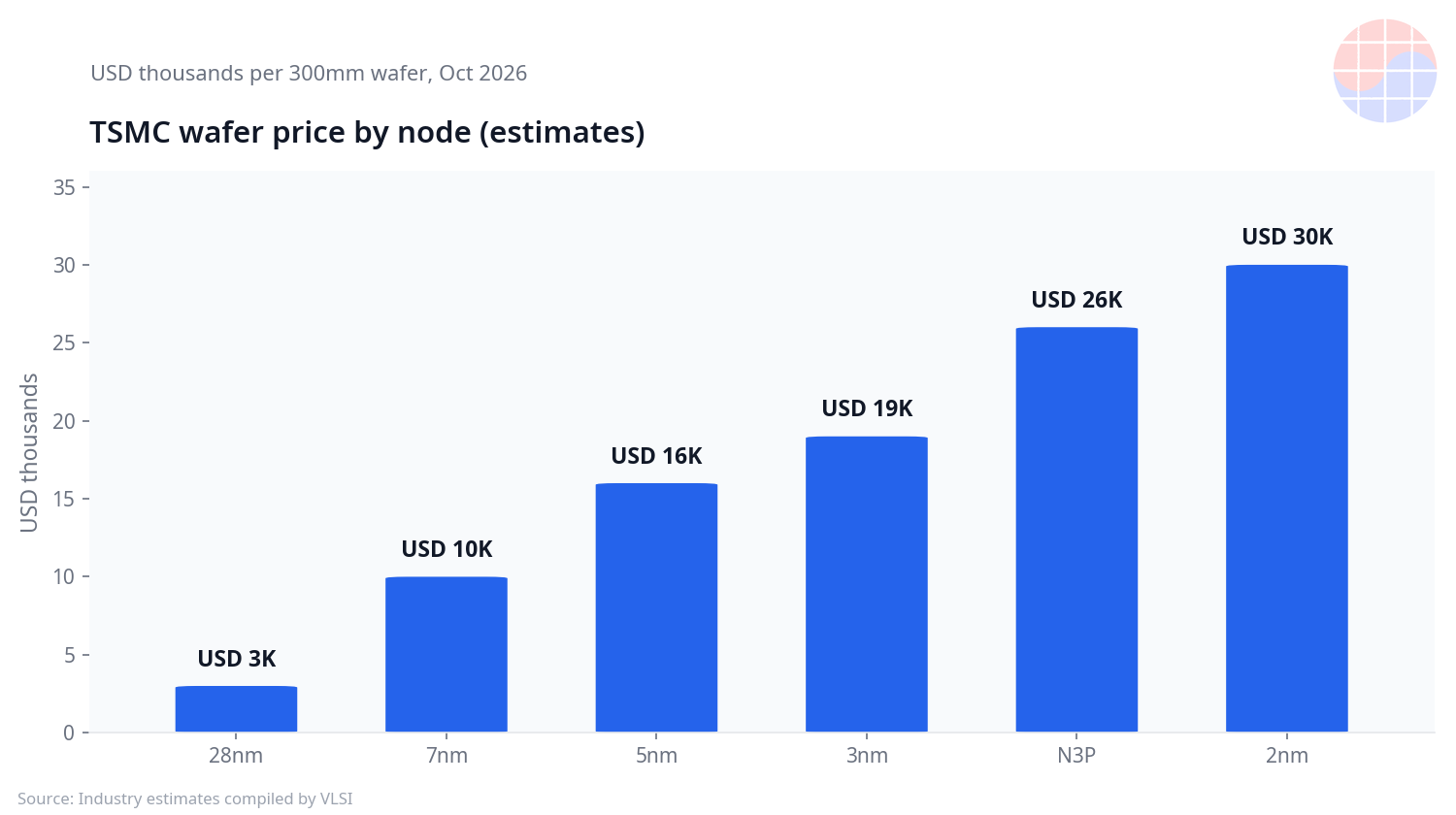
The justification is clear: recovering USD 65 billion-plus in overseas fab investment including Arizona, and defending a gross margin above 53%. Chips made in Arizona cost 5–20% more than those made in Taiwan.
Other foundries have joined in. Samsung Foundry applied a one-time ~+15% on selected nodes (4nm, 5nm, some 8nm) for new customers. SMIC raised 8-inch and memory foundry prices. UMC has hinted at increases, and PSMC is pushing up to +40% on some products.
3. Materials: the three-year freeze is over
Overshadowed by equipment and foundry, material prices have been quietly rising too.
- Silicon wafers: Taiwan's big three wafer makers raised prices by at least +10% across all diameters (6/8/12-inch) in August 2026 — ending a freeze of more than three years. 2027 supply is under negotiation at +10–15%, centered on 300mm.
- ABF substrates: Ajinomoto notified substrate makers of a +30% ABF film price hike, effective Q3 2026. The ABF supply gap is projected to widen to ~20% in 2027.
- EUV photoresist: 3–5x the per-liter price of ArF immersion resist. With 15–20 EUV layers at 3nm, the price premium compounds with layer-count growth.
- Helium: the US helium price index jumped +118% quarter on quarter in Q2 2026 (reflecting spot and logistics premiums; highly volatile).
- Blank masks: 2025 average price about USD 10,514 per m².
Drivers include AI/HBM/advanced-logic wafer consumption growth (+23% for HBM, +12% for advanced logic) against just +3% growth in 300mm capacity, plus logistics shocks such as Middle East shipping disruptions.
4. The pass-through structure: depreciation is the fab's biggest cost
Why do rising equipment prices push wafer prices up? TSMC's 2025 annual report (20-F) has the answer. Depreciation of property, plant and equipment in cost of revenue rose from NT$492.8B (2023) to NT$616.4B (2024) to NT$638.0B (2025) — about 43% of cost of revenue (USD 48.7B), the single largest cost item.
The more advanced the node, the more equipment depreciation dominates cost structure. Pricier tools mean higher depreciation, which lifts wafer costs and underwrites foundry price hikes.
- 3nm wafer USD 15,500 → die cost USD 30.45 (vs USD 23.57 at 5nm)
- Apple A18 Pro case: 3nm wafer at USD 18,000, USD 0.25 per mm² — 3.6x the USD 0.07 of the 28nm A7 era.
- Yield matters: TSMC N3 yields are reportedly 90%+, while Samsung's 3nm yields sit in the 30–40% range. Lower yields sharply raise cost per good die.
The chain works like this: equipment price hikes → higher fab depreciation → higher wafer costs → foundry price hikes → higher fabless costs → higher chip prices → higher end-product prices. Each stage passes costs downstream, and whoever holds pricing power protects their margin.
5. Final prices: who gets the bill
At the end of the chain, real price increases are confirmed.
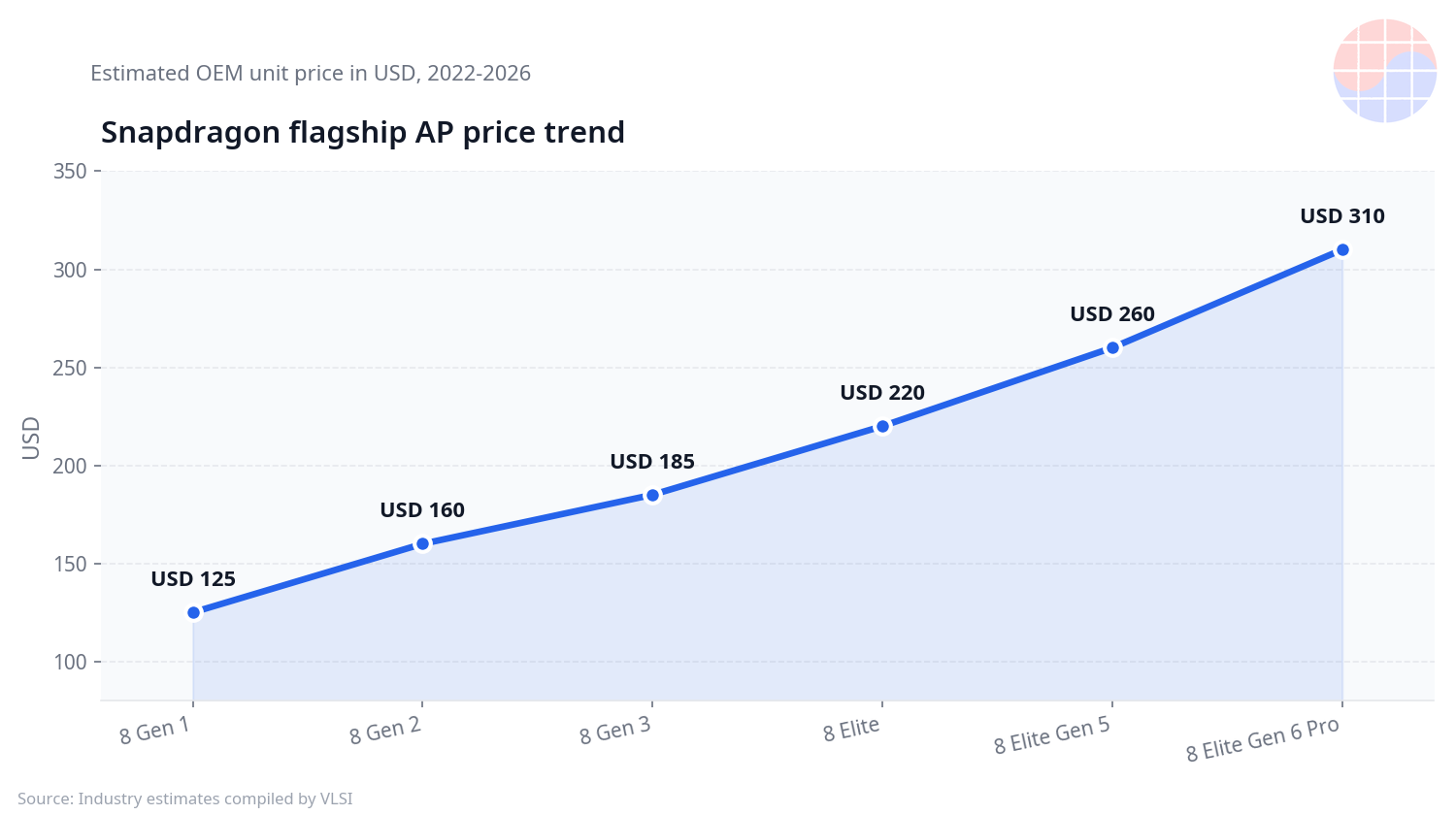
Smartphone APs: estimated OEM unit prices for flagship Snapdragon rose from USD 120–130 (8 Gen 1) to USD 240–280 (8 Elite Gen 5). The 2nm-based 8 Elite Gen 6 Pro is projected above USD 300. (Estimates)
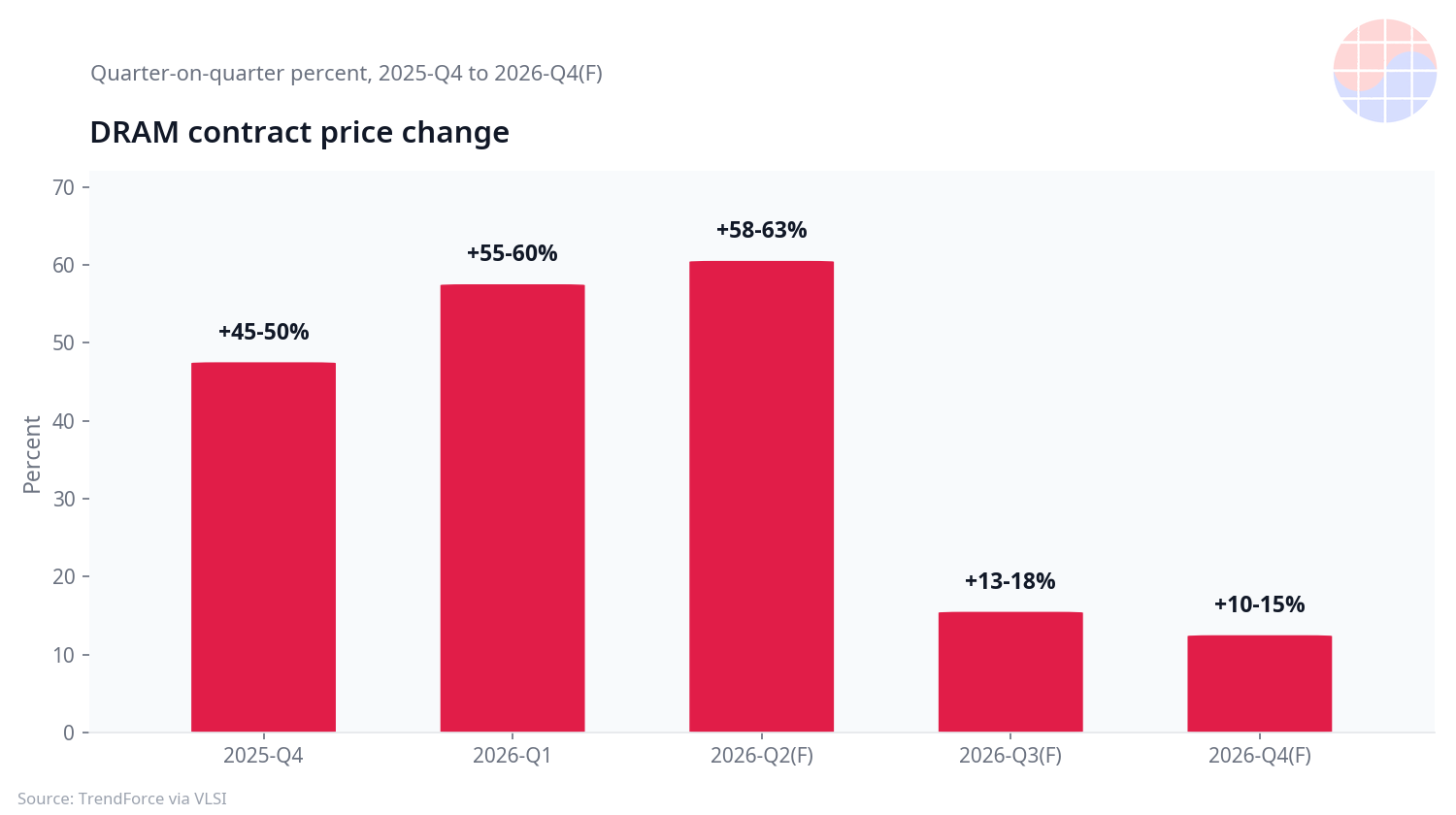
Memory: DRAM contract prices jumped +45–50% in Q4 2025 → +55–60% in Q1 2026 → +58–63% in Q2 2026 (forecast). Server DRAM is projected +270% for 2026. DDR5 spot prices went from USD 6.84 (Sep 2025) to USD 27.20 (Dec 2025) — roughly 4x in three months.
End products: Dell raised server prices on December 10, 2025, with industry-wide server increases of ~+15% and PC increases of 15–20%. Gartner forecasts 2026 average PC prices +17% and smartphones +13%. HP says memory now accounts for ~35% of PC bill of materials, up from 15–18% two quarters earlier.
Cloud: renting GPUs got more expensive too. In the October 1, 2026 price lists, H100 hourly rates rose from USD 3.85 to USD 4.50 (+16.9%) and B200 from USD 7.15 to USD 8.50 (+18.9%).
6. VLSI's View: pricing power wins
What stands out in this domino is the asymmetry of pass-through.
At the equipment stage, ASML holds pricing power — there is no substitute for EUV, so foundries absorb the hikes as depreciation. At the foundry stage, TSMC holds it — its advanced-node monopoly lets it pass increases to customers while defending 53% margins. In memory, the three-player oligopoly plus AI demand has shifted contract pricing power to manufacturers. At the fabless stage, Qualcomm and MediaTek pay up to +24% more for TSMC N3P yet still raise Snapdragon prices to pass it on. A USD 300+ chip now accounts for about a third of a flagship phone's bill of materials.
The burden ultimately reaches data center operators and cloud bills — and consumers buying PCs and smartphones. The forecast +17% in 2026 average PC prices is the evidence.
The outlook isn't brighter. TSMC's additional +3–6% across all nodes in January 2027, HBM prices projected +70–140% in 2027, and a prolonged memory shortage (projected to last until ~2030) are all on the calendar. The wafer fab equipment (WFE) market is projected to grow from USD 145B in 2026 to USD 200B in 2027 and USD 250B in 2028.
The takeaway: this semiconductor price surge is structural, not a passing cycle. Equipment price hikes are cemented into costs as depreciation, and as long as AI demand outstrips supply, the pass-through chain keeps moving. If you buy chips, the question is whether you have the pricing power to pass costs on. If you make them, the question is where that power sits.
FAQ
What is the biggest reason semiconductor prices rose?
No single cause — the entire chain raised prices. AI-driven shortages compounded equipment and material cost increases, and each stage's pricing-power holder passed the increase downstream to final prices.
Why does TSMC keep raising wafer prices?
Recovering USD 65B+ in overseas fab investment including Arizona, defending 53%+ gross margins, and its monopoly position in advanced nodes. From +10% in 2025 to +3–6% across all nodes in January 2027, increases have run three years straight.
How much did consumer product prices rise?
Gartner forecasts 2026 average PC prices +17% and smartphones +13%. Servers saw ~+15% increases, and cloud GPU rental rates rose 17–21%.
How long will the price increases last?
Likely a while. TSMC's 2027 increases, HBM prices projected +70–140% in 2027, and a prolonged memory shortage all point to continued pressure.
Note: some figures (TSMC wafer prices, Snapdragon unit prices) are industry estimates, as manufacturers do not disclose them. Official figures per ASML earnings, TSMC 20-F, and TrendForce. As of October 2026.