VLSI Korea
Top 10 Countries for Semiconductor Engineer Pay (After Tax)
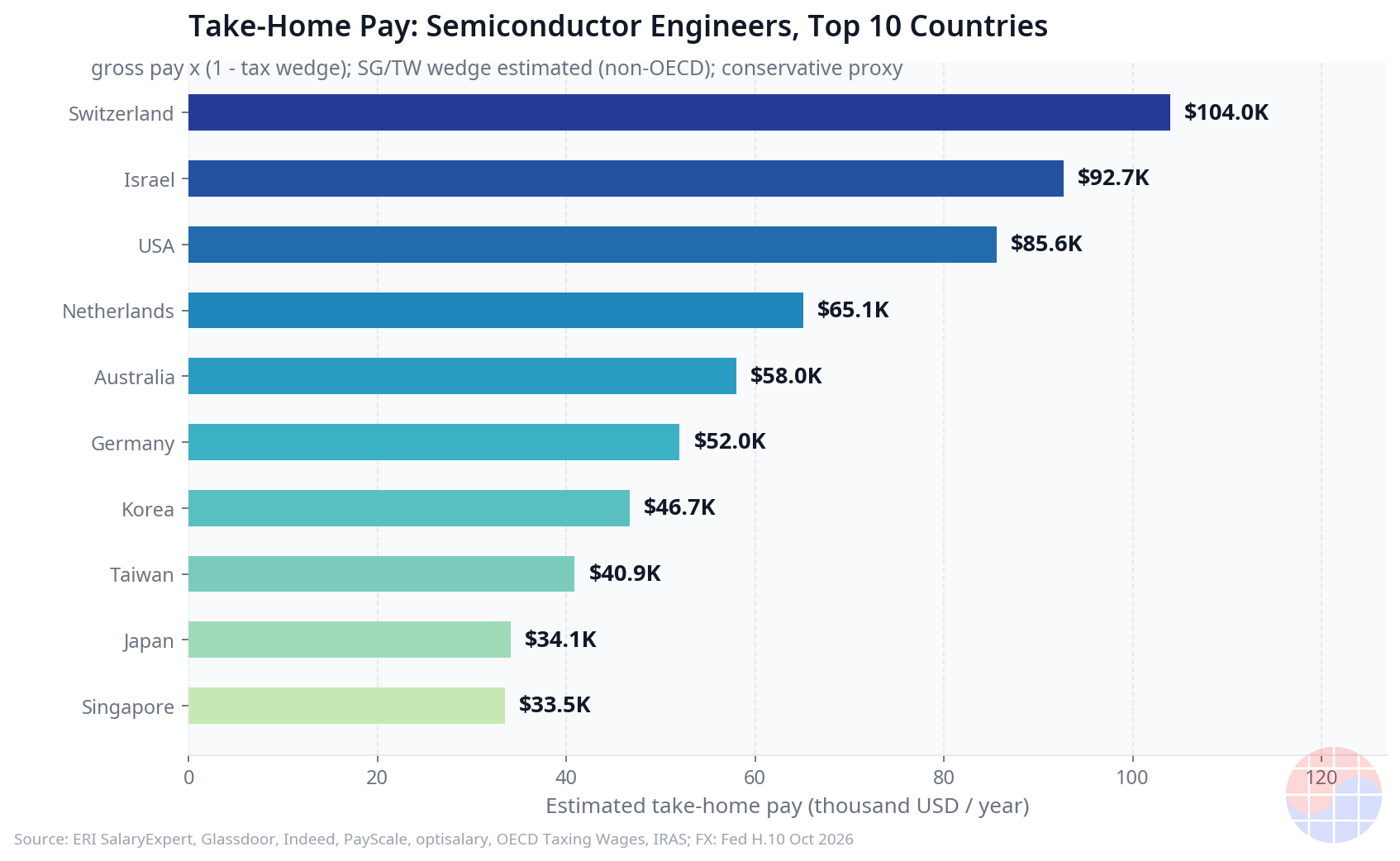
30-Second Summary * Gross salary is a mirage. For the same "semiconductor engineer" title, the tax wedge alone flips the ranking. By take-home pay, number one is Switzerland at about 104,000 USD a year. * Number two is Israel (about 92,700 USD) — high gross meets a low 23.6% tax wedge. The most underrated destination for


30-Second Summary
- Gross salary is a mirage. For the same "semiconductor engineer" title, the tax wedge alone flips the ranking. By take-home pay, number one is Switzerland at about 104,000 USD a year.
- Number two is Israel (about 92,700 USD) — high gross meets a low 23.6% tax wedge. The most underrated destination for chip designers.
- The USA ranks third (about 85,600 USD). ERI puts gross at 123,161 USD, but a 30.5% tax wedge eats a chunk. Note: RSUs are not in this math.
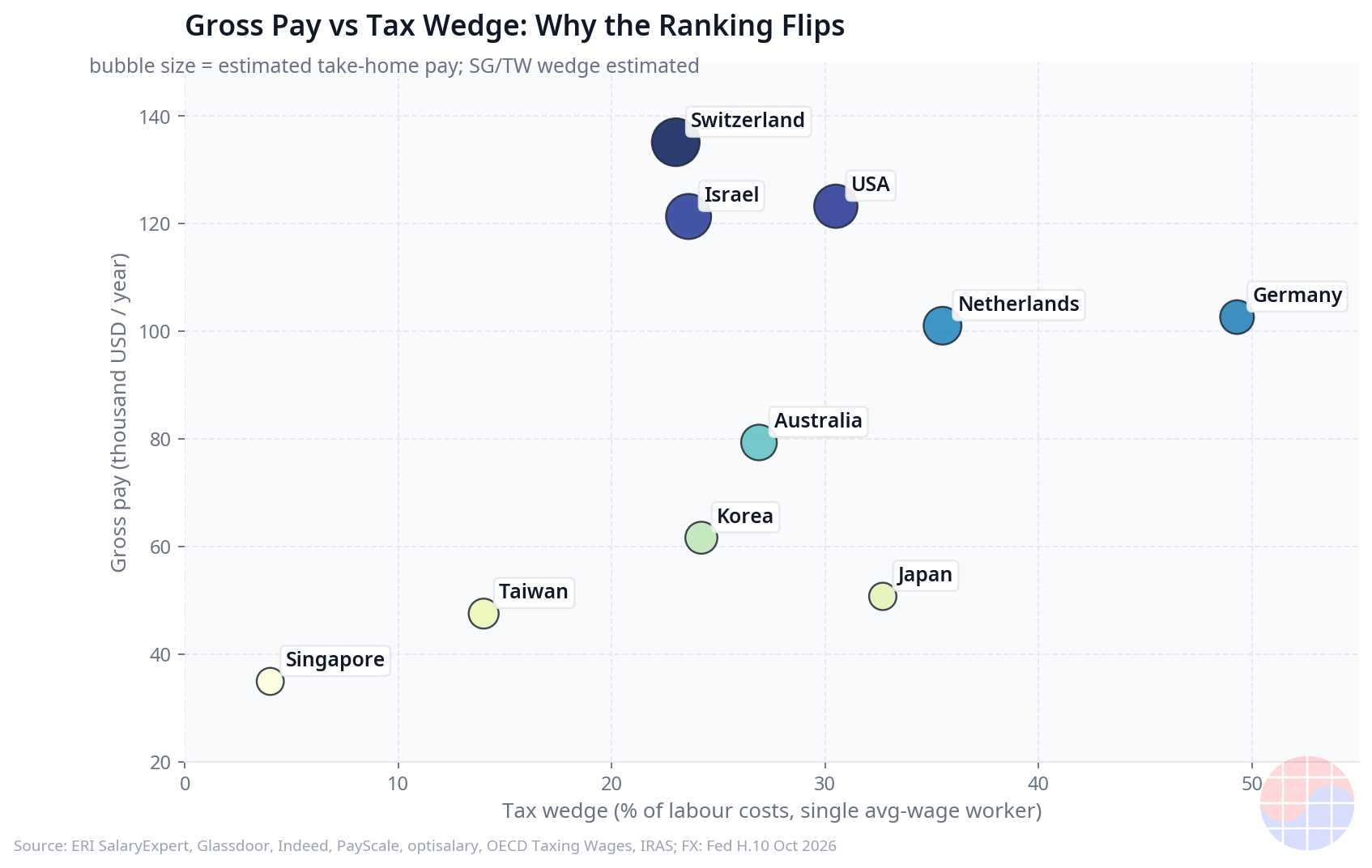
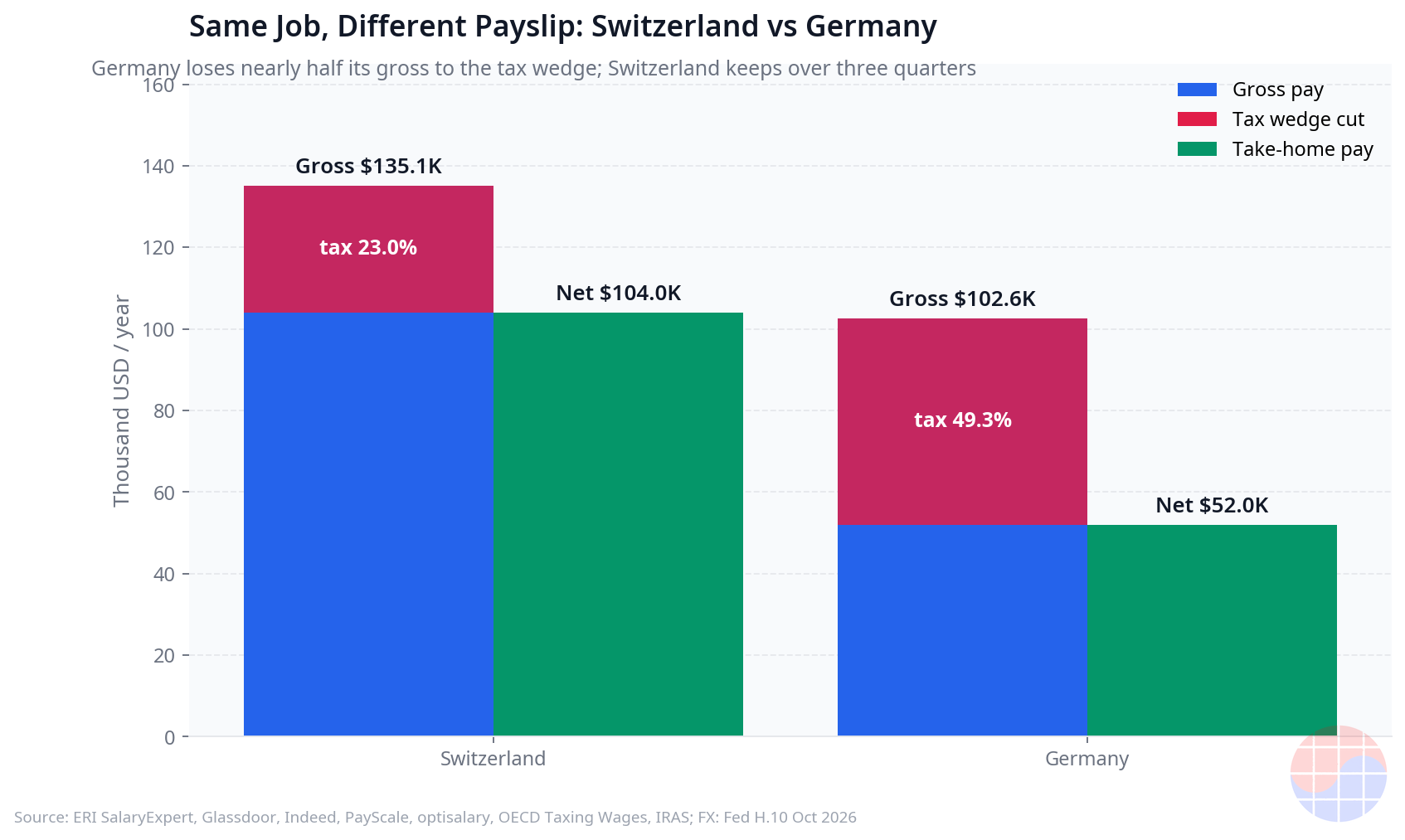
- The European paradox: Germany is 5th by gross (102,600 USD) but 6th by take-home (52,000 USD). Its 49.3% tax wedge takes half. The Netherlands (65,100 USD) leapfrogs it.
- Singapore wins on "tax efficiency" — an effective rate of about 4%. Lowest gross of the ten, but almost no tax.
- Korea is 7th (about 46,700 USD). Gross of KRW 82,963,021 (ERI) with a 24.2% tax wedge, far below the OECD average of 35.1%. On taxes alone, Korea treats engineers well.
- Method: gross (local currency) x (1 - tax wedge), FX from Fed H.10 on 2026-10-02. The wedge comes from OECD Taxing Wages (single worker at the average wage, including employer contributions) — a conservative proxy, so real take-home runs slightly higher.
Intro: The Neighbor's Rice Cake Looks Bigger (Until the Tax Bill Arrives)
Every Korean semiconductor engineer knows the meme: "Move to the US and double your salary" — followed by the inevitable rebuttal, "after taxes it's all the same." Both are half right, and nobody ever did the math.
Picking a country by gross salary is like picking a restaurant by the menu price before tip and tax. You walk in thinking it's cheap, then the bill arrives. The only number that matters is take-home — what actually lands in your account.
So this piece does the math head-on. Ten countries' semiconductor engineer gross pay, unified into USD, run through OECD Taxing Wages tax-wedge data to get take-home pay. The results surprised me. Gross number one and take-home number one are the same country, but everything below rank two is a different picture. And Germany — sorry — is a tax graveyard.
Deep Dive: Ten Country Episodes
The rules first. Gross figures prioritize ERI SalaryExpert; where ERI has no country page, I used the semiconductor engineer (or closest-matching role) average from Glassdoor, Indeed, PayScale, or optisalary — each cited inline. The tax wedge is OECD Taxing Wages (single worker at the average wage: income tax + employee SSC + employer SSC). Because that metric includes employer contributions in its denominator, real take-home is slightly higher than the estimates below — I stayed conservative. Singapore and Taiwan are not OECD members, so their wedges are estimates from the IRAS rate schedule and Taiwan's tax system, marked accordingly.
#1 Switzerland — take-home ~104,000 USD (gross 135,100 USD, wedge 23.0%)
Switzerland tops both gross and take-home. PayScale's semiconductor manufacturing average of CHF 112,000 converts to about 135,100 USD. After the 23.0% wedge, 104,000 USD remains — more than 11,000 USD clear of second-place Israel. Dominant.
What does the money actually buy? Zurich is one of the priciest cities on earth. Rent and lunch money gnaw at the bragging rights. Still, plenty remains. Switzerland's real weapons are low taxes and a strong franc. The catch: work permits for non-EU nationals run on tight quotas, and chip jobs cluster around Zurich and Lausanne, so options are narrow.
#2 Israel — take-home ~92,700 USD (gross 121,300 USD, wedge 23.6%)
The dark horse of this ranking. PayScale's design verification engineer average of ILS 370,000 converts to about 121,300 USD. With a wedge of just 23.6%, take-home hits 92,700 USD — ahead of the USA.
Why so high? Israel's hardware engineer shortage is now a "national issue" (Globes, 2026-10-06). The same reporting notes chip and system architects clearing NIS 100,000 a month in some cases. Design centers of Intel, NVIDIA, Broadcom, and Apple compete for talent with money. Immigration bonus: English is the working language, and non-Jewish engineers enter on B-1 work visas. Geopolitical risk is yours to judge — but on numbers alone, this is the most underrated destination for Asian engineers.
#3 USA — take-home ~85,600 USD (gross 123,161 USD, wedge 30.5%)
ERI puts the average US semiconductor engineer at 123,161 USD gross. After the 30.5% wedge: 85,600 USD. It slips from 2nd by gross to 3rd by take-home.
One trap here: this math excludes RSUs. ERI's average bonus figure is only 4,360 USD, but actual big-tech and fabless equity grants dwarf that average. So the USA ranks 3rd on "average" — yet in the top quartile it is the only country that threatens Switzerland. The price: the H-1B lottery, a game of luck no skill can cover, and wildly different tax rates by state — California and Texas are effectively different countries.
#4 Netherlands — take-home ~65,100 USD (gross 101,000 USD, wedge 35.5%)
The Netherlands beats Germany. ERI's electro-optical engineer average (the closest role to ASML lithography) of EUR 89,732 converts to about 101,000 USD. After the 35.5% wedge, 65,100 USD remains — 13,000 USD more than Germany on lower gross.
Then there is the expat secret weapon: the 30% ruling, which exempts 30% of taxable income for qualifying incoming talent (2026 criteria apply). With it, take-home climbs above the chart. It is being scaled back from 2027, so it is not forever — but it changes the felt salary of your first five years.
#5 Australia — take-home ~58,000 USD (gross 79,300 USD, wedge 26.9%)
PayScale's Engineering Design, Semiconductor average of AU$114,000 converts to about 79,300 USD. A 26.9% wedge leaves 58,000 USD — ahead of Germany on take-home despite Germany's gross being 23,000 USD higher.
Australia's appeal is structure, not numbers. The skilled-migration points system is transparent, it is English-speaking, and engineer demand is solid in defense, mining, and energy. Chip jobs are thinly spread across Sydney and Melbourne — go as an "engineer," not as a "chip person."
#6 Germany — take-home ~52,000 USD (gross 102,600 USD, wedge 49.3%)
The plot twist of this piece. Optisalary's semiconductor engineer average of EUR 91,121 converts to about 102,600 USD — 5th by gross. But the tax wedge is 49.3%, among the OECD's highest. Half vanishes into taxes and social contributions; take-home is 52,000 USD, 6th place. The gap to Korea (46,700 USD) is barely 5,000 USD.
Germany's EU Blue Card keeps the door open for non-EU engineers, and the Dresden/Munich clusters around Infineon and Bosch are solid. But "moving to Germany for the raise" deserves a calculator first. The counterargument — thick welfare and pensions — is a story about 30 years from now; your bank balance is a story about today.
#7 Korea — take-home ~46,700 USD (gross 61,600 USD, wedge 24.2%)
ERI's Korea average of KRW 82,963,021 converts to about 61,600 USD. The 24.2% wedge sits far below the OECD average of 35.1%. Take-home: 46,700 USD, 7th place. Note the gap to Germany is only about 5,000 USD — one-eighth of the 41,000 USD gross gap.
Korea's real problem is not taxes but structure: low gross itself, plus uncompensated overtime intensity. On tax rates alone, Korea treats engineers decently. Anyone dismissing "Korean salaries" in a job negotiation will find the tax card hard to play.
#8 Taiwan — take-home ~40,900 USD (gross 47,500 USD, wedge ~14%*)
Taiwanese chip-engineer medians: NT$1.72M for analog IC design, NT$1.59M for digital IC design (Asia Business Daily, 2026-09-11, citing local job-market data). I used NT$1.52M — the mean of four role medians — as the representative figure, about 47,500 USD. Taiwan is not in the OECD, so the ~14% wedge is an estimate (effective income tax plus labor and health insurance). Take-home: about 40,900 USD.
Taiwan's paradox: the country with the world's best fabs pays its engineers 8th of ten on gross. But TSMC and MediaTek bonuses inflate the total — top employers' average employee compensation exceeds NT$4M (BigGo Finance, 2026). "Go to Taiwan, go to TSMC" is the answer for a reason. The Employment Gold Card also makes the professional visa relatively smooth.
#9 Japan — take-home ~34,100 USD (gross 50,700 USD, wedge 32.7%)
Glassdoor's Tokyo semiconductor engineer average of JPY 8.0M converts to about 50,700 USD. After the 32.7% wedge: 34,100 USD. Caveat upfront: the sample is tiny (3 Glassdoor entries), so the error band is wide.
Japan's problem is the exchange rate and wage stagnation more than taxes. Yen weakness eats the dollar-converted gross. Jobs are growing — Rapidus, TSMC Kumamoto, Micron Hiroshima — but without gross growth, Japan cannot win the take-home game.
#10 Singapore — take-home ~33,500 USD (gross 34,900 USD, wedge ~4%*)
Indeed's semiconductor engineer average of S$3,715/month (121 reports, 2026-08) annualizes to S$44,580, about 34,900 USD. Tax is roughly 2-4% effective under the IRAS schedule — Employment Pass holders do not pay CPF (pension) either. Take-home: 33,500 USD, nearly identical to gross.
Last place, but with a story. That Indeed average skews junior and understates reality — Micron Singapore's semiconductor engineer average is S$89,500 (Indeed, 2026). Experienced hires should redo the math entirely. Singapore is a "tax efficiency" country, not a "gross" country. Remember: what you don't pay in tax becomes savings.
Table: take-home = gross x (1 - tax wedge). Singapore/Taiwan wedges are estimates (non-OECD).
| Rank | Country | Gross (local) | Gross (USD) | Tax wedge | Take-home (USD) | Gross source |
|---|---|---|---|---|---|---|
| 1 | Switzerland | CHF 112,000 | 135,100 | 23.0% | 104,000 | PayScale (semiconductor manufacturing avg) |
| 2 | Israel | ILS 370,000 | 121,300 | 23.6% | 92,700 | PayScale (design verification engineer) |
| 3 | USA | $123,161 | 123,161 | 30.5% | 85,600 | ERI SalaryExpert |
| 4 | Netherlands | EUR 89,732 | 101,000 | 35.5% | 65,100 | ERI (electro-optical engineer) |
| 5 | Australia | AU$114,000 | 79,300 | 26.9% | 58,000 | PayScale |
| 6 | Germany | EUR 91,121 | 102,600 | 49.3% | 52,000 | optisalary |
| 7 | Korea | KRW 82,963,021 | 61,600 | 24.2% | 46,700 | ERI SalaryExpert |
| 8 | Taiwan | NT$1,520,000 | 47,500 | ~14%* | 40,900 | Asia Business Daily (role-median mean) |
| 9 | Japan | JPY 8,000,000 | 50,700 | 32.7% | 34,100 | Glassdoor (small sample) |
| 10 | Singapore | S$44,580 | 34,900 | ~4%* | 33,500 | Indeed (121 reports) |
Wedge sources: OECD Taxing Wages (Germany 49.3% and Switzerland 23.0% from Taxing Wages 2026, 2025 earnings year; other OECD members from the same report series), Singapore from the IRAS 2025 rate schedule (estimate), Taiwan from Taiwan income tax plus labor/health insurance (estimate). FX: Fed H.10, 2026-10-02.
Tech Tree for Korean Engineers
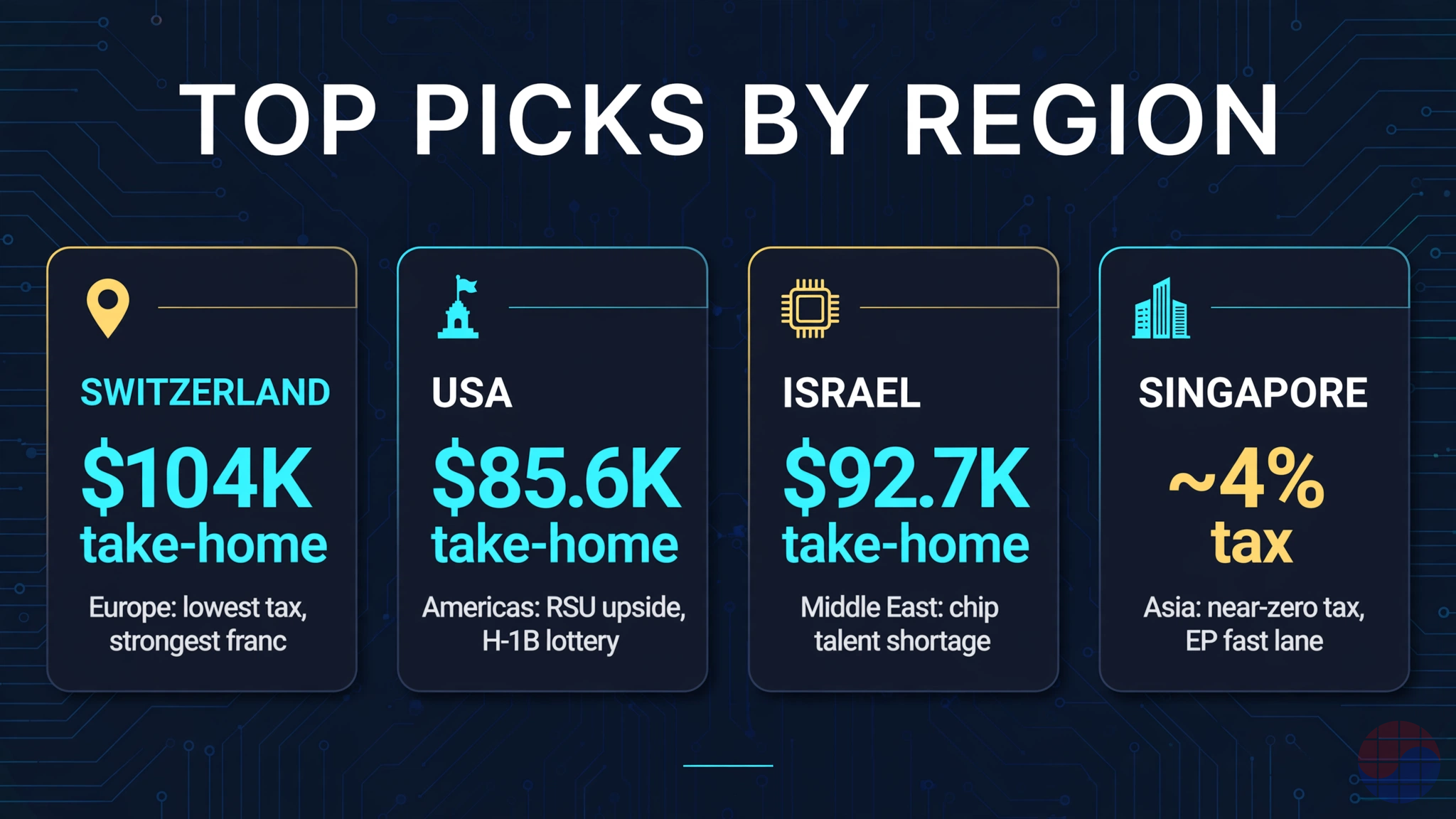
You have seen the numbers; here are the routes. Each scores difficulty (hiring + visa barriers) and reward (take-home + career optionality).
Route A: The Swiss Precision Strike — Difficulty ★★★★☆ / Reward ★★★★★
Path: ETH Zurich / EPFL master's or PhD into a Swiss employer, or an internal transfer to a Swiss entity of a global chip company. The non-EU quota permit is the hardest gate. Clear it and you save in the strongest currency of the top take-home country. Engineering runs on English, but settling in takes German.
Route B: The US H-1B Lottery — Difficulty ★★★★★ / Reward ★★★★★
Path: US master's → OPT → H-1B lottery → big tech or fabless. The lottery is the one gate skill cannot cover. But when RSUs hit, take-home math stops mattering — the top quartile is the only segment that threatens Switzerland. The O-1A (extraordinary ability) visa is the back door around the lottery.
Route C: The Israel Hardware Express — Difficulty ★★★☆☆ / Reward ★★★★☆
Path: 3+ years of chip design/verification → direct application to Israeli design centers (Intel, NVIDIA, Broadcom, Apple). With hardware engineers a national shortage, experienced demand is solid. A 23.6% wedge on high gross makes take-home #2. Hebrew not required; English is the working language.
Route D: The Singapore EP Fast Lane — Difficulty ★★☆☆☆ / Reward ★★★☆☆
Path: experienced hire at a Singapore fab/assembly player (Micron, GlobalFoundries) → Employment Pass. Lowest visa barriers, unbeatable tax rate, high savings rate. Gross itself is modest, so go for the "saving game." Housing is the variable.
Shared skill tree: working-level English → depth in one domain (STA/PD/DFx at senior level) → one of open source, papers, or patents. In every route, "proven skill in Korea" comes before the visa paperwork.
Chase's Take
Honestly, before running these numbers, I thought "the US is the answer." Working at Synopsys, I once reached the final round at a US big-tech company. The outcome was the visa sponsorship wall — not a skill problem, a paperwork problem. That taught me careers are a skill game and an institutions game at the same time.
This table says one simple thing. Don't get excited by gross. Look at the tax wedge first, then layer on RSUs, bonuses, and cost of living. Germany's 49.3% is not just a number — it is a declaration that half your salary is not yours. Israel's 23.6% means your skill stays in your account.
The most realistic move for a Korean engineer sits, paradoxically, in the least-discussed place: Israel. While everyone stares at the US, your STA/PD experience commands a premium in a country with a national hardware-engineer shortage. Judge the geopolitical risk yourself. But put gut feelings aside in front of numbers. Calculators don't lie.
FAQ
Q1. Switzerland is #1 by gross — is it also #1 by take-home?
Yes. At 135,100 USD gross and a 23.0% wedge, take-home is about 104,000 USD — the only country topping both lists. That said, Zurich's cost of living is among the world's highest, so the felt gap is smaller than the table suggests.
Q2. Does including US RSUs change the ranking?
It can. This analysis uses base plus average bonus; RSUs are excluded. Add top-tier big-tech RSUs and the USA becomes the only challenger to Switzerland. At a mid-size fabless with no RSUs, the table stands as is.
Q3. What exactly is the tax wedge?
An OECD Taxing Wages metric: income tax plus employee and employer social security contributions, as a share of total labor costs. Because employer contributions are included, real take-home runs slightly above this piece's estimates.
Q4. Singapore ranks last — why go there?
Last by gross, first by tax efficiency. The Indeed average (S$44,580) skews junior; top employers like Micron pay around S$89,500. Experienced hires should redo the math. Visa barriers are low and taxes near zero, so the savings rate is high.
Disclaimer: this is not investment or immigration advice. Figures are estimates and vary with individual circumstances; always verify against official sources before deciding.