VLSI Korea
Semiconductor Equipment Companies Ranked: Global Top 5, Top 10 and Korea's Makers Explained
The semiconductor equipment ranking by revenue: ASML, Applied Materials, Lam Research, Tokyo Electron and KLA lead a record USD 135.1B market. Includes segment leaders, Korea's SEMES and Hanmi, and why the ranking rarely changes.


🆓 Free article · Anyone can read this article for free
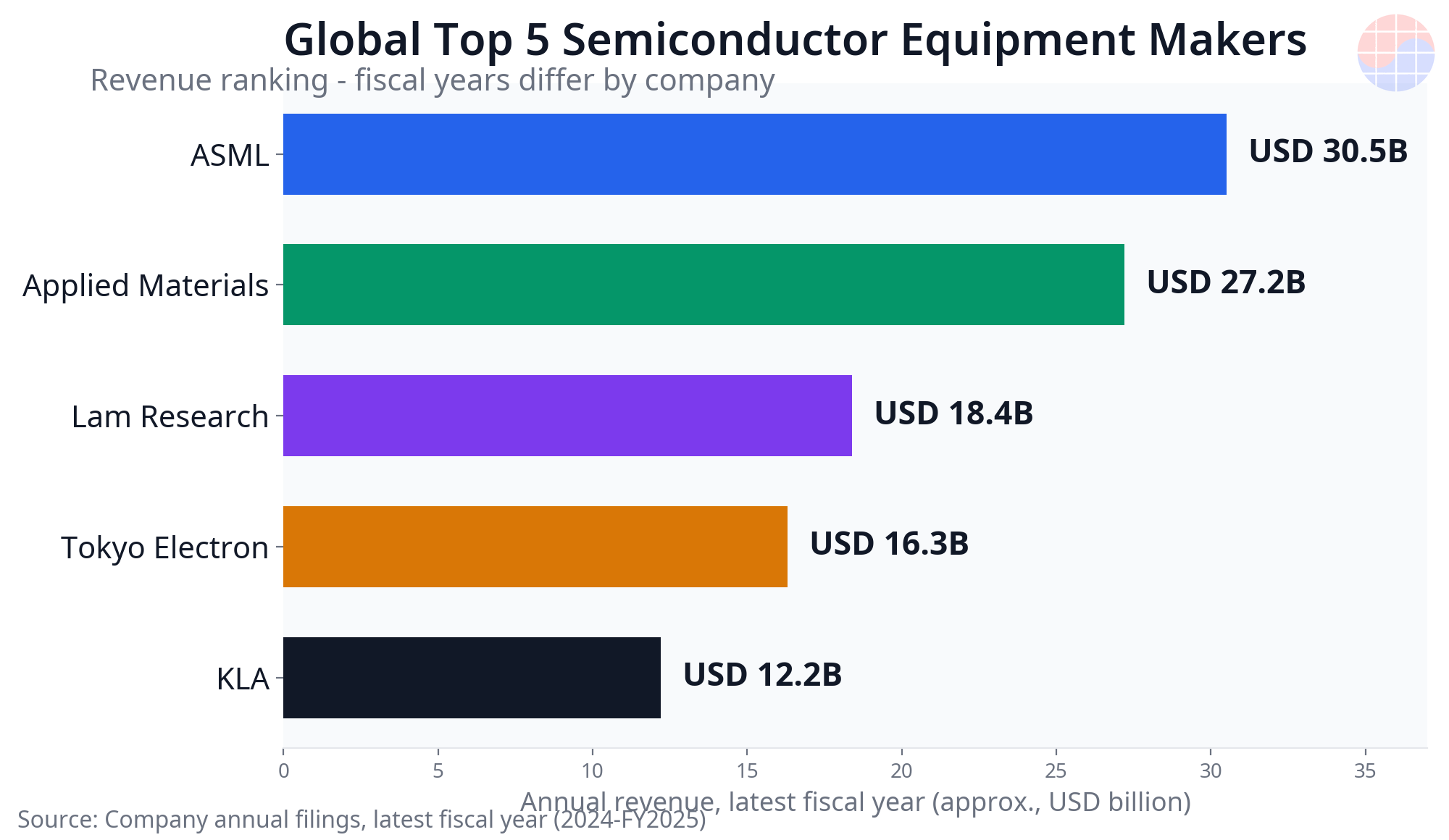
The global semiconductor equipment market is ruled by five companies. Ranked by revenue: 1. ASML, 2. Applied Materials, 3. Lam Research, 4. Tokyo Electron, 5. KLA. Together they take about 85% of the revenue of the top 10 vendors (CINNO Research, first half of 2025). The total market hit a record USD 135.1 billion in 2025 (SEMI). Korea, one of the world's top three equipment buyers, has not a single company in the global top 10.
This guide ranks semiconductor equipment companies as of October 24, 2026 — by revenue, by process segment, and with a separate ranking for Korean makers. It also explains the ranking method first, so you can judge why other lists sometimes show a slightly different order.
Market size: a record USD 135.1 billion in 2025
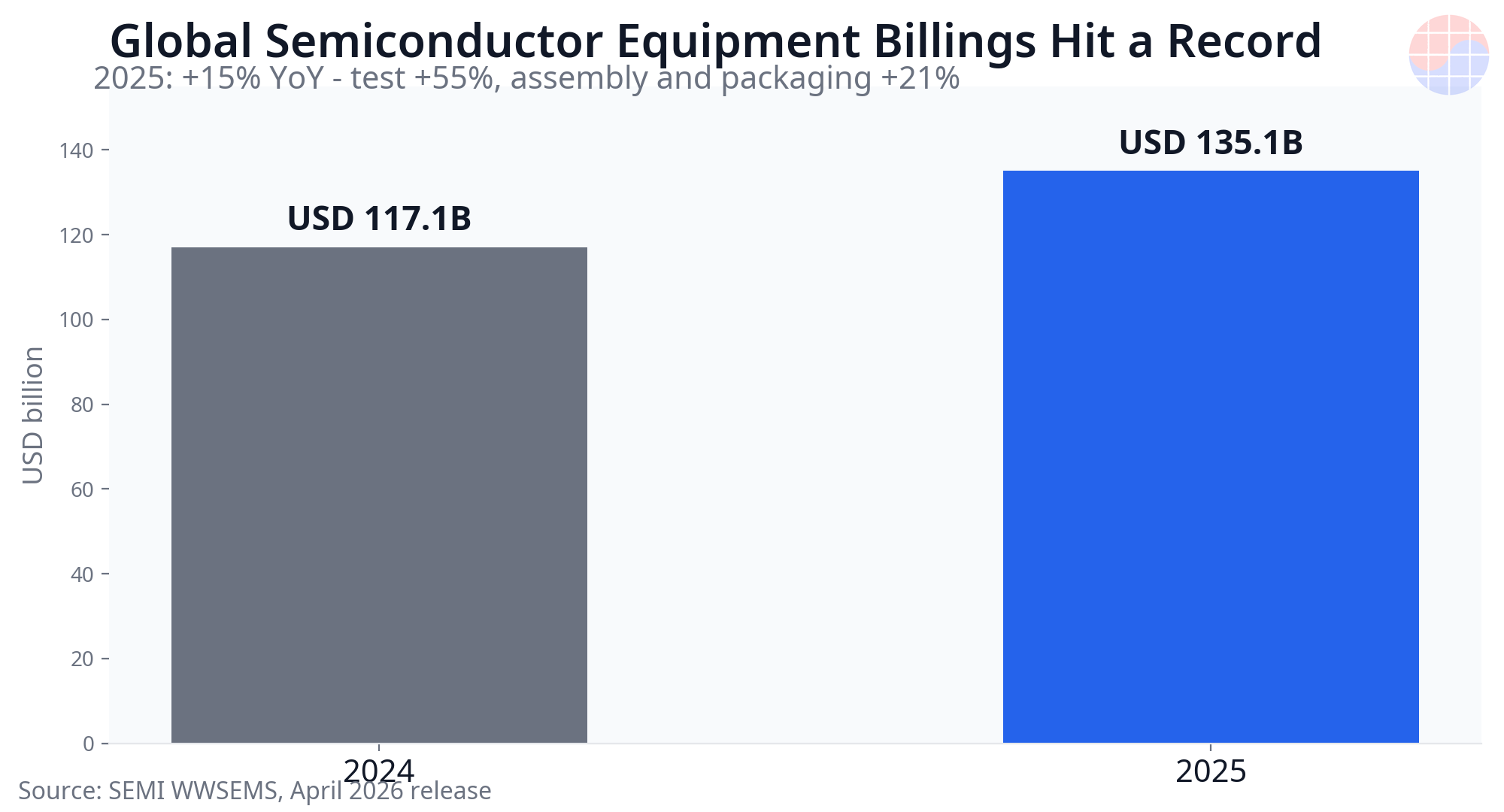
According to SEMI's WWSEMS statistics, worldwide semiconductor manufacturing equipment billings rose 15% to USD 135.1 billion in 2025, from USD 117.1 billion in 2024, driven by AI-related investment in advanced logic and memory. China, Taiwan and Korea together accounted for 79% of all equipment spending — demand is concentrated in Asia, and Korea is one of the biggest buyers on earth.
The fastest growth was in the back end. Test equipment billings surged 55% year on year and assembly and packaging equipment rose 21%, a sign that HBM and advanced packaging now pull equipment spending as strongly as front-end wafer processing.
Global top 10 ranking by revenue
The ranking below is based on each company's latest full fiscal-year total revenue, cross-checked against CINNO Research's first-half 2025 tally and TechInsights' 2025 ranking. All three sources agree on the order of the top five.
| Rank | Company | HQ | Core strength | Annual revenue (latest FY, approx.) |
|---|---|---|---|---|
| 1 | ASML | Netherlands | Lithography (sole EUV supplier) | USD 30.5B (EUR 28.3B in 2024) |
| 2 | Applied Materials | USA | Deposition, etch, CMP, implant — broadest portfolio | USD 27.2B (FY2024) |
| 3 | Lam Research | USA | Etch and deposition | USD 18.4B (FY2025) |
| 4 | Tokyo Electron | Japan | Coater/developer, etch, deposition, clean | USD 16.3B (FY2025, JPY 2.44 trillion) |
| 5 | KLA | USA | Inspection and metrology (process control) | USD 12.2B (FY2025) |
| 6 | Naura | China | Etch, deposition, clean | CNY 39.4B (2025) |
| 7 | ASM International | Netherlands | ALD and epitaxy | About EUR 3B |
| 8 | Screen Holdings | Japan | Wafer cleaning (world No. 1) | - |
| 9 | Hitachi High-Tech | Japan | Metrology, etch, analytical tools | - |
| 10 | AMEC | China | Etch and MOCVD | - |
What makes each of the top 5 different
No. 1 ASML sells lithography. It is the only company in the world that can supply EUV lithography systems, which every leading-edge fab requires. One EUV system costs about USD 200 million and a High-NA EUV system about USD 380 million — the most expensive single tools in the industry. More than the revenue rank, ASML's position is irreplaceability: every advanced investment plan at Samsung, SK hynix and TSMC starts with securing ASML tools.
No. 2 Applied Materials has the widest portfolio in the industry — deposition (PVD and CVD), etch, CMP, ion implantation and metrology. It earns revenue in almost every process step at almost every fab, and it trades the No. 1 spot with ASML depending on the year and the metric used.
No. 3 Lam Research is the etch specialist, with an estimated 50% share of dry etch. It is especially strong in the deep-hole etch of 3D NAND and the TSV processes behind HBM, which also makes its results more exposed to the memory cycle.
No. 4 Tokyo Electron holds an estimated 90% share of photoresist coater/developers — the de facto standard that sits immediately before and after the lithography tool in every advanced fab, even though TEL does not sell the scanner itself.
No. 5 KLA does not make chips; it verifies that chips were made correctly. KLA holds more than half of the inspection and metrology (process control) market with operating margins around 40%. The more advanced the node, the more a single defect costs, so KLA's importance grows with scaling.
📩 Following this story?
Get the follow-up analysis — earnings, reports and HBM supply — in your inbox daily at 10:30 KST. Subscribe free →
Every process step has its own king
Total revenue shows company size, not process-level dominance. The equipment market is really a bundle of separate process markets, and most of them have a de facto standard supplier.
| Process | Leader | Position |
|---|---|---|
| Lithography | ASML | EUV monopoly; also leads DUV |
| Etch | Lam Research | About 50% of dry etch |
| Coater/developer | Tokyo Electron | About 90% |
| Inspection / metrology | KLA | Over 50%; operating margin around 40% |
| ALD deposition | ASM International | About 55% |
| Cleaning | Screen Holdings | World No. 1 in single-wafer clean |
| Test | Advantest, Teradyne | The two leaders in ATE |
The implication for chipmakers is structural: building a fab means buying from a predetermined winner in process after process. Equipment tenders look competitive, but in many steps there is effectively no substitute.
Korea ranking: SEMES is No. 1 at home, and no Korean maker is in the global top 10
The honest answer to the much-searched question about Korean equipment makers is this: TechInsights' 2025 global top 10 contains no Korean company. The list is three American, three Japanese, two Dutch and two Chinese vendors. For a country that hosts the world's two largest memory makers, the absence of a global-scale equipment champion is widely seen as the biggest structural gap in its semiconductor ecosystem.
| Korean company | Core field | Position |
|---|---|---|
| SEMES | Track, etch, clean and other front-end tools | Largest in Korea; revenue under KRW 3 trillion (about one tenth of ASML) |
| Hanmi Semiconductor | TC bonders for HBM packaging | World leader in its niche; record KRW 558.9B revenue in 2024 |
| PSK | Dry strip | Global niche leader |
| Jusung Engineering | ALD, CVD | A few hundred billion KRW in revenue |
| Wonik IPS | CVD, ALD, thermal processing | A few hundred billion KRW in revenue |
| TES, Eugene Technology | PECVD, LPCVD and other steps | Single-process specialists |
The Korean pattern is consistent: not generalists that equip a whole fab, but specialists that reached world class in one process. Hanmi Semiconductor is the clearest case — it leads the world in TC bonders, the tool that attaches HBM stacks, and rode the HBM cycle to record revenue. PSK's dry strip business follows the same model.
From a business perspective, the Korean opportunity is not a head-on fight in mature general-purpose steps. It is owning the standard early in newly created processes — HBM and advanced packaging above all. The 55% jump in test equipment billings in 2025 shows how fast the back end is gaining weight.
Why the ranking almost never changes
First, qualification takes years: a tool must prove itself on yield inside a customer's fab, and once adopted it is first in line for the next generation. Second, the installed base is an asset in itself — process data from thousands of installed tools feeds the next tool's development, a flywheel new entrants cannot easily copy. Third, service: fabs run 24 hours a day, so a global field-service network is a precondition for winning orders. Fourth, R&D scale: each of the top five spends billions of dollars a year on research and development.
The one fast-moving variable is China. Naura's revenue grew roughly fourfold in four years, from CNY 9.7 billion in 2021 to CNY 39.4 billion in 2025, lifting it to global No. 6 on the back of huge domestic fab investment and localization policy — though the gap remains wide in the most advanced steps such as EUV.
What could shake the ranking next
- The GAA transition at 2nm raises the value of ALD and etch, favoring ASM International and Lam Research.
- HBM4 and advanced packaging raise the value of hybrid bonding, TC bonders and test — a tailwind for back-end specialists.
- Backside power delivery (BSPDN) adds entirely new deposition and etch steps to the flow.
- China's localization drive is the most likely force to reshuffle the ranks below the top five, through Naura and AMEC.
Frequently asked questions
Who is the world's No. 1 semiconductor equipment company?
By latest revenue, ASML. CINNO Research's first-half 2025 tally also puts ASML first and Applied Materials second. Applied Materials has the broadest portfolio, and in wafer-fab-equipment-only tallies the order between the two can flip by year. Both are far ahead of No. 3.
Who are the five biggest semiconductor equipment companies?
ASML, Applied Materials, Lam Research, Tokyo Electron and KLA. Their combined revenue equals about 85% of the top 10 total (first half of 2025, CINNO Research).
What is the largest semiconductor equipment company in Korea?
SEMES. Its revenue is still under KRW 3 trillion — roughly a tenth of ASML — and no Korean company has yet entered the global top 10. In niches, Hanmi Semiconductor is the world leader in TC bonders for HBM.
Why does the equipment ranking change so rarely?
Because qualification cycles run for years and the installed base, process data and service network of an adopted tool all feed the next order. A challenger must beat the incumbent's tool and its global support organization at the same time.
Sources: SEMI WWSEMS (April 2026), CINNO Research (first half of 2025), TechInsights (2025 ranking), company annual filings. As of October 24, 2026. Methodology note: rankings vary by metric (total revenue vs wafer-fab equipment only vs segment share) and by fiscal-year end (for example March for Tokyo Electron, June for Lam Research and KLA); this article uses latest full-fiscal-year total revenue as the primary basis.
📩 Missed today's analysis? Get tomorrow's in your inbox
Daily Silicon at 10:30 KST plus earnings and analyst-report breakdowns, first. Samsung Electronics, SK hynix, TSMC and HBM supply, read by practicing engineers. Join 300+ subscribers.
Subscribe free →
Free · No spam · Unsubscribe anytime