VLSI Korea
The Silicon Photonics Squeeze: Prepayments Reveal AI's Optical Bottleneck
Customers are paying cash for chip capacity that doesn't exist yet: Tower took USD 290M in prepayments for 2027 silicon photonics capacity, Soitec locks 10+ customers with cash deposits, Lumentum is sold out into 2029. The scarcest AI asset isn't the laser — it's the fab that prints the PIC.


30-second summary: Customers are paying cash today for chip capacity that does not exist yet. Tower Semiconductor booked USD 290 million in customer prepayments to reserve silicon photonics capacity for 2027. Soitec is locking more than ten photonics customers into multi-year reservation agreements with cash deposits. STMicroelectronics says a growing number of customers want long-term agreements with cash advances. Meanwhile 1.6T optical module shipments are forecast to jump from 2.5 million to 20 million units in a single year, and Lumentum says its optical components are sold out through early 2029. The AI buildout's true scarce asset is not lasers or DSPs — it is the fab that can print a photonic chip. This is a business story about pricing power, not a technology story about light.
Background
Inside every AI data center, GPUs talk to each other at speeds that copper cables can no longer handle. A copper trace carrying 200 gigabits per lane burns power, distorts signals, and runs out of distance after a few meters. Light does not. So the industry converts electrical signals into optical ones, fires them through fiber, and converts them back — billions of times per second.
The heart of that conversion is the photonic integrated circuit (PIC): a chip that generates, modulates, routes, and detects light, manufactured on a silicon wafer using semiconductor processes. Silicon photonics (SiPh) is the technology of building PICs with CMOS-compatible processes on 300mm wafers — in other words, making light chips the way the industry makes logic chips: at scale, in a foundry.
Three forces are colliding in 2026:
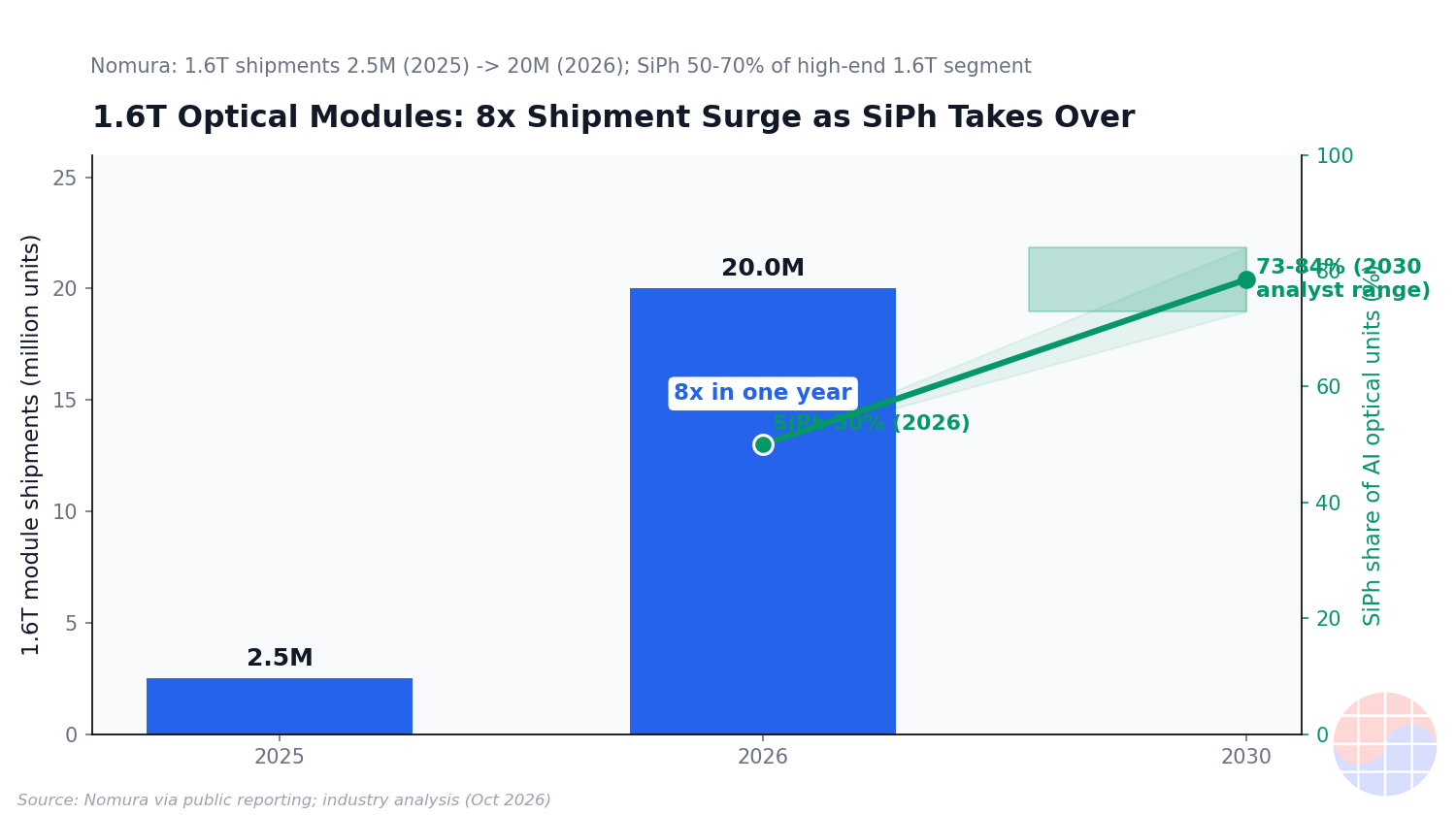
- Bandwidth explodes. Commercial 1.6-terabit optical transceivers arrived this year, and analysts forecast 1.6T module shipments jumping from 2.5 million units in 2025 to 20 million in 2026 — an eightfold surge — as NVIDIA and Broadcom race to deploy 102.4T switching fabrics. (Source: TokenRing/observernewsonline)
- The architecture moves. Pluggable transceivers are giving way to near-packaged and co-packaged optics (CPO/NPO), where the optical engine sits next to — or on the same package as — the switch ASIC. Research forecasts suggest CPO could account for roughly 35% of optical modules in AI data centers by 2030. (Source: GlobeNewswire) NVIDIA's Spectrum-X Ethernet Photonics switch is already in full production with five named hyperscaler customers. (Source: NextMSC)
- Every optical unit needs a PIC, and every PIC needs a fab. Unlike DSP chips, which dozens of foundries can print, a PIC needs a specialized photonics process: waveguides, modulators, germanium photodetectors, and laser integration. Very few fabs have it. That is where the business story begins.
Business Deep Dive
1. The prepayment signal: customers paying for capacity that does not exist
In semiconductors, the strongest demand signal is not an order. It is a prepayment for capacity that does not exist yet — customers hand over cash now because they believe the capacity will not be available otherwise. In May 2026, that signal flashed red in silicon photonics:
| Company | Lock-in instrument | Scale | What it reserves |
|---|---|---|---|
| Tower Semiconductor | Customer prepayments + 2027 contracts | USD 290M received; USD 1.3B in 2027 SiPh contracts; larger 2028 commitments, next prepayment expected Jan 2027 | 300mm SiPh capacity for 2027 production (Source: TipRanks) |
| Soitec | Multi-year capacity reservation agreements with cash deposits | 10+ photonics customers; ~80% of agreements to be signed within weeks; deposits tied to committed volume (refunded if taken, forfeited if not) | Photonics-SOI substrate supply — Soitec holds ~95% of the market (Source: Reuters via SRN News) |
| STMicroelectronics | Long-term agreements with cash advances | "Significant number" of customers seeking 1–3 year LTAs locking capacity, volumes, pricing, and cash advances | SiPh capacity at Crolles 300mm plant; datacenter revenue >USD 1B in 2026, well above USD 2B in 2027 (Source: AmericanBankingNews) |
Tower's announcement is the cleanest data point: USD 290 million in received prepayments against USD 1.3 billion in 2027 silicon photonics revenue contracts, with customers committing to even larger 2028 orders. Management's framing matters — the commitments represent a floor, not a ceiling: contractual minimums with actual demand forecasts running higher. (Source: Berrit Media)
Soitec's version is arguably more dramatic because it sits upstream of everyone. Its photonics-SOI wafers are the substrate under nearly every silicon photonics chip shipping today. When the substrate monopolist starts demanding cash deposits tied to committed volumes — with customers forfeiting the deposit if they fall short — and requiring customers to share inventory data so they cannot hoard wafers away from competitors, that is a seller's market by definition. Soitec's photonics-SOI revenue passed USD 100 million in the fiscal year ended March 2026 and is guided to more than double this year — a figure CEO Laurent Rémont now calls "absolutely a floor." The company does not expect to need a new fab until around 2029. (Source: Reuters via SRN News)
2. The five-fab map: who can actually print a PIC
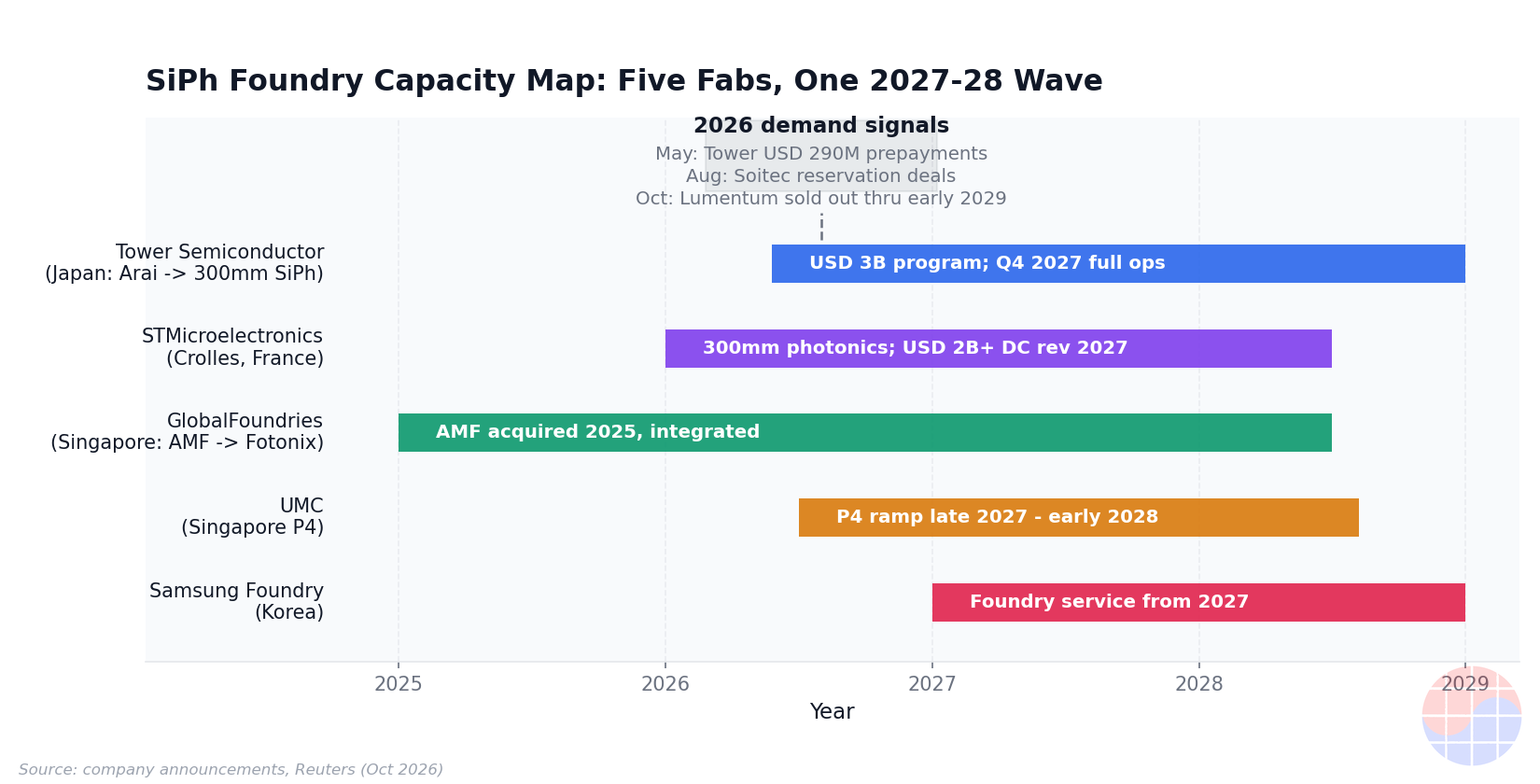
Here is the layer the mainstream coverage misses. Analysts price the lasers (Lumentum, Coherent), the DSPs (Marvell, Broadcom), and the module makers (Innolight, Eoptolink). But almost nobody maps the layer in between: the fabs that can actually manufacture a PIC at scale. As of late 2026, that map has roughly five names:
- Tower Semiconductor — the largest dedicated merchant SiPh player; PH18 platform; Israel/US/Japan footprint. USD 1.3B in 2027 contracts.
- GlobalFoundries — Fotonix platform (Malta, New York); acquired Singapore SiPh foundry AMF in 2025 and folded it into Fotonix. (Source: DQIndia)
- STMicroelectronics — an IDM that ships PICs at roughly Tower's scale through its PIC100 platform, mostly to optical module makers; investing in its 300mm Crolles plant for photonics. Datacenter connectivity is set to be ~80% of its 2027 datacenter billings. (Source: AmericanBankingNews)
- UMC — Singapore 12-inch fab delivered its first mass-produced SiPh wafers in July 2026 (with startup SILITH); its own 300mm platform opens to general customers in 2027; Phase 4 cleanroom expansion underway; 2026 capex raised to USD 2B. (Source: DQIndia; Source: Reuters via WNCY)
- Samsung Foundry — formally entered the SiPh foundry business at OFC 2026 with a 300mm platform; optical engines via thermocompression bonding in 2027, foundry service from 2027, turnkey CPO targeted for 2029. (Source: ChipPub)
The classification is where the mispricing lives. STM is usually modelled as a chipmaker, not a merchant PIC supplier. Samsung is counted as a logic foundry challenger, not a photonics player. TSMC's COUPE platform is in mass production but is effectively captive — it sells photonics through its own SoIC bonding flow, not as open merchant capacity. Intel has the longest SiPh volume history (millions of PICs in its own pluggables) but likewise serves itself first. So the genuinely open merchant supply of PIC wafers is far scarcer than the headline names suggest. Scarcity plus non-substitutability equals pricing power.
3. The pricing-power mechanics: why foundries win first
The economics work like this:
- Demand is lumpy and urgent. Hyperscalers cannot wait out a photonics shortage the way they waited out GPUs — optical interconnect is on the critical path of every new AI cluster. Lumentum's CEO told Bloomberg on October 9 that the company's optical components are sold out through early 2029, that it cannot meet roughly 70% of demand for some products through 2027 and ~30% for others through 2028, and that customers are already booking into 2030. (Source: TechDefused)
- Supply is inelastic. Adding SiPh capacity means converting or building 300mm lines — 12 to 18 months at best, and BiCMOS equipment lead times are long. Soitec needs no new fab until ~2029, which tells you how tight the upstream is.
- Customers self-select into prepayment. A module maker that pays USD 290 million in aggregate prepayments to Tower is not buying an option — it is buying insurance. The deposit economics (take the volume and get it back, miss it and forfeit it, per Soitec's terms) screen out phantom demand, which is precisely what burned the industry in the 2021–22 double-ordering cycle.
The result: in the near term, rent accrues to whoever controls capacity — the PIC foundry and the substrate supplier. This is the same cycle mechanics as memory LTSAs and foundry prepayments in past shortages: the first dollars of pricing power land with the bottleneck owner.
4. The 2027–28 irony: shortage now, capacity wave later
Here is the twist every investor must hold in their head at once. While 2026–27 is a shortage market, a capacity wave lands in 2027–28:
- Tower: USD 3B Japan program — Arai facility converts to 300mm SiPh production with full operations by Q4 2027, plus a new 300mm fab next to Fab 7, backed by USD 1B in Japanese government grants. Tower raised its 2028 revenue target to USD 3.6B (from 2.8B). (Source: Reuters)
- UMC: Singapore P4 cleanroom ramps late 2027 to early 2028; proprietary 300mm platform open to all customers from 2027.
- GF: AMF Singapore integrated into Fotonix.
- STM: Crolles 300mm photonics capacity coming online.
- Samsung: foundry service from 2027.
Near-term shortage and medium-term capacity wave coexist — and that is normal in semiconductors. The implication is a rent-capture baton pass: PIC foundries and substrate suppliers hold pricing power through the shortage phase; when the wave arrives, pricing normalizes and rent shifts downstream to whoever wins the volume game — the optical module and DSP vendors shipping tens of millions of units. Bank of America estimates the wafer area needed for photonic chips grows ~60% per year from 2026 to 2030, which is why even the capacity wave may not be enough. (Source: IndexBox)
5. The market's misread: "CPO delayed" does not mean "photonics dead"
A common 2026 narrative holds that because co-packaged optics volume has slipped toward 2028–29, photonics momentum is over. The price action disagrees: on October 9, the same day Lumentum announced it was sold out through early 2029, Applied Optoelectronics (AAOI) and Lumentum (LITE) both jumped mid-single-digits in a single session as optical stocks rallied. (Source: TradingKey)
The confusion is between two different arguments. The short-term volume debate (when does CPO ramp?) is genuinely uncertain. The medium-term capacity argument (is there enough PIC fab capacity for the 1.6T/3.2T transition?) is not — it is arithmetic. 2.5 million to 20 million 1.6T modules in one year, with SiPh taking 50–70% of the high-end segment. Every one of those modules needs a PIC. The "photonics is delayed" trade conflates a packaging-form-factor timing question with a wafer-supply question, and the prepayments tell you which one the people spending real money are worried about.
Chase's Take
I have seen this movie before — in DRAM, in foundry, in every cycle where demand shows up before capacity does. The tell is always the same: who is paying for something that does not exist yet. Tower's USD 290 million is not a purchase order. It is a confession. You do not hand a foundry nine figures for 2027 capacity unless your 2027 product plan dies without it.
What makes this cycle sharper than the memory cycles is the substitutability gap. In DRAM you can at least switch vendors. In silicon photonics at 1.6T speeds, the list of fabs that can print your PIC is five names long — and two of them (TSMC, Intel) are effectively captive to their own flows. That is not a supply chain. That is a shortlist.
The second thing I would watch is Soitec's inventory-data clause. A supplier that demands visibility into customer inventories has been burned by phantom demand before — and Soitec has, in RF-SOI for smartphones. The fact that it is imposing these terms now, while describing 2x revenue growth as "absolutely a floor," tells you management believes this demand is real but refuses to build on faith. That discipline is exactly what creates the shortage: nobody is building ahead of signed, deposit-backed commitments, so the gap between real demand and committed supply stays open — and pricing power stays with the bottleneck.
The strategic read: for the next 18–24 months, the best risk-adjusted exposure in optical AI infrastructure is not the laser maker or the DSP designer — it is the capacity owner. When the 2027–28 wave lands, rotate the question from "who has capacity" to "who has volume," because that is when the module makers and DSP vendors take the baton. Markets always price the visible layer first and discover the bottleneck layer second. This time, the bottleneck is filing its own earnings reports — you just have to read them.
Implications
For investors: - Duration of foundry pricing power: The shortage phase runs through at least 2027 (Tower's prepaid 2027 capacity, Lumentum sold out into early 2029, Soitec reservation deposits). Track utilization and prepayment balances in Tower/Soitec/STM quarterly reports as the leading indicator — when prepayments stop growing, the shortage is ending. - The 2028 rotation: The capacity wave (Tower Japan Q4 2027, UMC P4 late 2027–early 2028, Samsung foundry service 2027, GF/AMF integration) normalizes wafer pricing. Rent shifts to volume winners in optical modules and DSPs. Do not extrapolate foundry margins into 2029. - Post-2028 oversupply risk: Every foundry expanding at once is the classic setup for the next glut. Watch for second-wave announcements (new fabs beyond the current five) as the sell signal for the pricing-power trade. - What to watch: (1) Tower's January 2027 prepayment round for 2028 capacity — the size confirms or denies the demand trajectory. (2) Soitec's deposit cash flow actually arriving in stages — if customers hesitate, demand is softer than claimed. (3) Whether a second named SiPh customer appears at UMC beyond SILITH — the tell for merchant capacity diversification.
For operators (fabless/module makers): Capacity reservation is now a strategic function, not procurement. If you are designing a 1.6T or 3.2T product without a foundry slot and a substrate allocation, you do not have a product — you have a slide deck. The prepayment game also means smaller players get squeezed: deposits favor the balance-sheet-strong.
For policymakers: Japan's USD 1B grant to Tower's USD 3B program is the template — governments are now subsidizing the optical layer of AI infrastructure directly. Photonic-SOI substrate concentration (~95% with one supplier) is a single-point-of-failure the EU, US, and Japan will all eventually address.
FAQ
Q1: What is a photonic integrated circuit (PIC), and why does it matter for AI? A PIC is a chip that generates, modulates, guides, and detects light, made on a silicon wafer with semiconductor processes. In AI data centers, PICs are the heart of optical transceivers that move data between GPUs at 800G–1.6T speeds, where copper cables run out of power and distance headroom. Every optical module needs one.
Q2: Why are customers prepaying for silicon photonics capacity? Because they believe the capacity will not exist otherwise. Tower Semiconductor received USD 290 million in customer prepayments to reserve 2027 capacity; Soitec is signing multi-year reservation agreements with cash deposits tied to committed volumes; STMicroelectronics reports customers seeking long-term agreements with cash advances. Prepayment is the strongest demand signal in semiconductors — cash for capacity that does not exist yet.
Q3: Which companies can manufacture PICs at scale today? Roughly five: Tower Semiconductor, GlobalFoundries, STMicroelectronics, UMC, and Samsung Foundry — with TSMC and Intel operating effectively captive (in-house) photonics flows. All five are expanding 300mm capacity in 2027–28 (Tower in Japan, GF via its AMF acquisition in Singapore, STM at Crolles, UMC in Singapore, Samsung in Korea).
Q4: Will the 2027–28 capacity wave end the shortage? It normalizes wafer pricing but does not necessarily end tightness: demand (1.6T modules jumping from 2.5M to 20M units in one year; wafer area for photonic chips growing ~60%/yr per Bank of America) is growing into the new capacity. The rent-capture baton passes from capacity owners (foundries, substrate) to volume winners (optical module and DSP vendors) as supply loosens.
This analysis is for informational purposes only and is not investment advice. Market data cited reflects conditions as of October 2026; supply, pricing, and company plans can change.