VLSI Korea
Market Bulletin: Silicon Wafer Prices Rise Toward 40% - ASP Heads From USD 92 to USD 166 as Utilization Reaches 99%
12-inch silicon wafer ASP is set to rise from USD 92 in 2026 to USD 122 in 2027 and USD 166 in 2028. Polished wafer long-term prices rise over 40%, utilization reaches 99% in 2028, and suppliers say small hikes will not fund new capacity.


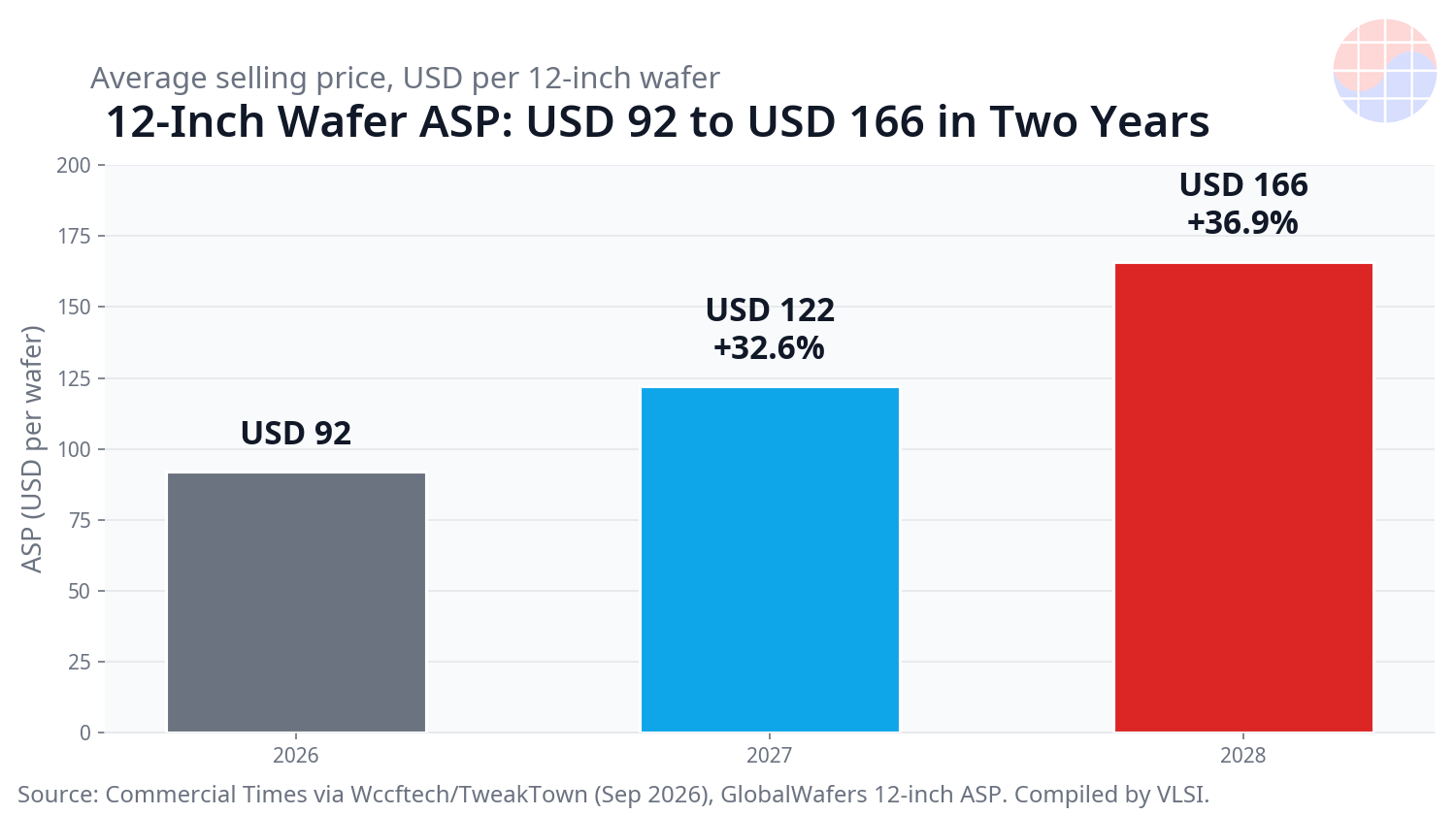
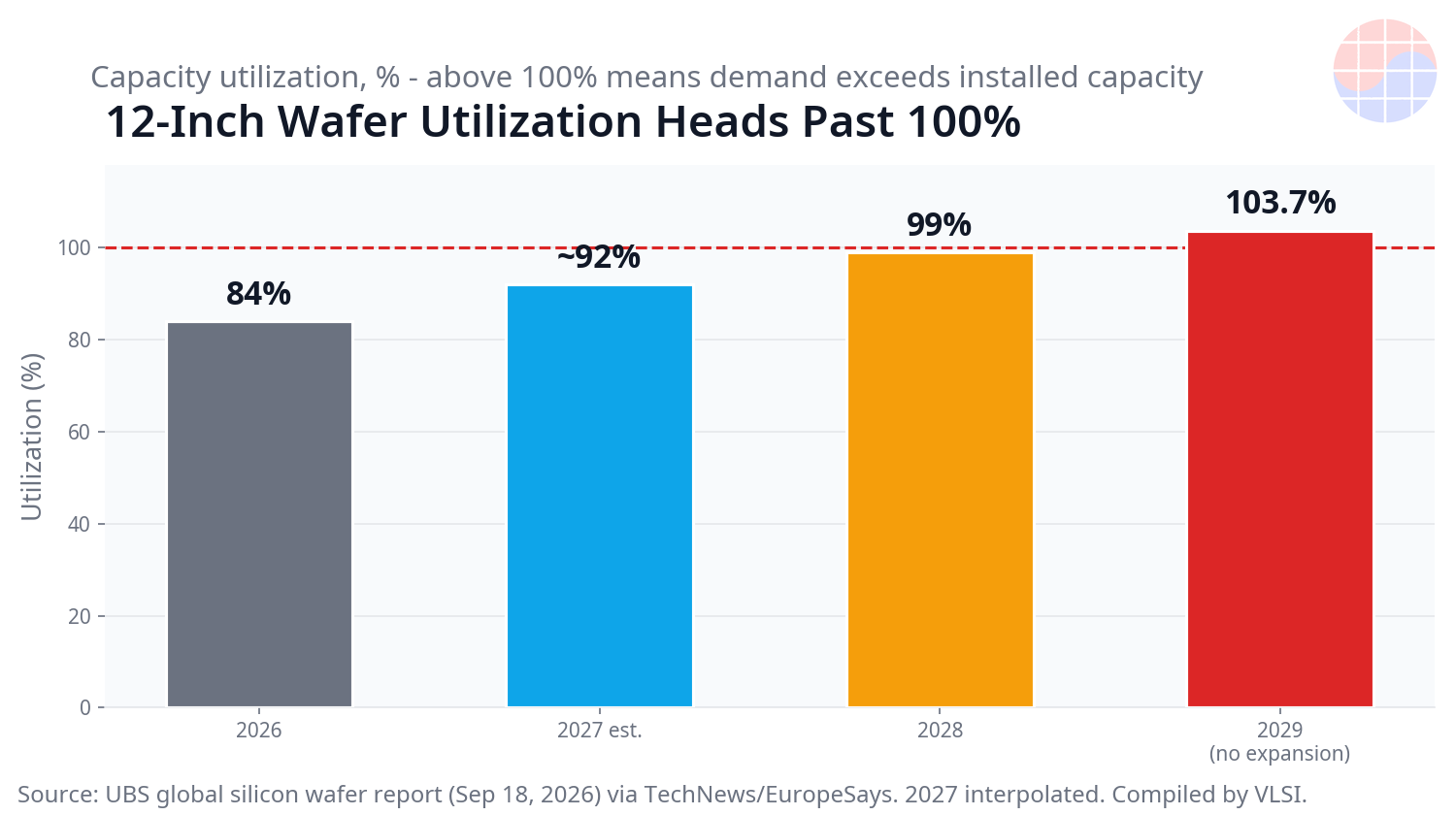
The cheapest layer of the chip stack is about to stop being cheap. The average selling price (ASP) of a 12-inch silicon wafer for GlobalWafers is expected to rise from USD 92 in 2026 to USD 122 in 2027, up 32.6%, and to USD 166 in 2028, up another 36.9% (Commercial Times reporting via Wccftech, September 2026). Polished wafers, the grade used across logic and memory, face long-term agreement (LTA) increases above 40% in 2027, while epitaxial wafers for advanced AI chips rise 15% to 25%. Utilization tells why suppliers hold the pricing power: 12-inch wafer utilization rises from 84% in 2026 to 99% in 2028, and would reach 103.7% in 2029 if no new capacity is added.
Key Highlights
- ASP USD 92 to USD 166: GlobalWafers' 12-inch ASP rises 32.6% to USD 122 in 2027 and 36.9% to USD 166 in 2028. Quarterly wafer shipments are projected to rise from 11.9 million in 2026 to 16.1 million in 2027 and 21.7 million in 2028 (Wccftech, September 2026).
- Polished wafers lead the increase: Polished wafer contract prices rise more than 40% in 2027, ahead of epitaxial wafers at 15% to 25%. Some second-tier customers face increases above 50%, and spot prices in Q4 2026 are expected to move above existing LTA prices (TweakTown, September 2026).
- Utilization reaches 99%: Utilization for 12-inch wafers rises from 84% in 2026 to 99% in 2028. Demand growth was revised up to 11% for 2026, 14% for 2027 and 13% for 2028, driven by customer restocking and faster DRAM capacity expansion (TechNews, September 24, 2026).
- Demand math is unforgiving: CoWoS packaging capacity grows 70.9% year over year in 2027, GPU and custom AI ASIC shipments rise 44.9%, and combined CPU shipments from the three largest vendors climb 36%, while DRAM bit supply grows only 22% (Wccftech, September 2026).
- Buyers lock supply early: In July 2026, GlobalWafers and Micron announced a 10-year long-term supply framework for advanced silicon wafers, alongside USD 500 million in strategic financing from Micron for AI memory and data-center demand (SemiMedia, September 25, 2026).
Market Update
Silicon wafers look like a commodity until you try to buy more of them. Four suppliers - Shin-Etsu Chemical and SUMCO of Japan, GlobalWafers of Taiwan and Siltronic of Germany - supply the large majority of high-purity wafers, qualification takes years, and a new wafer plant cannot be built inside a single pricing cycle. That is why the renewal calendar matters: many pandemic-era LTAs are now expiring, and they were signed before two to three years of higher raw-material, electricity and fab construction costs. Suppliers are using the renewal window to reset prices, and buyers who wait for the spot market face a worse signal - spot prices are already rising toward the new contract levels.
| 2026 (current) | 2027-2028 (projected) | |
|---|---|---|
| 12-inch wafer ASP (GlobalWafers) | USD 92 | USD 122 in 2027 (+32.6%), USD 166 in 2028 (+36.9%) |
| Polished wafer LTA price | Pandemic-era LTA levels | Rise above 40% in 2027 |
| Epitaxial wafer LTA price | Pandemic-era LTA levels | Rise 15% to 25% in 2027 |
| 12-inch utilization | 84% | 99% in 2028, 103.7% in 2029 without expansion |
| Quarterly wafer shipments | 11.9 million | 16.1 million in 2027, 21.7 million in 2028 |
| CoWoS capacity / GPU+ASIC shipments | 2026 base | CoWoS +70.9% YoY, GPU+ASIC +44.9% in 2027 |
ASP, shipment and CoWoS figures are Commercial Times estimates reported in September 2026. Utilization and demand growth are UBS estimates dated September 18, 2026. Projections are not reported results.
The suppliers' own words explain why a 40% headline is not greed but arithmetic. SUMCO's president said in August 2026 that a 5% to 10% price increase would fall far short of covering the cost of fresh investment, and the company remains cautious about greenfield expansion. Analysts covering the sector put the threshold higher still: wafer makers may need increases of 40% to 50% before new capacity is justified, and if prices rise more than 20% in 2027 without triggering expansion, a shortage in 2029 becomes the next bottleneck. Chinese suppliers do not close the gap for leading-edge work: the largest Chinese maker reports an ASP near USD 54 against an industry range of USD 100 to 120, reflecting a mix weighted to non-fabrication-grade wafers, and re-certification limits use in advanced logic and memory lines.
VLSI's View
The bottleneck moves to the substrate. For three years the AI supply debate focused on accelerators, HBM and packaging capacity. Wafers sit underneath all three. Every GPU, every HBM stack and every server CPU starts as a polished or epitaxial wafer, so a 70.9% jump in CoWoS capacity and a 44.9% jump in accelerator shipments translate directly into wafer starts. When utilization passes 99%, there is no buffer left for yield excursions, rework or a single supplier outage.
The Korea angle is memory wafers. Korea's two memory makers are among the world's largest buyers of polished wafers for DRAM and NAND, including the wafers that become HBM. A move from USD 92 toward USD 166 does not break a memory business that is raising its own contract prices by double digits, but it changes the cost structure of every bit shipped in 2027 and 2028, and it rewards buyers who signed long frameworks early. The July framework between GlobalWafers and Micron is the template: financing and tenure in exchange for secured volume.
Price is now a capacity signal, not just a cost. In wafer supply, a higher price does two jobs at once: it rations today's scarce output and it is the only argument that can persuade a supplier board to approve a multi-year plant. Reading the 2027 LTA round as simple inflation misses the second job. If the round settles too low, the industry buys cheaper wafers in 2027 and a harder shortage in 2029.
Chase's Take: In chip implementation, the substrate is the floorplan nobody talks about until it fails. You can optimize placement and routing for months, but if the die size and the package were wrong at the start, no amount of engineering downstream fixes it. Silicon wafers are the industry's floorplan decision for 2029 being made in the 2027 contract round. The teams that treat wafer LTAs as procurement paperwork will discover, two years from now, that they were signing their capacity ceiling.
Outlook
- Q4 2026 spot prices: whether spot moves above existing LTA prices as expected, which would harden the 2027 renewal baseline.
- 2027 LTA settlements: the final polished and epitaxial increases, and whether any supplier pairs a large increase with a firm capacity commitment.
- Supplier capex signals: any greenfield or major brownfield announcement from the four large suppliers would change the 2029 utilization math.
- Memory maker frameworks: further long-term wafer agreements from large DRAM and NAND buyers following the July 2026 template.
FAQ
How much will silicon wafer prices rise in 2027? Polished 12-inch wafer long-term prices are projected to rise more than 40% in 2027, while epitaxial wafers rise 15% to 25%. GlobalWafers' 12-inch ASP is expected to rise from USD 92 in 2026 to USD 122 in 2027 and USD 166 in 2028 (Commercial Times, September 2026).
Why are silicon wafer prices rising? AI infrastructure demand is raising wafer starts for logic, DRAM and NAND at the same time. Utilization rises from 84% in 2026 to 99% in 2028, pandemic-era long-term agreements are expiring, and input and construction costs are higher than when those agreements were signed.
Who makes silicon wafers? Shin-Etsu Chemical and SUMCO of Japan, GlobalWafers of Taiwan and Siltronic of Germany supply the large majority of the world's high-purity silicon wafers to foundries and memory makers.
Will higher prices bring new wafer capacity? Not automatically. Suppliers say increases of 5% to 10% are far below what fresh investment requires, and analysts estimate increases of 40% to 50% may be needed to justify expansion. Without expansion, utilization would reach 103.7% in 2029, implying a shortage.
📩 Subscribe to VLSI Korea
Get our daily semiconductor deep-dives delivered to your inbox first. Free to subscribe.