VLSI Korea
UK HPI Visa for Chip Engineers: No Sponsor Needed
30-Second Summary * The High Potential Individual (HPI) visa is the UK's offer to graduates of top global universities. No job offer. No sponsor. * Stay: 2 years for bachelor's/master's, 3 years for PhDs. No extension, one application per lifetime. * Requirements: degree within the last 5 years + listed university + English at B2 + GBP 1,


30-Second Summary
- The High Potential Individual (HPI) visa is the UK's offer to graduates of top global universities. No job offer. No sponsor.
- Stay: 2 years for bachelor's/master's, 3 years for PhDs. No extension, one application per lifetime.
- Requirements: degree within the last 5 years + listed university + English at B2 + GBP 1,270 in savings held 28 days.
- The reported 2025-26 list includes Seoul National University and Yonsei University (new). KAIST dropped off the 2025 cycle but stays valid for 2024 graduates under the 2024 list — always check the list for your graduation year.
- Cost: GBP 822 application fee + Immigration Health Surcharge GBP 1,035 per year + Ecctis qualification check.
- Plan B is the Skilled Worker visa: sponsor required, general salary threshold GBP 41,700 per year (raised 22 July 2025), settlement (ILR) after 5 years.
- Cambridge hardware engineers average GBP 54,703 per year (Glassdoor, Sep 2026). A Cambridge 1-bed rents for GBP 1,256 per month (ONS, Aug 2026) — workable. London's average rent of GBP 2,290 per month is a different sport.
Intro
The US visa game is a lottery with extra steps. H-1B is a draw, O-1 is a paperwork war, and plenty of chip engineers have reached a big-tech final round only to be filtered out on visa sponsorship. The UK plays by different rules. The HPI visa removes the middleman entirely: no employer, no offer letter, no salary floor. Your degree is the ticket. The catch is a single one — your university has to be on a list the UK government publishes. And if you're a Korean engineer, you may be surprised to learn which Korean universities are on it.
Deep Dive
Episode 1: ARM lives in Cambridge
The most important chip company on earth owns zero fabs. ARM. Nearly every smartphone AP and a fast-growing share of datacenter CPUs run on ARM IP. Its headquarters is not in Silicon Valley — it's in Cambridge. That fact alone defines the UK chip scene.
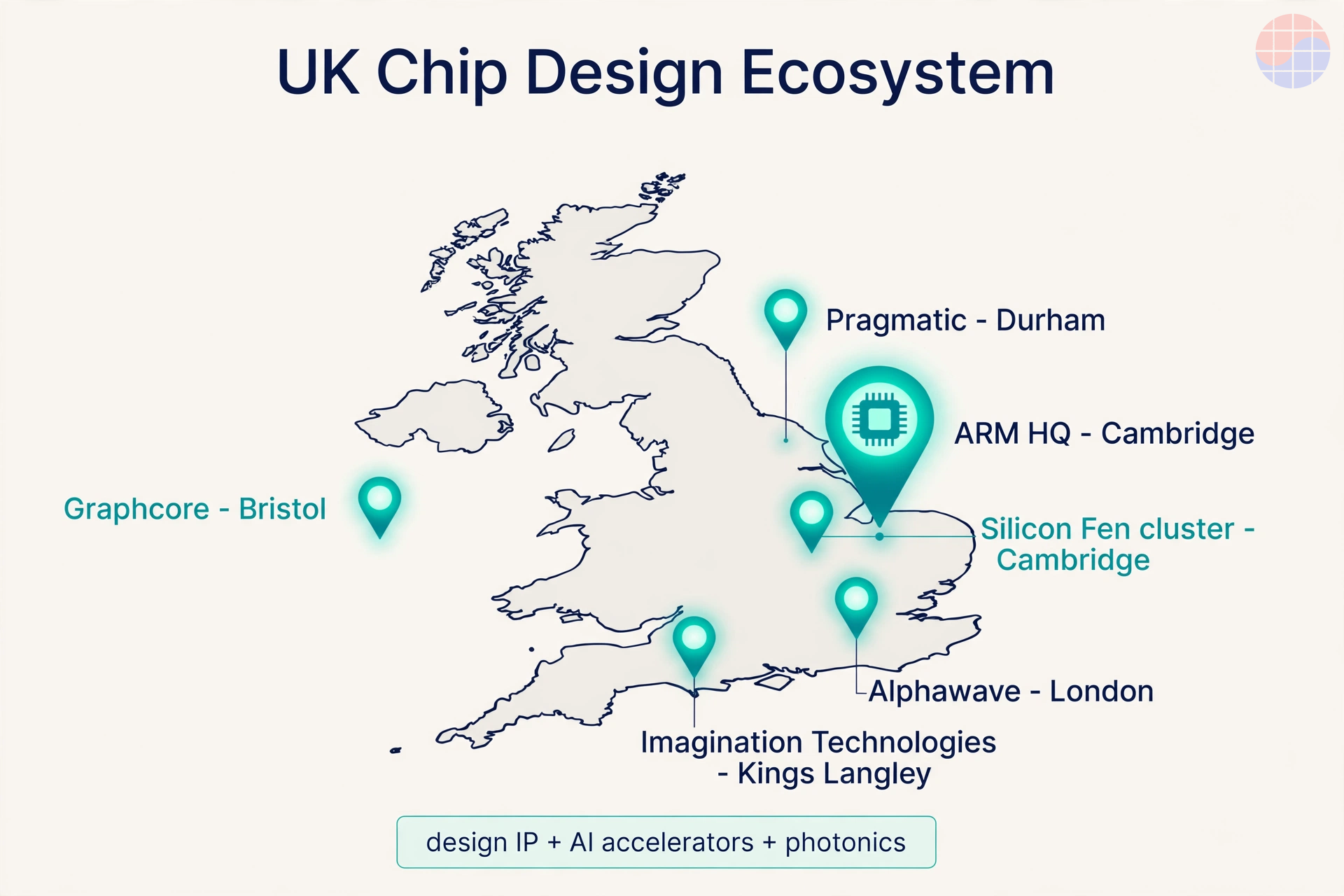
Around ARM sits the Silicon Fen design cluster: Graphcore (AI accelerators, Bristol), Imagination Technologies (GPU IP, Kings Langley), Alphawave (London), Pragmatic (Durham). No foundries, no OSAT. This is a country of design IP and architecture. Physical design jobs are relatively scarce; microarchitecture, RTL design, verification, compilers, and EDA tools are the center of gravity. As an STA/signoff engineer myself, I can tell you ARM's timing teams are among the best in the industry.
Why this matters: the UK is an escape hatch from the equation "semiconductors = Samsung/Hynix/foundry" that dominates Korean thinking. If you want to learn the design-IP business model with your hands, this is the densest place on earth to do it.
Episode 2: Anatomy of the HPI visa
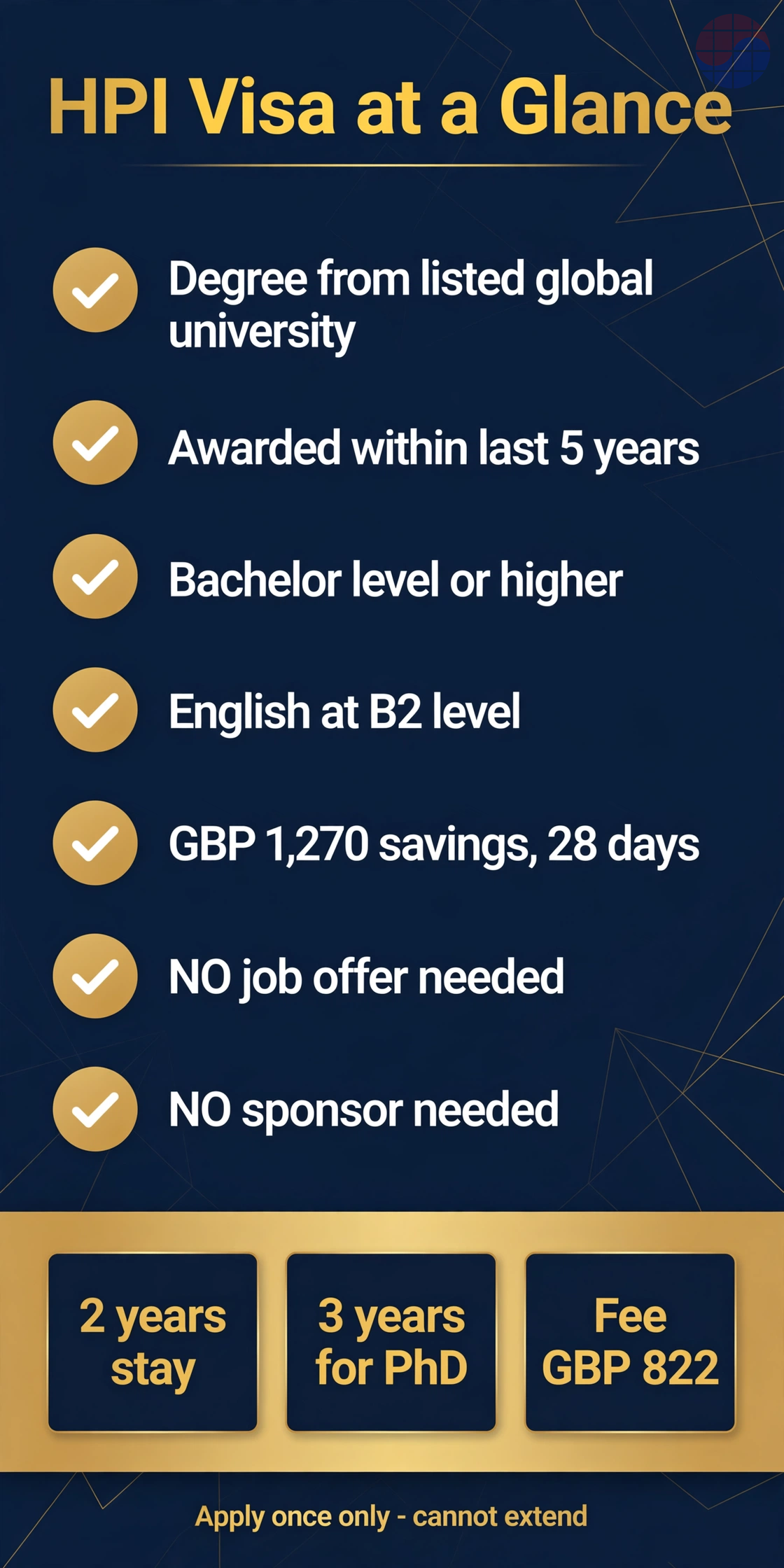
The eligibility list on gov.uk is refreshingly short. The essentials:
- Degree awarded within 5 years of application. Counted from the award date, not the ceremony.
- University on the eligible list for your award year. Lists refresh every 1 November–31 October cycle. UK universities are excluded.
- Qualification at bachelor's level or above, confirmed by an Ecctis assessment.
- English at B2 — via an approved test or an English-taught degree.
- GBP 1,270 held for 28 consecutive days. Lower and shorter than most other UK routes.
- One application per lifetime. If you've already held a Graduate visa or came through the Doctorate Extension Scheme, you can't apply.
- No job offer required. You can arrive unemployed.
The visa lasts 2 years, 3 for PhDs, and cannot be extended. The intended play is to find work and switch to Skilled Worker before it expires — the settlement clock starts on that route. The Immigration Health Surcharge is GBP 1,035 per year, paid upfront.
The real weapon of HPI is the reversed order. Normally it's "job, then visa." HPI is "visa, then job." Land in the UK, meet ARM engineers at a Cambridge pub, interview, get the offer. You don't even need the employer to hold a sponsor licence. During HPI you can work for any employer, in any role, or be self-employed.
Episode 3: The Korean university plot twist
Here's the part that matters for Korean engineers. The reported 2025-26 list (1 Nov 2025–31 Oct 2026), covering 80 universities, includes Seoul National University and Yonsei University — Yonsei is a new entrant. KAIST, meanwhile, dropped off the 2025 cycle after appearing in 2024. That does NOT disqualify 2024 KAIST graduates: eligibility is judged against the list for your graduation year. So don't let the rumor mill decide for you — check the gov.uk list for your own award year.
One more timing trap: the list changes every year as rankings move. If you're 4 years and 11 months out and your school looks shaky on next year's list, move fast.
Episode 4: Plan B — the Skilled Worker reality
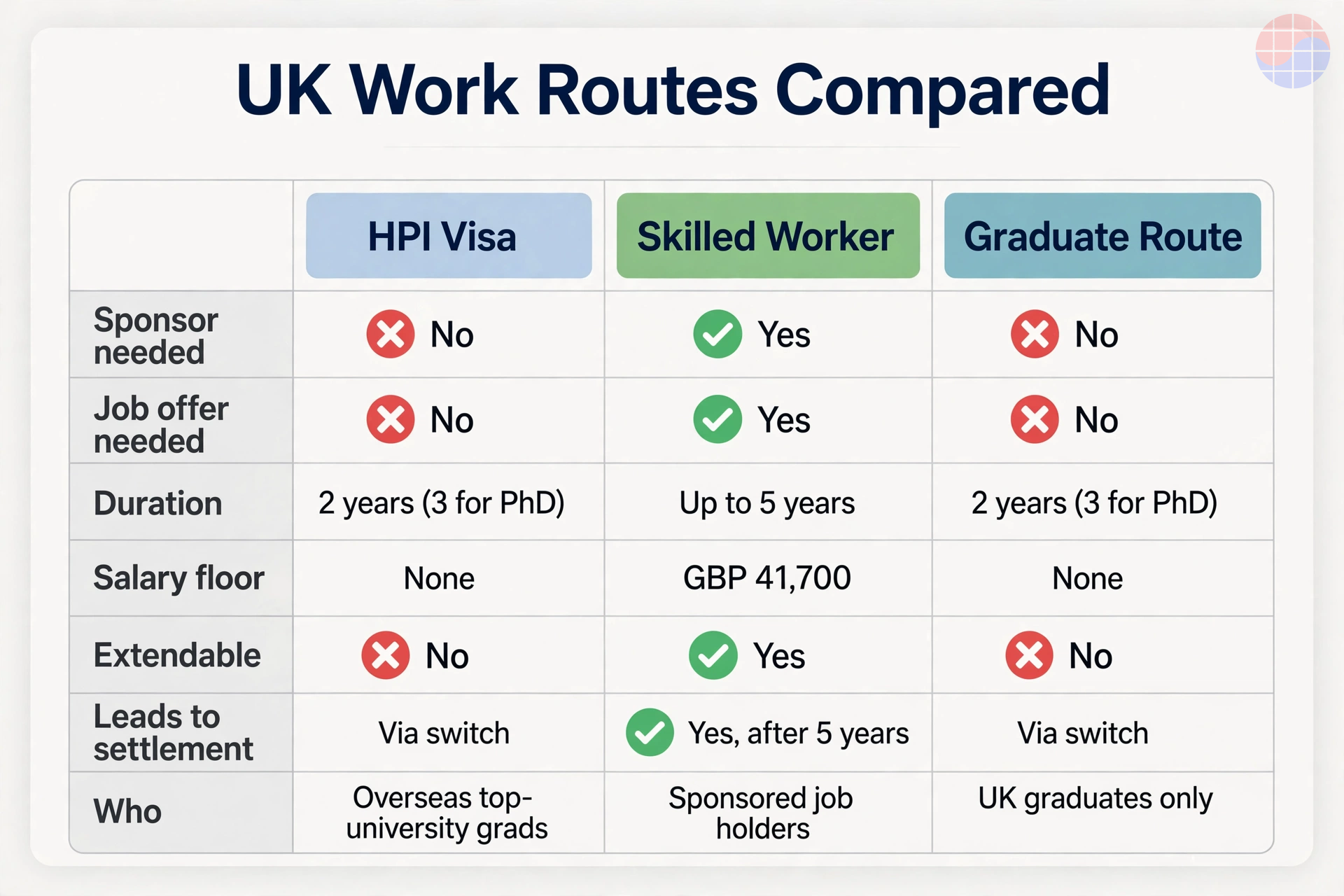
Most readers won't qualify for HPI. Graduated more than 5 years ago, or your school never made the list? Skilled Worker is the standard route. Three conditions: a job offer from a Home Office-approved sponsor, English at B2, and the salary bar — the general threshold is GBP 41,700 per year (up from GBP 38,700 on 22 July 2025), or the occupation's going rate, whichever is higher. New entrants under 26 get a 70% discount down to GBP 33,400.
Skilled Worker's upside is certainty: up to 5 years per grant, extendable, ILR after 5 years. Unlike HPI's two-year ticket, it's a settlement route. The downside is total employer dependence — the company must hold a sponsor licence and issue a Certificate of Sponsorship. ARM obviously does; a tiny startup might not.
Episode 5: The visa cost calculator — how much cash to bring
HPI has no sponsor, which is great — but the upfront cost is entirely yours. Adding up the published components for a 2-year HPI: application fee GBP 822, IHS at GBP 1,035 per year × 2 = GBP 2,070, Ecctis qualification check around GBP 230. Total: roughly GBP 3,100. The GBP 1,270 maintenance balance (held 28 days) sits on top of that. Before flights and settling-in costs, you're looking at around GBP 4,500 in visa-related cash.
A PhD-holder's 3-year grant pushes IHS to GBP 3,105, making the total about GBP 4,100. Cheap next to US H-1B legal fees, but the "land first, job-hunt later" strategy demands a real cash plan. If you don't switch to Skilled Worker within 2 years, that money becomes the price of a return ticket.
Episode 6: The pay is lower than the US. The math still works.
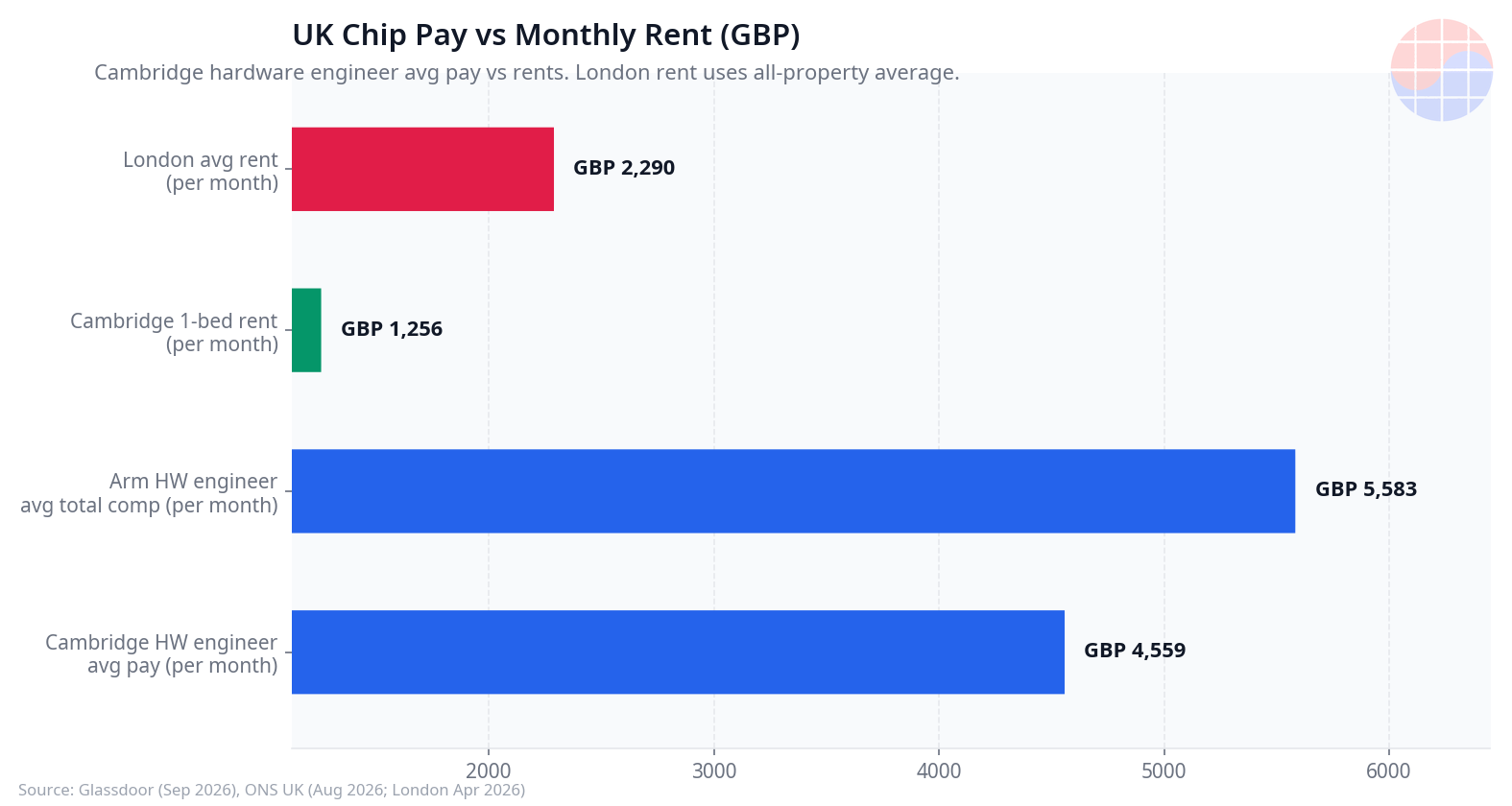
Let's be honest: UK chip pay doesn't touch US big tech. Glassdoor (Sep 2026) puts Cambridge hardware engineers at GBP 54,703 per year on average, ranging GBP 42,774–72,592. At Arm specifically, hardware engineers average GBP 51K base plus GBP 16K additional pay — about GBP 67K total (81 submissions). Senior postings from employers show GBP 74K–100K (median 87K), with some reaching GBP 97K–132K (median 115K).
Now the rent side. ONS (Aug 2026): a Cambridge 1-bed averages GBP 1,256 per month, a 2-bed GBP 1,613. On GBP 54,703 a year (GBP 4,559 a month), that's about 28% of gross pay — tight after UK taxes, but workable for a single engineer. London averages GBP 2,290 per month (ONS) — and chip design jobs there are scarce anyway. The conclusion writes itself: UK chip engineers live in Cambridge. London is for visiting.
Tech Tree for Korean Engineers
Route A: HPI direct — difficulty 2/5, reward 3/5
For SNU/Yonsei graduates within 5 years (or overseas listed-university grads). Ecctis check, English B2, GBP 1,270 for 28 days, apply. Land first, job-hunt second. Targets: ARM Cambridge, Graphcore, Imagination. The real quest ending is switching to Skilled Worker within 2 years.
Route B: Skilled Worker head-on — difficulty 3/5, reward 4/5
For experienced engineers outside HPI eligibility. Apply to ARM/Graphcore from Korea, secure offer + CoS. The GBP 41,700 line is comfortably clearable at senior level. Straight shot to ILR in 5 years. Most stable, but 100% employer-dependent.
Route C: UK master's, then Graduate route — difficulty 2/5, reward 3/5
A one-year UK master's unlocks the 2-year Graduate visa (UK universities are excluded from HPI, but the Graduate route exists separately). Costs tuition, but buys a Cambridge network and a UK degree. Full-time study required — a different commitment from an executive program.
Chase's Take
I'm a Synopsys engineer working on STA/signoff tools. I once reached a US big-tech final round and got filtered on visa sponsorship. So a visa like HPI makes me genuinely envious — one more gate you can clear on merit is one more option on the table.
But coldly: HPI is a ticket, not a guarantee. Fail to land locally within 2 years and you're on a flight home. And the UK chip scene being design-IP-centric is a matter of taste. No fabs, no HBM, no advanced packaging. Heaven if RTL and architecture excite you; a desert if you crave devices and process. As an STA person, ARM's timing teams honestly tempt me. Pick your route by taste — but treat the numbers (pay, rent, visa duration) as arithmetic, not emotion. That's the engineer's way.
FAQ
Can I start a business on the HPI visa?
Yes. HPI holders can work for any employer, in any role, or be self-employed. You cannot access public funds.
Can the HPI visa be extended?
No — not in the same category. You must switch to another visa, such as Skilled Worker, before it expires to keep staying.
I graduated more than 5 years ago. Any options?
HPI is out, but Skilled Worker doesn't care about graduation year. You need a sponsored job offer meeting the salary threshold (GBP 41,700 per year or the occupation going rate).
Does HPI time count toward permanent residence?
HPI itself doesn't lead to settlement. After switching to Skilled Worker, 5 years on that route qualifies you to apply for ILR.
Disclaimer: This article is not investment or immigration advice. Figures and rules are approximate as of October 2026; always verify current regulations on gov.uk and other official sources before applying.
Sources: gov.uk High Potential Individual visa · gov.uk HPI visa overview · Glassdoor: Arm Hardware Engineer Salaries · Glassdoor: Hardware Engineer Cambridge · ONS: Housing prices in Cambridge · Economic Times: HPI university list 2025 · ukvisa.blog: Skilled Worker salary 2026 · lawble.co.uk: HPI visa costs