VLSI Korea
The Geopolitics of the Equipment Supercycle: Why the Cycle Is Getting Longer
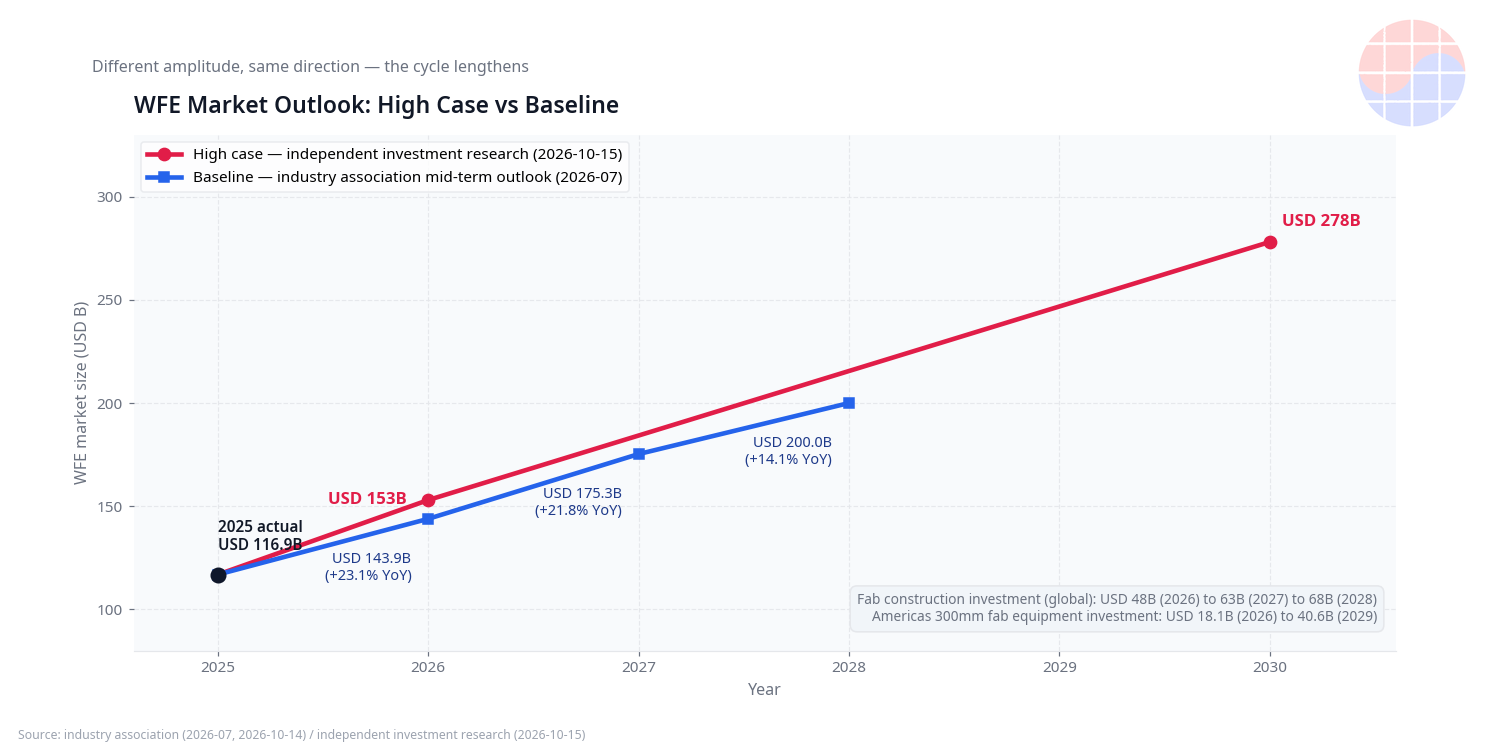
The equipment supercycle is getting longer — not from a demand bubble, but from duplicated capacity investment across a split supply chain and structural growth in mature/specialty processes. WFE high case: ~$153B (2026) to $278B (2030). Korea's four front-end equipment makers sit in its path.


The Geopolitics of the Equipment Supercycle: Why the Cycle Is Getting Longer
30-Second Summary
The equipment supercycle is not ending. It is getting longer. The reason is not a demand bubble but two structural forces. First, a split supply chain — two parallel supply chains building the same nodes twice, creating duplicated capacity investment that pushes WFE (wafer fab equipment) demand beyond the traditional cycle frame. Second, the structural growth of mature and specialty processes — as GlobalFoundries' "we are not chasing 2nm" strategy shows, the bottleneck of AI infrastructure has already moved to "the other half" of the supply chain. The high case from an independent investment research house (October 15, 2026): WFE at roughly $153 billion in 2026, growing to $278 billion by 2030. The conservative side: the industry association's mid-year 2026 outlook sees WFE at $143.9 billion in 2026 (+23.1%) rising to $200 billion by 2028 (announced July 2026). Korea's four front-end equipment makers — Wonik IPS, Jusung Engineering, Hanmi Semiconductor, and SEMES — sit directly in its path.
Background: In October 2026, the equipment Big 4 hit all-time highs simultaneously
In mid-October 2026, the quarterly results of the four largest semiconductor equipment companies converged on a single message. The cycle is not rolling over.
- ASML (Q3, October 14, 2026): Revenue €11.7 billion (+55% YoY, top of guidance). Full-year 2026 guidance raised to €44–45 billion; memory systems revenue expected to grow +75% for the year. Management warned that 2027–2028 deliveries would not keep up with demand, committing to expand production capacity by more than 30% by 2028.
- Applied Materials (fiscal Q3, August 13, 2026): Revenue $9.12 billion (+25% YoY, a record). Semiconductor Systems $7.04 billion (+27%); DRAM was 26% of Semiconductor Systems revenue (versus 22% a year ago) — a direct tracker of HBM-driven DRAM expansion. Q4 guidance: revenue of $10.25 billion.
- Lam Research (fiscal Q4, July 29, 2026): Revenue $6.72 billion (+30% YoY, a record). NAND revenue doubled quarter-over-quarter; advanced packaging expected to grow +70% YoY or more in 2026. September-quarter results due October 21, 2026 (not yet released as of October 18, 2026).
- Tokyo Electron (fiscal Q1, quarter ended June 30, 2026): Revenue ¥732.4 billion (+33.3% YoY), net income ¥164.3 billion (+39.5% YoY). Management expects 2026 WFE to reach a record on AI server demand.
Yet Wall Street still talks about "late cycle." Past cycles were demand-driven; this one is driven by demand, geopolitics, and supply-chain structure all at once. Once you see that difference, the lengthening cycle comes into focus.
Deep Dive: Two Structural Forces Stretching the Cycle
Force 1. Two supply chains building the same nodes twice
The core equation of equipment demand is simple: WFE demand = capacity investment × tool cost per fab. But in 2026, global semiconductor capacity is being invested twice — because of fragmentation.
The backdrop is export control. As US–Netherlands discussions intensified over restricting immersion DUV lithography tool exports to China (at the legislative-proposal stage; service restrictions not yet in effect as of October 18, 2026), China chose to stockpile ahead of controls. According to a think-tank analysis dated October 5, 2026, Chinese fabs had secured roughly 296 advanced immersion DUV scanners. On September 28, 2026, CXMT announced a new investment plan totaling ¥34.9 billion (about $4.9 billion), with 92.9% of its ¥24.1 billion R&D project earmarked for equipment purchases.
What matters is that this is hardening into a separate equipment ecosystem, not a one-time stockpile. China's DUV fleet supports simultaneous mature-node and advanced-node expansion. On one side, the Western supply chain expands under fab subsidies and reshoring (Americas 300mm fab tool spending more than doubling from $18.1 billion in 2026 to $40.6 billion by 2029, per the industry association, October 14, 2026); on the other, China builds its own. Each duplicated fab buys a full set of tools — demand stays the same while equipment demand is effectively counted twice.
The most telling indicator of this structure is Lam Research's regional mix. China's share of revenue fell from 34% to 26% quarter-over-quarter (June 2026 quarter). On the surface that reads as a slowdown in China's mature-node investment. Underneath, it signals that Chinese fabs' tool sourcing is shifting from Western to domestic tools. Western vendors' China share falling does not mean global WFE shrinks — it means the same capacity is feeding two equipment pools as it grows.
Force 2. The "other half" of the AI supply chain is becoming where the money is
Look at ASML's Q3 2026 systems revenue mix: EUV at 49%, non-EUV at 51% — immersion DUV alone is 39% (about €3.27 billion). Memory and mature nodes running DUV multi-patterning without EUV account for half of ASML's revenue. Applied Materials' 26% DRAM share, Lam's doubled NAND revenue and +70% advanced-packaging outlook, Tokyo Electron's +50% outlook for coater/developers — all "other half" stories, not leading-edge logic stories.
The strategic apex of this "other half" is GlobalFoundries: no chasing the 2nm race, concentration on specialty nodes and silicon photonics, fab utilization in the high 80s percent, SiGe capacity oversubscribed through 2027. And the events of 2026 are decisive.
- Two acquisitions ten days apart early in 2026: Advanced Micro Foundry (Singapore's pure-play photonics foundry) plus InfiniLink (a Cairo optical-interconnect startup) — silicon photonics targeted at a $1 billion annual run rate by 2028.
- May 2026: the SCALE platform, aimed at setting the optical standard for AI systems.
- April 2026 reporting: AMD will have GF build the optical chips for its Instinct MI500 AI accelerators launching in 2027 — compute dies at TSMC 2nm, optical connectivity at GF.
- October 6, 2026: a multi-year contract with Xanadu (photonic quantum computing) to transfer ultra-low-loss silicon nitride photonics and single-photon detectors into volume manufacturing on the Malta 300mm line.
- Expanded partnership with Marvell on pluggable optical transceivers, LPO, NPO, and CPO.
The thesis is clear: as the AI cluster bottleneck moves from compute to interconnect, optics has become a new strategic asset. GF's Fotonix is in volume production at 200G per lane with 400G demonstrated — a near-exclusive position at the core bottleneck of AI infrastructure.
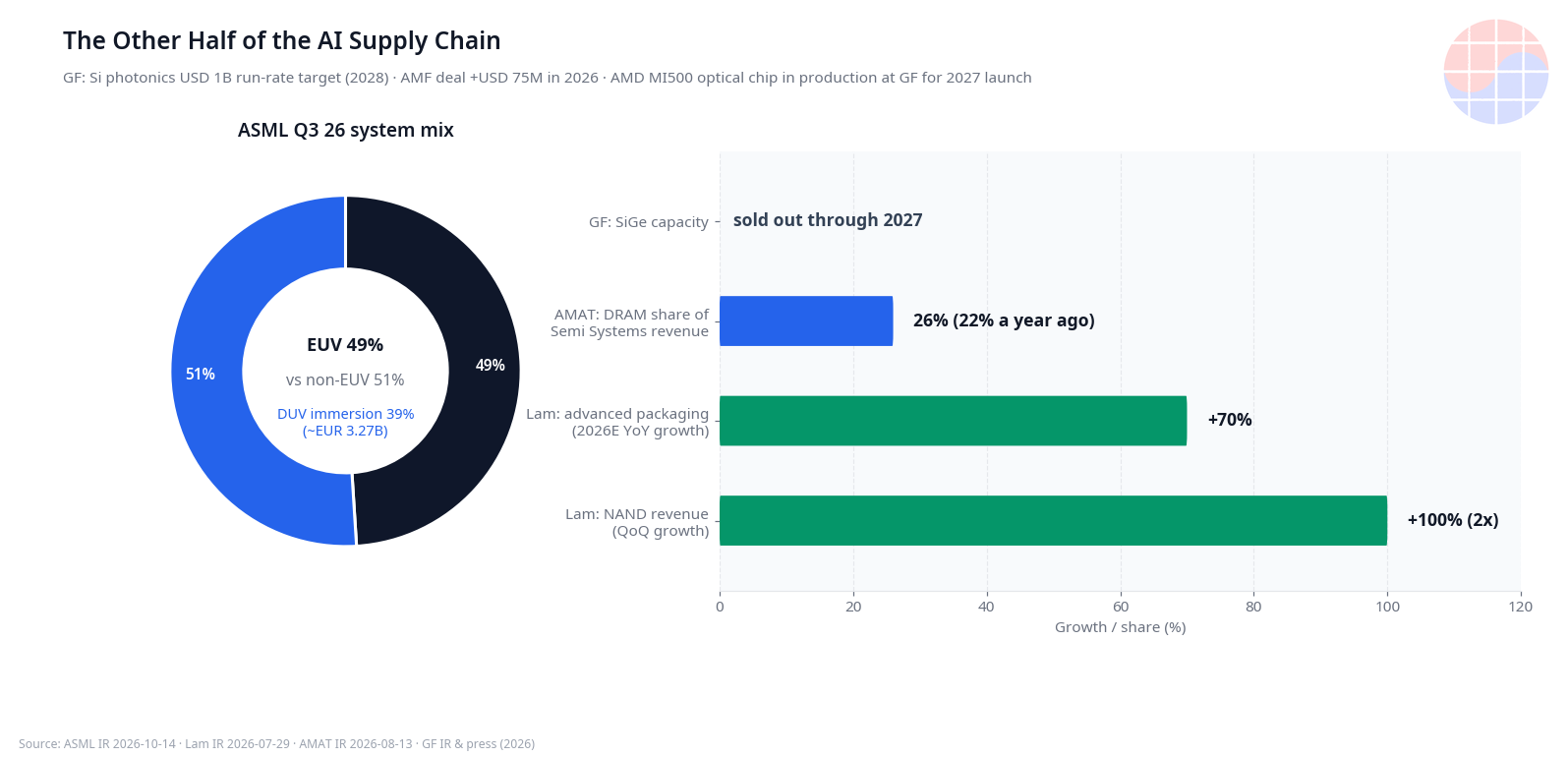
Balancing the numbers: $278 billion is a high case
The WFE trajectory of $153 billion (2026) to $278 billion (2030) is the high-case estimate of one independent investment research house (October 15, 2026), presented with the claim that "ASML, Applied, and TSMC's results point to the high case." It may carry a thesis-driven bias.
Consider the conservative baseline alongside it. The industry association's mid-year 2026 equipment market outlook (announced July 2026) sees WFE at $143.9 billion in 2026 (+23.1% YoY, off a 2025 base of $116.9 billion) rising to $200 billion by 2028 — three consecutive years of double-digit WFE growth (+21.8% in 2027, +14.1% in 2028), contradicting the conventional "late cycle" wisdom.
The amplitude differs; the direction does not. Global fab construction investment is $48 billion (2026) → $63 billion (2027) → $68 billion (2028) (the industry association, October 14, 2026). Capacity is already booked three years out.
Counterpoints: Three Scenarios Where the Cycle Could Break
The bull case can be wrong. Testing it:
First, China's mature-node overcapacity. Two supply chains duplicating investment means, flipped around, double the overcapacity risk. To the extent China's DUV fleet supports mature-node expansion, a price collapse in mature-node chips from oversupply would halt capacity investment. Lam's China revenue share falling from 34% to 26% already reflects a mature-node investment slowdown.
Second, the high case's thesis-driven bias. The $278 billion (2030) figure is one independent research house's estimate, presented alongside the claim that "ASML, Applied, and TSMC's results point to the high case." Estimates published at earnings peaks deserve discounting. the industry association's $200 billion (2028) baseline provides the balance. The actual trajectory likely falls somewhere between the two.
Third, geopolitics can hit equipment vendors directly. If export controls extend to services and spare parts (currently at the legislative-proposal stage), maintenance revenue from installed tools in China gets hit. ASML's installed-base management revenue was €3.3 billion in Q3 2026 alone — about €400 million above guidance.
Even accounting for these risks, the direction itself does not flip. Fab construction investment is booked through 2028, and structural demand from silicon photonics and advanced packaging runs on its own track. Only the slope of the trajectory depends on the risk scenario.
The Korean angle: Korea's equipment makers in 2026
- Wonik IPS (240810): Meritz Securities' estimate (October 12, 2026) puts Q3 revenue at ₩342.5 billion (+28% YoY) and operating profit at ₩58.3 billion (+112% YoY, 17.0% margin), target price ₩169,000 (versus ₩133,700 at the prior close). DRAM and foundry revenue is being recognized sequentially from new Pyeongtaek fabs and the Austin and Taylor foundry fabs.
- Jusung Engineering (036930): Shares up 866% in 2026 (as of October 14, 2026). Order backlog of ₩233.6 billion at end-June — roughly triple in three months. Its flagship ALD tools serve advanced DRAM and 3D NAND. Consensus: operating profit ₩40.8 billion (2026) → ₩140.1 billion (2027); 2027 revenue ₩497.0 billion (+36.4%). CXMT's ¥34.9 billion investment announcement (September 28, 2026) was the direct catalyst for the stock.
- Hanmi Semiconductor (042700): Q2 2026 revenue of ₩251.0 billion (+39.5% YoY), operating profit of ₩130.0 billion (51.9% margin). On October 6, 2026, it won a ₩24.48 billion MSVP order from Samsung Electro-Mechanics — back-end equipment for AI semiconductor substrates, and a signal of resumed business with the Samsung group.
- SEMES (Samsung Electronics subsidiary, unlisted): No public figures, but as a back-end equipment maker it is positioned as a direct beneficiary of Samsung's HBM4 volume ramp (reported September 28, 2026).
The backdrop: SK hynix's September 2026 decision to invest ₩54 trillion in Yongin Y2 and Cheongju M17, and Samsung's expanded HBM4 and server DRAM supply in the second half. Domestic research houses see "no signs of slowdown" in memory-centered HBM and high-performance DRAM orders (as of October 2026). Micron announced roughly $25 billion of capex for fiscal H1 2027 in its September 30, 2026 results — nearly matching its full FY2026 figure of $27.4 billion — with full-year FY2027 capex estimated at $50 billion.
Chase's Take: The Cycle's Governing Variable Has Changed
The long-standing premise of semiconductor equipment cycle analysis was "demand makes the cycle." This cycle differs because the governing variable has shifted from demand to geopolitics.
Past supercycles (2017, 2021) followed a single loop: demand surge → capacity shortage → expansion → oversupply → correction. The 2026 loop is different. Supply-chain fragmentation duplicates capacity, and duplicated capacity generates tool orders independent of demand. China's DUV stockpile, CXMT's ¥34.9 billion investment, the doubling of Americas fab tool investment — none of these are "because demand is strong." They are investments made because the supply chain is being split. When the demand loop and the geopolitics loop overlap, the cycle stretches.
Second, while attention stays fixed on leading-edge logic, half of actual equipment revenue comes from DUV, mature nodes, and specialty processes. GF's choice — "we are not chasing 2nm" — is portfolio optimization, not surrender: oversubscribed SiGe, a $1 billion silicon-photonics run-rate target for 2028, the AMD MI500 optical-chip win. Precisely positioned for AI infrastructure's bottleneck shift from compute to interconnect. Investors still value specialty foundries in a "second-tier foundry" frame, but that frame changes the moment silicon photonics is repriced as a strategic asset of the AI supply chain.
Third, the 2026 numbers from Korea's four equipment makers confirm "K-equipment" as a structural beneficiary of the memory supercycle. Wonik IPS's +112% operating profit, Jusung's tripled backlog, Hanmi's 51.9% operating margin — share gains and mix improvement, not cycle beta. CXMT's expansion catalyzing Jusung's stock also shows Korean equipment makers' customer diversification is progressing.
Implications: For Investors and Operators
Investment implications
- Reframing equipment valuations: The traditional late-cycle discount frame no longer fits. The demand loop and the geopolitics loop have structurally lengthened the cycle. With the equipment Big 4 all hitting records and capacity expansion booked through 2028, betting on "peak-out" is premature.
- The specialty and photonics premium: Silicon photonics is being repriced as the strategic asset that unblocks AI clusters' interconnect bottleneck. GF's Fotonix volume production and 400G demonstration, the SCALE platform, and the Xanadu and Marvell partnerships are the verification points. Watch for repricing of specialty foundry assets still trading at "second-tier foundry" discounts.
- Structural beneficiaries in K-equipment: Wonik IPS, Jusung Engineering, Hanmi Semiconductor, and SEMES sit directly in the path of memory capex (Samsung HBM4, SK hynix's ₩54 trillion, Micron's estimated $50 billion FY2027 capex). For names with China customer exposure like Jusung (CXMT), export-control risk and benefit coexist.
Management implications
- "Supply-chain resilience" is now a capex variable: Capacity investment decisions are no longer driven by demand forecasts alone. In the two-supply-chain era, which bloc's capacity you secure determines vendors' regional mix and order visibility. Lam's China share falling from 34% to 26% shows the regional rebalancing is already underway.
- Dual-sourcing tool procurement: For fab operators, parallel testing of Western and Chinese tools is becoming the standard risk hedge. Vendors must review customer mixes overexposed to a single bloc.
- M&A value of photonics capability: GF's acquisition of AMF and InfiniLink ten days apart in early 2026 demonstrates the scarcity value of silicon-photonics capability. The strategic value of companies holding optical-interconnect IP and foundry capability is in an uptrend.
Disclaimer: Market forecasts cited in this article (e.g., WFE $153B→$278B) are estimates from specific institutions and may differ from actual outcomes. Do not use as a basis for investment decisions.
FAQ
What is the WFE (wafer fab equipment) market?
WFE is the front-end equipment market for patterning circuits onto wafers — lithography, etch, deposition, and cleaning tools — roughly 80% of the total semiconductor equipment market. When capacity investment rises, WFE is the first and largest beneficiary.
Why is this equipment supercycle getting longer than past ones?
Two structural reasons. First, supply-chain fragmentation duplicates capacity for the same nodes across two supply chains, generating tool orders independent of demand. Second, structural growth in the "other half" — memory (HBM), advanced packaging, silicon photonics — creates equipment demand separate from the leading-edge logic cycle. Overlapping loops stretch the cycle.
Why does GlobalFoundries' "we are not chasing 2nm" strategy matter?
GF concentrated on specialty nodes and silicon photonics instead of the leading-edge race, and its SiGe capacity is oversubscribed through 2027. As AI clusters' bottleneck moves from compute to interconnect, optical connectivity has become a new strategic asset. AMD's MI500 optical-chip win (launching 2027) proves it. Repricing potential exists for valuations still trapped in the "second-tier foundry" frame.
What is the basis for Korean equipment stocks' benefit?
Wonik IPS's Q3 operating profit +112% (estimate, October 12, 2026), Jusung Engineering's backlog tripling in three months, Hanmi Semiconductor's Q2 operating margin of 51.9% — all direct beneficiaries of memory capex expansion (Samsung HBM4, SK hynix's ₩54 trillion investment, Micron's estimated $50 billion FY2027 capex). CXMT's ¥34.9 billion investment announcement directly catalyzing Jusung's stock also evidences customer diversification.
<!-- CHART-SPECS Chart 1 — WFE outlook comparison bars (chart-wfe-trajectory)
- Title: "WFE Market Outlook: High Case vs Baseline" (English text only)
- Data:
- High case (independent investment research, 2026-10-15): $153B (2026) → $278B (2030)
- Baseline (the industry association mid-year outlook, 2026-07): $143.9B (2026, +23.1% YoY) → $200B (2028)
- 2025 actual $116.9B (the industry association) — baseline marker
- the industry association WFE growth rates: +21.8% (2027), +14.1% (2028)
- Global fab construction investment: ~$48B (2026) → $63B (2027) → $68B (2028) (the industry association, 2026-10-14)
- Americas 300mm fab tool spending: $18.1B (2026) → $40.6B (2029) (the industry association, 2026-10-14)
- Style: high contrast, VLSI logo watermark, Source: the industry association / independent investment research
Chart 2 — The "other half" of the AI supply chain (chart-specialty-half)
- Title: "The Other Half of the AI Supply Chain" (English text only)
- Data points:
- ASML Q3 2026 systems revenue mix: EUV 49% / non-EUV 51% (immersion DUV 39% ≈ €3.27B) (ASML IR, 2026-10-14)
- Lam: NAND revenue doubled QoQ, advanced packaging +70% YoY or more in 2026 (Lam IR, 2026-07-29)
- Applied Materials: DRAM 26% of Semiconductor Systems revenue (vs 22% a year ago) (AMAT IR, 2026-08-13)
- GF: SiGe capacity oversubscribed through 2027; silicon photonics $1B run-rate target for 2028; AMF acquisition contributing +$75M in 2026 (GF IR/reporting, 2026)
- AMD MI500 optical chips at GF, launching 2027 (reported 2026-04)
- Style: real company logos/products clearly visible, no generic illustrations, VLSI logo watermark, Source attribution
-->