VLSI Korea
Where Semiconductor Engineers Want to Go: 10 Countries, 10 Dream Destinations
30-Second Summary * No one has ever surveyed 10,000 semiconductor engineers about where they want to live — so this piece takes a detour. It compiles where the people of 10 major semiconductor countries (Korea, Taiwan, the US, Japan, China, India, Singapore, the Netherlands, Germany, Israel) want to emigrate, from migration statistics and opinion polls, then re-reads the results


30-Second Summary
- No one has ever surveyed 10,000 semiconductor engineers about where they want to live — so this piece takes a detour. It compiles where the people of 10 major semiconductor countries (Korea, Taiwan, the US, Japan, China, India, Singapore, the Netherlands, Germany, Israel) want to emigrate, from migration statistics and opinion polls, then re-reads the results through an engineer's lens.
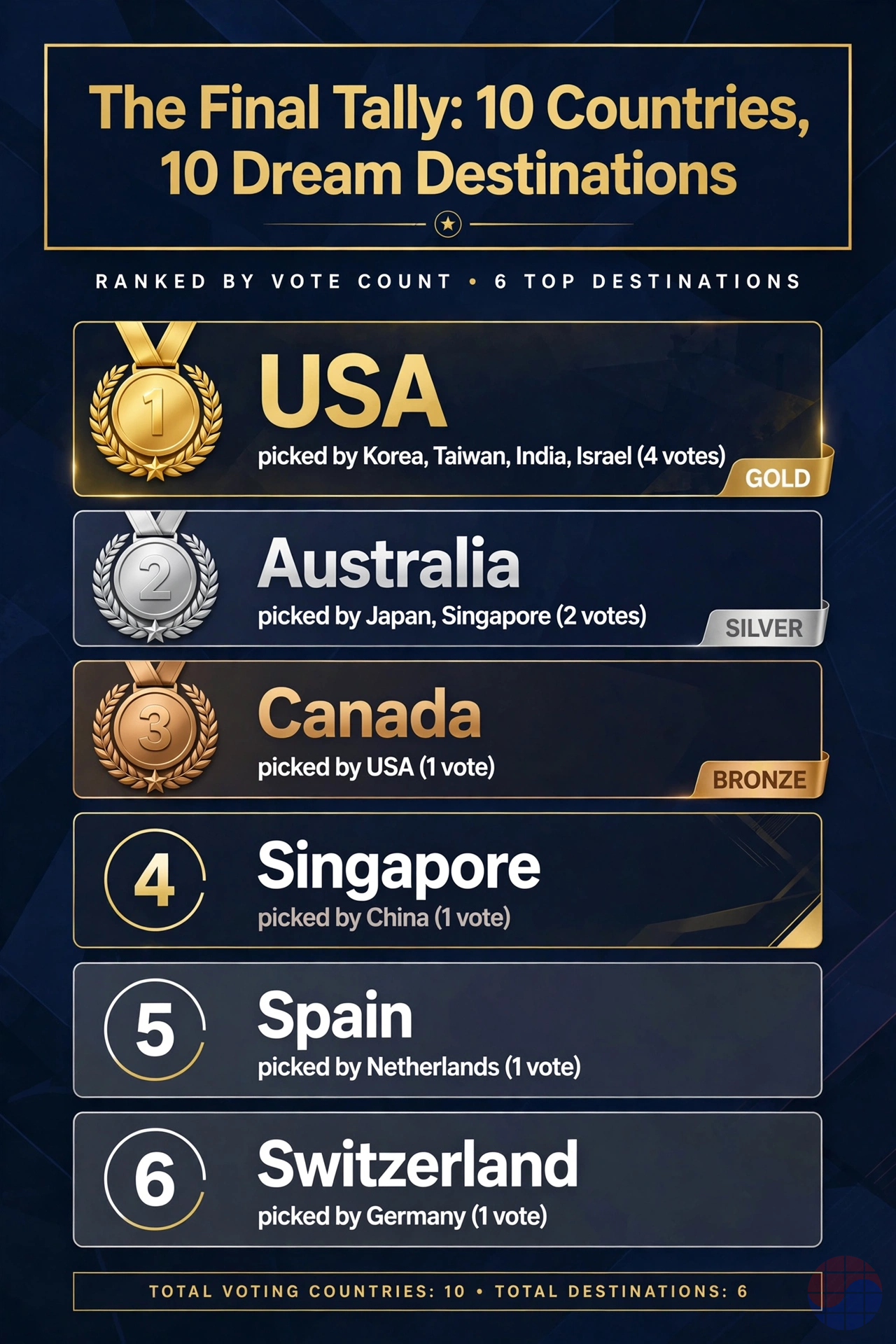
- The 10 picks: Korea→USA, Taiwan→USA, USA→Canada, Japan→Australia, China→Singapore, India→USA, Singapore→Australia, Netherlands→Spain, Germany→Switzerland, Israel→USA.
- Aggregated winner: the USA (top choice of 4 out of 10). Runner-up: Australia (2 out of 10).
Intro: Why the Grass Looks Greener
Ask young Europeans where they'd emigrate and you get a funny map: Germans want Switzerland, the French want Switzerland, the Irish want the UK, the British want Australia. The neighbor's rice cake always looks bigger.
I wanted a semiconductor-engineer version. The problem is the sample: no credible survey of chip engineers exists, and one probably never will. So I took a detour: compile where the people of 10 semiconductor powerhouses actually want to go — from migration statistics and polls — and re-read it as an engineer. One top destination per country, with reasons: salary, visa, industry, language.
10 Countries, 10 Choices
1. Korea → USA
Ask Koreans where they want to work and the answer hasn't changed in 40 years: America. A September 2025 Catch survey of 1,900 job seekers found 53% of Gen Z preferred working abroad, with the US the overwhelming #1 at 80%, followed by Australia and Japan (25%), Canada (23%), and Germany (20%) (MK). The Korean diaspora is also largest in the US (UN and Foreign Ministry data).
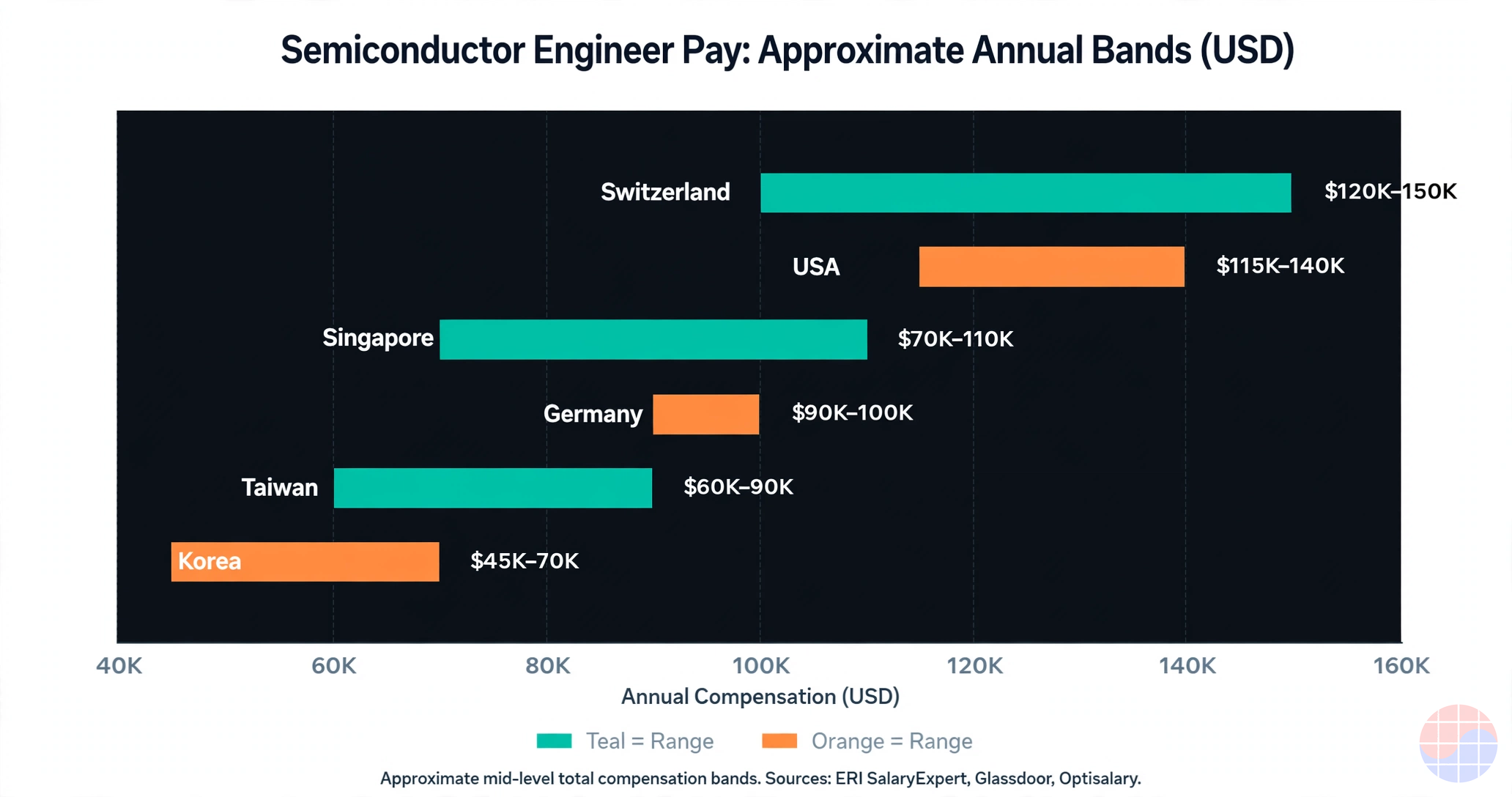
The engineer's reading is simple: America is the salary ceiling and the visa graveyard. ERI SalaryExpert puts the average US semiconductor engineer salary at $123,161 (SalaryExpert) — double Korea's ₩82,963,021, roughly $60,000 (SalaryExpert). But the H-1B is a lottery, and without sponsorship the door doesn't open. So the realistic Korean playbook is: join a multinational's Korea office, then transfer on an L-1; or do a US master's/PhD and ride OPT into the H-1B.
2. Taiwan → USA
Taiwanese youths' hearts are in Japan; their resumes go to America. A 1111 Job Bank poll found 77% of under-35s interested in working abroad, naming Japan, the US, and Singapore as top destinations (Taipei Times). But 2022 government data on Taiwanese working overseas shows mainland China/HK/Macau at 37.5%, the US at 21.8%, Southeast Asia at 15% — with China's share collapsing from 54.9% in 2018 (ThinkChina). That's decoupling, in numbers.
Read as an engineer, the answer is the USA. With TSMC Arizona ramping, "going to America" is no longer someone else's story. For a Taiwanese engineer it's double the salary plus a home-away-from-home fab in Arizona. Japan has the lower bar (working holiday, J-Skip), but if you're chasing the pay jump, it's America.
3. USA → Canada
The country where Americans most actually live abroad is Mexico — 799,248 in 2024 (Beacon Journal). That's retirees and remote workers. But in "where do you want to go" surveys, Canada wins: a Harris Poll found 42% of Americans considering a move abroad, with Canada the top destination (Harris Poll), and moveBuddha's Google-search analysis agrees (The Manual).
For engineers, Canada's appeal is Express Entry plus near-zero friction — same language, same time zones, same culture. Toronto-Waterloo has the AI labs; Vancouver has design outposts. The trade: you won't get US pay, but you'll stop worrying about medical bills.
4. Japan → Australia
Young Japan's exit runs through Australia. In FY2022-23 Australia issued a record 14,398 working-holiday visas to Japanese nationals (Unseen Japan), and Australia's minimum wage (26.44 AUD/hour) is more than double Japan's. By actual residents (Foreign Ministry data), the US is #1 and Australia #2.
Australia doesn't have many design jobs for chip engineers — which is exactly the point. Japanese engineers going to Australia are choosing life over salary: farm work paying 500,000 yen a month for six-hour days, versus rigid seniority pay at home. By money it's America; by heart it's Australia. This ranking followed the heart.
5. China → Singapore
Rich Chinese favor Singapore, Canada, and the US, in that order (2024 Hurun report, SCMP). Immigration-consulting surveys put North America, Australia/NZ, and Singapore on top (China Trading Desk).
The engineer's answer is Singapore. Mandarin works, taxes are low, and there are fabs (GlobalFoundries, Micron, UMC). The H-1B is a lottery for Chinese nationals too, with geopolitical risk on top. Singapore's ONE Pass and Tech.Pass actively suck in top talent. For a Chinese engineer, Singapore is "70% of US pay with 200% of the stability."
6. India → USA
India is the world's largest exporter of high-skilled talent. Indians received 71% of approved US H-1B petitions in FY2024-25 — 283,400 of them (WION). India ranks #2 for UK Skilled Worker visas and #2 for EU Blue Cards (Deel, The Hindu BusinessLine). The UAE is #1 for Indian workers overall, but that includes mid- and low-skilled flows; for engineers, America dominates.
The wind is shifting, though. Germany's Indian population grew 41%, and Indians took 21% of EU Blue Cards (Times of India). H-1B uncertainty is pushing diversification toward Germany, Canada, and Australia. Still, as of 2026, #1 is America — the gravity of the Silicon Valley Indian network is too strong.
7. Singapore → Australia
Singaporeans pick Australia. A Jobstreet survey found 33% of Singapore workers ranked Australia in their top three (Asia News Network). An Answers.sg poll of 7,744 put Australia at 20%, Malaysia at 19%, Japan at 15% (MustShareNews). In tech, 91% wanted to live abroad (TransferWise).
The funny thing: Singapore is a receiving country. Chinese and Indian engineers flow into Singapore; Singaporean engineers flow out to Australia. It's a talent food chain. Push factors: HDB prices and competitive pressure. Pull: bigger houses in the same language. Note that Singaporeans prefer short 1–3 year stints — many don't go as far as permanent residency.
8. Netherlands → Spain
The Dutch search most for Spain (Remitly search data). The historical diaspora went to the US, Canada, and Australia, but the heart wants the Mediterranean. Reasons: taxes (top marginal rates near 49.5%) and the housing crisis.
The engineer's version splits. For an ASML engineer, the money destination is the USA (Intel Arizona/Ohio). The heart destination is Spain. Dutch engineer emigration is a choice between salary and life — this ranking went with the search data's #1, Spain. Neighboring Germany and Belgium remain the pragmatic "commutable" options.
9. Germany → Switzerland
Germans pick Switzerland. In 2025 alone 22,730 Germans moved there; 323,600 Germans live in Switzerland, the second-largest foreign group after Italians (Newsy Today, FTN News). An Indeed survey tied Switzerland with the UK at the top (A News). The reason is taxes: the tax-and-social-security wedge for an average single earner is 38.7% in Germany vs 18.1% in Switzerland (OECD), and PPP-adjusted average wages are $92,285 vs $76,285.
For chip engineers, Switzerland has no fabs — but it has headquarters: Google and Apple chip design in Zurich, plus the precision-manufacturing premium. A Dresden engineer (TSMC/Infineon/GlobalFoundries cluster) moving to Switzerland gets "same German, 1.5x take-home." No language barrier is the whole trick.
10. Israel → USA
Israeli high-tech's destination is America. The Israel Innovation Authority's 2026 report found 23% of senior executives at private Israeli tech firms now based in the US, down 9.6 points at home since 2019 (Haaretz). Long-term high-tech departures rose from 610/month (summer 2022) to 944/month (summer 2024). A general-population poll preferred the EU (43%) over North America (27%) (Matzav) — but engineers' feet vote America.
The reason is market size. An Israeli startup's exit is a Nasdaq listing; after Series B, a US entity and US customers are mandatory. "Startup Nation's" next chapter is "scale up in the USA." Some R&D disperses to Eastern Europe, but decision-makers go to America.
The Aggregate: Where Is the Real #1?
Tallying the 10:
- USA: 4 countries (Korea, Taiwan, India, Israel)
- Australia: 2 (Japan, Singapore)
- Canada, Singapore, Spain, Switzerland: 1 each
The winner is the USA. The semiconductor engineer's world map points at Silicon Valley, Phoenix, and Austin. Runner-up Australia is the holy land of the "life over salary" faction. And notably, all three European countries' picks stay inside Europe — language, distance, and taxes keep them on the continent.
A Realistic Tech Tree for Korean Semiconductor Engineers
Routes first, dreams second. A country without visa sponsorship might as well not be on the map.
Route A: USA (difficulty ★★★★★, reward ★★★★★)
Don't bet your life on the H-1B lottery. Three realistic paths: Korea office of a multinational → L-1 transfer; US master's/PhD → OPT → H-1B; or O-1 (papers, patents, awards help). The fabs: Arizona (TSMC, Intel), Texas (Samsung Taylor, TI), New York (Micron), Ohio (Intel).
Route B: Singapore (difficulty ★★★, reward ★★★★)
ONE Pass and Tech.Pass are salary-threshold based — clear the bar and you're in. Mandarin helps daily life; taxes are low. Fabs: GlobalFoundries, Micron. Remember Singapore is often a transit stop — many use it as a springboard to Australia or the US in five years.
Route C: Australia / Canada (difficulty ★★★, reward ★★★)
Points-based. Stack age, degree, experience, English scores. Australia has few design jobs, but Canada has Toronto/Vancouver design hubs. If quality of life is the goal, this is the answer.
Route D: Germany (difficulty ★★, reward ★★★)
The EU Blue Card needs only a salary threshold; the Opportunity Card (Chancenkarte) works without a job offer. Dresden hosts the TSMC/Infineon/GlobalFoundries fab cluster. Taxes are high, but English-speaking engineering jobs are plentiful — Indian engineers are already walking this path in large numbers.
Route E: Japan (difficulty ★, reward ★★)
J-Skip and the Highly Skilled Professional points system have the lowest bar. TSMC Kumamoto and Rapidus Hokkaido fabs are hiring. The pay jump is small, but so is the risk of failure. Not a bad first overseas move.
One universal rule: "where will take me" beats "where do I want to go." A sponsoring company, a city with fabs or design centers, a team that works in English — a destination meeting all three is a real destination.
Chase's Take
Five-plus years as a semiconductor engineer taught me one thing: the #1 variable in emigration isn't salary, it's the visa. I once reached the final round at a US big-tech company and got filtered out on sponsorship. Everyone can read a salary table; few companies hand out sponsorships.
Re-reading this 10-country map, what matters isn't "where you want to go" but "where you can go." America tops four countries partly because of pay — but also because H-1B, L-1, and O-1 exist, however narrow. Australia is #2 because the door is wide: working holiday and points systems have no lottery.
One more thing: the fab map IS the jobs map. TSMC Arizona, Intel Ohio, Samsung Taylor, Micron New York, Rapidus Hokkaido, TSMC Dresden, TSMC Kumamoto — plot the mega-fabs announced in the last three years and the engineer's migration map overlaps it. The answer to "where do you want to go" is, in the end, "where the fabs are being built."
And one word for Korean engineers: Korea is a semiconductor powerhouse, so it feels like there's no need to leave — but paradoxically, that's why you should. Samsung and SK hynix on a resume work globally. Build 3–5 years at home, get your English score, move to a company that sponsors. Sometimes the neighbor's rice cake really is bigger.
Preparing in English: If you are aiming for a role abroad, English interview and conversation practice matters alongside the technical prep. Preply offers 1-to-1 online English lessons you can tailor to interviews and workplace situations. Purchases through this link may generate a commission.
FAQ
Q1. Is this ranking from a survey of semiconductor engineers?
No — no such global survey exists. This piece compiles each country's people's emigration preferences (polls, migration statistics) for 10 semiconductor nations and interprets them from an engineer's perspective. The directions are data-verified; the "engineer's #1" framing is interpretation, stated as such.
Q2. Why does the USA win the aggregate?
Four of ten countries (Korea, Taiwan, India, Israel) pick the USA as #1. Reasons: pay levels (ERI average $123,161), concentration of fabs and design centers, and visa paths that exist albeit narrow (H-1B, L-1, O-1).
Q3. Why don't European engineers leave Europe?
Netherlands→Spain and Germany→Switzerland are about language, distance, and taxes. Germany→Switzerland is barely "emigration" — more like tax optimization in the same language.
Q4. What's the most realistic first destination for a Korean engineer?
By visa friction, lowest first: Japan (J-Skip) → Germany (EU Blue Card) → Singapore (ONE Pass) → Australia/Canada (points) → USA (H-1B/L-1). For a pay jump: the USA. For quality of life: Australia/Canada. For minimum risk: Japan.
Footnote: each country's #1 destination reflects its people's emigration preferences (OECD, national statistics, polls by 1111 Job Bank, Catch, Hurun, Indeed, Harris Poll, Jobstreet, and others), interpreted from a semiconductor engineer's perspective — not a direct survey of engineers. Salary figures are approximate estimates from ERI SalaryExpert, Glassdoor, and Optisalary and vary by timing and seniority. Visa programs change frequently; check each country's official immigration guidance. Not investment or immigration advice.