VLSI Korea
SK hynix Explores $10B Solidigm U.S. IPO as Chey Tae-won Vows Early Honam Fab Groundbreaking
Daily Silicon for Saturday, October 10, 2026. SK hynix has begun exploring a U.S. IPO for its NAND subsidiary Solidigm. SK chairman Chey Tae-won vowed to break ground on the Honam semiconductor cluster "even if power and water lag behind," and the U.S. Department of War committed a $1.5 billion conditional loan to Wolfspeed.


Daily Silicon for Saturday, October 10, 2026. SK hynix has begun exploring a U.S. IPO for its NAND subsidiary Solidigm. SK chairman Chey Tae-won vowed to break ground on the Honam semiconductor cluster "even if power and water lag behind," and the U.S. Department of War committed a $1.5 billion conditional loan to Wolfspeed. A day that opens the next chapter of the memory supercycle.
Executive Summary
- SK hynix explores $10B Solidigm U.S. IPO: hired Goldman Sachs and Morgan Stanley to explore listing its NAND arm Solidigm. A Korean lawmaker raised concerns about dilution for SK hynix shareholders.
- Chey Tae-won vows early Honam fab groundbreaking: during an October 9 site visit, said construction will start "even if power and water infrastructure is delayed." Memory capacity must more than double within five years — the Yongin cluster, pulled forward 12 years, is not enough.
- Wolfspeed lands $1.5B conditional U.S. loan: the Department of War's Office of Strategic Capital committed the loan to build domestic SiC and GaN supply chains. Onshoring accelerates for defense and power semiconductors.
- Samsung's record Q3 aftermath: operating profit of ₩107.4T (+782.5% YoY) and revenue of ₩195T (+126.6%) — the first-ever ₩100T+ quarterly operating profit, at a 55.1% margin. Shares still fell 2.42% — attention shifts to SK hynix earnings on October 27.
- U.S. and Taiwan indict 11 over chip smuggling to China: Taiwan indicted 10 on October 6 for reselling export-controlled chips; the U.S. arrested Greg Lui on October 1 over ~$300M of Nvidia-chip servers.
01. SK hynix Explores $10B U.S. IPO for NAND Arm Solidigm
TL;DR: SK hynix's NAND subsidiary Solidigm is exploring a U.S. IPO worth up to $10 billion, with Goldman Sachs and Morgan Stanley hired as advisors.
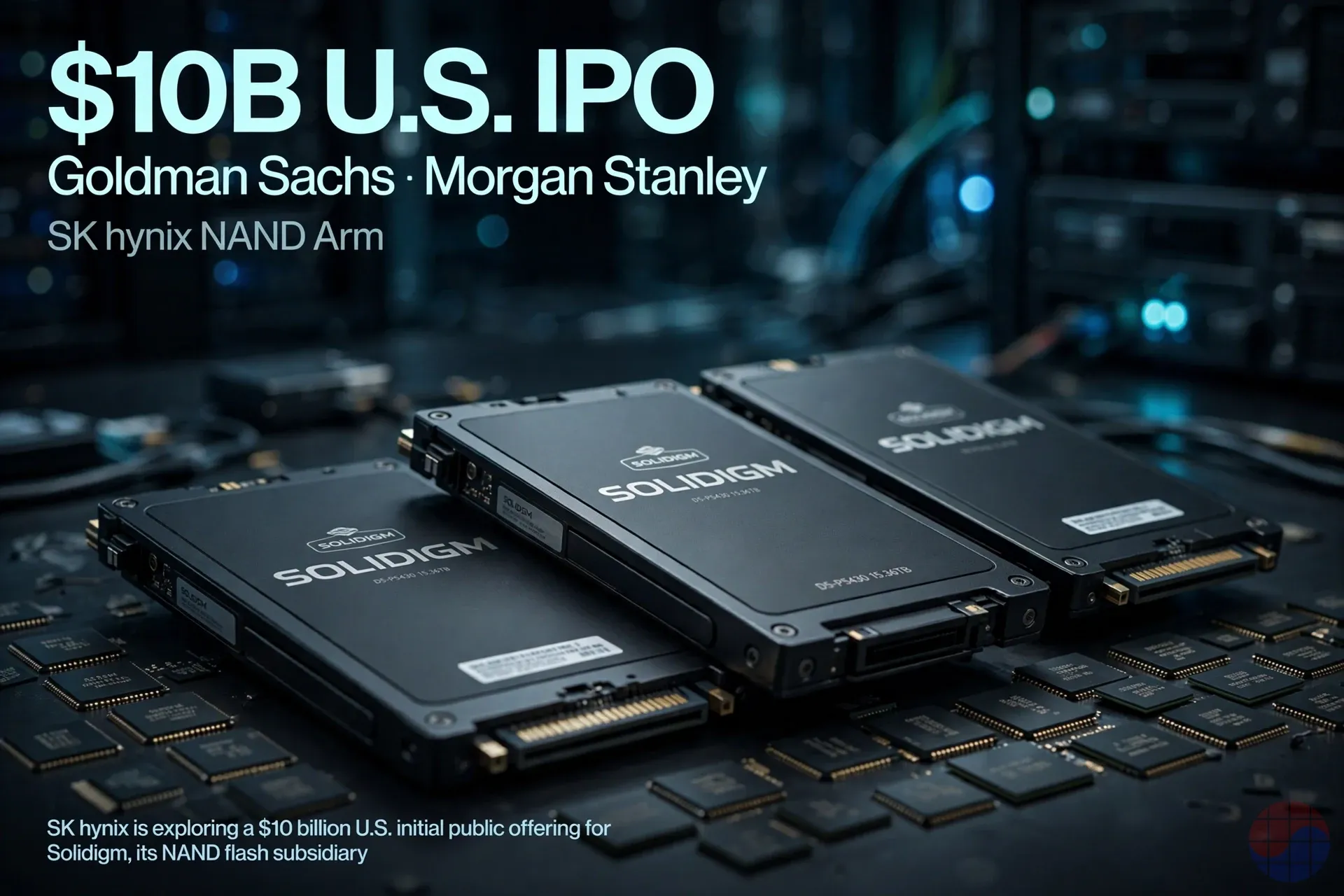
Solidigm is the enterprise SSD subsidiary SK hynix created from its $9 billion acquisition of Intel's NAND business in 2021. According to October 9 reports, Solidigm has hired Goldman Sachs and Morgan Stanley to explore a U.S. listing, with a valuation of up to $10 billion under discussion. With AI data-center storage demand exploding, it is an ideal window for SK hynix to have the market re-rate the subsidiary's value.
Pushback has already emerged in Korea. A National Assembly office raised concerns that a Solidigm listing could dilute value for existing SK hynix shareholders — the classic holding-company discount debate. With SK hynix's valuation anchored to HBM and DRAM, how it monetizes NAND assets is now directly tied to shareholder-return policy.
Chase's Take: This is a signal that the memory supercycle's benefits are spreading beyond DRAM into NAND. A $10B valuation would trigger a sum-of-the-parts re-rating for SK hynix. The key is structure — the market's read will hinge on how much equity is sold and what the proceeds fund (capex vs. shareholder returns).
Source: MoneyCheck
02. Chey Tae-won: "Break Ground on Honam Cluster Even If Utilities Lag"
TL;DR: SK chairman Chey Tae-won visited the planned Honam semiconductor national industrial complex on October 9 and declared early groundbreaking. Memory capacity must more than double within five years.
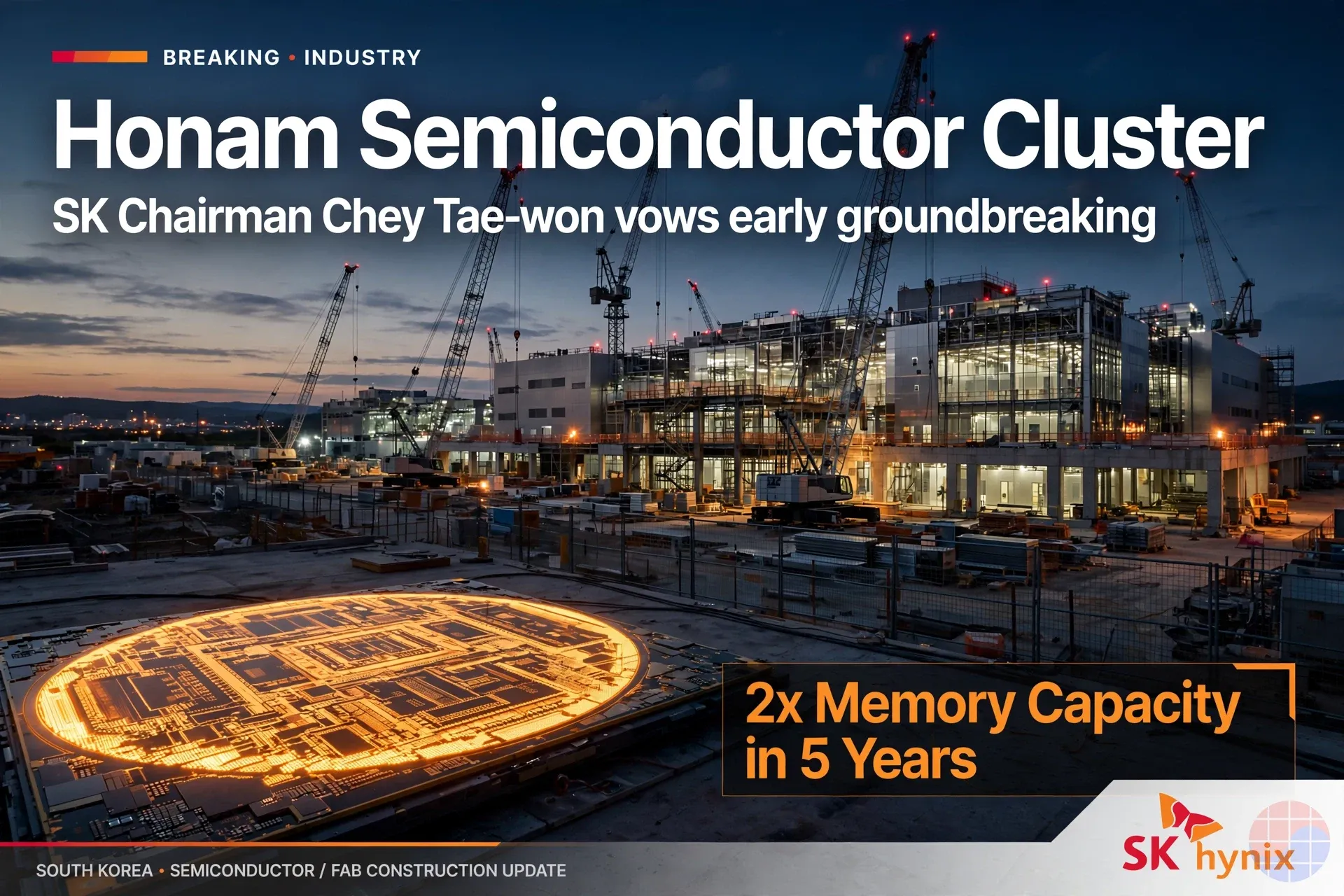
Chey toured the candidate site — including the planned relocation area for the Gwangju air base ammunition depot — with key executives including Min Hyung-bae and SK hynix CEO Kwak Noh-jung. On site, he said, "Even if the build-out of power and water is delayed, we will break ground first." "Seeing with one's own eyes is more important than a hundred words," he added, forecasting semiconductor demand "growing at a fairly rapid pace."
The backdrop is a speed race on memory expansion. "We advanced the Yongin completion timeline by 12 years, but that alone is not enough," Chey said. "We need to develop another site and push ahead in parallel if necessary." His judgment: responding to the AI era requires more than doubling memory semiconductor production capacity within five years — effectively formalizing a second production base beyond Yongin as SK's next memory strategy.
Chase's Take: "Build first even if infrastructure lags" is not something you say without demand conviction. With HBM eating DRAM wafer capacity (see item 08), memory makers' expansions will also affect conventional DRAM supply. The Honam cluster is the bet that decides SK hynix's 2030s memory leadership.
Source: ChosunBiz
03. Wolfspeed Secures $1.5B Conditional Loan from U.S. Office of Strategic Capital
TL;DR: The Department of War's Office of Strategic Capital announced a $1.5 billion conditional loan commitment to Wolfspeed to strengthen domestic silicon carbide and gallium nitride supply chains.
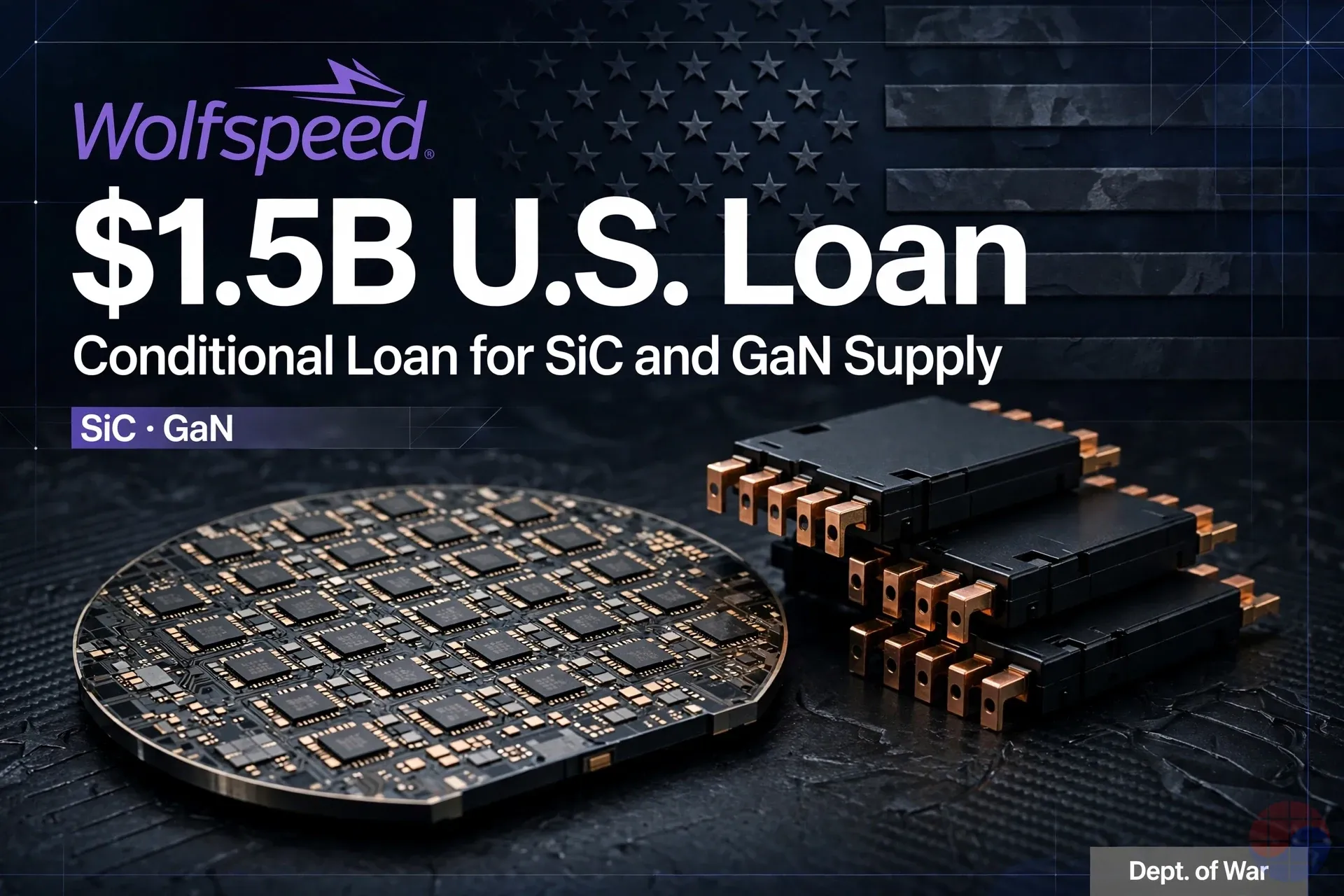
Announced October 9: the Office of Strategic Capital (OSC) under the Department of War committed a $1.5 billion conditional loan to semiconductor manufacturer Wolfspeed. Combined with private capital, the financing aims to build secure U.S. supply chains for silicon carbide (SiC) and gallium nitride (GaN) — advanced power and RF materials used in high-performance propulsion, directed energy weapons, drones, electronic warfare, radars, and missile defense.
"Securing U.S. military and economic superiority requires bold domestic investments in critical dual-use capabilities," said Peter B. Zuckerman, Senior Managing Director at OSC. The announcement is part of the Trump administration's push to accelerate domestic semiconductor production, framed as aligned with national security objectives "in the era of Super Intelligence." Wolfspeed is the leading SiC wafer and device maker; if executed, the loan takes U.S. SiC/GaN capacity up a level.
Chase's Take: Power semiconductors are being reclassified as national-security assets. Logic and memory were already in the "domestic supply chain" frame — now SiC and GaN join them. That's a geopolitical premium on compound-semiconductor valuations.
Source: Lokmat Times (citing Dept. of War announcement)
04. Samsung's Record Q3 Aftermath — Eyes Turn to SK hynix on October 27
TL;DR: Samsung posted operating profit of ₩107.4T (+782.5% YoY) and revenue of ₩195T (+126.6%) — the first ₩100T+ quarterly operating profit ever, at a 55.1% margin. Shares still fell 2.42%.
Samsung's preliminary Q3 results, announced October 8, are literally historic: ₩107.4 trillion in operating profit — a quarterly record with no precedent, not just among Korean companies but among global tech giants including Apple and Nvidia. Revenue of ₩195 trillion is also a record. Yet shares closed down 2.42% at ₩262,000 on Thursday, on disappointment versus the high end of Bloomberg consensus and pressure from climbing global bond yields — a textbook sell-the-news. SK hynix fell 2.44% to ₩1,681,000. (Korean markets were closed October 9 for Hangeul Day.)
Attention now shifts to SK hynix's Q3 results due October 27. Analysts expect record quarterly operating profit of around ₩75 trillion, driven by rising memory prices. If Samsung's print was "better than expected but already priced in," the question for SK hynix is whether it can beat expectations — with shareholder-return policy in focus alongside.
Chase's Take: The ₩100T quarterly operating profit era — the memory supercycle proven in numbers. But flat shares mean the market has already priced 2027 earnings. The next catalyst isn't "how much more can they earn" but evidence for "how long this cycle runs." October 27 is the test.
Source: Herald Business · MoneyCheck
05. U.S. and Taiwan Indict 11 Over Chip Smuggling to China
TL;DR: U.S. and Taiwanese authorities separately indicted or arrested 11 people for illegally reselling export-controlled semiconductor chips to China. Routing through Singapore and Malaysia was the common technique.
Per the Institute for the Study of War's October 9 China & Taiwan Update, Taiwanese prosecutors charged 10 individuals on October 6 with reselling export-controlled semiconductor chips to the PRC from 2017 to at least April 2026. The group allegedly forged end-user documents and falsely claimed to represent Taiwan's National Chung-shan Institute of Science and Technology (NCSIST). Taiwanese authorities stated the PLA sought the advanced chips for missiles and radar systems.
In the U.S., California resident Greg Lui was arrested October 1 for reselling servers containing around $300 million worth of export-controlled Nvidia chips designed for large AI models. Lui allegedly first exported the servers to Singapore and Malaysia to evade restrictions before selling them on to the PRC. Authorities say recent cases share the same playbook: falsified end-user documents plus Southeast Asian routing.
Chase's Take: The export-control hole is the classic playbook — forged paperwork plus third-country routing. Tighter enforcement raises compliance costs across legitimate distribution — structurally, that becomes a premium for authorized channels.
Source: ISW China & Taiwan Update (2026-10-09)
06. Sumitomo Bakelite to Invest ¥10B in Chip Packaging Materials
TL;DR: Sumitomo Bakelite will add semiconductor packaging material lines in Suzhou, China and Singapore — about ¥10 billion (~$63.2M), targeting operation in fiscal 2030.
Reported by SemiMedia on October 9: Sumitomo Bakelite plans to invest approximately ¥10 billion to add production lines at its Suzhou and Singapore plants, with new capacity expected online in FY2030. The expansion targets growing demand for advanced packaging materials as generative AI and data-center investment continue — higher-power chips need materials with stronger heat resistance, mechanical strength, and long-term reliability.
Sumitomo Bakelite is one of the world's leading packaging-materials suppliers. It already announced a Suzhou expansion in June (capacity by end-2028) and agreed in January to acquire Kyocera's chemical materials business for ~¥30 billion. Other Japanese materials suppliers are following — new photoresist developer and electronic substrate material capacity is part of the same wave.
Chase's Take: Materials are where the money is right now. As AI chips push power density higher, packaging-material specs become yield. The Japanese chemical capex rally is a lagging indicator of the advanced-packaging supercycle — and it's not over.
Source: SemiMedia
07. ASE August Revenue +45.7% YoY — Packaging and Test Demand Expands
TL;DR: ASE Technology's August consolidated revenue hit TWD 82.247 billion, up 45.7% year over year. ATM (assembly, testing, material) revenue rose 53.1% YoY.
The world's largest OSAT reported monthly results October 9: unaudited August consolidated revenue of TWD 82.247 billion (~$2.6B), up 11.5% month over month and 45.7% year over year. ATM revenue reached TWD 51.287 billion, up 53.1% YoY and 7.9% from July. In Q2, net income surged 180% YoY — far outpacing 27% revenue growth — showing operating leverage as advanced packaging and test demand expanded.
Management guidance calls for Q3 consolidated revenue growth of 21–22% quarter over quarter with an operating margin of 11.5–12.5%. The company flagged semiconductor cyclicality, competition, trade policy, and FX as risk factors.
Chase's Take: OSAT numbers are lagging confirmation of AI chip volumes. ATM at +53% means advanced-packaging demand — CoWoS and beyond — is still accelerating. Read it as a data point for the packaging-bottleneck thesis.
Source: ad-hoc-news.de
08. WSTS: Global Chip Market Closing In on $2 Trillion
TL;DR: WSTS's updated forecast puts 2026 global semiconductor revenue at ~$1.655T and 2027 at ~$2.1T, on first-half 2026 actuals of $702B (+102% YoY).
Reported by TechTimes on October 9: the World Semiconductor Trade Statistics organization's updated forecast — based on $702 billion in first-half 2026 actual revenue, up 102% year over year — projects ~$1.655 trillion for full-year 2026 and ~$2.1 trillion for 2027. The $2 trillion milestone is no longer speculative; it is the central case of the industry's most authoritative data source. Risks are a memory correction or hyperscaler capex slowdown — neither visible in the data.
The paradox inside the numbers: record memory profits come from HBM, and HBM production consumes standard DRAM wafer capacity at roughly a 3-to-1 ratio versus conventional DDR5. As Samsung, SK hynix, and Micron redirect DRAM lines toward HBM, commodity DRAM for smartphones, laptops, and ordinary servers tightens — the same AI boom making chipmakers extraordinarily profitable is raising memory costs inside everyday devices.
Chase's Take: $2T isn't about the number — it's about power. When semiconductors become a two-trillion-dollar industry, every government's industrial policy re-centers on it. And HBM's 3:1 capacity cannibalization structurally lengthens the memory cycle — that's what makes this supercycle different.
Source: TechTimes
09. Friday U.S. Session — Calm After Thursday's Plunge; Micron Buyback Thesis
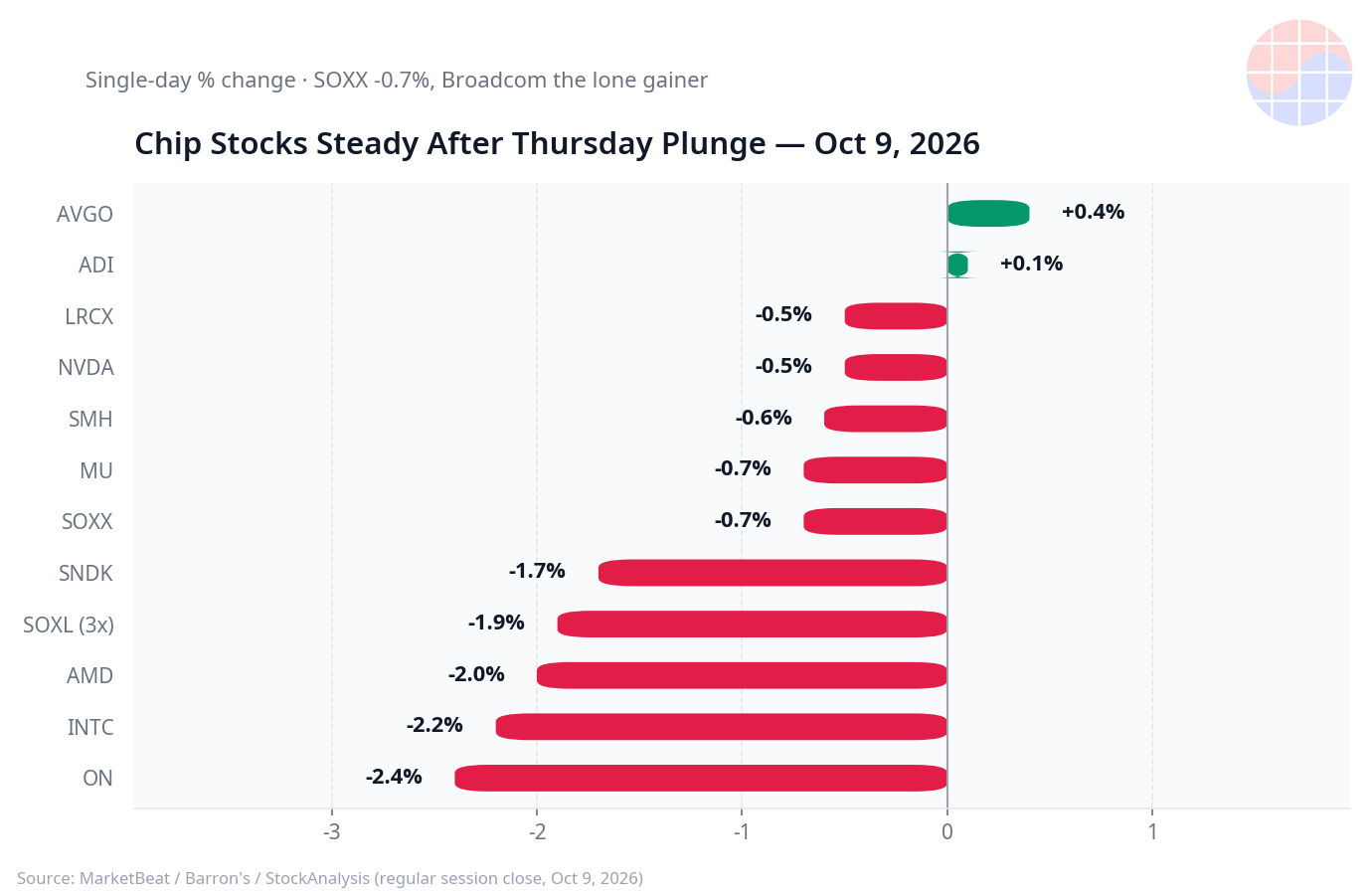
TL;DR: October 9 U.S. trading was a breather after Thursday's -3.4% plunge: SOXX -0.7%, Nvidia -0.5%, AMD -2.0%, Micron -0.6–0.7%, SanDisk -1.7%. Broadcom +0.4% stood alone in the green.
A day after the OpenAI-driven selloff, chip stocks stabilized with smaller losses. SOXX closed at $559.40 (-0.7%); SMH at $603.33 (-0.6%). Nvidia $229.28 (-0.5%), AMD $608.10 (-2.0%), Intel $104.70 (-2.2%), Broadcom $361.54 (+0.4%), Lam Research $318.84 (-0.5%), Analog Devices $406.19 (+0.1%), onsemi $77.53 (-2.4%).
The memory pair diverged. Micron closed at $1,028.61 (-0.7%), and Barron's flagged the next catalyst: buybacks. Under its 2024 U.S. CHIPS Act funding terms, Micron can begin major repurchases from December 9 — UBS's Timothy Arcuri argues it could start at ~$20B a quarter, rising toward $50B quarterly by the end of FY2027, i.e., up to $200B a year, on the scale of Nvidia's record buyback. "The path for Micron to buy back ~30% of the company over the next two years and potentially about half through 2029." SanDisk closed at $1,581.82 (-1.7%) ahead of October 29 earnings.
Chase's Take: The Micron buyback story is the classic late-cycle signal — cash so abundant the company buys its own stock. If $200B/year materializes, it puts a floor under memory valuations. The variable is the CHIPS Act condition (December 9).
Source: Barron's · StockAnalysis (SNDK) · MarketBeat
10. Three AI-Chip Financing Talks — Broadcom, SpaceX, Oracle
TL;DR: Three AI-chip financing discussions surfaced October 7: Broadcom–OpenAI custom chip at $50B+, SpaceX's $40B for Nvidia chips, Oracle's large chip purchase. All early-stage.
Per NeoTeo's October 9 roundup, three separate large AI-chip financing discussions were reported on October 7. Broadcom is working to arrange more than $50 billion tied to the custom AI chip it is developing with OpenAI, with Apollo and Blackstone among potential participants. SpaceX reportedly discussed $40 billion in financing for Nvidia chips, with Pimco named as a prospective participant. Oracle is in talks with Apollo and Goldman Sachs about financing a large chip purchase. None are completed financings; amounts could change.
The common thread: chip vendors directly financing demand. It follows Nvidia's up-to-$100B OpenAI commitment (Sept 2025), AMD's up-to-$5B Anthropic equity (Jul 2026), and Broadcom's $42B Anthropic package (Oct 2026). The cost of compute is increasingly recycled through the vendors that build it.
Chase's Take: From "selling demand" to "financing demand" — the nature of the AI chip business is changing. When vendor financing becomes routine, chipmakers' credit risk is directly tied to AI labs' survival. The next cycle's risk isn't demand — it's counterparty.
Source: NeoTeo · Plutux (vendor-financing roundup)
Semiconductor Stock Roundup (U.S. regular session close, October 9)
One line for the day: Thursday's panic faded; the market waits for the next catalyst. SOXX trimmed its loss to -0.7%, Micron has the buyback thesis, SanDisk reports October 29, SK hynix on October 27.
| Name | Oct 9 change | Note |
|---|---|---|
| onsemi (ON) | -2.4% | Closed $77.53 |
| Intel (INTC) | -2.2% | Closed $104.70 |
| AMD | -2.0% | Closed $608.10 |
| Direxion SOXL (3x) | -1.9% | Closed $139.76 |
| SanDisk (SNDK) | -1.7% | Closed $1,581.82; earnings Oct 29 |
| iShares SOXX | -0.7% | Closed $559.40 |
| Micron (MU) | -0.7% | Closed $1,028.61; buyback thesis |
| VanEck SMH | -0.6% | Closed $603.33 |
| NVIDIA | -0.5% | Closed $229.28 |
| Lam Research (LRCX) | -0.5% | Closed $318.84 |
| Analog Devices (ADI) | +0.1% | Closed $406.19 |
| Broadcom (AVGO) | +0.4% | Closed $361.54; lone gainer |
| Samsung Electronics (005930) | -2.42% (Oct 8) | ₩262,000 close; Korea closed Oct 9 |
| SK hynix (000660) | -2.44% (Oct 8) | ₩1,681,000 close; earnings Oct 27 |
Price data: MarketBeat, Barron's, StockAnalysis (U.S. regular session close Oct 9, 2026; Korea Oct 8 close)
FAQ
What is Solidigm?
The enterprise SSD subsidiary SK hynix created from its ~$9B acquisition of Intel's NAND business in 2021. AI data-center storage demand has driven its valuation sharply higher, and a U.S. IPO worth up to $10B is now being explored.
What is the Honam semiconductor cluster?
SK hynix's planned second memory production base, following the Yongin cluster. Chairman Chey Tae-won says memory capacity must more than double within five years. Power and water infrastructure are the bottlenecks.
Why does Wolfspeed matter?
The leading silicon carbide (SiC) wafer and device maker. SiC and GaN are core power-semiconductor materials for EVs, defense, and power infrastructure — classified as national-security assets, with the U.S. Department of War committing a $1.5B conditional loan.
What backs the WSTS $2T forecast?
An updated forecast built on $702B in first-half 2026 actual revenue (+102% YoY): ~$1.655T for 2026, ~$2.1T for 2027. Risks are a memory correction or hyperscaler capex slowdown — neither visible in current data.
* Figures and schedules are per each cited source; earnings and prices are preliminary/closing values as of publication. See the Sources links for originals.