VLSI Korea
Chinese Big Tech Ordered USD 35 Billion of Nvidia Chips — 5 Facts on Why Only 5-10% May Ship (RTX PRO 5500, B300, H200)
ByteDance, Alibaba and Tencent ordered over 3 million RTX PRO 5500 cards worth over USD 35 billion, but Nvidia may fill only 5-10%. China orders top 6 million against a 3 million 2027 cap, with Rubin first in line for capacity.


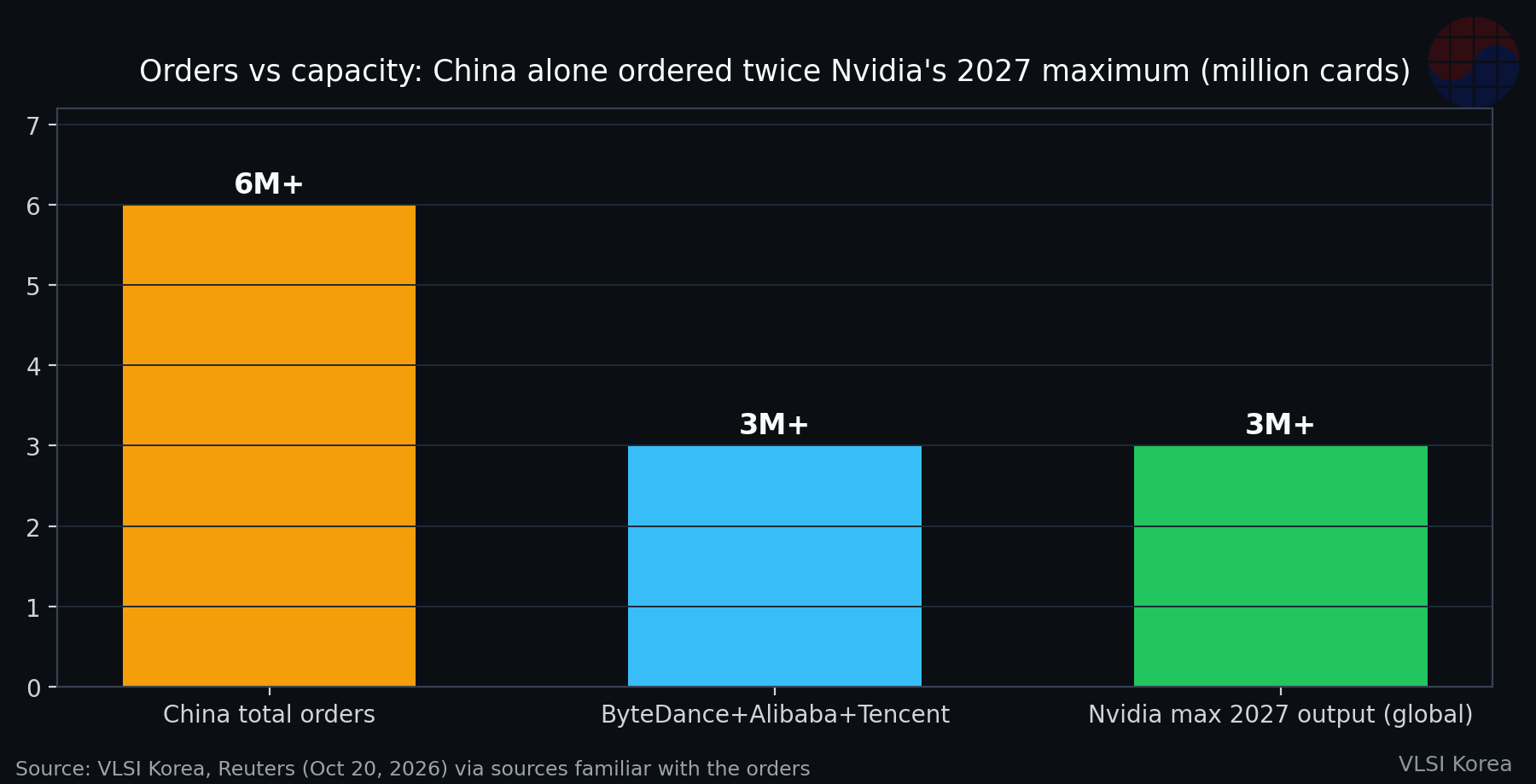
Conclusion first: the USD 35 billion headline is not Nvidia revenue. It is a queue. ByteDance, Alibaba and Tencent ordered more than 3 million RTX PRO 5500 cards, total orders from China passed 6 million, and Nvidia can produce at most 3 million of the cards worldwide in 2027, as reported by Reuters on Oct 20, 2026. The binding number in this story is not demand. It is allocation: 5% to 10%.
That distinction changes everything an investor, a buyer or a competitor should take from the news. An order that cannot be filled is a statement about scarcity, not a sales forecast. As of Oct 21, 2026, the verified facts point to a market where export controls did not remove demand for Nvidia hardware in China. They moved that demand down one performance tier, into a workstation card, and then ran it into a hard production ceiling that Nvidia itself is choosing not to raise, because its foundry capacity is reserved for a more profitable platform.
5 Facts, in Order
- Three buyers alone ordered more than 3 million cards, worth more than USD 35 billion. ByteDance, Alibaba and Tencent ordered more than 3 million RTX PRO 5500 cards at about USD 11,400 per card, giving a combined value above USD 35 billion, Reuters reported on Oct 20, 2026, citing two people familiar with the matter. None of the three companies responded to a request for comment.
- Total orders from China are more than double Nvidia's maximum 2027 output. Orders from customers in China have exceeded 6 million cards. Nvidia has indicated it can produce no more than 3 million RTX PRO 5500 cards globally in 2027. Chinese orders alone are therefore at least twice the entire planned global supply, before any buyer outside China receives a single card.
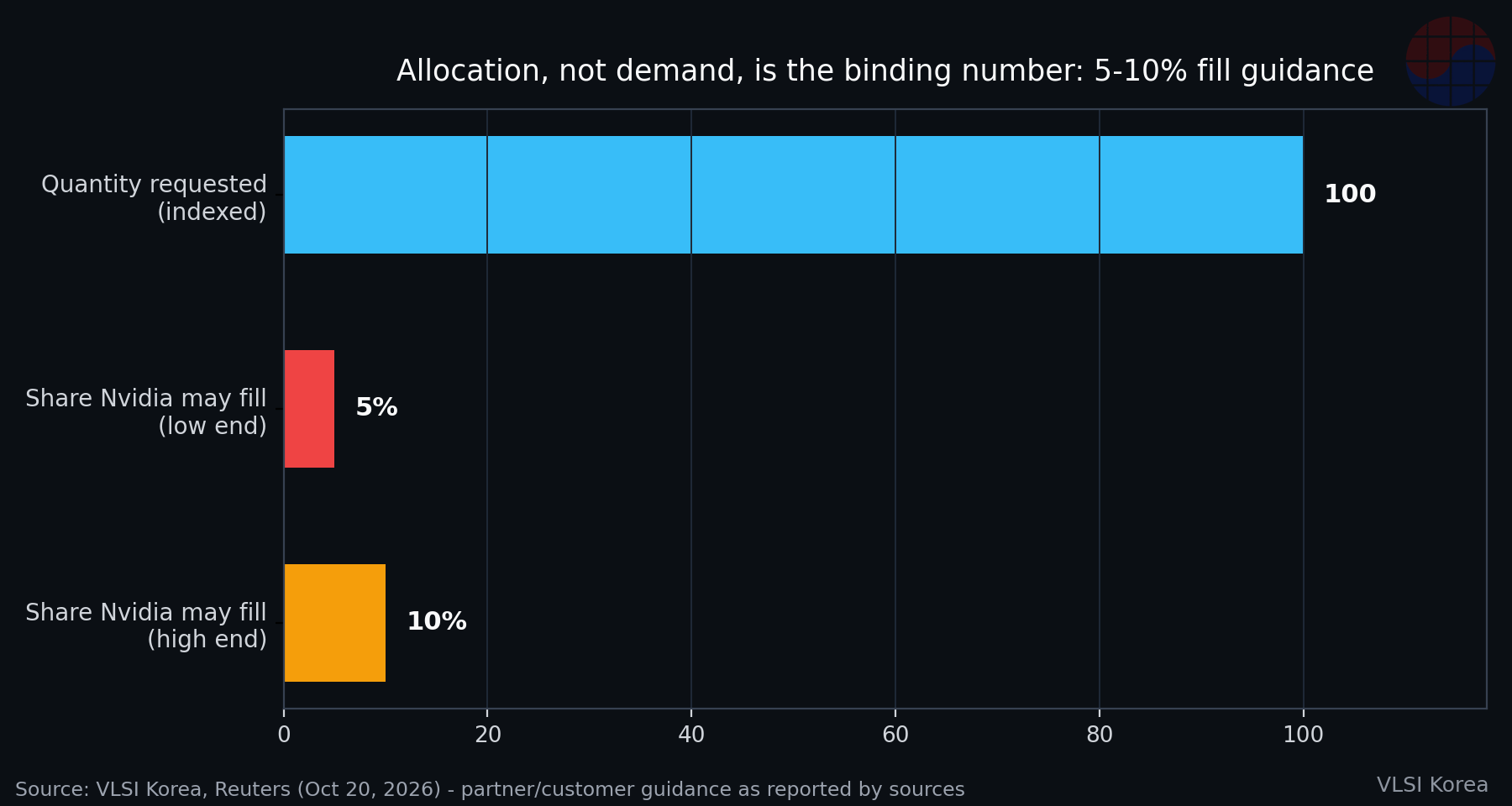
- Nvidia has told partners to expect only 5% to 10% of what they asked for. One source told Reuters that Nvidia told partners and customers they might receive only 5% to 10% of the quantities requested, and that the company cannot guarantee it can fill the orders. Allocation, decided by the seller, replaces the order book as the real market mechanism.
- The card is a workaround created by export controls, not a first choice. The RTX PRO 5500 is a workstation card for powerful professional computers, not a data center accelerator. Nvidia's Blackwell-based B300 cannot be sold to Chinese buyers under US export controls, and Hopper-based H200 exports are reviewed case by case and need licences. The RTX PRO 5500 is among the most powerful Nvidia chips still available to Chinese buyers, and its performance is similar to the RTX 6000D, a card built to meet the same controls.
- Delivery starts late, and capacity is being reserved for Rubin instead. Nvidia has told customers to expect early samples in December 2026 and commercial deliveries from the first quarter of 2027. At the same time, Nvidia is expected to assign a large share of TSMC capacity in 2027 to Rubin, its next data center platform, rather than expanding output of this lower tier. A confirmed purchase also exists on paper: Tansun Technology, listed in Shenzhen, disclosed on Oct 13, 2026 that it would buy 20,000 RTX PRO 5500 cards, while warning that deliveries could be delayed or reduced because of supply shortages and overseas technology restrictions.
| Item | Figure | As of / Source |
|---|---|---|
| ByteDance, Alibaba, Tencent orders | More than 3 million cards | Reuters, Oct 20, 2026 |
| Price per card | About USD 11,400 | Reuters, Oct 20, 2026 |
| Combined order value, three buyers | More than USD 35 billion | Reuters, Oct 20, 2026 |
| Total orders from China | More than 6 million cards | Reuters, Oct 20, 2026 |
| Nvidia maximum global output, 2027 | 3 million cards | Reuters, Oct 20, 2026 |
| Fill guidance given to partners | 5% to 10% of requested quantity | Reuters, Oct 20, 2026 |
| Early samples | December 2026 | Reuters, Oct 20, 2026 |
| Commercial deliveries | From Q1 2027 | Reuters, Oct 20, 2026 |
| Confirmed disclosed purchase | 20,000 cards, Tansun Technology | Company disclosure, Oct 13, 2026 |
Why a Workstation Card, and Why Now
The buyers want the cards primarily for AI inference, according to the sources cited by Reuters. That detail is the key to the economics. Training a frontier model needs the fastest accelerators, the fastest interconnect and the largest memory system a buyer can obtain. Inference — answering questions, generating content, running agents — needs enough compute, delivered reliably, at a cost per token the service can survive. A workstation card that clears export controls is not ideal for inference. Under scarcity, ideal stops being the purchasing criterion. Available becomes the criterion.
The clearest proof is the predecessor. The RTX 6000D, launched in mid-2025 for the China market under the same logic, was rejected by Chinese buyers as poor value for its price. It was then discontinued. Its price in China has since doubled, according to a source cited by Reuters. The same class of hardware moved, in about a year, from unwanted to fought over, with no change in the hardware itself. What changed was the duration of the controls and the depth of the compute shortage. Buyers stopped waiting for a better legal option and started queuing for the option that exists.
This is a familiar pattern in semiconductors. In a shortage, the purchasing question shifts from performance per dollar to certainty of supply. A card secured at a known price, on a known date, can be planned around: racks can be designed, power can be contracted, services can be priced. A faster card that may never receive a licence cannot. Anyone who has worked through a tapeout under a capacity constraint recognises the logic — a slower, signable, manufacturable option beats a theoretically better option that misses the window.
Allocation Is the Real Story: The TSMC Zero-Sum
The second force in this story is on the supply side, and it is a choice, not an accident. Every wafer allocated to a workstation card in 2027 is a wafer not allocated to Rubin, Nvidia's next data center platform. Reuters reported that Nvidia is expected to assign a substantial share of TSMC capacity to Rubin from 2027. That is rational capital allocation: data center platforms carry the strategic position, the ecosystem lock-in and the margin structure that justify priority. A compliant workstation tier for one restricted market does not outrank them.
So the ceiling of 3 million cards is not simply what the supply chain can physically produce. It reflects where this product sits in Nvidia's own priority order. Chinese buyers are not only competing with each other for the cards. They are competing, indirectly, with every hyperscaler waiting for Rubin. In that contest, a 5% to 10% fill rate is not a surprise. It is the predictable output of the priority stack.
For Nvidia's financials, discipline matters more than the headline. On its most recent earnings call at the end of August 2026, Nvidia's CFO said less than 1% of data center revenue came from customers in China, and the company has been giving guidance without counting on a resumption of large Chinese sales. Read correctly, the USD 35 billion is therefore potential upside that is not in the guide, not a number to annualise. If only 5% to 10% of the three buyers' requested quantity ships, the realised value is a small fraction of the headline — still meaningful, but an order of magnitude smaller, and spread from 2027, not booked this quarter.
What This Means for Everyone Else in the Chain
For Chinese buyers, the lesson is uncomfortable. Queuing harder does not create supply, and a compliant tier provided by the same supplier the controls target is a rented capability, not a sovereign one. The orders will strengthen the domestic substitution argument inside every large Chinese technology company: not because domestic chips matched Nvidia — this episode proves they have not yet, for these buyers, at this scale — but because dependence now has a visible fill rate attached to it. Expect parallel tracks to continue: maximise compliant Nvidia supply while funding domestic alternatives for inference, where the performance gap is easiest to close.
For memory and component suppliers, including Samsung Electronics and SK hynix, inference volume is still volume. Millions of additional inference cards, even at a 5% to 10% fill rate, mean hundreds of thousands of cards that need memory, substrates, boards and power components. The direction is positive for the inference supply chain, but the honest sizing uses the fill rate, not the order headline. A plan built on 6 million cards will be wrong. A plan built on delivered cards, phased from Q1 2027, is defensible.
For competitors, the opening is real but narrow. A buyer told it will receive a tenth of what it requested will listen to any credible second source for inference compute. Credibility is the hard part: the second source must ship in volume, with a software stack teams can actually deploy. That is the same qualification problem that protects incumbents everywhere in this industry — in EDA, in signoff, in process technology. Trust is earned in production, not in a datasheet.
Watchlist: Four Signals That Decide Whether This Story Grows
- Sample delivery in December 2026: do early RTX PRO 5500 samples arrive on the schedule Nvidia communicated, and in what quantity?
- First-quarter 2027 commercial shipments: does the realised fill rate land inside the 5% to 10% range, above it, or below it?
- Rubin capacity allocation: does reporting through 2027 confirm that TSMC capacity priority is limiting this tier, as expected?
- Follow-on disclosed purchases: do more listed Chinese companies disclose confirmed orders like the 20,000-card Tansun Technology purchase of Oct 13, 2026 — and do those filings repeat the delay and reduction warnings?
If fill rates rise above the guided range, the revenue story becomes real. If they stay at the low end while orders keep growing, the story is not a sales boom. It is a rationing system, and rationing systems push buyers to build alternatives.
FAQ
Is the USD 35 billion figure Nvidia revenue?
No. It is the combined sticker value of more than 3 million cards ordered by ByteDance, Alibaba and Tencent, as reported by Reuters on Oct 20, 2026. Nvidia has told partners it may fill only 5% to 10% of requested quantities, and deliveries start in 2027, so realised revenue will be far smaller and later than the headline suggests.
Why are Chinese companies buying a workstation card for AI?
Primarily for AI inference, according to Reuters' sources. The RTX PRO 5500 is among the most powerful Nvidia chips still available to Chinese buyers under US export controls. The Blackwell B300 cannot be sold to them, and the H200 needs case-by-case licences, so buyers are using a compliant card for work that needs less compute than training.
Why can Nvidia not simply make more cards?
Its stated maximum is 3 million cards globally in 2027, and capacity is a choice as well as a constraint. Nvidia is expected to assign a large share of TSMC capacity to its next data center platform, Rubin, from 2027. Expanding a lower-priority compliant tier would mean taking wafers from that platform.
What happened to the previous China card, the RTX 6000D?
It was launched in mid-2025, rejected by Chinese buyers as poor value, and discontinued. Its price in China has since doubled, according to a source cited by Reuters. The reversal shows how scarcity changed buyer behaviour: a card class once refused is now ordered in the millions.
Disclosure
This article is analysis, not investment advice. It is based on reporting by Reuters dated Oct 20, 2026, a company disclosure dated Oct 13, 2026, and Nvidia earnings-call comments from August 2026, as cited above. Order, production and allocation figures come from sources speaking to Reuters and have not been confirmed by ByteDance, Alibaba, Tencent or Nvidia in the reporting cited.
📩 Subscribe to VLSI Korea
Get our daily semiconductor deep-dives delivered to your inbox first. Free to subscribe.