VLSI Korea
SK hynix Ends Its 40 Trillion Won Buyback — 5 Facts After the 55 Trillion Won Bid Disappears (SK hynix, Samsung, HBM)
SK hynix finished its 40.0434 trillion won buyback a month early and Samsung ended a 15 trillion won program, removing a combined 55 trillion won bid. What the 3.3% cancellation means and what to check on Oct 28.


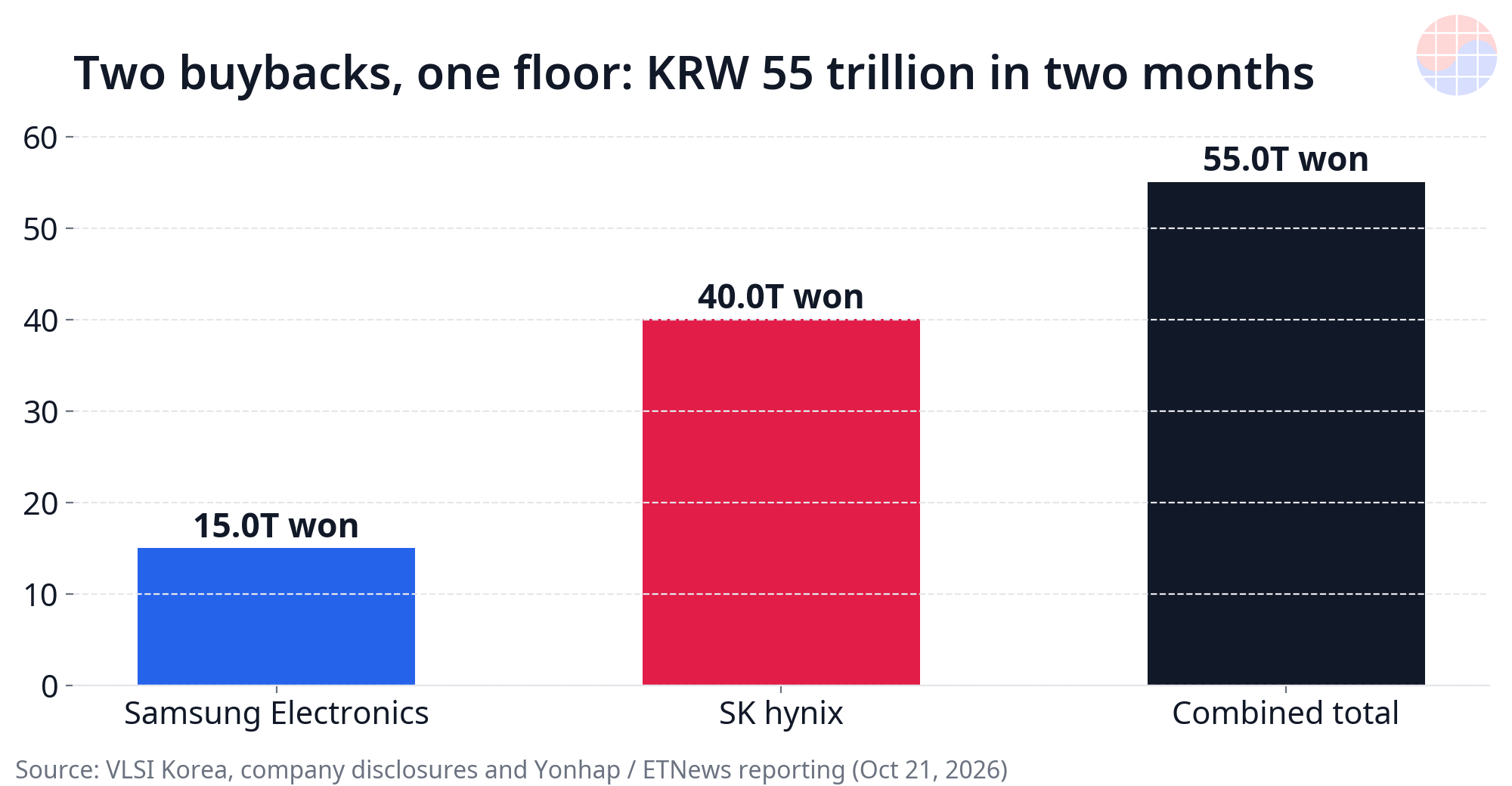
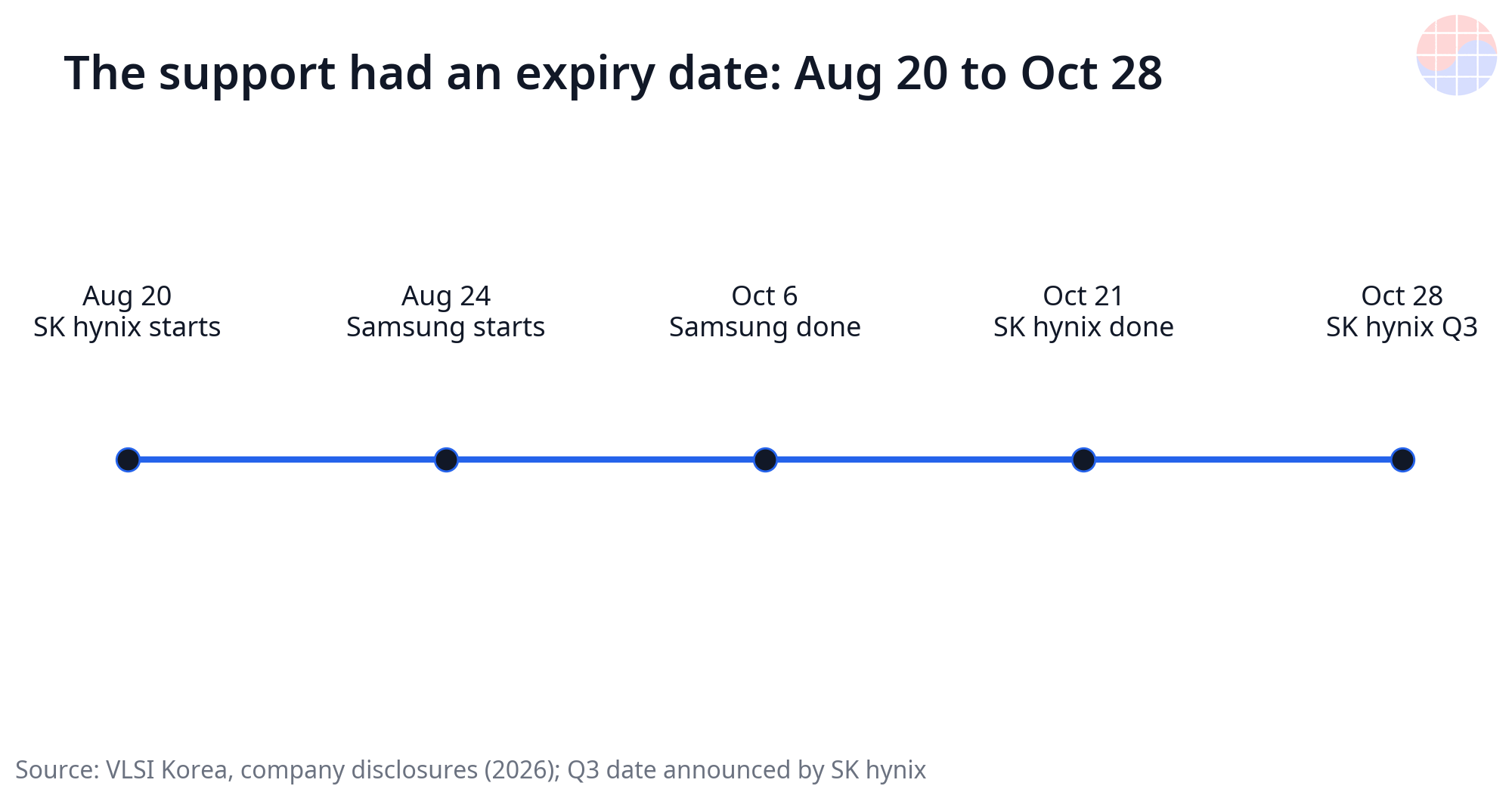
Conclusion first: the largest standing bid in Korean chip stocks is gone. SK hynix completed a 40.0434 trillion won buyback on Oct 21, 2026, about a month before its Nov 19 deadline, and Samsung Electronics had already finished a roughly 15 trillion won buyback on Oct 6. Together, the two companies absorbed about 55 trillion won of stock in two months while foreign investors sold. From Oct 22, that floor no longer exists. The next test is already dated: SK hynix reports third-quarter earnings on Oct 28 and has said it will disclose additional shareholder return measures at the same time.
That is the whole story in one paragraph, and it is a business story, not just a market story. A buyback of this size is capital allocation made visible. SK hynix chose to spend 40 trillion won buying and then cancelling its own shares at the peak of the HBM cycle, instead of holding that cash, paying it out as a special dividend, or reserving every won for the next fab. Understanding why it finished early, what the cancellation does to the share count, and what must replace the bid is more useful than watching the next daily candle.
5 Facts, in Order
- SK hynix finished about a month early. The company completed its buyback on the KOSPI market on Oct 21, 2026. The disclosed purchase period was Aug 20 to Nov 19, 2026. Completion on Oct 21 closed the program roughly a month ahead of schedule, after about two months of buying. Source: company disclosure reported by Yonhap and ETNews on Oct 21, 2026.
- The size is 40.0434 trillion won for 24.07 million shares, all to be cancelled. SK hynix said it spent 40.0434 trillion won to acquire 24.07 million of its own shares and will cancel all of them. That is about 3.3% of shares outstanding, and it is the largest share cancellation by value announced by a South Korean listed company. Source: company disclosure, Oct 21, 2026.
- Samsung finished first, and the combined total is about 55 trillion won. Samsung Electronics acquired 56.85 million shares for about 15 trillion won between Aug 24 and Oct 6, 2026. Adding the two programs gives about 55.04 trillion won of corporate buying in roughly two months. Source: company disclosures reported Oct 6 and Oct 21, 2026.
- The buybacks were the counterweight to foreign selling. Korean reporting on Oct 21 noted that the two chipmakers became a central source of demand supporting the market while foreign investors sold heavily. With both programs now complete, that specific source of demand is exhausted. Whether selling pressure eases or new buyers arrive is now an open market question, not a scheduled one. Source: Yonhap and Seoul Economic Daily, Oct 21, 2026.
- The replacement, if there is one, will be announced on Oct 28. SK hynix plans to disclose additional shareholder return measures when it reports third-quarter earnings on Oct 28, 2026. The company has said it is considering further buyback-and-cancellation and dividends together, taking cash flow, market conditions and distributable profit into account, subject to a board decision. Source: company statements reported Oct 21, 2026.
| Item | Figure | As of / Source |
|---|---|---|
| SK hynix buyback total | 40.0434 trillion won | Disclosure, Oct 21, 2026 |
| SK hynix shares acquired | 24.07 million shares | Disclosure, Oct 21, 2026 |
| Share of outstanding stock | About 3.3% | Disclosure, Oct 21, 2026 |
| SK hynix purchase period | Aug 20 to Oct 21, 2026 (planned to Nov 19) | Disclosure, Oct 21, 2026 |
| Samsung buyback total | About 15 trillion won, 56.85 million shares | Disclosure, Oct 6, 2026 |
| Combined total, both companies | About 55.04 trillion won | VLSI Korea calculation from disclosures |
| SK hynix share price at completion | 1,288,000 won, up 5.31% on Oct 21 | Market data reported Oct 21, 2026 |
| Next scheduled disclosure | Q3 earnings and added return plan, Oct 28, 2026 | Company, Oct 21, 2026 |
What a Cancellation Actually Does
A buyback that ends in cancellation is different from a buyback that ends in a treasury account. Cancelled shares do not come back. If SK hynix cancels shares equal to about 3.3% of the outstanding count, the share count falls permanently, and earnings per share rise mechanically even if total profit does not change. The arithmetic is simple: dividing the same profit by a count that is 3.3% smaller lifts per-share earnings by about 3.4%. That figure is a calculation from the disclosed 3.3%, not a forecast.
That mechanical effect is why the distinction between buying and cancelling matters for an MBA-style reading of the decision. Treasury shares can be reissued, used for employee awards, or held as a financing tool. Cancelled shares are a commitment. Management is stating, in capital rather than in words, that it believes the cash creates more value per remaining share when the share count shrinks than it would sitting on the balance sheet. At the top of an HBM-driven earnings cycle, that is a strong claim, and Oct 28 is when investors can test it against the actual third-quarter cash generation.
There is also a timing question hidden in the early finish. A program scheduled to run to Nov 19 that ends on Oct 21 was not slowed down by a lack of cash or by hesitation about price. Companies do not accelerate a 40 trillion won purchase by a month by accident. The plausible readings are discipline and intent: the target quantity was reached, the company was willing to buy at the prices the market offered during a volatile two months, and it wanted the program closed before it reported earnings. Anything beyond that is speculation, and this article does not present speculation as fact.
The Capital Allocation Tension: Buyback Versus the Next Fab
The honest tension in this story is not bull versus bear. It is buyback versus build. Memory is a capital-intensive business. HBM capacity, advanced packaging and the next generation of DRAM and NAND all compete for the same cash flow that funded this buyback. Every engineer who has lived through a capacity cycle knows the pattern: cash feels abundant at the peak, and the shortage arrives one generation later, when a competitor kept building.
SK hynix has now placed a visible bet that it can do both: return 40 trillion won and still fund the technology race. That bet is falsifiable, which is what makes it useful to track. If capital spending, HBM qualification progress and technology leadership hold while the share count falls, the buyback reads as confidence backed by cash flow. If investment slows or a technology milestone slips, the same buyback will be re-read as cash returned at exactly the moment it was needed for the fab. The Oct 28 earnings release will not settle that question on its own, but its cash flow statement and its guidance language are the first hard evidence.
From a signoff and supply-chain seat, the practical point is narrower. Memory pricing and capacity decisions made in this quarter determine allocation, lead times and bargaining power for everyone downstream for the next several quarters. A shareholder return headline is therefore also an operations signal: the largest HBM supplier is telling the market it generates enough cash to shrink its share count by 3.3% in two months. Suppliers, customers and competitors will price that signal into their own plans whether or not equity investors do.
What Replaces the Floor: A Checklist for Oct 28
With the scheduled bid gone, the debate should move from sentiment to four checkable items.
- Additional return plan, specified or vague. SK hynix has promised additional shareholder return measures on Oct 28. A plan with a size, a period and a cancellation commitment is a replacement floor. A general statement of intent is not.
- Third-quarter cash flow versus the buyback. Operating cash flow in the quarter shows whether a 40 trillion won return was funded from current generation or from the balance sheet. The two readings carry opposite implications.
- Capital spending language. Any change in investment plans, HBM capacity commentary or technology timelines decides whether buyback-versus-build was a real trade-off or a false one.
- Foreign flow after Oct 21. The buybacks mattered because they absorbed selling. The first sessions without them show whether that selling was a temporary wave or a continuing position change.
None of these items requires a prediction. Each one will be answered by a disclosure or by market data within days. That is the right way to hold this story: the floor is gone, the date of the next evidence is fixed, and the checklist is short.
FAQ
How much did SK hynix spend, and how many shares will be cancelled?
SK hynix spent 40.0434 trillion won to acquire 24.07 million shares, about 3.3% of shares outstanding, and said it will cancel all of them, according to its disclosure reported on Oct 21, 2026.
Why did the buyback end early?
The disclosed period ran to Nov 19, 2026, but purchases were completed on Oct 21. The company reached its planned acquisition under the program about a month ahead of schedule. Reporting has not attributed the early finish to a single stated cause beyond completion of the planned purchases.
How large were the Samsung and SK hynix buybacks combined?
About 55.04 trillion won. Samsung Electronics spent about 15 trillion won on 56.85 million shares from Aug 24 to Oct 6, 2026, and SK hynix spent 40.0434 trillion won, based on company disclosures.
What happens next?
SK hynix reports third-quarter earnings on Oct 28, 2026 and has said it will disclose additional shareholder return measures at that time, which may combine further buyback-and-cancellation with dividends, subject to a board decision.
Disclosure
This article is based on company disclosures and reporting by Yonhap, ETNews and the Seoul Economic Daily dated Oct 21, 2026, checked on Oct 22, 2026. The combined 55.04 trillion won figure and the approximately 3.4% per-share arithmetic are calculations by VLSI Korea from the disclosed figures. This article is industry analysis, not investment advice or a recommendation to buy or sell any security.
📩 Subscribe to VLSI Korea
Get our daily semiconductor deep-dives delivered to your inbox first. Free to subscribe.