VLSI Korea
Microsoft Project Zenith reduces setup. The memory arithmetic remains.
Project Zenith separates into two tests: reproducible setup and local AI execution. Weight-storage calculations, bandwidth limits, WSL and agent permissions explain what to check before buying.


The first day with a new development PC often involves more installation than development. You install the editor, match runtime versions and make hidden files visible. If you also want to run AI models locally, the memory arithmetic comes next.
Microsoft's Project Zenith announcement on 9/4 brings these problems into one device experience. It combines Windows settings and developer tools with a hardware class offering at least 64 GB of unified memory and 250 GB/s of memory bandwidth. AMD Ryzen AI Halo is planned as the first device. This is not a sudden change to the minimum requirements for ordinary Windows 11.
VLSI Korea view: A computer with its tools installed still needs to become a computer on which our work has been verified.
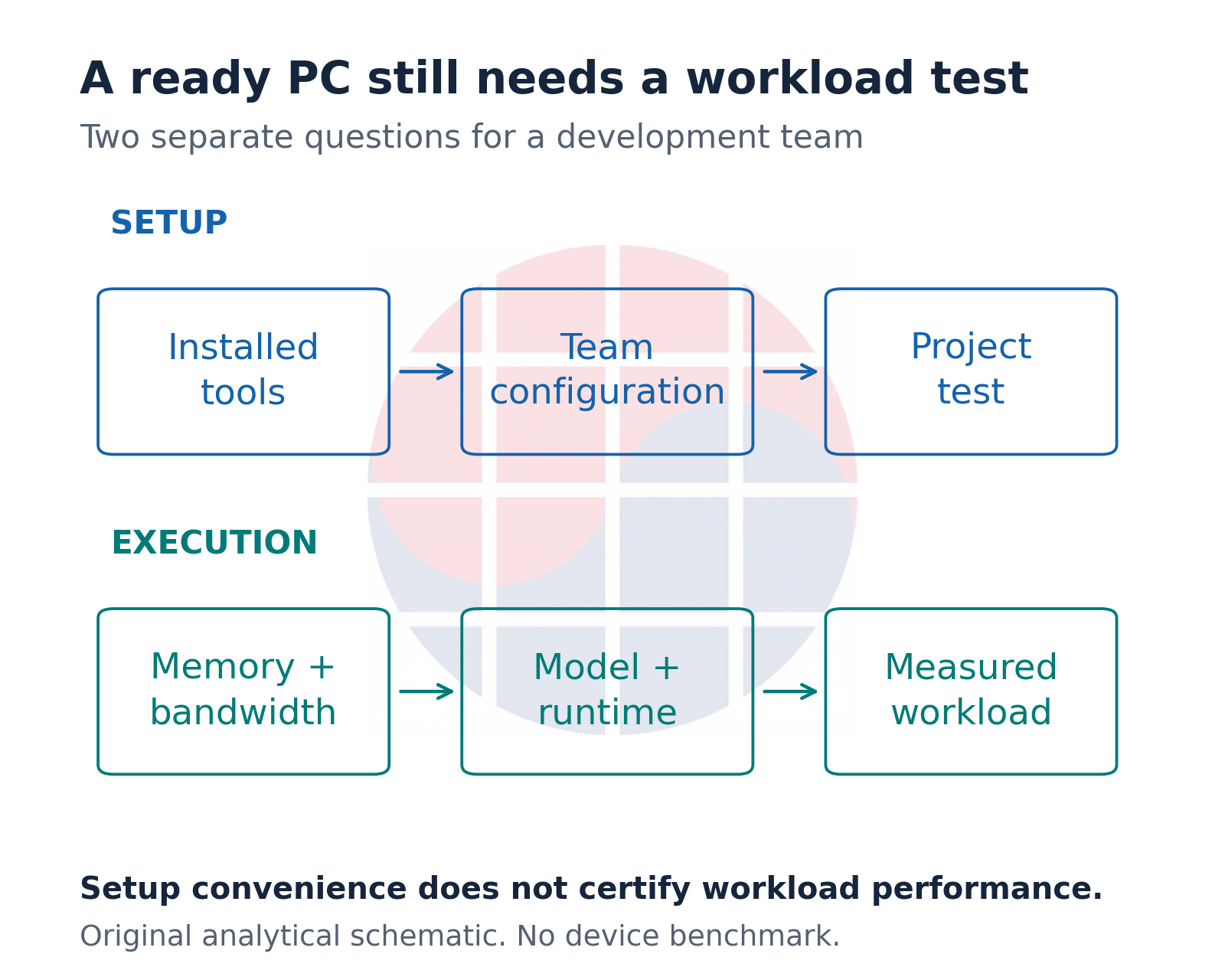
A device baseline is a starting point; the team's environment is a separate asset
Zenith includes development tools and Windows settings suited to the work. Its practical value depends on how much repetitive setup it removes when a new machine arrives. A factory configuration, however, cannot be treated as the team's standard development environment. Projects require different combinations of compilers, dependencies and drivers.
Two engineers can open the same repository in the same editor and still get different results. One uses a new runtime; the other uses the version the project has validated. If nobody records the difference, reproducing the problem takes time. The useful record is which versions and settings produced the result, beyond which tools were installed. This is a general adoption task for preconfigured PCs, not a defect we have found in Zenith.
WinGet Configuration is an existing tool for managing that difference. Packages and settings are declared in YAML, and Windows Package Manager and PowerShell DSC apply the desired state. Microsoft has not announced that Zenith writes each team's configuration file automatically. Treat this as a way to apply a team-maintained configuration above the device baseline.
Even automated setup cannot collapse every success and failure into one check mark. Microsoft's documentation says that other configuration operations can continue when some assertions or dependencies fail. An installation command finishing therefore does not establish that the entire environment is ready. Check individual failures and the actual build result. The team first needs agreed tool versions, expected results and a previous configuration it can restore.
| Layer | What to record | Acceptance evidence |
|---|---|---|
| Device baseline | OS build, driver, firmware | Supported combination recorded |
| Team configuration | Packages, versions, settings | Configuration results checked |
| Project | Dependency lock and test input | Expected build and test output |
This table is VLSI Korea's proposed adoption test, not a record of completed testing on a particular device.
Calculate a 30B model's weight storage before interpreting 64 GB
Microsoft discusses running models with 30B or more parameters locally on this device class. Parameters are numbers containing learned values. Their count alone does not determine total memory demand. The bits used to represent each number and the additional data retained during execution also matter.
The following is an ideal calculation for exactly 30 billion values, not a measurement of a particular model file. At 16 bits per value, the weights occupy 60 GB; at 8 bits, 30 GB; at 4 bits, 15 GB. Here, 1 GB means 1,000,000,000 bytes. Quantization represents values with fewer bits, while actual formats can add information such as scaling factors.
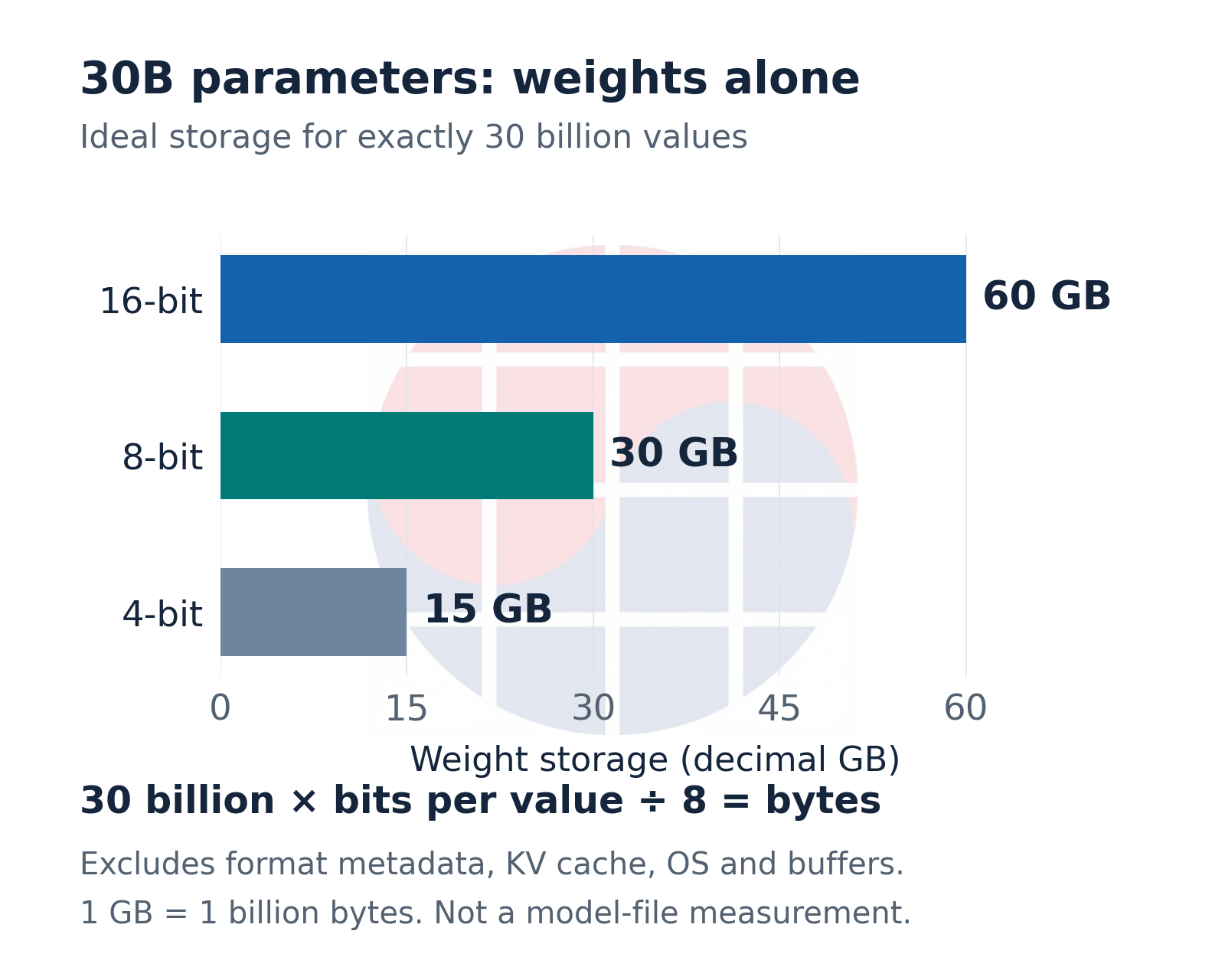
Seeing 64 GB beside 60 GB does not establish that the remaining 4 GB will be enough. The operating system, editor, other applications, working buffers and conversation caches all use the device's resources. Model file size and peak runtime memory are also different quantities. This calculation is a starting point for finding omitted costs, not a purchase recommendation.
Hugging Face's cache documentation explains another variable. A KV cache retains information used in attention for earlier tokens, reducing repeated computation. A typical dynamic cache grows with context, while models using sliding-window or chunked attention can limit growth in some layers. The model architecture matters before applying a single context-to-memory formula.
A short question may run successfully, yet long code files and concurrent conversations can change the outcome. Quantizing a cache or moving it to another memory tier may reduce capacity pressure, but latency and implementation support need separate checks. A configuration that saves memory is not always faster. A purchase evaluation should include the context length and concurrency the team will actually use.
250 GB/s measures data movement, not storage space
Capacity measures how much can be held; bandwidth measures how much can move per unit of time. There is a reason the conditions are listed separately. A large model can fit in memory and still leave the user waiting if execution cannot read the required data quickly enough. Having room to install a program does not guarantee how fast it runs.
A small calculation helps check the units. Moving the earlier hypothetical 4-bit weight payload of 15 GB once at 250 GB/s gives 0.06 seconds, or 60 ms. This assumes full use of the bandwidth and no other costs. It is one ideal transfer time, not a measured token-generation rate or a prediction of Zenith response latency.
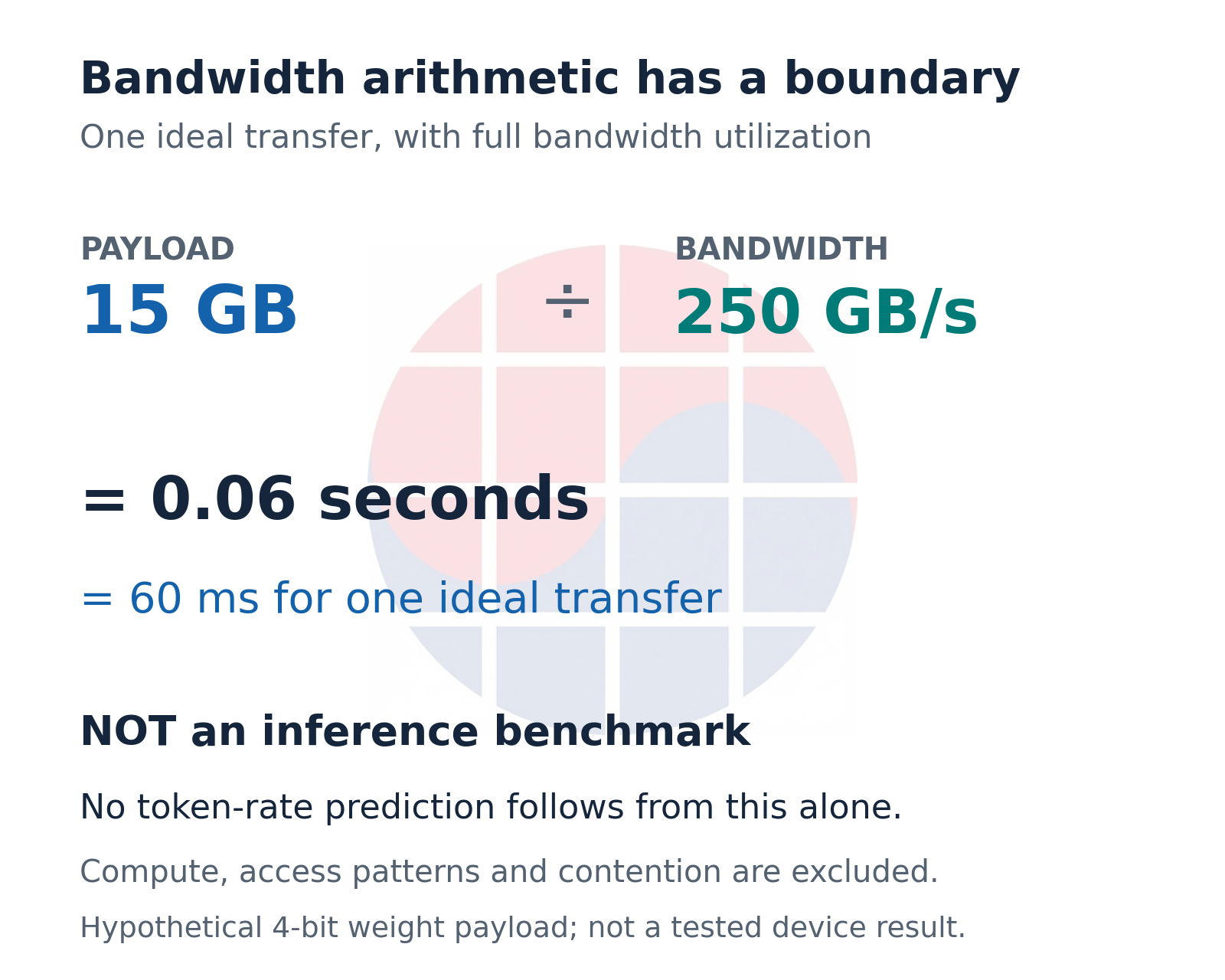
Real inference is more than a file copy. Model architecture, batch size, memory access, computation, kernel implementation, caching and competing work affect the result. There is no basis here for assuming that every token of a particular model reads exactly 15 GB. Taking the reciprocal of this division and advertising tokens per second would change the calculation's technical meaning.
AMD's Ryzen AI Halo user guide lists a configuration with 128 GB of memory and 256 GB/s of bandwidth. That device specification and Microsoft's Zenith device-class conditions have different scopes. The guide's Windows and Linux paths also do not establish that every configuration on sale already includes Zenith. Check the actual order configuration and delivery timing when purchasing.
For an evaluation, record time to first response separately from subsequent generation throughput. Hold the model file, quantization, input length, output length and concurrent requests constant, then repeat representative work. Record long delays and out-of-memory failures as well as averages. Those observations help distinguish a personal development PC from a shared machine. We have not tested this device.
WSL still leaves a choice of file paths and execution paths
Using Linux tools from Windows is familiar to many semiconductor engineers. The useful questions concern where code and data reside and which backend performs the computation, beyond how the terminal looks. As projects grow, these boundaries can affect convenience, performance and reproducibility.
Microsoft's WSL comparison explains that WSL 2 runs an actual Linux kernel inside a managed virtual machine. It separately addresses performance across Windows and Linux file systems. With Linux tools, keeping files in the Linux file system is an option to examine. That does not promise a speedup for every workload; the tools and file-access pattern still matter.
A build that reads many small source files and an inference job that initially loads a large model call for different observations. For the build, examine file metadata access and reproducibility. For the model job, examine loading and the actual compute backend. Neither can be evaluated from a new PC's memory capacity alone. Keep inputs and tool versions fixed when comparing paths so the cause can be narrowed down.
| Test | Hold constant | Observe |
|---|---|---|
| Build path | Source revision and toolchain | Result parity and elapsed time |
| Model execution | Model, precision and prompt | Actual backend and memory peak |
| Long session | Context and request count | Tail latency and failures |
These are proposed comparisons, not measured results. Commercial EDA tools also require separate checks of the vendor's supported operating systems and licensing terms. WSL running successfully does not establish official support for a particular EDA combination. Moving from a personal experiment to a team's signoff environment raises the standard of evidence.
The execution environment must limit a local agent's permissions
An agent reading code and an agent modifying files and running commands perform different work. Running the model locally does not remove that distinction. The decision to reduce external token usage belongs alongside decisions about working directories, credentials and network access.
Microsoft's agent-security direction described at Build 2026 combines operating-system-managed identity, containment through Microsoft Execution Containers and enterprise management. This should not be expanded into a guarantee that every agent is automatically safe. Check which boundaries the actual application uses and what it can access.
VLSI Korea view: Putting the model on your desk does not automatically shrink the permissions of the programs it runs.
A team can first inspect results against a read-only repository, then retain change records and a recovery method when allowing writes. An environment inheriting all of a person's account permissions is not equivalent to one with task-specific permissions. Counting unrestricted convenience as productivity, then adding deployment restrictions later, changes the evaluation. This is a proposal for defining adoption scope, not a claim that we found a product vulnerability.
Who needs new hardware, and who should first repair the environment?
A developer constrained by local-model capacity has a reason to examine Zenith hardware configurations. A team whose workloads already run well but whose setup drifts with every new project may address its problem more directly through configuration files and validation. These likely users are our workload-based analysis, not a verified customer list.
Product economics & specifications
| Dimension | Details | Buyer implication | Evidence |
|---|---|---|---|
| Purchase price | No verified Zenith-equipped order price in the reviewed announcement. Region, currency, tax, shipping and exact sales SKU are unconfirmed. | Obtain a configuration-specific quote; no break-even claim. | unavailable · unavailable |
| Likely users | Developers constrained by local-model capacity; teams regularly provisioning development PCs. | Analysis by workload, not a customer-adoption claim. | analysis · analysis |
| Less direct benefit | Teams whose existing hardware runs the work but whose project environments drift. | First version and test the configuration; buying a PC may miss the cause. | analysis · analysis |
| Halo guide configuration | 128 GB LPDDR5x; 256 GB/s memory bandwidth. | Device-guide scope; verify the actual ordered configuration. | verified · Source |
| Model-memory budget | Weight representation, cache, OS and runtime buffers share the available resources. | Parameter count alone cannot establish peak memory or speed. | analysis · analysis |
| Deployment evidence | The device baseline and a versioned team configuration are separate layers. | Check configuration results and the project build. | analysis · analysis |
| Delivery and support | Exact Zenith delivery, local support and the ordered software image are unconfirmed. | Do not treat an announced first device as every available SKU. | unavailable · unavailable |
| Operating cost | Hardware, energy, maintenance and recovery remain local costs. | A reduced external token bill is not total-cost savings by itself. | analysis · analysis |
Share-price context
Share-price chart unavailable: Nasdaq returned no historical observations. The issuer-linked lookup ended at 2026-09-02; a current series with confirmed reuse terms was not obtained.
Microsoft also provides market information through its official stock-lookup page.
The easy-to-miss costs sit behind the token bill being reduced. Local execution still involves equipment, maintenance, electricity, updates and failure recovery. A team making better use of existing hardware also starts somewhere different from a team buying a new device. This announcement cannot establish a break-even point. That requires an exact configuration and price, actual workload and the competing service's rates.
For Korean development teams, delivery, local support, corporate Windows-image policy and existing Linux workflows are practical starting points. Standardizing an environment does not require everyone to buy the same PC. First validate a representative project and long-context model workload on one device, recording setup time, execution time and result correctness separately. Actual availability of additional OEM devices and supported software combinations are the next developments to watch.
The first-day setup work Zenith aims to remove is welcome. What comes next is a record that can reproduce the team's second day. That record makes the case for buying new hardware, or continuing with the existing machine, much more concrete.
Public original sources checked on 2026/9/6. AI assisted research and writing, followed by a separate independent review. Original explanatory figures and calculations were prepared by VLSI Korea. No physical-device performance testing was performed.
Disclosure
This article is provided for informational purposes only and does not constitute a recommendation to buy or sell any security. Figures and factual statements are based on publicly available sources, including company filings, news reports, and market research, and may contain errors in the source material or in the preparation of this article. The author may own shares in companies mentioned. All investment decisions and their outcomes are the reader's responsibility.