VLSI Korea
The Foundry Talent War: What a 30% Pay Jump Really Means
Major countries face a shortfall of ~1M semiconductor workers by 2030. TSMC raised Q1 bonuses 30%, and industry communities report ~30% pay jumps for foundry technicians. How the talent war works — and how rising pay flows into wafer prices.


The 30-second summary
- The global chip labor shortage is now structural. Industry projections point to a shortfall of roughly 1 million semiconductor specialists across major countries by 2030 — 320,000 in China, 280,000 in the United States, and 127,000 in South Korea (as of 2026-10-16).
- TSMC plans to hire 8,000 people in 2026, and its chairman personally announced a 30% year-over-year increase in Q1 bonuses. At its Kumamoto fab (JASM), starting pay for kosen engineers runs about 40% above the local average.
- Korean industry communities have been buzzing with observations that foundry technician pay has risen roughly 30%. It is an observation, not an official statistic — but it points in the same direction as the public data.
- Rising labor costs flow through a clear chain: foundry cost structure → wafer prices → fabless customers' COGS. DB HiTek has already raised foundry prices twice in 2026.
- The career takeaway: engineers in bottleneck roles — yield, process integration, STA signoff — are seeing the steepest pay jumps.
Background: why the talent war is happening now
The chip labor shortage is not new. What is new in 2026 is that fabs are actually coming online — TSMC's Arizona fabs and Samsung's Taylor, Texas fabs are entering production — and the industry is discovering that buildings are easier to raise than people are to train.
An analysis by McKinsey for the SEMI Foundation projects the United States could face a shortfall of up to 157,000 semiconductor workers by 2030. Only 3% of American engineering graduates choose the chip industry each year, and 73% of chip employers report serious difficulty filling engineering positions (CNBC, 2026-09-17). SEMI's separate projection is even larger: a shortage of about 1 million semiconductor specialists across major countries by 2030, with China short 320,000, the United States 280,000, and South Korea 127,000.
Demand is exploding while the supply pipeline stays thin. That imbalance is the fuel of the talent war.
How the three foundry giants are fighting for people
TSMC: +30% bonuses, "no cap"
TSMC announced plans to hire 8,000 people in 2026. New engineers with a master's degree earn an average annual salary of NT$2.2M (about USD 69,000). The hires will be stationed across Taoyuan, Hsinchu, Miaoli, Taichung, Chiayi, Tainan, and Kaohsiung, spanning electrical engineering, physics, materials, chemical engineering — and AI and big-data talent for digital transformation.
The compensation signal is louder. Chairman C.C. Wei told employees at a town hall that Q1 bonuses would run about 30% higher than the same period last year — after canceling a scheduled business trip to address the issue in person. The trigger was an internal rumor of bonus cuts spreading through employee communities. "There is no cap on TSMC bonuses," he added.
The JASM Kumamoto case shows the ripple effects. In 2025, JASM raised starting pay for kosen engineers to 290,000 yen per month — roughly 40% above the Kumamoto prefecture average of 190,000–210,000 yen. It upended Japan's traditional credential-based pay hierarchy so thoroughly that regional chemical and HVAC firms began rewriting their own starting-salary tables in response.

Samsung: a 15-trillion-won retention bet in treasury shares
Samsung Electronics' DS division ran a large-scale experienced-hire campaign in July (around 800 open roles) followed by fall graduate recruiting in September, including campus tours at Texas A&M, Georgia Tech, and Purdue. The memory business is hiring externally for HBM, CXL, next-generation DRAM controllers, and advanced NAND process talent; the foundry business is hiring for eMRAM/eFlash process development, yield analysis, and defect resolution.
The compensation card is treasury stock. In August, Samsung approved a 15-trillion-won treasury-share repurchase to fund stock-based compensation tied to 2026 business performance. Back in March, it granted 2,039,151 treasury shares to 9,663 employees — about 406.6 billion won total, roughly 42 million won per recipient — explicitly for "retention and motivation of key talent." Total salaries at the Korean headquarters rose 6.8% in the first half of 2026.
Intel: the foundry pivot's retention dilemma
Intel has staked its turnaround on becoming a merchant foundry. Its 18A process is positioned as the answer to TSMC's 2-nanometer-class nodes, but yield and schedule discipline remain unproven at scale. Intel can draw on its existing Oregon and Arizona workforce — an advantage — but retention is a challenge after rounds of layoffs and restructuring. With foundry customers like Microsoft and AWS committed, staffing the promised capacity is the binding constraint.
Demand differs by role: who is getting expensive fastest
Not all "semiconductor talent" commands the same premium. The front line of the war is in bottleneck roles.
- Yield and process-integration engineers: the hardest roles to fill at any foundry. One percentage point of yield can mean hundreds of millions of dollars, so experienced yield engineers saw their market price move first. Samsung's foundry hiring list puts yield analysis and defect resolution at the very top.
- STA signoff and timing methodology: signoff complexity grows superlinearly at 2-nanometer-class nodes. Engineers who can drive signoff tools like PrimeTime deep are in demand across foundries, fabless companies, and EDA vendors alike.
- Physical design: steady demand, but a relatively deeper supply pool. Advanced-node experience remains scarce and valuable.
- Equipment and materials engineers: the war is spreading beyond fabs. Lam Research Korea recently granted technical staff company stock worth USD 35,000 and introduced a program letting employees buy shares below market price with up to 15% of monthly salary. First-year compensation at Tokyo Electron Korea reaches 80–100 million won; ASML Korea starts around 70 million won including fixed bonuses and exceeds 100 million won from the second year. Career options once concentrated at Samsung and SK hynix are widening to global equipment and materials firms.
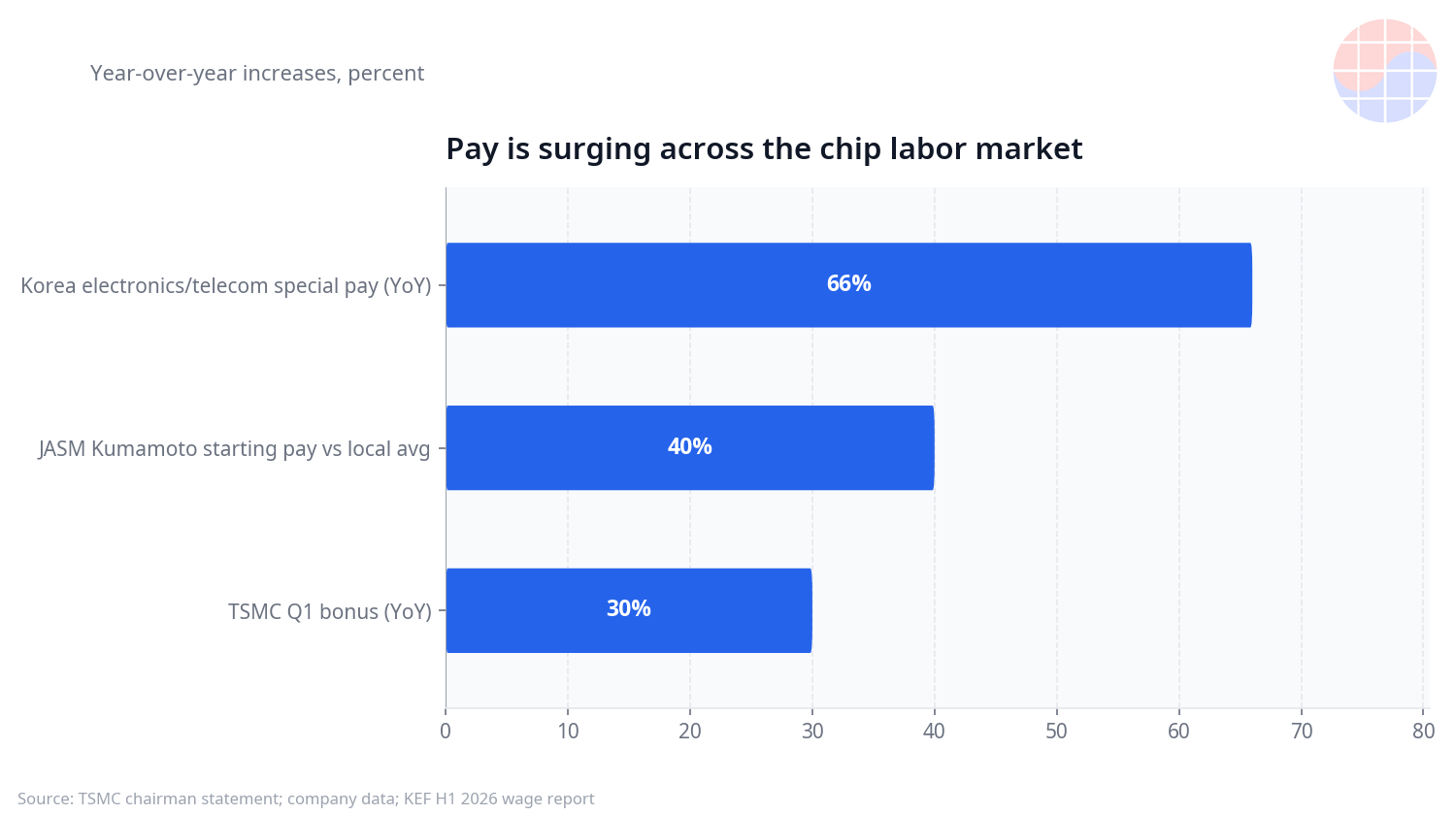
Korean industry communities have recently shared observations that foundry technician pay has risen roughly 30%. That is an observation, not a verified statistic — but it aligns with the public data points: TSMC's +30% Q1 bonus, JASM's +40% starting pay versus the local average, and the 66% year-over-year jump in special pay (bonuses) in Korea's electronics and telecom sector (Korea Employers Federation, H1 2026).
Business deep dive: the MBA-style ripple analysis
A pay raise is not just personal good news. It shakes the cost structure of the entire foundry business model.
Step 1: labor cost → manufacturing cost. Depreciation dominates foundry cost structure, but advanced nodes are increasingly labor-intensive. Running EUV tools, maintaining them, and managing yield requires skilled labor that automation cannot replace. When people are scarce, foundries must raise pay — like it or not — because lines cannot run without them.
Step 2: manufacturing cost → wafer prices. The pass-through is already happening. DB HiTek raised foundry prices twice in 2026. With first-half orders reaching about two-thirds of full-year 2025 orders, demand supports the increases. TSMC, with the strongest pricing power, needs no such justification.
Step 3: wafer prices → fabless COGS → end-product prices. Foundry price hikes push up fabless customers' cost of goods sold, which flows into final product prices or margin pressure for smartphones, PCs, and servers. Products with explosive demand, like AI accelerators, can pass costs through; fiercely competitive consumer chips eat the margin instead.
In short, the "30% foundry pay jump" may be the starting point of a semiconductor version of the wage-price spiral. Foundries that secure talent recover labor costs through pricing power; those that cannot fall behind on yield and delivery, widening the gap. The talent war is the market-share war.
Chase's Take
I call this phenomenon the "TSMC-ization of labor." Just as the foundry industry consolidated into a few giants, the labor market is hardening into a structure where where you worked determines your price. An engineer who has touched advanced-node yield at TSMC or Samsung Foundry carries a resume that is itself a scarce asset.
From a career standpoint, what matters most is the irreplaceability of your role. Running process recipes gets automated; finding the root cause when yield breaks, or getting a design through signoff, remains human work. In MBA terms: dig a moat around your own labor.
One caution: today's pay surge reflects an unusual overlap of the AI-driven memory supercycle and geopolitically driven fab expansion. When the cycle turns, variable pay (bonuses) adjusts first. Build the habit of evaluating your market price on total compensation, not base salary.
Implications
- Engineers: consider moving into bottleneck roles — yield, process integration, STA signoff. Equipment and materials firms (Lam, TEL, ASML and peers) now offer compensation rivaling Samsung and SK hynix.
- Fabless customers: foundry price pressure will persist. Build price-adjustment clauses into long-term agreements (LTAs).
- Investors: rising labor costs pressure foundry margins — but for the top player with pricing power, they act as a higher entry barrier instead.
- Policymakers: Korea's projected 127,000-worker shortfall by 2030 will not be solved by contracted university departments alone. Overseas talent recruitment and incumbent reskilling must run in parallel.
FAQ
Did foundry technician pay really rise 30%?
That figure circulates as an observation in industry communities, not an official statistic. Public indicators point the same way, though: TSMC's +30% year-over-year Q1 bonus, JASM's starting pay +40% above the local average, and a 66% jump in special pay in Korea's electronics and telecom sector (as of 2026-10-16).
Which roles are seeing the biggest pay jumps?
Yield-analysis and process-integration engineers, plus STA signoff specialists. Both sit directly on the advanced-node yield path, are hard to replace, and are being chased by all three foundry giants simultaneously.
Do labor-cost increases get passed into foundry prices?
Yes. DB HiTek's two foundry price hikes in 2026 are the textbook case. When demand is strong, foundries can layer rising labor costs into wafer prices.
Can the US fab labor shortage be fixed?
Not in the short term. McKinsey's analysis for the SEMI Foundation sees a US shortfall of up to 157,000 semiconductor workers by 2030. TSMC's model of flying in Taiwanese engineers to train local hires is likely to continue for a while.
This article is for informational purposes and is not investment advice. Figures cited are as of 2026-10-16 and may change.