VLSI Korea
TSMC's Record Q3: What 8% 2nm Revenue Really Means for the AI Chip Cycle
TSMC posted record Q3 results: NT$1.49T in revenue, net income up 68.7% to NT$763B. 2nm jumped to 8% of wafer revenue in one quarter; HPC now accounts for 68% of total revenue. The CEO declared demand still exceeds supply. The numbers prove the AI chip cycle's bottleneck is supply, not demand.


🆓 Free article · Anyone can read this article for free
30-Second Summary
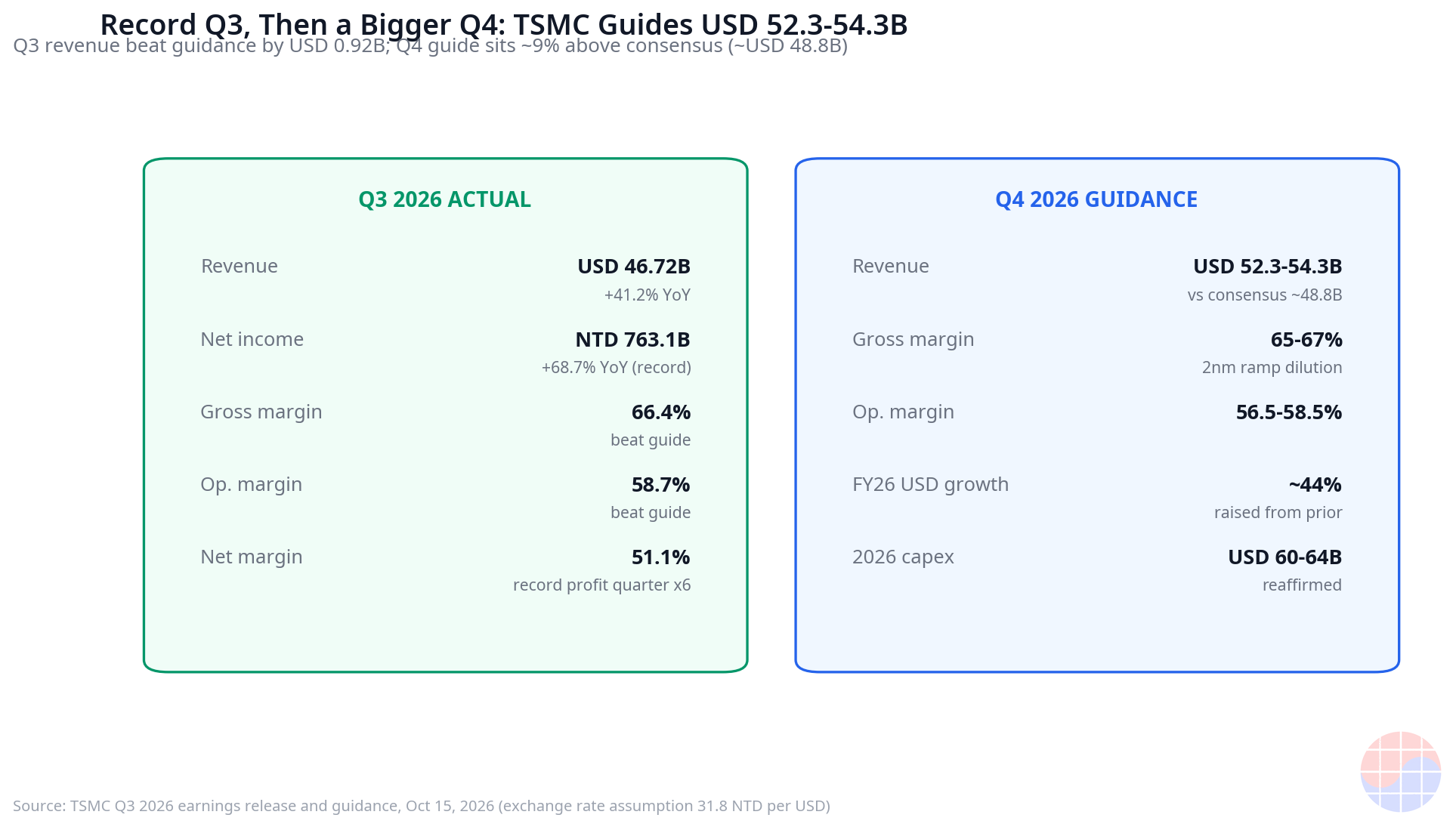
TSMC reported third-quarter 2026 results on October 15, and every line was a record. Revenue hit NT$1,494.24 billion (about USD 46.72 billion); net income surged 68.7% year over year to NT$763.06 billion, an all-time high. Operating margin came in at 58.7%, above the top of guidance; gross margin held at 66.4%. But the numbers are less important than the structure beneath them. The newest 2nm process jumped from 3% to 8% of wafer revenue in a single quarter, and the HPC (high-performance computing) platform now accounts for 68% of total revenue — up from 57% a year ago. On the earnings call, CEO C.C. Wei said AI demand still exceeds TSMC's supply capability. The stock fell 1.8% anyway, because September US CPI came in hot. Macro set the day's price, but the quarter's numbers tell a different story: the AI chip cycle's bottleneck is not demand, it's supply — and the economics of the foundry that controls that supply have fundamentally changed.
Background
TSMC is the world's largest contract chipmaker. Fabless chip designers send it their designs; it manufactures the silicon. Nvidia's AI accelerators, Apple's iPhone chips, and AMD's data-center processors all pass through its fabs. In leading-edge nodes, TSMC operates what is effectively a monopoly.
The headline figures from the October 15 release: Source: TSMC Q3 2026 results roundup
| Metric | Q3 2026 | YoY change |
|---|---|---|
| Revenue | NT$1,494.24B (USD 46.72B) | +50.9% (NT) / +41.2% (USD) |
| Net income | NT$763.06B (~USD 23.9B) | +68.7% (record) |
| Diluted EPS | NT$29.43 (USD 4.60/ADR) | +68.7% |
| Gross margin | 66.4% | vs 59.5% a year ago |
| Operating margin | 58.7% | above 56–58% guidance |
| Net margin | 51.1% | sixth straight record quarter |
Guidance was beaten on every front. July's revenue guidance was USD 44.6–45.8 billion; actual revenue of USD 46.72 billion cleared the top by about USD 920 million. Net income beat the LSEG consensus (NT$746.3B) by 2.2%. Sequentially, NT-dollar revenue rose 17.6% and net income 8.0%.
The market's reaction was paradoxical. The stock closed down 1.8% at USD 422.15 — at one point off 3.4% in premarket. The culprit was macro: September US CPI printed 3.7%, above the 3.6% expected, and the Philadelphia semiconductor index sold off alongside. A day when rate fears moved the stock, not fundamentals.
Business Deep Dive
1. The margin-absorption mechanism of a node ramp — how 66.4% happened
There is an old rule in the foundry industry: new nodes eat margins. Early production runs at low yield while fixed costs pile up, so the learning curve is loss-making until yields climb. TSMC management itself warned earlier this year that second-half gross margins would face 3–4 percentage points of dilution from the initial 2nm ramp and overseas fab expansion.
Then Q3 printed 66.4% gross margin — up 6.9 points from 59.5% a year ago, at the top of the company's 65–67% guidance band. Operating margin of 58.7% broke through the 56–58% guidance ceiling. How?
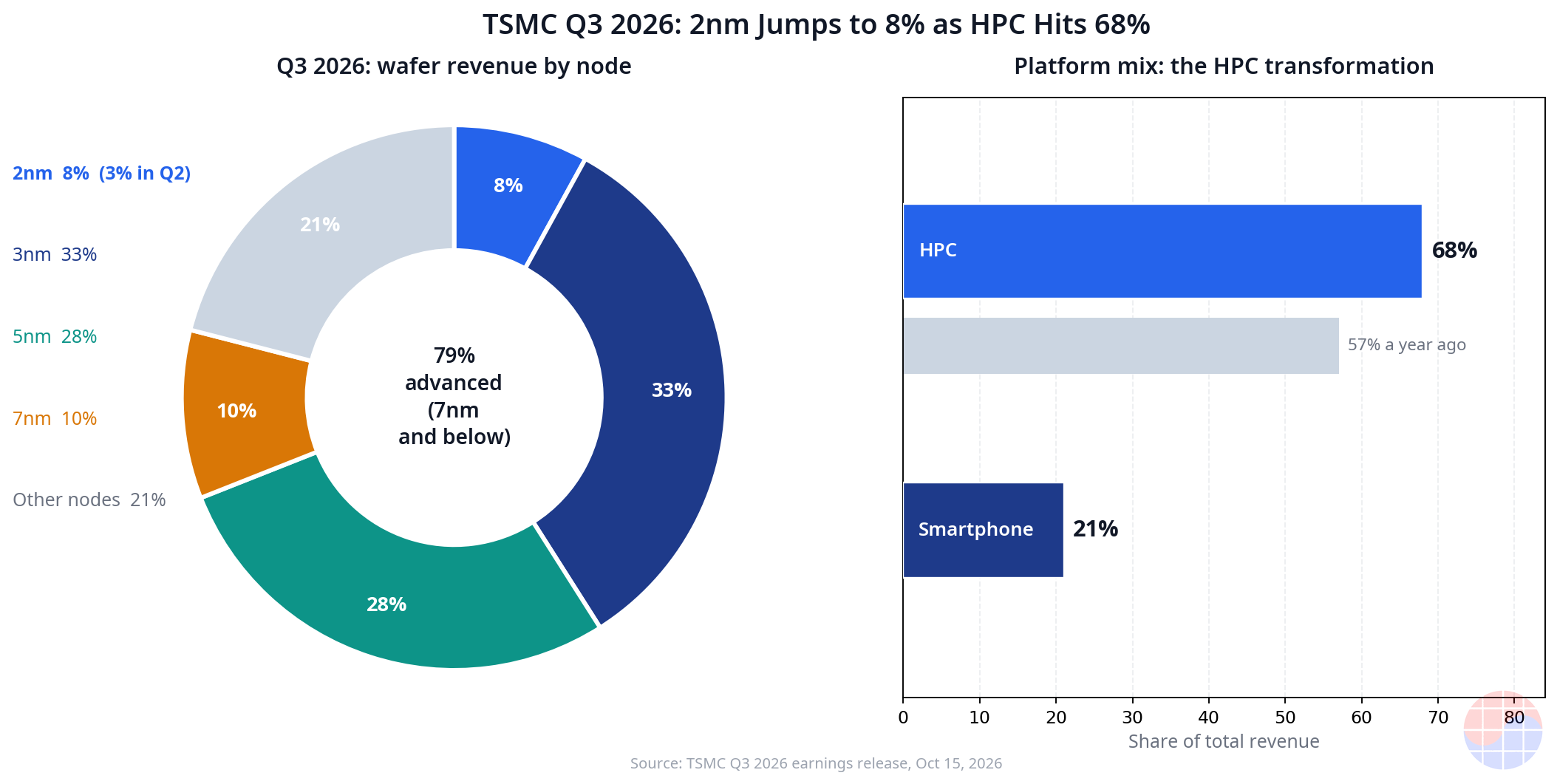
The answer is mix. Look at wafer revenue by node: Source: TSMC Q3 2026 earnings call highlights
| Node | Q2 2026 | Q3 2026 | Change |
|---|---|---|---|
| 2nm | 3% | 8% | +5pp in one quarter |
| 3nm | ~34% | 33% | stable cash cow |
| 5nm | — | 28% | solid |
| 7nm | — | 10% | solid |
| 7nm and below | 77% | 79% | leading-edge share rising |
Four out of five wafers leaving the fabs are at leading-edge nodes. And the platform mix did the heavy lifting: HPC revenue surged 22% sequentially to 68% of total revenue. HPC chips carry higher prices and fatter margins than smartphone APs. The high-margin HPC portfolio swallowed the 2nm ramp's learning-curve costs whole.
To be precise, dilution has begun. Gross margin fell 1.3 points sequentially (67.7% to 66.4%), which the company attributed directly to initial 2nm production dilution. Net income grew only 8% sequentially partly because Q2's one-off gains — NT$95.8 billion from Vanguard International Semiconductor share disposals and revaluations — did not recur. So 66.4% may be the pre-dilution peak. The 3–4 points of overseas-fab dilution management flagged will widen over the coming years.
This is the core of the foundry business model: learning-curve costs of an advanced node are ultimately offset by customer mix. A node transition gnaws at margins — but if the customers buying that node first are the ones paying the highest prices (HPC, AI), the transition-period margin can be defended. That's why TSMC is ramping 2nm on both smartphone and HPC AI demand.
2. The business-model transformation — from phone-chip company to AI-chip company
Platform revenue mix, one year apart, shows the speed of the transformation:
| Platform | Q3 2025 | Q3 2026 | Change |
|---|---|---|---|
| HPC (AI accelerators, data-center) | 57% | 68% | +11pp |
| Smartphone | — | 21% (+10% QoQ) | shrinking |
| IoT, automotive, other | — | 11% | — |
HPC jumped from 57% to 68% of revenue in twelve months. TSMC is no longer mainly a smartphone-chip company. It is mainly an AI-chip company that also makes smartphone chips.
The business meaning: customer-concentration risk has been reshuffled, not removed. Apple dependence used to be the biggest risk; now it's dependence on AI-accelerator customers and the hyperscalers designing custom AI silicon. The concentration didn't disappear — it changed address.
It's a double-edged sword. HPC is high-margin and high-growth, but its cycle is steep. If AI infrastructure spending slows, the platform carrying 68% of revenue wobbles all at once. The smartphone era had diversified demand; the HPC era has concentrated demand. Concentrated demand is explosive on the way up — and explosive on the way down.
3. Pricing power — what the 2027 price hike of up to 10% means
The second margin lever is price. Reporting in July said TSMC had told major customers that foundry prices would rise by up to 10% starting in 2027, with negotiations running June through July. Source: Reuters
- Increase: 5–10% depending on customer and product, up to 10%
- Mature nodes (12nm, 16nm, 28nm): up to 10%
- Advanced nodes (6nm and below): up to 10%
- Rationale: rising material and equipment costs plus overseas fab construction
- Effective: January 2027
The company spokesperson's comment is worth quoting in full: "Our pricing strategy is strategic, not opportunistic. We will continue to work closely with customers and sell our value to them." CEO Wei said in June he wanted to raise prices but would avoid the abrupt hikes some memory companies had imposed.
Here is the MBA insight. TSMC has held near-monopoly pricing power while pricing with restraint. Why? Foundry customers' design cycles run for years. Extracting maximum rent in one year pushes customers to seek alternatives for the next design. The value of long-term lock-in exceeds the value of short-term rent extraction. That is what "strategic" actually means.
The 2027 increase is a variation on that strategy: raise prices within the range customers can accept, justified by cost recovery (overseas fabs, equipment, materials). The effect starts showing in 2027 results — just as 2nm ramp dilution and overseas-fab dilution intensify. Price supports margin exactly when dilution bites.
4. The capex reinvestment cycle — where USD 126 billion in cash goes
TSMC reaffirmed its 2026 capex budget of USD 60–64 billion (Q3 capex was USD 13.84B; year-to-date USD 40.64B). Management said capex from 2026 to 2028 will be "significantly higher" than the prior three years.
The cash generation funding it is extraordinary. Quarterly operating cash flow was NT$919.8 billion; free cash flow after capex was NT$476.6 billion (about USD 15 billion). Cash and marketable securities stand at roughly USD 126 billion. A company stacking up USD 15 billion in cash per quarter is investing USD 60 billion a year. Inventory days fell five to 82.
The destinations are clear. Nearly 20 fabs are under development worldwide — 13 leading-edge and advanced-packaging facilities in Taiwan, five to six overseas.
- N2 (2nm): entered high-volume manufacturing in Q4 2025, ramping in Hsinchu and Kaohsiung. Annual N2-family capacity is expected to more than double in 2027.
- N3 (3nm): a new Tainan Science Park fab is on track for volume production in the first half of 2027; TSMC decided to add another 3nm fab in Tainan (first half of 2028).
- Arizona: the second fab completed construction and is in tool installation, with volume production expected in Q3 2027 — ahead of schedule.
- A14: risk production in 2027, volume production in 2028. Wei said customer activity on A14 is already higher than 2nm's at a comparable stage, and that "A14 will be a bigger node than 2nm."
Geopolitical diversification is accelerating. Wei confirmed TSMC is evaluating expansion in the US beyond Arizona, with Texas among the options — an evaluation team has been dispatched, and discussions with a customer about the Terafab project are underway. But he drew one firm line: "Either way would be possible, but the fab has got to be run by TSMC." That contrasts with Elon Musk's October 7 remark that TSMC would at most sublease part of Terafab. Talks continue.
The number investors should watch is dilution. Overseas-fab margin dilution is expected to widen to 3–4 percentage points over the coming years. Today's 66.4% is a Taiwan-concentration margin. Geopolitical diversification has a cost.
5. Advanced packaging — the next phase of CoWoS
As important as logic nodes is advanced packaging. Wei said 5x reticle-size products are in production, with 9x and 14x reticle sizes in development. CoWoS remains customers' "leading choice," and TSMC is developing additional packaging approaches while working with GlobalFoundries to address backend capacity needs.
This shows the AI accelerator bottleneck is widening from the front end (shrinking transistors) to the back end (packaging). CoWoS capacity — attaching HBM stacks to logic dies — is the second gateway of AI chip supply. TSMC is expanding packaging capacity the way it expands nodes.
Chase's Take
One sentence for this quarter: "The textbook said node transitions eat margins; TSMC overwrote the textbook with customer mix."
Read as an MBA case, the foundry business model has one core. In a fixed-cost-dominated business, margin is decided by two levers: price (pricing power) and mix (who you sell to). TSMC held both at once — raising price via the 2027 increase, and absorbing 2nm learning-curve costs with the 68% HPC mix. Defending margins through a node transition turned out to be a portfolio-design problem, not a technology problem.
Second, the weight of "demand still exceeds our supply capability." It sounds like an earnings-call platitude, but read with the numbers it isn't. Inventory days fell to 82; Q4 guidance sits 9% above consensus. Excess demand is proven by order books, not declared by management. And the declaration is also the justification logic for the price increase — in a market where demand exceeds supply, raising prices is the surest margin lever.
Third, the counterargument. 66.4% may be the peak. 2nm dilution has only just started (-1.3pp sequentially), and the 3–4 points of overseas-fab dilution will widen for years. Margins face downward pressure until the 2027 price effect is fully reflected. And 68% HPC is cycle-concentration risk: if AI capex bends, this mix works in reverse. Whether today's mix is "structure" or "the top of the cycle" will be answered by the 2027 capex guidance.
So the leading indicator for the next two years is clear: the quarterly trajectory of 2nm's revenue share. The 3%-to-8% jump — how far it goes in 2027 — will decide margins and capex. Wei's remark that A14 will be "a bigger node than 2nm" previews the wave after that.
Implications
For investors
- Three catalysts ahead: Q4's 2nm mix (does it cross double digits?), the 2027 capex guidance (does the USD 60B-plus level hold or rise?), and the actual pass-through of the 2027 price increase.
- Remember the stock paradox: record quarter, -1.8%. Short-term prices are set by macro (CPI, rates). But quarterly numbers set the direction of fundamentals. This is a window for betting on fundamentals through macro noise.
- Value-chain spillover: the 2nm ramp is a leading indicator for equipment, materials, and EDA demand. N2 capacity more than doubling in 2027 means leading-edge equipment demand doesn't bend in 2027 either.
For managers
- For fabless companies: leading-node slot allocation is now part of design strategy. "Demand exceeds supply" means the politics of slot allocation has begun. 2nm and A14 design-transition timing must be matched to fab capacity schedules.
- For foundry competitors: TSMC's 2027 price increase becomes the industry's price umbrella. Followers gain both the justification and the room to raise prices.
- For policymakers: the "Texas evaluation" and Terafab talks are leverage in subsidy negotiations. TSMC is playing fab location as a card. "The fab has to be run by TSMC" signals that operating control is the heart of the negotiation.
FAQ
Q1. What are TSMC's Q3 headline numbers? Revenue of NT$1,494.24 billion (USD 46.72B, +50.9% YoY), net income of NT$763.06 billion (+68.7%, a record), gross margin 66.4%, operating margin 58.7%, net margin 51.1%. The sixth straight quarter of record profit; revenue beat July guidance by about USD 920 million.
Q2. Why does 8% 2nm revenue share matter? 2nm entered high-volume manufacturing in Q4 2025, and its wafer-revenue share jumped from 3% in Q2 to 8% in Q3 — 2.7x in one quarter. Normally low early yields crush margins during a node ramp, yet TSMC held 66.4%. The high-margin HPC customer mix absorbed 2nm's learning-curve costs. The quarterly trajectory of 2nm's share is the leading indicator for margins over the next two years.
Q3. What does 68% HPC mean? 68% of TSMC's total revenue now comes from high-performance computing — AI accelerators and data-center chips — up 11 points from 57% a year ago. TSMC has structurally transformed from a "smartphone chip company" into an "AI chip company." But it is also a reshuffling of customer-concentration risk: lower Apple dependence, higher dependence on the AI infrastructure cycle.
Q4. Why did the stock fall on a record quarter? Macro overwrite. September US CPI printed 3.7%, above expectations, spreading rate fears, and the Philadelphia semiconductor index sold off. TSMC closed down 1.8% at USD 422.15. Short-term prices are set by macro — but Q4 guidance (USD 52.3–54.3B, above consensus) and the 2nm ramp point to where fundamentals are headed.
This analysis is based on public earnings materials and reporting, and is not investment advice. Figures are as of TSMC's announcement date (October 15, 2026) and may change thereafter.
Related reading
- TSMC Q3 2026 Earnings (2nm, HBM, CoWoS) — 18 Facts
- Why TSMC Is Building a Fourth 3nm Fab: Capacity as the Moat
- Daily Silicon: TSMC at 73%, Samsung SF2: AI Foundry Revenue Up 29%
- Daily Silicon: TSMC Packaging Yield Hits 98% — Cracks in the Cycle Peak
- Daily Silicon: TSMC $1.5T Forecast, AMAT Record Quarter, Korea Chips +173%