VLSI Korea
BofA: Memory Valuations Have Hit a Cycle Floor — a P/E of 2-3x Meets Supercycle Earnings (HBM·DRAM)
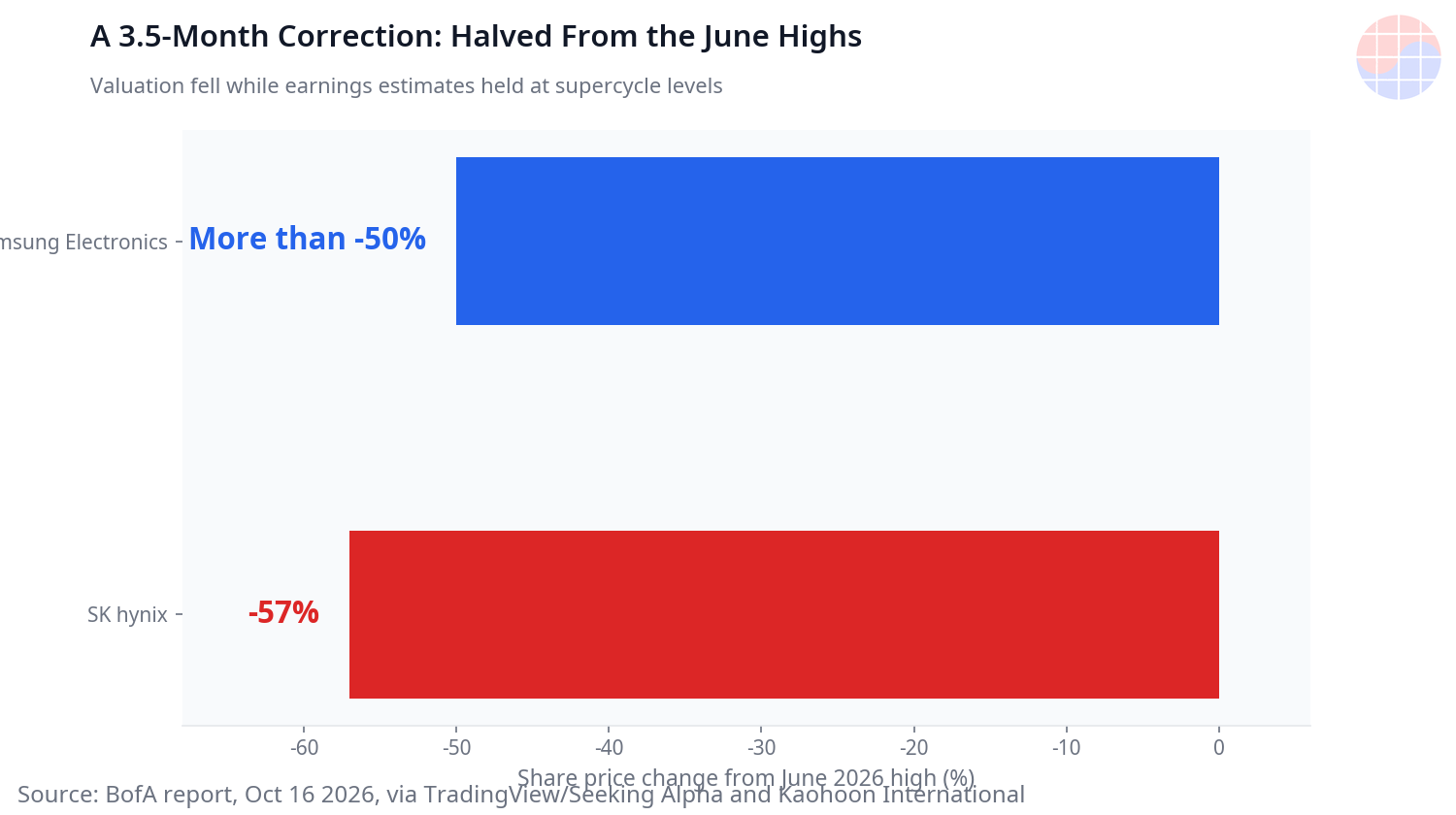
Bank of America said on Oct 16, 2026 that memory valuations have reached a cycle floor. Samsung and SK hynix are down over 50% from June highs, yet trade at 2.99x and 2.72x fiscal 2027 earnings while supercycle prices, revenue and margins are forecast through 2028.


🆓 Free article · Anyone can read this article for free
30-Second Summary
- Bottom line first: in a report dated October 16, 2026, Bank of America judged that memory-stock valuation multiples have already entered cycle-trough territory. The correction reflects excessive concern about an AI memory boom-bust cycle, not a downturn in the underlying business (TradingView/Seeking Alpha, Kaohoon International).
- Stock fact 1: Samsung Electronics and SK hynix have each fallen more than 50% from their June highs. The correction has run for roughly three and a half months, and SK hynix's drawdown was put at 57% (TradingView/Seeking Alpha, TechFlow).
- Stock fact 2: on fiscal 2027 estimates, the P/E ratios are 2.99x for Samsung, 2.72x for SK hynix and 4.96x for Micron. On 2027-28 consensus earnings both Korean names sit at two to three times earnings, a discount of 30% to more than 50% against the four-to-seven-times multiples of earlier upcycles (Kaohoon International).
- Stock fact 3: price-to-book has fallen to roughly 1.0 times projected 2027-28 book value. BofA associates such valuations with industry troughs marked by excess inventories, DRAM selling-price cuts above 50%, substantial operating losses and expensive borrowing, as in 2019 and 2023 — and argues none of those conditions is present now (Kaohoon International).
- Earnings fact: BofA expects supercycle-level selling prices, revenue and margins from the fourth quarter of 2026 through 2028. Even if 2028 EPS declines by a single-digit percentage, absolute revenue, operating profit and EPS stay near 2027 peaks and record levels (TradingView/Seeking Alpha).
- Same number, opposite reading: Morgan Stanley read the same low multiples as a cycle-peak signal on October 13. The two houses differ not on the multiple but on how long earnings stay high. Our earlier breakdown is at Morgan Stanley's memory valuation-trap note.
Every figure in this article comes from secondary reporting. The original report is client-only and was not directly reviewed — "original not verified." Each figure carries a source, and BofA, UBS and JPMorgan figures were cross-checked across separate outlets before use.
Intro: The Problem Is Not the Size of the Fall, but Its Direction Versus Earnings
On October 16, 2026, Bank of America opened its note with a sentence that frames the whole debate: the recent correction in memory stocks "appears largely disconnected from memory fundamentals and reflects excessive concern over an AI-memory boom-bust cycle" (TradingView/Seeking Alpha).
In numbers, the disconnect is plain. Samsung Electronics and SK hynix are down more than 50% from their June highs after a correction of about three and a half months. Over the same period, earnings estimates did not collapse. BofA maintains a forecast of supercycle-level prices, revenue and margins from the fourth quarter of 2026 through 2028. The stocks carry a trough price tag while the earnings forecast keeps peak numbers — that gap is the report's core claim.
The timing is what makes the call matter. One week apart, the market got opposite readings of the same data. Morgan Stanley's October 13 weekend note treated the low forward P/E itself as a peak signal — "the easy money is past." Three days later, BofA presented the same multiple as evidence of a floor. Which reading wins will be decided not by the multiple, but by how long 2027-28 earnings actually stay elevated.
1. The Numbers: Trough Multiples, Peak Earnings Forecasts
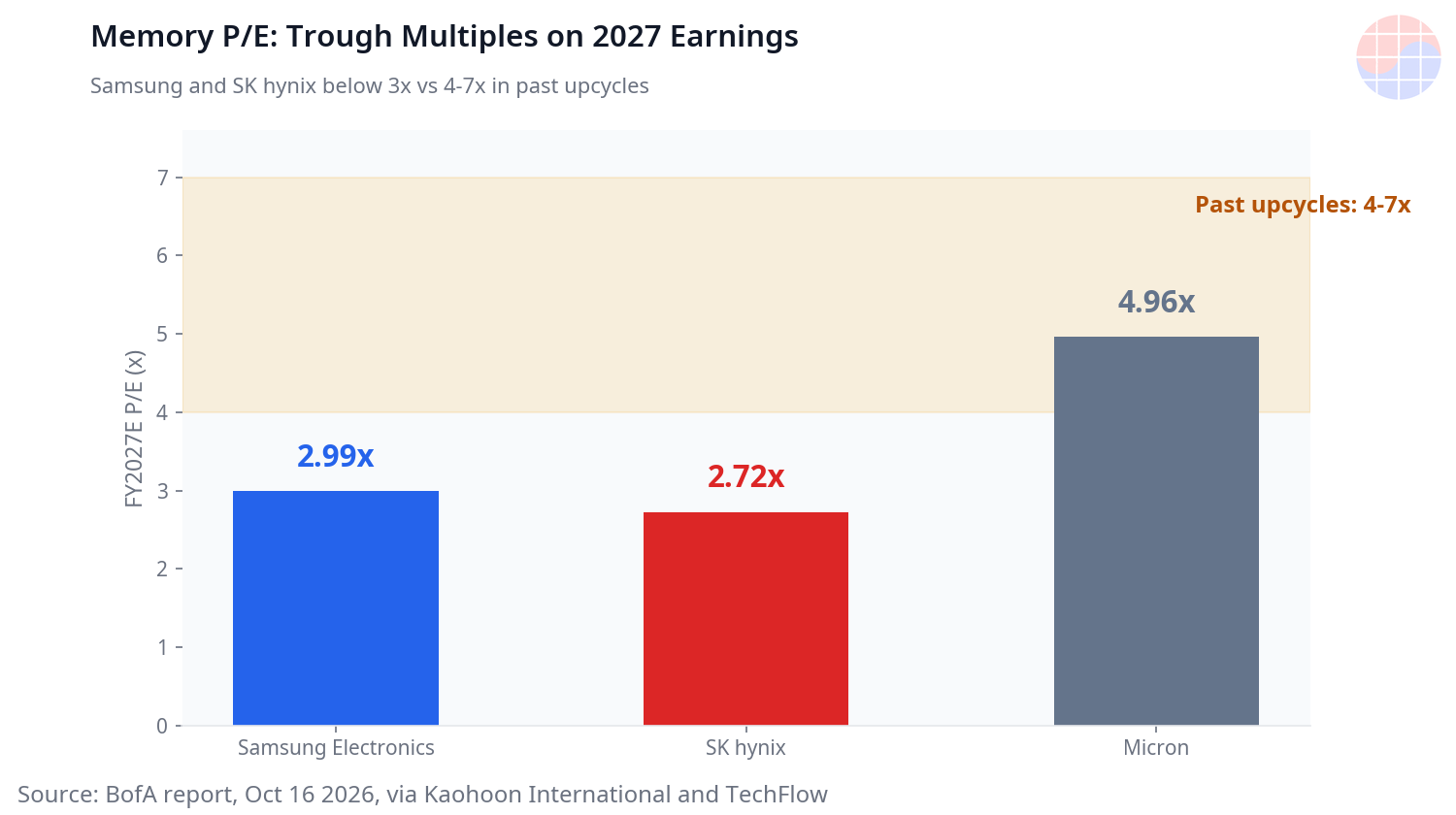
BofA's framework has two layers. The first is valuation. On consensus EPS for 2027-28, Samsung Electronics and SK hynix trade at two to three times earnings. By company, the fiscal 2027 figures reported were 2.99x for Samsung, 2.72x for SK hynix and 4.96x for Micron (Kaohoon International, TechFlow). In earlier expansion phases — before the 2001 internet bubble collapse, the 2008 financial crisis, the 2018 cloud boom and the 2022 online-commerce expansion — the same names traded at four to seven times. Today's multiple is a 30% to more-than-50% discount to that range.
The second layer is book value. Price-to-book has approached 1.0 times projected 2027-28 book value per share, with one account putting the 2028 figure at 0.9x (TechFlow). BofA then asks what a P/B near one has historically meant: excess inventories, DRAM selling-price reductions exceeding 50%, substantial operating losses and expensive borrowing — the conditions of 2019 and 2023 (Kaohoon International). Memory today sits on the opposite side of every one of those markers: supply is short, prices are rising, and profits are at record levels.
On earnings, BofA concedes the slowdown. Sequential growth during 2027 may be limited, and 2028 EPS could decline by a single-digit percentage year on year. The point is the level after the decline: BofA expects 2028 revenue, operating profit and EPS to remain near 2027 peaks and close to records (Kaohoon International). Growth bending is not earnings breaking. The market has priced the second; BofA only grants the first.
Domestic Korean data points the same way. As of October 22 reporting, 2027-estimate P/E ratios stood at 3.3x for Samsung and 2.7x for SK hynix, and on a 12-month forward basis at 3.5x and 2.8x — below the lows of past downcycles (Newdaily). Different source, same order of magnitude.
| Metric (FY2027 estimates) | Samsung Electronics | SK hynix | Micron |
|---|---|---|---|
| P/E | 2.99x | 2.72x | 4.96x |
| P/B (2027-28E) | ~1.0x | ~1.0x | — |
| Drawdown from June high | More than -50% | -57% | — |
Table: as reported from BofA's October 16, 2026 report (Kaohoon International, TechFlow). Original report not verified.
2. Structural Implications: What Supports the Call, and What Could Break It
BofA's evidence that fundamentals have not turned is in the present tense: prices and demand. Monthly PC DRAM contract prices are rising 15% or more, and spot prices are steady. Taiwan's Nanya Technology has already issued a positive fourth-quarter forecast (TradingView/Seeking Alpha). The demand base is also widening: data-center AI memory replacement demand covers LPDDR5, SOCAMM, HBM and eSSD, and each new GPU and ASIC generation raises the memory content per system (TechFlow).
The nearest verification date is October 28, when SK hynix reports. BofA expects a strong fourth-quarter outlook with rising ASPs and margins, a strong ramp of 12-high HBM4, and raised the possibility of a special cash dividend (TradingView/Seeking Alpha). In BofA's own framing, the fourth-quarter guidance and price data are the decisive variables that would prove the valuation floor.
The counter-evidence sits inside the same report. Feedback from investors BofA met in Singapore was mixed: hedge funds were bearish, most long-term investors remained bullish. The bears' worries were threefold — high borrowing costs at AI cloud companies, rising memory supply from China, and a possible slowdown in AI spending (TradingView/Seeking Alpha). Those are the same concerns behind Morgan Stanley's peak call, and the same ones Nomura's October 19 report dismissed as excessive.
📩 Following this story?
Get the follow-up analysis — earnings, reports and HBM supply — in your inbox daily at 10:30 KST. Subscribe free →
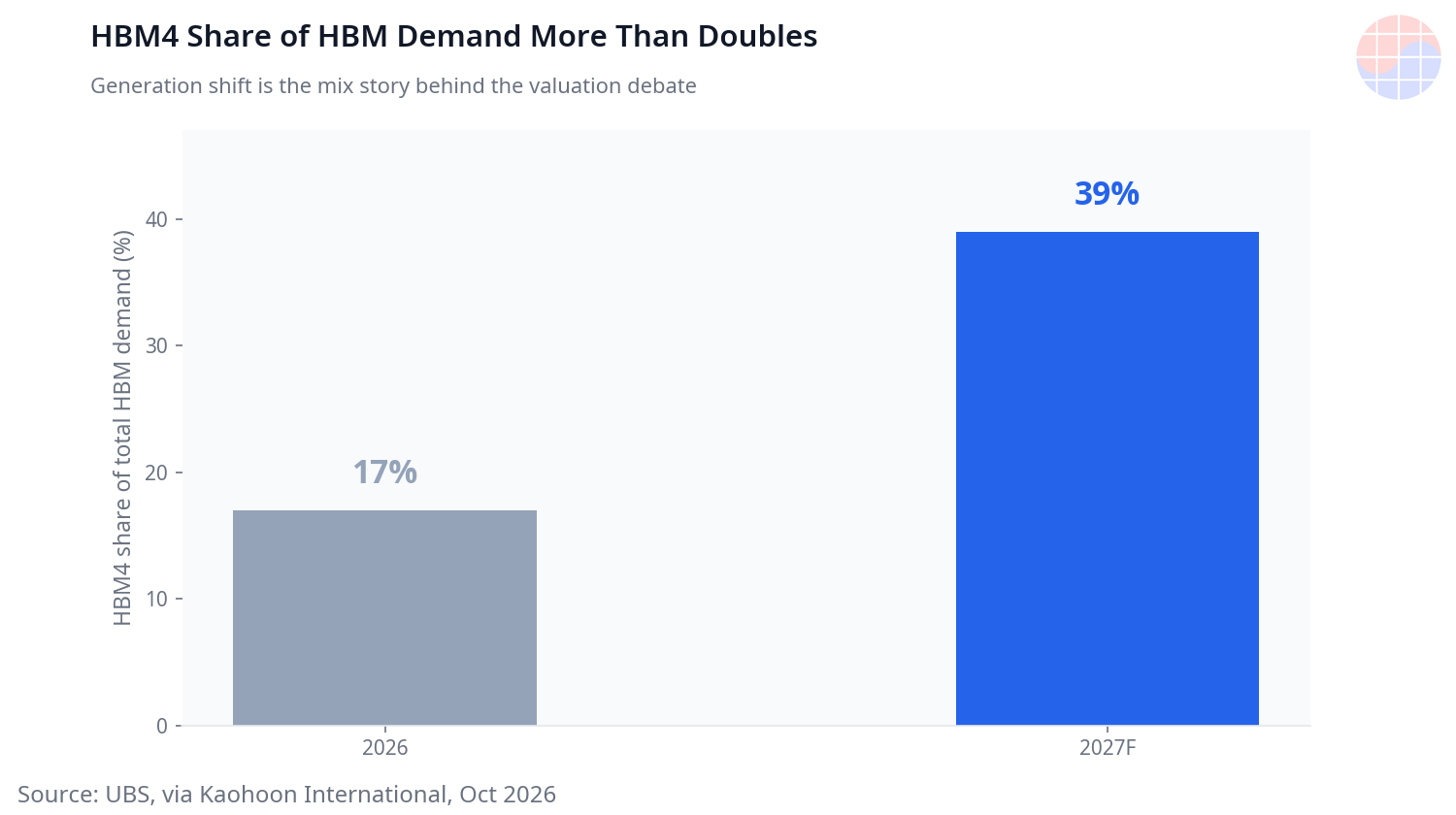
Contemporaneous calls from other houses lean BofA's way. UBS regards the 19% memory-stock selloff as a buying opportunity rather than evidence of a failing cycle, and expects AI agents to strengthen server DDR5 orders through 2027. UBS forecasts HBM4's share of total HBM demand at 39% in 2027, up from 17% in 2026, and expects Samsung's addition of 120,000 wafers per month of DRAM capacity by late 2027 to have little meaningful effect on availability before late 2028 (Kaohoon International). JPMorgan, in an Asia thematic strategy report, maintained overweight on Korea and Taiwan, estimating that AI-related stocks account for more than 50% of Asian market indexes and will contribute roughly 70% of total earnings growth in 2027, with net profit across Asia's AI hardware ecosystem surpassing USD 1 trillion by 2028 (The Korea Herald).
3. Winners, Losers, and the Korea Angle
If the call is right, the winners line up in a clear order. First, the three memory makers with pricing power: a P/E of two to three times embeds the assumption that earnings are at a peak, and if that assumption fails, multiple normalization alone creates upside. Second, the HBM4 transition: in a market where HBM4's share jumps from 17% to 39% in a year, whoever passes the generation change first improves mix fastest. Third, the Korean market as a whole: as JPMorgan notes, Korea is the memory and HBM axis of Asia's AI hardware supply chain, and AI-linked earnings now steer the index itself.
On the losing side, the exposure is positioning rather than logic. Short and underweight hedge-fund positions face the October 28-29 earnings window, where a single guidance line can squeeze them. And if BofA is wrong, the losers are equally clear: if the 2028 EPS decline turns out to be double-digit rather than single-digit, or if Chinese supply breaks conventional DRAM pricing before it touches HBM, then a P/E of two to three times was a peak price tag after all — and Morgan Stanley's reading was the right one.
For Korea, three dates do the verifying. October 28: SK hynix's results and fourth-quarter guidance — the wording on ASP, margins, the HBM4 ramp and shareholder returns. October 29: Samsung Electronics' results — memory pricing and HBM4 qualification progress. And through it all: whether monthly DRAM contract prices keep rising at a double-digit pace. If those three confirm BofA's direction, today's multiples will likely be recorded as cycle-trough pricing.
Chase's Take
From a seat where you look at wafers and price sheets at the same time, the core of this argument is duration, not the multiple. A 2.7x P/E is not cheap by itself. It is the market's compressed sentence: "these earnings last a year or two at most." Morgan Stanley and BofA read the same sentence and answered differently. Morgan Stanley watched the second derivative of earnings — the point where estimate revisions stop accelerating. BofA watched the physical quantities: prices, contracts, capacity.
I lean toward the physical side for three reasons. First, capacity does not lie. Even Samsung's additional 120,000 wafers per month only registers as supply in late 2028 on UBS's math — and for anyone who knows cleanroom lead times, that is not a forecast, it is a schedule. Second, long-term agreements and strategic customer agreements have changed the shape of earnings. When volume and price floors are contract-bound, earnings volatility itself falls, and the "it's a cycle" justification for a trough multiple weakens. Third, as products like HBM4E — which consumes four times as many wafers per bit as conventional DRAM — fill the mix, the profit per wafer rises structurally.
The other side is not weak. After consensus estimates have already risen by hundreds of percent, "the absolute level is high" was also true at every past peak. So I watch the calendar instead of the multiple debate. If the October 28 guidance leads with the HBM4 ramp and ASP strength, BofA's frame wins. If the first sentence is about the pace of price increases slowing, Morgan Stanley's frame wins. The answer will come from the next earnings print, not from another report.
FAQ
What exactly did BofA argue?
In its October 16, 2026 report, Bank of America argued that memory-stock valuation multiples have reached the cyclical trough range and that the recent correction is largely disconnected from fundamentals, reflecting excessive concern over an AI-memory boom-bust cycle. On 2027-28 consensus earnings, Samsung Electronics and SK hynix were put at two to three times earnings with price-to-book near 1.0 times. This article is based on secondary reporting; the original report was not reviewed.
What are the fiscal 2027 P/E ratios for Samsung, SK hynix and Micron?
As reported by Kaohoon International from BofA's report: Samsung Electronics 2.99x, SK hynix 2.72x and Micron 4.96x. In earlier upcycles the comparable multiple was four to seven times, so current levels were presented as a discount of 30% to more than 50%.
How does BofA's reading differ from Morgan Stanley's valuation-trap warning?
Morgan Stanley's October 13 note read the low forward P/E as a cycle-peak signal and argued that further upside would require much higher DRAM contract prices. BofA's October 16 report read the same multiples as cycle-trough characteristics and held that even a single-digit EPS decline in 2028 would leave absolute earnings near record levels. The difference is the assumed duration of earnings, not the multiple itself.
What is the nearest date that tests BofA's call?
SK hynix's earnings on October 28, 2026, and its fourth-quarter guidance. BofA expected a strong outlook with rising ASPs and margins and a strong 12-high HBM4 ramp, and called the fourth-quarter guidance and price data the decisive variables for the valuation-floor call. Samsung Electronics' October 29 results are the second test on the same axis.
This article is for information only and is not investment advice. All cited report figures are based on secondary reporting; the original report was not directly reviewed. Investment decisions are your own responsibility.
📩 Missed today's analysis? Get tomorrow's in your inbox
Daily Silicon at 10:30 KST plus earnings and analyst-report breakdowns, first. Samsung Electronics, SK hynix, TSMC and HBM supply, read by practicing engineers. Join 300+ subscribers.
Subscribe free →
Free · No spam · Unsubscribe anytime