VLSI Korea
Market Bulletin: Server CPUs Are Back at the Center - AMD Data Center Revenue Doubles to USD 6.7 Billion as Agents Rewrite the Rack
AMD Data Center revenue doubled to USD 6.7 billion in Q2 2026, 58% of total revenue, as agentic AI lifts server CPU demand. AMD holds 46.2% server CPU revenue share, Arm passes half of AWS new CPU capacity, and NVIDIA Vera enters as a standalone CPU.


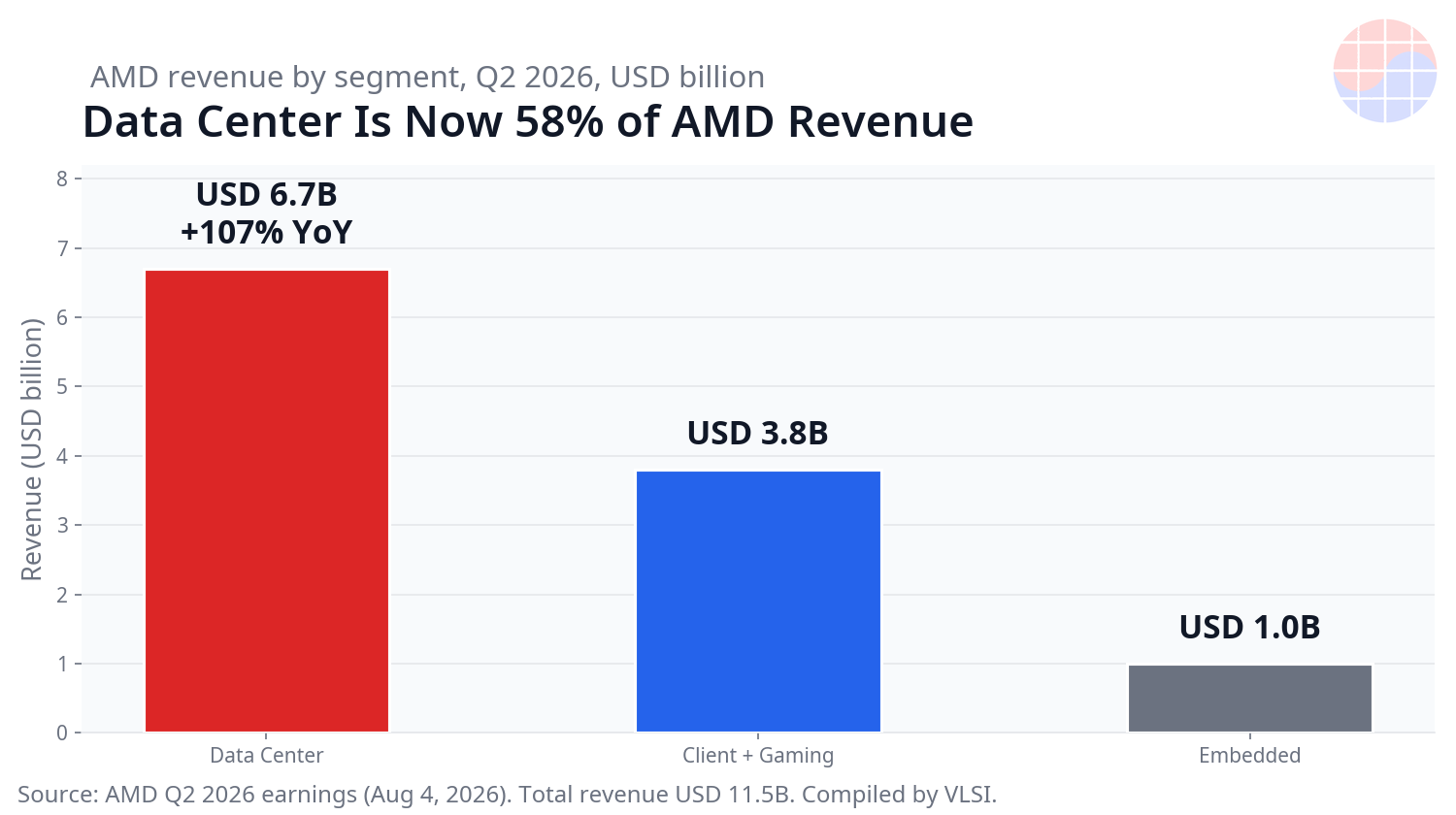
The server CPU is a growth market again, and the reason is agentic AI. AMD reported second-quarter 2026 revenue of USD 11.5 billion, up 50% year over year, with Data Center revenue more than doubling to USD 6.7 billion, up 107% (eeNews Europe, August 5, 2026). Data Center is now 58% of AMD revenue, up from 42% a year earlier, and AMD delivered its fifth consecutive quarter of record server CPU revenue, with cloud and enterprise server sales each growing more than 70% (Zacks, August 5, 2026). The workload logic is simple: GPUs and ASICs run the model, but agents write code, call tools, move data and check results between inference steps. That orchestration work runs on CPUs, so every AI rack now needs more host compute per accelerator than the training era did.
Key Highlights
- AMD Data Center revenue doubled: USD 6.7 billion in Q2 2026, up 107% year over year, within total revenue of USD 11.5 billion, up 50%. Non-GAAP gross margin reached 56% (AMD Q2 2026 results reporting, August 5, 2026).
- Server CPU revenue set a fifth straight record: Cloud and enterprise EPYC sales each rose more than 70% year over year in Q2 2026 (AMD Q2 2026 earnings reporting, August 5, 2026).
- Share is moving inside x86: In Q2 2026, AMD held 34.5% of broad x86 server CPU unit shipments, and 46.4% when only EPYC and Xeon core server products are compared; AMD server CPU revenue share reached 46.2% in Q1 2026 (Mercury Research data via TweakTown, 2026).
- The CPU market itself is being re-rated: AMD raised its server CPU total addressable market forecast to more than USD 200 billion by 2030, its third increase in nine months, as agentic workloads lift CPU demand (AMD Advancing AI 2026 reporting, 2026).
- Arm is now a volume business, not an experiment: AWS says Graviton accounts for more than half of the new CPU capacity it added over the past three years, and its custom silicon business has passed a USD 20 billion annual run rate (AWS Graviton5 reporting, June 2026).
Market Update
Start with the money. One year ago, AMD's Data Center segment was 42% of company revenue. In Q2 2026 it was 58%, on segment revenue of USD 6.7 billion that grew 107% year over year while total revenue grew 50% (eeNews Europe, August 5, 2026). That gap between segment growth and company growth is the cleanest public proof that server CPUs and data-center accelerators are expanding faster than the rest of the chip market. AMD guided third-quarter revenue to about USD 13 billion, and said data-center revenue should accelerate further in the second half and more than double again in 2027 on a higher base.
The product race explains where the demand lands. Flagship core counts now span from 88 to 288 cores per socket, but the architectures split into two philosophies: maximum thread density for cloud-native throughput, and high per-core performance with tight accelerator coupling for agent orchestration. The table below compiles the flagship parts each vendor has disclosed.
| Vendor | Flagship server CPU | Cores / threads | Process | Status in 2026 |
|---|---|---|---|---|
| AMD | EPYC Venice (Zen 6) | 256 / 512 | TSMC 2nm class | Sampling / early production; Genoa and Turin carry volume |
| Intel | Clearwater Forest (Xeon 6+) | 288 / 288 | Intel 18A | Launched 2026; Diamond Rapids (256 P-cores) pushed to 2027 |
| NVIDIA | Vera (Olympus) | 88 / 176 | TSMC 3nm class | Standalone sales from 2026; fall availability via server makers |
| AWS | Graviton5 | 192 / 192 | TSMC 3nm | Deployed in EC2 instance families rolling out through 2026 |
| Microsoft | Cobalt 200 | 132 / 132 | TSMC 3nm | First production servers live; wider rollout in 2026 |
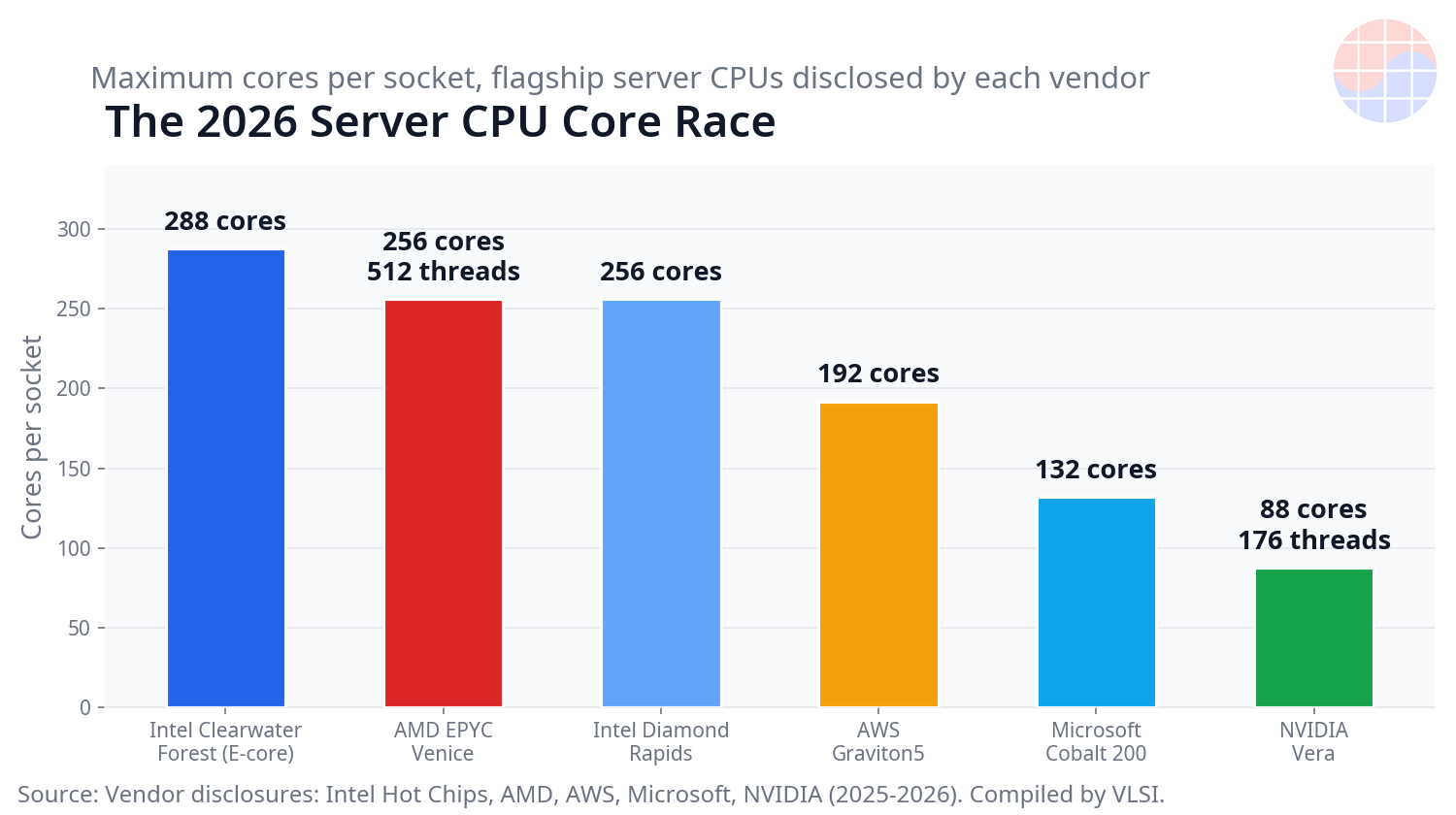
Three supply facts matter as much as the specs. First, NVIDIA is selling Vera as a standalone CPU, not only as the host inside its GPU racks: Vera carries 88 custom Olympus Arm cores, 1.2 TB/s of memory bandwidth and a 1.8 TB/s NVLink-C2C link to Rubin GPUs, with fall 2026 availability from Dell, HPE, Lenovo and Supermicro (TechSpot, March 2026). Second, the hyperscalers are shipping their own silicon at scale: AWS Graviton5 packs 192 cores on a 3nm-class process (TechTimes, June 2026), and Microsoft's Cobalt 200, with 132 cores, delivers a stated 50% performance gain over Cobalt 100, with first production servers already live (Data Centre Dynamics, 2026). Third, Intel's highest-performance P-core part, Diamond Rapids with up to 256 cores, has slipped to 2027, leaving Clearwater Forest and Granite Rapids to hold the line through 2026 (The Register, August 25, 2026).
VLSI's View
The structural shift is the CPU-to-accelerator ratio. Training clusters paired a small number of host CPUs with dense GPU racks. Agentic inference inverts part of that logic: each agent session spawns code execution, retrieval, tool calls and evaluation loops that are serial, latency-sensitive and CPU-bound. When AMD says inference is the larger half of the AI market and lifts its CPU market forecast three times in nine months, it is pricing that ratio change, not a normal server refresh cycle (AMD Advancing AI 2026 reporting, 2026).
📩 Following this story?
Get the follow-up analysis — earnings, reports and HBM supply — in your inbox daily at 10:30 KST. Subscribe free →
Winners and losers are sorting by supply, not by slides. AMD wins while its EPYC roadmap ships on schedule and TSMC capacity holds. The Arm camp wins sockets wherever hyperscalers control the software stack, because Graviton, Axion and Cobalt do not need to win the open market to win volume. NVIDIA is the most dangerous entrant: Vera turns the GPU incumbent into a CPU vendor with the rack already sold. Intel's risk is timing: a 288-core efficiency part is a strong cloud product, but the delayed P-core flagship leaves the highest-value agent and HPC sockets open for another year.
For Korea, the read-across is memory and packaging. More CPU sockets per rack means more server DRAM and more advanced packaging per system, on top of HBM demand from the accelerators those CPUs orchestrate. Samsung Electronics and SK hynix sell into both sides of the new ratio. The domestic CPU design ecosystem is smaller, but the socket expansion raises the value of the server platforms, boards and thermal and power components Korean suppliers ship into AI racks.
Chase's Take: For a decade the server CPU was the part of the AI bill of materials nobody discussed. That era is over. The agent stack made the CPU the conductor of the AI factory, and conductors get paid. Watch AMD's server revenue streak and Vera's first standalone deployments: if both hold through early 2027, the CPU line becomes the second profit pool of AI infrastructure, after accelerators and alongside HBM.
Outlook
- Q3-Q4 2026 earnings: Whether AMD extends its record server CPU revenue streak to six and seven quarters, and what Intel discloses about Xeon supply.
- Vera standalone deployments: First named production deployments of NVIDIA Vera in CPU-only racks, expected from fall 2026 system shipments.
- Hyperscaler silicon cadence: Graviton5 instance expansion, Cobalt 200 general availability, and the next Google Axion generation.
- Intel's 2027 window: Diamond Rapids sampling and pricing, and whether Granite Rapids discounting slows share loss in the meantime.
- Foundry allocation: Venice, Vera, Graviton and Cobalt all compete for leading-edge TSMC capacity with AI accelerators and HBM base dies.
Sources: AMD Q2 2026 earnings and earnings-call reporting (August 2026), Mercury Research shipment data reported by TweakTown (2026), AMD Advancing AI 2026 disclosures reported by Wccftech (2026), NVIDIA Vera disclosures reported by TechSpot (March 2026), AWS Graviton5 reporting by TechTimes (June 2026), Microsoft Cobalt 200 reporting by Data Centre Dynamics (2026), Intel Diamond Rapids reporting by The Register (August 25, 2026). Figures are company disclosures and reported shipment estimates compiled by VLSI; forward-looking statements are the issuing companies' own.
📩 Missed today's analysis? Get tomorrow's in your inbox
Daily Silicon at 10:30 KST plus earnings and analyst-report breakdowns, first. Samsung Electronics, SK hynix, TSMC and HBM supply, read by practicing engineers. Join 300+ subscribers.
Subscribe free →
Free · No spam · Unsubscribe anytime