VLSI Korea
321-Layer NAND, China's Chase and AI Storage: 5 Facts (YMTC, Enterprise SSD)
SK hynix began mass production of the world's first 321-layer NAND on Oct 24, 2026. Its 2Tb QLC posts writes up to +56%, reads +18% and write power -23%, while YMTC leads China at 38.5% and enterprise SSDs reach 48% of NAND bit shipments.


The centre of the NAND contest has moved from layer counts alone to enterprise SSDs for AI data centres and to share inside China — and SK hynix's 321-layer launch is aimed at both fronts at once.
30-Second Summary
- SK hynix announced on October 24, 2026 that it has started mass production of the world's first 321-layer NAND (company announcement). The product completes a full-stack AI memory portfolio led by HBM in DRAM and ultra-high-performance NAND for AI data-centre SSDs and on-device AI.
- The 321-layer 2Tb QLC device uses a six-plane architecture and 3,200 MT/s I/O, with writes up to 56% faster, reads 18% faster and write power 23% lower than the prior generation (product reporting).
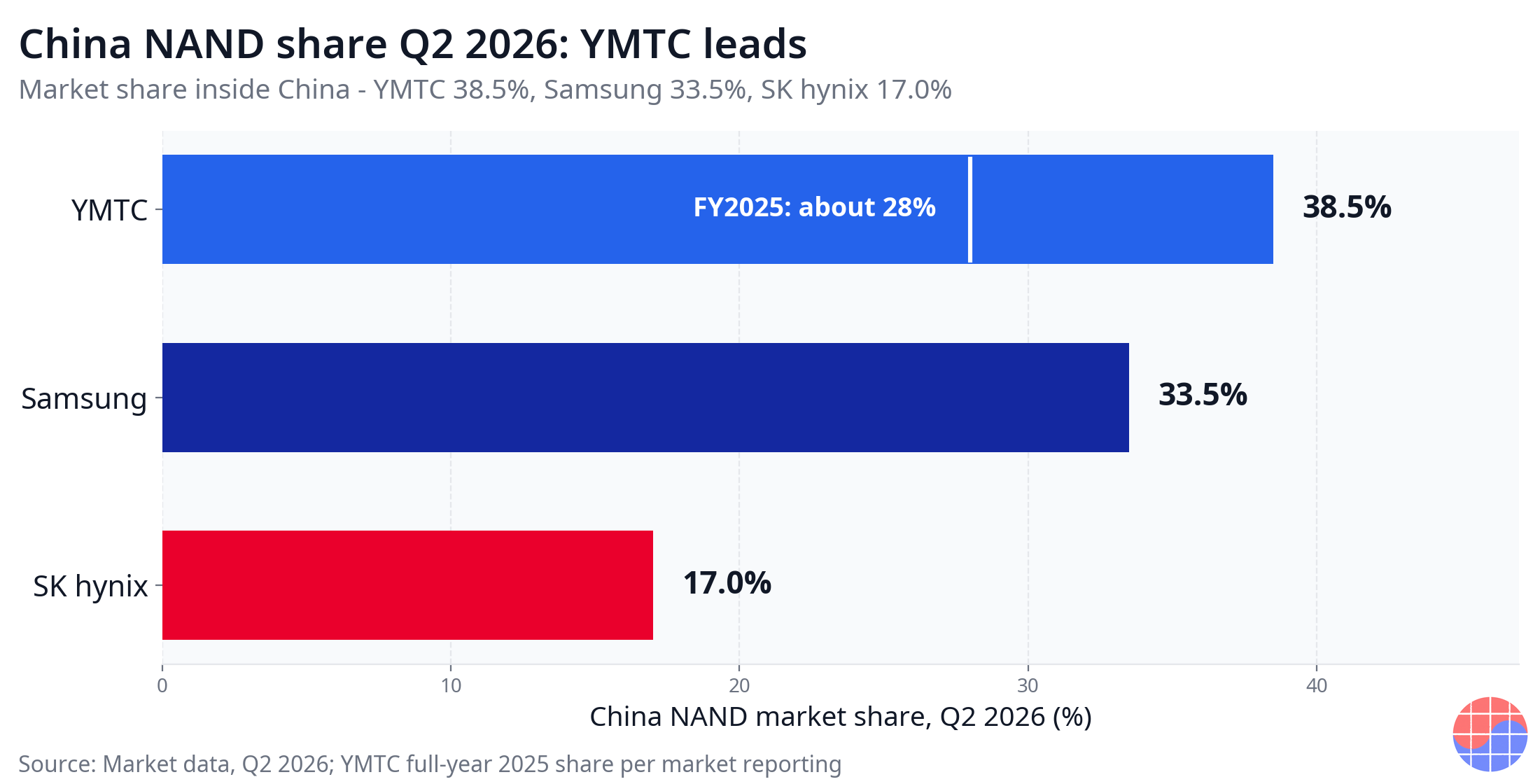
- In China's NAND market in Q2 2026, YMTC held 38.5% share, ahead of Samsung Electronics at 33.5% and SK hynix at 17%. YMTC stood at about 28% for full-year 2025.
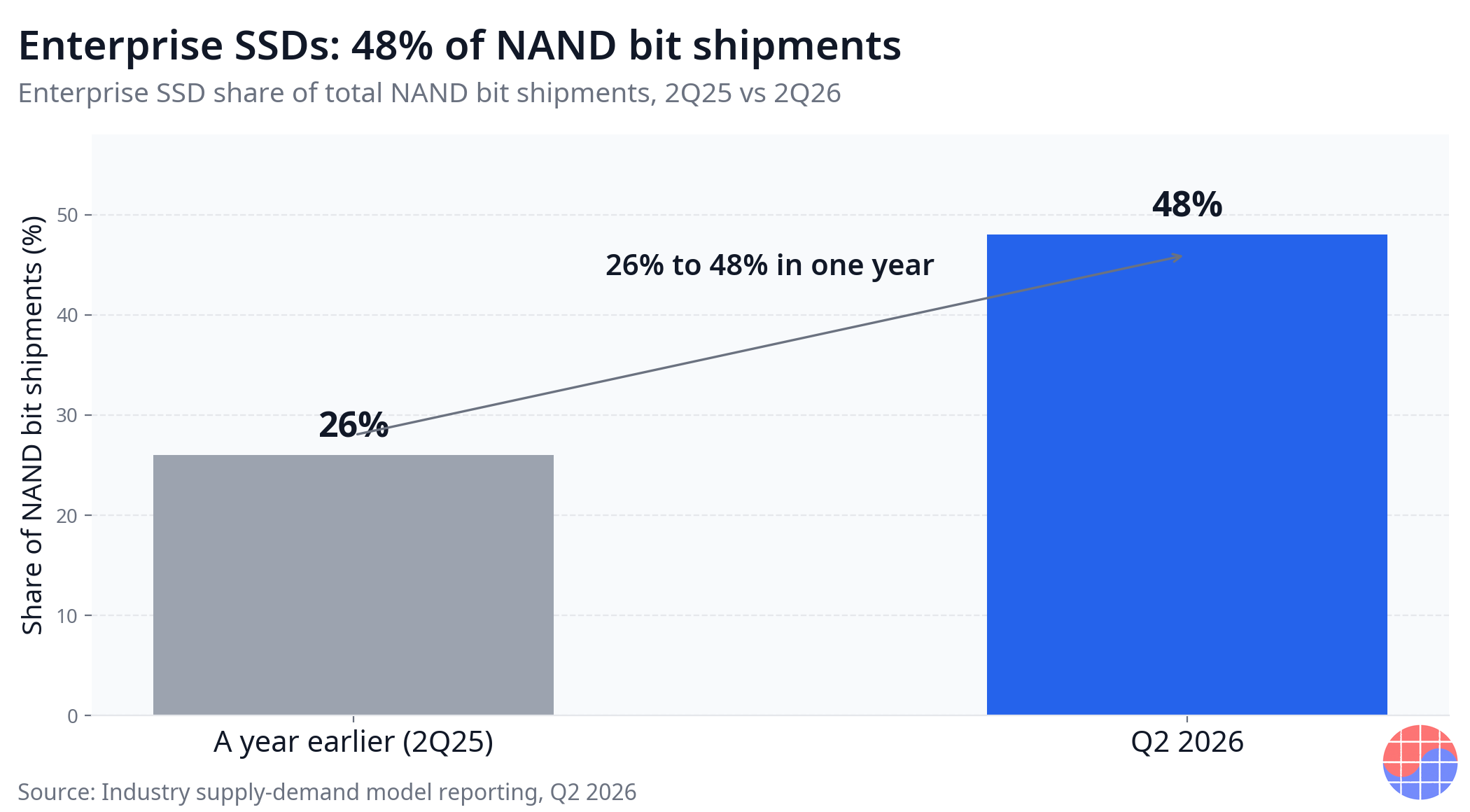
- Enterprise SSDs accounted for 48% of NAND bit shipments in Q2 2026, up from 26% a year earlier (industry supply-demand model reporting).
- Samsung Electronics has shifted about 60% of its V-NAND capacity to V9 (286 layers), has begun V10 mass production, and is developing V11 at roughly 500 layers.
Background
NAND spent decades treated as a commodity: storage for phones and PCs, judged on cost per bit and on whether the market was oversupplied. AI data centres have changed that framing. As large language model inference grows longer and heavier, operators need somewhere fast and economical to keep training datasets, model checkpoints and the intermediate data of inference itself, including KV-cache. Storage has moved from a peripheral component sitting next to the compute to a layer of AI infrastructure in its own right. The value of NAND is being redefined, from capacity pricing alone to the throughput and power budget of the whole data centre.
SK hynix's 321-layer announcement on October 24, 2026 is a direct answer to that redefinition. The company release presents the product as the piece that completes a full-stack AI memory portfolio: HBM-led DRAM on one side, and ultra-high-performance NAND for AI data-centre SSDs and on-device AI on the other. Jungdal Choi, the head of NAND development, described the launch in paraphrased terms as a step closer to leadership of the AI storage market. Read carefully, the message is that layer count is no longer a record for its own sake. It is a claim about which storage demand the company intends to win.
A second force sits behind the headline: China. China is one of the world's largest NAND consumption markets and, at the same time, the home market of YMTC, a domestic supplier that is scaling quickly. Both Korean makers operate large NAND fabs inside China, so competition there involves local production, equipment licences and geopolitics at once — three contexts behind the 321-layer headline: AI demand, stacking technology, and the China market.
5 Facts
- SK hynix has started mass production of the world's first 321-layer NAND. SK hynix announced on October 24, 2026 (company release distributed via PR Newswire) that mass production has begun. The release frames the product as one pillar of a full-stack AI memory portfolio led by HBM in DRAM, targeting AI data-centre SSDs and on-device AI. Jungdal Choi, Head of NAND Development, said in paraphrase that the launch brings the company a step closer to leadership of the AI storage market.
- The 321-layer 2Tb QLC improves speed and power together. According to product reporting, the 2Tb QLC version adopts a six-plane architecture and 3,200 MT/s I/O, delivering writes up to 56% faster, reads 18% faster and write power 23% lower than the prior generation. It is a design tuned for AI data-centre workloads that write and read large volumes of data continuously, rather than for occasional consumer storage access.
- Samsung Electronics' stacking roadmap has not paused. Samsung Electronics has shifted about 60% of its V-NAND capacity to V9 at 286 layers, has begun mass production of V10, and is developing V11 at roughly 500 layers. The 321-layer milestone is therefore not a one-company record in isolation. It is part of a race in which every leader is accelerating its next generation at the same time.
- Inside China, YMTC already leads. In China's NAND market in Q2 2026, YMTC held 38.5%, Samsung Electronics 33.5% and SK hynix 17%. YMTC's share rose from about 28% for full-year 2025. Measured only inside China, the two Korean makers look less like pursuers of a local champion and more like incumbents being pursued.
- The centre of NAND demand has moved to enterprise SSDs. Enterprise SSDs accounted for 48% of NAND bit shipments in Q2 2026, against 26% in the same quarter a year earlier (industry supply-demand model reporting). Close to half of all NAND bits now ship into data centres, including AI data centres, rather than into consumer devices — which is precisely the demand that the stacking race is ultimately competing to serve.
Business Deep Dive
The 321-layer 2Tb QLC: what actually changed
| Item | 321-layer 2Tb QLC | Note |
|---|---|---|
| Stacking | 321 layers | World's first in mass production (company announcement, Oct 24, 2026) |
| Capacity and cell | 2Tb QLC | 4 bits per cell |
| Architecture | Six-plane | More parallel processing units |
| I/O speed | 3,200 MT/s | Per product reporting |
| Write performance | Up to +56% | Vs prior generation |
| Read performance | +18% | Vs prior generation |
| Write power | -23% | Vs prior generation |
The logic of adding layers is simple. More bits from the same wafer area lowers cost per bit and allows the same SSD capacity to be built from fewer chips. The complication is that each additional layer also adds process steps and difficulty, so the economics of the layer race only work when yield holds and demand absorbs the output. What makes this 2Tb QLC notable is less the layer number itself than the combination around it: a very large QLC die, presented for data-centre use, with write performance and power improved at the same time. QLC stores 4 bits per cell and therefore offers attractive capacity economics, but it has historically been marked down on speed and endurance. The six-plane architecture and the faster interface are an attempt to close that gap on the terms data-centre workloads actually measure.
China market share: a home-market reversal
| Company | China NAND share, Q2 2026 | Note |
|---|---|---|
| YMTC | 38.5% | Up from about 28% for full-year 2025 |
| Samsung Electronics | 33.5% | — |
| SK hynix | 17.0% | — |
| Others | 11.0% | Residual after the three companies above (89.0% combined) |
China figures need to be read differently from global share. YMTC's rise does not by itself prove that every technology gap has closed. It does show that a domestic supplier is expanding its customer base and volumes quickly inside an enormous home market. For the two Korean makers, China is now two things at once: still a major sales market, and increasingly the home arena of a growing local champion. The gap inside the table also matters. At 17%, SK hynix holds roughly half of Samsung Electronics' China share, which makes defending its China position a task in its own right, separate from its global NAND standing.
📩 Following this story?
Get the follow-up analysis — earnings, reports and HBM supply — in your inbox daily at 10:30 KST. Subscribe free →
China fab upgrades: the licence dilemma
Both Korean makers are also upgrading the generations produced inside their China fabs. Samsung Electronics' Xi'an fab is moving toward 236 layers, and SK hynix's Dalian fab has been reported moving from 192 layers toward 240 layers and above. The constraint is that these upgrades require annual United States equipment licences. Reporting indicates that the 2026 licences were granted, but how much upgrade equipment was approved could not be confirmed. That single uncertainty captures the structural dilemma. If the China fabs are not upgraded, their cost and product competitiveness inside China erodes against YMTC year by year. If they are upgraded, the companies accept licence and geopolitics risk as a recurring annual cost of competing.
Samsung's V-NAND roadmap: V9 to V11
| Generation | Layers | Status |
|---|---|---|
| V9 | 286 layers | About 60% of V-NAND capacity shifted to V9 |
| V10 | — | Mass production begun (layer count not specified in reporting) |
| V11 | About 500 layers | In development |
Samsung Electronics' moves combine defence and offence. Shifting the majority of capacity to V9, the current workhorse generation, tightens the cost structure today, while V10 production and V11 development signal that it does not intend to concede the next round of the layer race. Set against SK hynix's 321 layers and a future V11 at roughly 500 layers, the stacking contest is clearly unfinished. The decisive question, however, is no longer only who announces the higher number. It is whose generation converts into enterprise SSD volumes and customer qualifications.
Why NAND became AI infrastructure
The work NAND performs inside an AI data centre is broadening into three roles. The first is the bulk layer that holds training datasets and model checkpoints. The second is the fast layer that absorbs intermediate data generated during inference, including KV-cache, which is written and read repeatedly as generation proceeds. The third is the storage layer for on-device AI, where work is processed locally on the device itself. The jump in the enterprise SSD share of bit shipments, from 26% to 48% in a year, is the measurable result of that shift. If DRAM and HBM decide how fast a model can compute, NAND increasingly decides whether that compute is fed without interruption.
Layer-race economics tie the threads together. Higher layers raise bits per wafer, but also process cost, development spending and the path to stable yield. In strong AI demand, a leading generation earns premium positioning and volume; in weaker demand, the same investment becomes fixed cost. That asymmetry is why the China position matters: a supplier with a large, growing home base can keep volumes running through cycles that an export-dependent rival feels more sharply.
Chase's Take
Reading this contest through layer counts alone misses half of it. The 321-layer milestone is real, but the business outcome will be decided in two places. The first is the enterprise SSD. In a market where 48% of bits already ship for enterprise use, a NAND maker's results are set less by consumer storage prices than by data-centre qualifications and long-term volume agreements. That is why SK hynix presented 321 layers together with HBM and the language of a full stack. If NAND can be layered onto the data-centre customer relationships built through HBM, it stops being a standalone component sale and becomes part of account-level selling.
The second place is China. YMTC's 38.5% China share is an uncomfortable number for the Korean makers. Both companies need to sell inside China, which means the generations inside their China fabs have to keep advancing, which means passing an annual equipment licence test whose full scope stays opaque. Freezing the upgrades avoids that exposure but concedes competitiveness a little more each year. Either choice carries a cost, which is why the China fabs have become both an asset and a strategic burden. For YMTC, the mirror image holds: expanding home share builds scale economics and customer references, and whether that base extends into the global enterprise market is the next question to watch.
The coldest reading is about conversion speed. Layer leadership only pays if the leading generation becomes shipped enterprise SSD volume before its cost advantage is matched. On that measure, the 321-layer announcement should be judged not by the headline number but by how quickly the product appears in qualified, high-volume AI data-centre SSDs — and by whether the China business can hold its ground while that conversion happens.
Implications
- The scoreboard for NAND has changed. Layer counts and cost per bit are no longer sufficient measures. Enterprise SSD mix, data-centre qualifications and the reach of QLC inside data centres now belong on the same dashboard.
- China strategy is a licence question as much as a technology question. The pace of the Xi'an and Dalian generation upgrades depends not only on process capability but on the scope of annual equipment licences. Investors and buyers should treat that scope as part of supply security.
- YMTC's home share is a leading indicator, not a local curiosity. A 38.5% share inside China represents volume, and volume builds cost position and references that can matter later in enterprise competition beyond China.
- Full-stack portfolios are becoming a sales weapon. A supplier that can discuss HBM and NAND in the same data-centre negotiation can bundle memory and storage at the account level. The shift from component contests to account contests has begun in NAND as well.
FAQ
Q1. What did SK hynix announce on October 24, 2026? SK hynix announced the start of mass production of the world's first 321-layer NAND (company announcement). The release presented the product as part of a full-stack AI memory portfolio spanning HBM-led DRAM, ultra-high-performance NAND for AI data-centre SSDs and on-device AI, and Jungdal Choi, Head of NAND Development, described it in paraphrase as a step closer to leadership of the AI storage market.
Q2. How does the 321-layer 2Tb QLC differ from the prior generation? According to product reporting, it adopts a six-plane architecture and 3,200 MT/s I/O, with writes up to 56% faster, reads 18% faster and write power 23% lower than the prior generation. It is a large-capacity QLC design tuned on speed and power for data-centre workloads.
Q3. What were the China NAND market shares in Q2 2026? YMTC led with 38.5%, followed by Samsung Electronics at 33.5% and SK hynix at 17%. YMTC's share rose from about 28% for full-year 2025, putting the domestic supplier ahead of both Korean makers inside China.
Q4. Why do enterprise SSDs matter so much to the NAND market now? Enterprise SSDs accounted for 48% of NAND bit shipments in Q2 2026, up from 26% a year earlier (industry supply-demand model reporting). AI data centres store training data, checkpoints and intermediate data such as KV-cache at large scale, so the centre of NAND demand has moved from consumer devices to data centres.
Sources
- SK hynix company announcement, distributed via PR Newswire, October 24, 2026 — start of 321-layer NAND mass production and the full-stack AI memory portfolio
- Product reporting, 2026 — 321-layer 2Tb QLC specifications (six-plane, 3,200 MT/s, writes up to +56%, reads +18%, write power -23%)
- Industry reporting, 2026 — Samsung Electronics V-NAND roadmap (V9 conversion, V10 mass production, V11 development) and China fab generation upgrades
- Market data, Q2 2026 — China NAND market share (YMTC, Samsung Electronics, SK hynix)
- Industry supply-demand model reporting, Q2 2026 — enterprise SSD share of NAND bit shipments
This article is for information purposes only and is not a recommendation to buy or sell any security. Figures follow the cited company announcement and industry reporting, and may differ from other published estimates that use different methodologies.
📩 Missed today's analysis? Get tomorrow's in your inbox
Daily Silicon at 10:30 KST plus earnings and analyst-report breakdowns, first. Samsung Electronics, SK hynix, TSMC and HBM supply, read by practicing engineers. Join 300+ subscribers.
Subscribe free →
Free · No spam · Unsubscribe anytime