VLSI Korea
Samsung and SK hynix Said No to a 25 Trillion Won Power Prepayment: 5 Facts About the Grid Bill Behind the Fabs (KEPCO, Yongin Cluster, Power Grid)
KEPCO proposed a 25 trillion won electricity prepayment, about 20 trillion from Samsung and 5 trillion from SK hynix. Both declined. Five facts on the bond-limit cliff and the 15 GW grid bill behind the fabs.


🆓 Free article · Anyone can read this article for free
Previous: the Solidigm listing halt closed one of SK hynix's funding windows. This piece asks the next question: who pays for the grid that has to power the fabs. https://www.vlsi.kr/en/sk-hynix-solidigm-ipo-halt-20t-en/
The conclusion first: Korea Electric Power Corporation (KEPCO) has failed to win a 25 trillion won electricity prepayment from Samsung Electronics and SK hynix. KEPCO wanted roughly five years of power bills paid upfront to cut its bond issuance burden and fund the grid buildout for Korea's semiconductor clusters. Both chipmakers declined, citing the burden of tying up that much cash at once. This is not just a failed tariff negotiation. It is a signal that the contest has moved beyond fab construction budgets: grid connection, and who pays for it, now decides semiconductor capacity.
Fact 1. The proposal was 25 trillion won: about 20 trillion from Samsung, 5 trillion from SK hynix, five years of bills
The amounts KEPCO proposed were about 20 trillion won from Samsung Electronics and about 5 trillion won from SK hynix, 25 trillion won in total, sized on the previous year's bills and covering roughly five years of electricity charges. KEPCO reportedly offered interest above the two-year treasury yield, with the prepaid amounts offset against future bills. At an October 12, 2026 National Assembly audit, KEPCO CEO Kim Dong-cheol said opinion inside the companies was split: teams responsible for grid construction were positive, but the finance departments at both companies reached a negative conclusion after weighing various circumstances. The proposal did not go through.
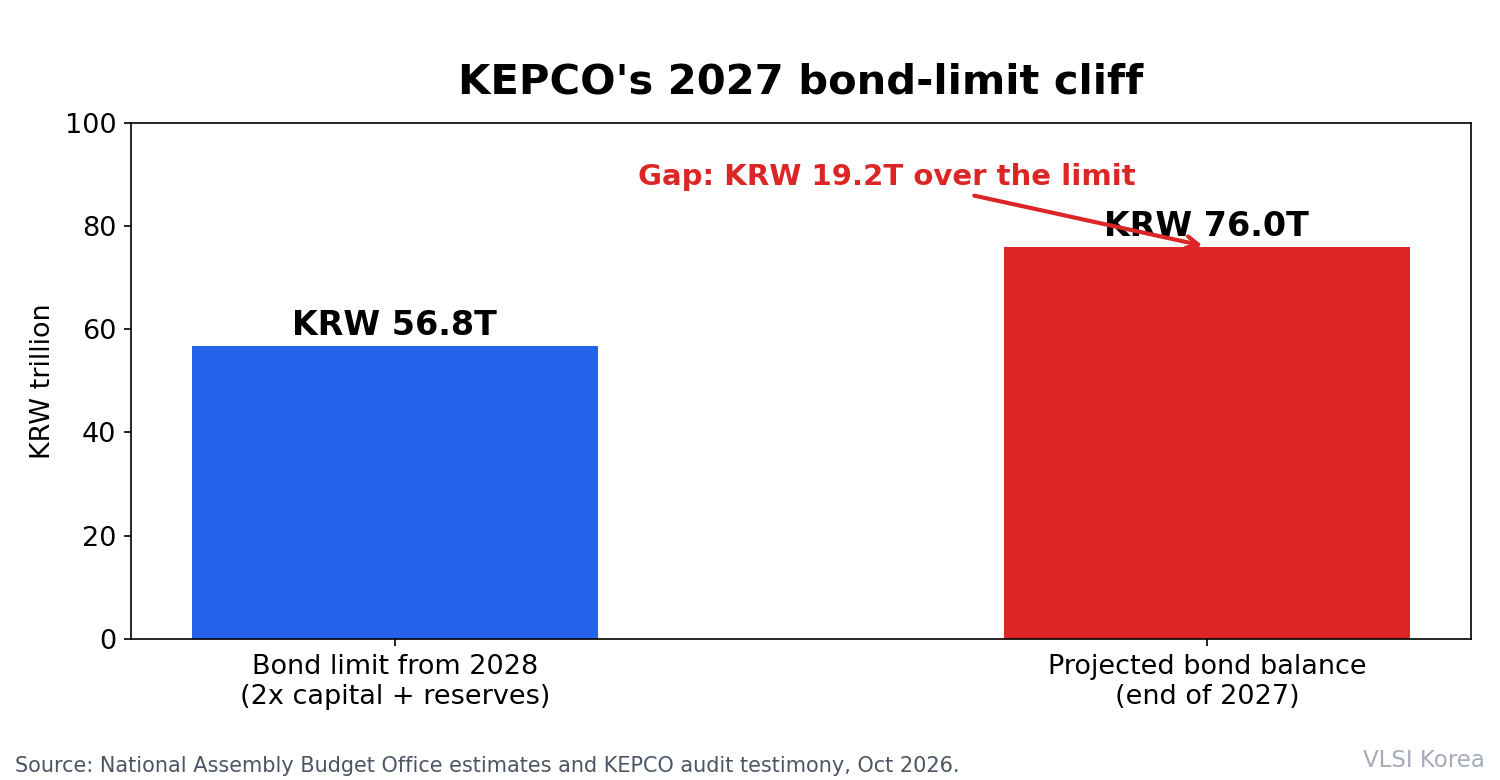
Fact 2. KEPCO asked because of a bond-limit cliff that arrives at the end of 2027
KEPCO currently operates under a special rule allowing bond issuance up to five times its capital and reserves. That rule expires at the end of 2027, and without new legislation the limit falls back to two times. National Assembly Budget Office estimates put KEPCO's capital and reserves at 28.4177 trillion won at the end of 2027, which makes the two-times limit 56.8354 trillion won. The projected bond balance at the same point is 76.049 trillion won, or 19.2135 trillion won over the limit; the balance already stood at 71.5 trillion won in the first half of 2026. The excess is not money due immediately, but above the limit KEPCO would face constraints not only on new issuance but on refinancing maturing bonds. KEPCO said receiving more than 20 trillion won in prepayments would have brought it back inside the limit.
Fact 3. On the demand side: 15 GW for Yongin, 6.3 GW for Honam — power must be contracted before fabs ramp
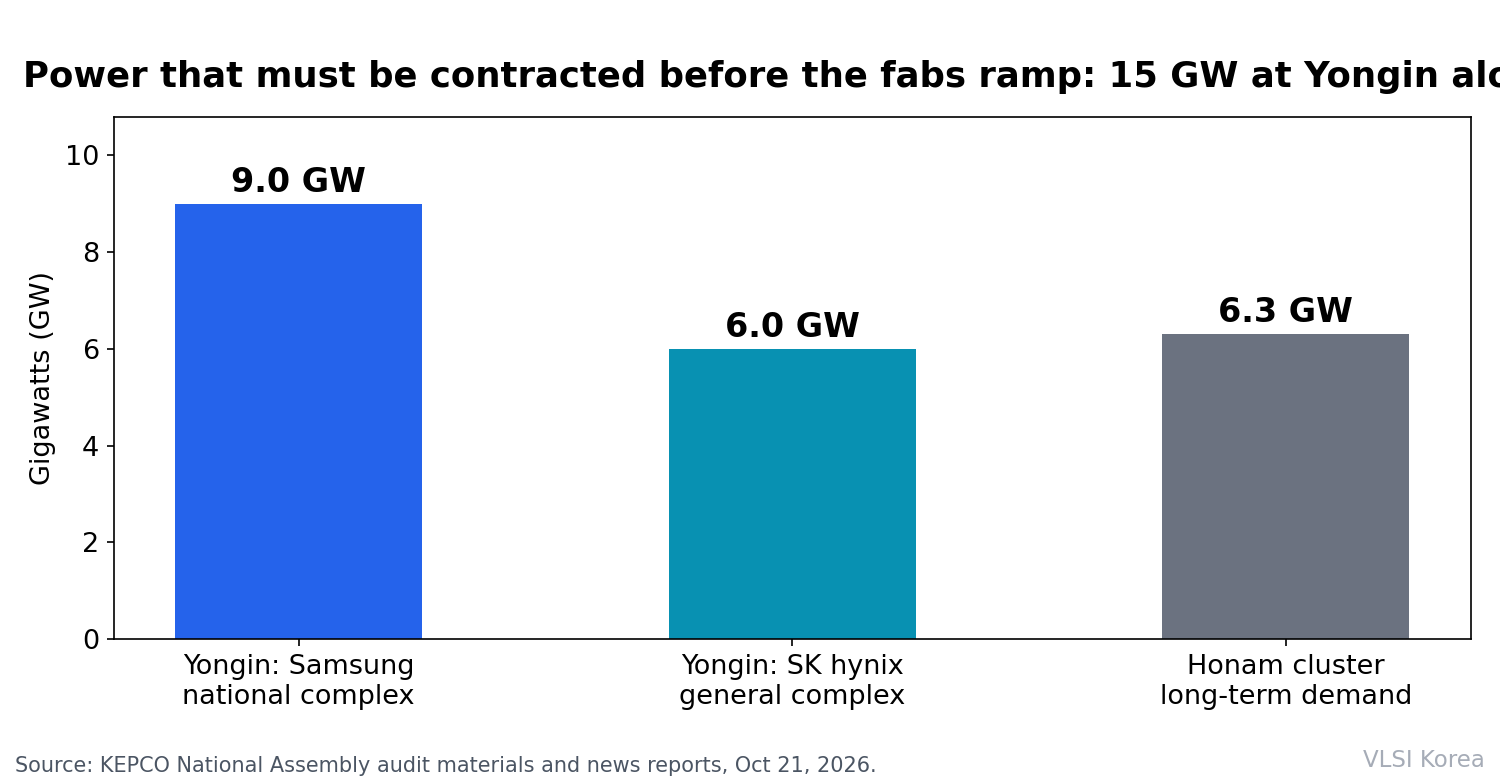
Expected power demand at the Yongin semiconductor cluster totals 15 GW: 9 GW for Samsung's national industrial complex and 6 GW for SK hynix's general complex. Samsung has completed supply agreements for 6 GW in two 3 GW steps in 2024 and 2025, with the final 3 GW agreement planned for 2027. SK hynix's 6 GW of agreements are already complete. The Honam semiconductor complex has expected long-term demand of about 6.3 GW; after fixing a first-phase 3 GW in August 2026, KEPCO aims to sign a second-phase agreement within this year to complete a 6 GW supply plan, including an additional 345 kV transmission line and substation. An agreement, however, is not energization: actual completion dates depend on fab construction schedules and permits.
Fact 4. The grid bill is 72.8 trillion won for transmission alone by 2038, 113 trillion including distribution
Under KEPCO's 11th long-term transmission and substation plan, transmission investment alone reaches 72.8 trillion won by 2038, up 16.3 trillion won from the previous plan. Combined transmission and distribution investment is put at 113 trillion won, with transmission lines growing 1.72 times and substations 1.43 times versus 2023. KEPCO's balance sheet has to carry this while weakening: its debt ratio was 479.7% in the first quarter of 2025, and broker consensus reported this week expects third-quarter 2026 operating profit of 2.6966 trillion won, down 52.29% year on year, with a fourth-quarter net loss of 493 billion won forecast. Grid investment is rising exactly as the profit and borrowing capacity to fund it shrink.
Fact 5. The next cards are tariffs and public money — and nothing has been decided yet
At an October 19, 2026 National Assembly audit, KEPCO CEO Kim Dong-cheol said a minimum electricity tariff increase needs to be discussed with the government, citing grid investment, and that funding the grid purely through borrowing is not viable. The same audit raised 46.1 trillion won of support from a government future-response fund. As of October 24, however, no tariff increase, residential or industrial, has been decided; the CEO himself described it as raising the need, with no concrete government discussion yet. The remaining calendar is clear: the Honam second-phase agreement within this year, Yongin's final 3 GW agreement in 2027, and the bond-rule expiry at the end of 2027.
📩 Following this story?
Get the follow-up analysis — earnings, reports and HBM supply — in your inbox daily at 10:30 KST. Subscribe free →
Strategic read: the bottleneck now sits outside the fab
List the bottlenecks of the past few weeks and a pattern appears: credit, helium, and now the power grid. All three decide capacity from outside the fab. In sign-off terms, power delivery has become a hard constraint like timing closure: no level of process excellence closes a schedule if the 345 kV line is not there. Anyone evaluating a fab investment now has to check the grid-connection date with the same seriousness as the process node and the tool orders.
The refusal itself is rational cash management. In the same month, the 55 trillion won buyback programs ended and the Solidigm listing, an external funding window, was halted. A limited cash pool is being contested by HBM expansion, shareholder returns and subsidiary investment. Even at interest above treasury yields, locking up five years of power bills loses on priority against HBM capex returns. But refusal does not make the cost disappear. Grid construction cost lands on someone's ledger: KEPCO debt, tariffs paid by all customers, or public funds. If the tariff route materializes, the cost spreads into the cost base of every fab and every materials and equipment supplier in Korea.
Three checkpoints will settle what this episode means. First, the October 28 SK hynix and October 29 Samsung Electronics earnings, for capex scale and any language on power and infrastructure costs. Second, whether the Honam 6 GW second-phase agreement is actually signed within the year. Third, whether the tariff discussion turns into a concrete industrial-rate adjustment. Together they will show whether the rejected 25 trillion won prepayment was a one-off negotiation failure or the turning point in Korea's semiconductor cost structure.
The key numbers at a glance (as of October 24, 2026)
| Total prepayment proposed | 25 trillion won (Samsung about 20 trillion + SK hynix about 5 trillion) |
| Prepayment horizon | About 5 years of electricity bills, sized on the prior year |
| Bond limit from 2028 (2x rule) | 56.8354 trillion won |
| Projected bond balance, end-2027 | 76.049 trillion won |
| Excess over the limit | 19.2135 trillion won |
| Yongin cluster power demand | 15 GW total (Samsung 9 GW + SK hynix 6 GW) |
| Honam complex power demand | About 6.3 GW (6 GW supply agreements targeted this year) |
| Grid investment by 2038 | 72.8 trillion won transmission; 113 trillion incl. distribution |
FAQ
Why did KEPCO propose an electricity prepayment?
To reduce its bond issuance burden and diversify funding for grid construction. When the special bond rule expires at the end of 2027, the limit drops from five times to two times capital and reserves, requiring a balance reduction of about 19.2 trillion won. KEPCO also argued that heavy issuance of its high-grade bonds crowds out corporate borrowers in the bond market.
Why did Samsung and SK hynix decline?
Because of the burden of committing that much cash at once. Audit testimony indicated that grid-related teams were positive but both finance departments judged negatively after weighing their circumstances. Both companies are simultaneously funding large HBM expansion and shareholder returns.
Does the refusal delay the semiconductor clusters?
It is not a direct cause of delay. Supply agreements are proceeding: 6 GW for Honam targeted within this year and Samsung's final 3 GW for Yongin in 2027. What remains uncertain is how grid construction is financed, which affects transmission line and substation completion. An agreement and actual power delivery are different stages.
Will electricity tariffs rise?
Nothing has been decided. KEPCO's CEO stated at the October 19, 2026 audit that a minimum increase needs discussion with the government. No specific increase or industrial-rate adjustment has been set.
This analysis is based on National Assembly audit testimony on October 12 and 19, 2026, reporting on October 21 and 24, 2026, and National Assembly Budget Office estimates. It is not investment advice. KEPCO earnings figures are broker consensus as reported.
📩 Missed today's analysis? Get tomorrow's in your inbox
Daily Silicon at 10:30 KST plus earnings and analyst-report breakdowns, first. Samsung Electronics, SK hynix, TSMC and HBM supply, read by practicing engineers. Join 300+ subscribers.
Subscribe free →
Free · No spam · Unsubscribe anytime