VLSI Korea
FuriosaAI vs Rebellions: Why a 3.2× Valuation Gap? RNGD Traction Meets a Stale Price Tag
FuriosaAI is marked at $735M (July 2025); Rebellions at $2.34B (March 2026). This deep dive decomposes the 3.2× valuation gap: stale pricing, investor composition, sovereign backing and IPO distance — against RNGD's post-price traction.


The 30-Second Summary
- The conclusion first: The 3.2× gap between FuriosaAI at $735M (reported July 2025) and Rebellions at $2.34B (reported March 2026) says less about chip quality than about when each price was set, who signed the term sheet, and how close each company is to an IPO.
- FuriosaAI's last valuation was struck before RNGD even entered mass production (January 2026). In the same window, Rebellions repriced twice: $1.4B in September 2025, then $2.34B in March 2026.
- Rebellions' premium has substance: revenue scale from the Sapeon merger, strategic investors such as Samsung, SK hynix and Arm, the National Growth Fund's first "K-Nvidia" investment, and an H1 2027 listing target.
- FuriosaAI's counter-argument also has substance: the LG AI Research EXAONE adoption, Samsung SDS's NPUaaS, and the 7,000+ unit Sweden deployment all happened after its price tag went stale.
- The verdict belongs to the Series D now in progress. If it closes at the KRW 2 trillion-plus level discussed in Korean press reports — roughly $1.4B — the gap halves without FuriosaAI selling a single extra chip.
Background — Two Price Tags, Two Different Calendars
Before comparing the two valuations, fix when and where each number was set. A private valuation is not a live quote; it is a snapshot from the moment the last round closed.
| FuriosaAI | Rebellions | |
|---|---|---|
| Latest valuation | $735M (about KRW 1.03 trillion) | $2.34B (about KRW 3.28 trillion) |
| Round and date | Series C bridge, July 2025 ($125M raised) | Pre-IPO, March 2026 ($400M raised) |
| Total raised | $246M | $850M |
| Named investors | Korea Development Bank, Industrial Bank of Korea, Keistone Partners, PI Partners, Kakao Investment | Mirae Asset, Korea National Growth Fund, Samsung, SK hynix, SK Telecom, KT, Arm, Aramco's Wa'ed |
| What the price misses | Mass production, Samsung SDS deal, Sweden deployment — none of it | Launched together with RebelRack and RebelPOD |
The last row matters more than the first. In September 2025, when both companies carried reasonably fresh marks, Rebellions stood at $1.4B against FuriosaAI's $735M — a 1.9× gap. Over the next six months Rebellions repriced upward by 67% in its pre-IPO round while FuriosaAI raised nothing at all. A large part of today's 3.2× is a calendar effect: only one side updated its price. KRW figures use USD 1 = KRW 1,400, and both valuations are as reported at the time of each round, not audited disclosures.*
One more number frames the whole story: Meta's acquisition offer in early 2025 was $800M. FuriosaAI turned it down, then closed its bridge four months later at a $735M valuation. It rejected a cash price higher than the paper price it accepted next. That choice is where any honest gap analysis has to start — FuriosaAI's lower mark may be the invoice for the independent path it chose, not evidence of weaker technology.
Business Deep Dive — Five Variables That Build the Gap
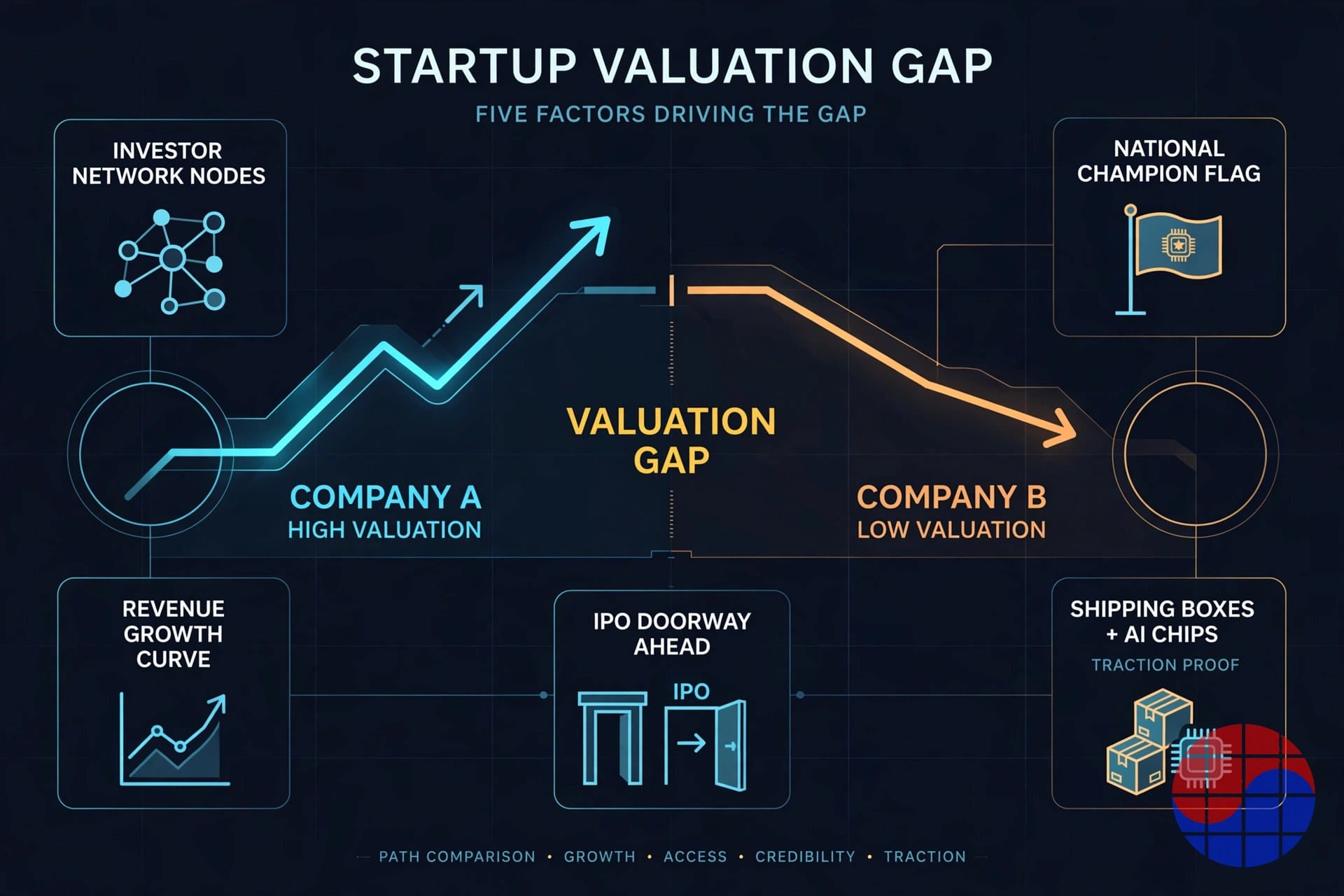
1. Investor composition: strategic money pays for the option
Rebellions' shareholder register reads like the Korean semiconductor supply chain itself: Samsung Electronics and SK hynix for memory, SK Telecom and KT for telecom and data-center demand, Arm for IP, plus Aramco's Wa'ed. For strategic investors, a stake is not only a financial claim — it is an option that ties an inference-chip supply line into their own ecosystem. Options carry premiums. The December 2024 merger with Sapeon Korea, SK Telecom's AI chip subsidiary, was the peak of this logic: absorb a rival, add scale, and complete the national-champion narrative.
FuriosaAI's July 2025 round, by contrast, was led by policy banks — the Korea Development Bank and the Industrial Bank of Korea — alongside financial investors. Beyond early backer Naver, the cap table is thin on strategics that can buy or distribute chips. Financial investors apply discount rates strictly. The same silicon gets a different number depending on who signs the price tag.
2. The sovereign story: designated champion vs. declared independence
In March 2026, Rebellions became the first investment of the Korea National Growth Fund — a reported KRW 250 billion commitment — and the designated vehicle of the government's "K-Nvidia" push. Being the state-picked champion supports the downside and raises visibility for public and telecom infrastructure orders.
FuriosaAI's sovereign story runs the opposite way. Rejecting Meta's $800M built a powerful brand — the independent chip company that refused absorption by US Big Tech — but it also closed the most certain exit and a global distribution machine. Reporting at the time said the talks broke down over post-acquisition business direction, not price. The market applauded the independence story; it has not yet repriced it.
3. Revenue visibility: an audited curve vs. a shipment plan
Rebellions can show a revenue staircase, largely thanks to merger accounting: Korean press reports put consolidated revenue at KRW 2.74B in 2023, KRW 10.3B in 2024, and above KRW 27B in 2025. Against a $2.34B valuation that is still a price-to-sales multiple above 100× — this price also buys the future, not the present. But the existence of a verifiable revenue curve is exactly what lets pre-IPO investors build a model. The CEO's $1B revenue target for 2027 is a target, not a result; there is at least a starting number to test it against.
FuriosaAI does not disclose revenue. What it discloses is units. RNGD entered mass production on TSMC's 5nm process in January 2026 with an initial batch of 4,000, and the company's 2026 target is 20,000 units. At an externally estimated unit price near $10,000, 20,000 units imply up to roughly $200M of shipment value — an estimate, and not recognized revenue. The absence of a verifiable revenue curve is the most plausible single discount factor in a financial-investor-led round.
4. Position in the IPO queue: the pre-IPO premium goes to the front
Rebellions has been reported to target completion of its listing review filings by the end of 2026 and a listing in the first half of 2027, with JP Morgan and Samsung Securities named as underwriters. A pre-IPO round is essentially a discounted claim on the listing price, so the more concrete the timetable, the easier a high price is to justify. Much of the six-month jump from $1.4B to $2.34B is timetable visibility being priced in.
FuriosaAI is one step behind in the queue. Its Series D is in progress now, targeting $300M–$500M according to press reports, advised by Morgan Stanley and Mirae Asset Securities, with an IPO window discussed for 2027–2028. Part of the gap is not a difference in merit. It is a difference in queue position.
5. The traction evidence: FuriosaAI's rebuttal is already shipping
So what is the FuriosaAI-side argument? Everything that happened after its price froze in July 2025. First, LG AI Research adopted RNGD for EXAONE inference after seven months of testing, with the customer itself confirming 2.25× better LLM inference performance per watt than its GPU baseline. Second, mass production started in January 2026, with an HBM3E derivative (72GB) extending the line — the base RNGD carries 48GB of HBM3 (384Gb). Third, Samsung SDS launched an RNGD-based NPUaaS on Samsung Cloud Platform in July 2026. Fourth, in Stockholm, Velox and I/ONX formalized a plan to deploy 1,800 RNGD units in phase one and more than 7,000 in total across a 15MW facility. We covered that deployment in depth in our Sweden RNGD deployment deep dive, and the company's own history — including the full Meta episode — in Startup Files #1: FuriosaAI.
Rebellions' traction is equally real: the ATOM line has been in mass production since 2023 with reported deployments in Japan, Saudi Arabia and the US, and March 2026 brought RebelRack and RebelPOD built on the Samsung 4nm Rebel100 with 144GB of HBM3E (1,152Gb). Both companies ship real silicon. The difference is not whether they ship. It is whether the shipments are reflected in the last price tag.
Chase's Take — Half Calendar, Half Cap Table
My decomposition of the 3.2× gap: the stale-price calendar effect is the largest block; the strategic and sovereign investor premium is second; IPO proximity and merger-built scale are third. The portion explained by raw chip competitiveness — architecture, performance per watt, software stack — is, in my view, the smallest. RNGD's Tensor Contraction Processor and Rebel100's chiplet design are different trade-offs, and no public benchmark yet justifies a 3× difference in enterprise value on technology alone.
That does not make Rebellions simply expensive. Its strategic investors are not buying a chip company's equity so much as the standard-setting seat in Korea's inference infrastructure — and the price of that seat is set by industrial policy, not by a DCF model. Nor is FuriosaAI simply cheap: with revenue undisclosed, the "undervalued relative to traction" argument only completes when shipment-to-revenue conversion is visible. The 20,000-unit target's actual attainment rate, and repeat orders, are the exam paper.
The honest summary is this: Rebellions is selling a future that has already been priced. FuriosaAI is stacking up results that have not been priced yet. Which side is right gets decided in 2027, when the Series D closing price and Rebellions' IPO price sit side by side.
Implications — What Narrows the Gap, What Widens It
Narrowing condition 1: the Series D print. If FuriosaAI closes at the KRW 2 trillion-plus valuation (about $1.4B) discussed in Korean reports, the gap compresses from 3.2× to roughly 1.7× overnight. Watch also whether a global strategic joins the round — a strategic signature lowers the discount rate on every round after it.
Narrowing condition 2: shipments converting to revenue. If Sweden's phase one (1,800 units) proceeds on its early-2027 schedule and Samsung SDS discloses real NPUaaS usage, FuriosaAI sheds the "no revenue curve" discount.
Widening condition 1: Rebellions' IPO price. An IPO priced above $2.34B re-rates the whole private sector. Paradoxically, FuriosaAI's stale tag would look even cheaper while its fundraising competition gets harder.
Widening condition 2: execution risk materializing. If either side stumbles on production yield, HBM supply, or software ecosystem depth (vLLM and PyTorch support), the gap hardens into a difference of merit. A slip in FuriosaAI's third-generation chip schedule, targeted for 2028, would shake the story that follows the Series D.
For the Korean AI chip sector as a whole, the lesson generalizes: late-stage private prices here react more sensitively to investor composition, policy designation and listing distance than to technology and revenue alone. Next time you read a valuation in this sector, check three things before the number itself — the date on the price tag, the names on the cap table, and the distance to the IPO.
FAQ
Q1. Exactly how large is the valuation gap between FuriosaAI and Rebellions?
About 3.2× on the latest reported rounds: FuriosaAI at $735M in its July 2025 Series C bridge, and Rebellions at $2.34B in its March 2026 pre-IPO round. The two prices are dated eight months apart, which is central to interpreting the gap — it is not a same-day comparison.
Q2. Is FuriosaAI undervalued?
It cannot be concluded yet. Mass production, the Samsung SDS deal and the 7,000+ unit Sweden deployment all postdate its last valuation, so re-rating factors have accumulated. But with revenue undisclosed, the speed of shipment-to-revenue conversion cannot be verified externally, and the final verdict rests on the closing price of the Series D now in progress.
Q3. How should the rejected $800M Meta offer be judged today?
The $800M offer was higher than the $735M bridge valuation set four months later — FuriosaAI declined a richer cash exit and accepted a lower paper price. Reporting indicates the reason was post-acquisition business direction, not price. Whether the choice was right will be judged by how far the independent path's Series D and eventual IPO prices exceed $800M.
Q4. When does the gap narrow?
The fastest trigger is the Series D closing. A print at the KRW 2 trillion-plus level discussed in Korean reports would cut the gap to roughly 1.7×. The next triggers are Rebellions' 2027 IPO price and whether FuriosaAI's 2026 shipments — a 20,000-unit target — convert into recognized revenue.
* Note: Valuations and funding figures are as reported at the time of each round, not official disclosures. KRW conversions use USD 1 = KRW 1,400. The roughly $10,000 unit price is an external estimate, not FuriosaAI's official pricing.
📩 Subscribe to VLSI Korea
Get our daily semiconductor deep-dives delivered to your inbox first. Free to subscribe.