VLSI Korea
Goldman Sachs: DRAM -5.9%, NAND -4.6% in 2027 — The Structural Memory Shortage
30-Second Summary * Goldman Sachs research dated October 1, 2026: the 2027 DRAM supply deficit revised from -2.5% to -5.9% — more than twice as deep. NAND also seen -4.6% short. Severe tightness runs through 2028. * Three reasons it is structural this time: visibility into AI server demand, constrained supply growth, and increasingly rigid long-term supply agreements


30-Second Summary
- Goldman Sachs research dated October 1, 2026: the 2027 DRAM supply deficit revised from -2.5% to -5.9% — more than twice as deep. NAND also seen -4.6% short. Severe tightness runs through 2028.
- Three reasons it is structural this time: visibility into AI server demand, constrained supply growth, and increasingly rigid long-term supply agreements (LTAs) locking in both volume and price.
- The token math: Goldman Sachs projects global token consumption rising 24-fold to 120 quadrillion per month by 2030, driven by autonomous AI agents. Tokens are memory demand.
- Kioxia is locking in 50% of its 2028 output under LTAs. Its 2026 NAND capacity is already fully booked by customer orders, and hyperscalers have submitted supply requests covering 2027–2028.
- The Korea angle: Samsung Electronics and SK hynix sit at the peak of pricing power. KB Securities sees HBM prices up more than 100% YoY in 2027, with HBM4 rising from 40% to 80% of Samsung's HBM revenue.
Intro: Not a Cycle — a Structure
The memory industry has an old saying: of every three shortages, two are fake. Supply expands, prices collapse, cuts follow, prices recover — the loop ran for 30 years. So many investors still read this one as a temporary rebound. That is why memory stocks trade at single-digit P/E ratios.
Goldman Sachs' October 1 report says the opposite: this time is different. Revising the 2027 DRAM deficit from -2.5% to -5.9% is not a routine tweak — it comes with language like "the most severe supply-demand picture in 15+ years." The case rests on three arguments, each of which breaks a past cycle's logic. This piece traces where the numbers came from, what they mean, and what they imply for Korea's two memory giants.
Deep Dive
Episode 1. Anatomy of -5.9%
The supply-demand balance is the surplus or shortfall of supply versus demand, in percent. Negative means demand outruns supply — a shortage. Goldman Sachs moved its 2027 DRAM balance from -2.5% to -5.9%, a shortfall more than twice as deep as previously forecast. NAND: -4.6%. Both stay negative through 2028.
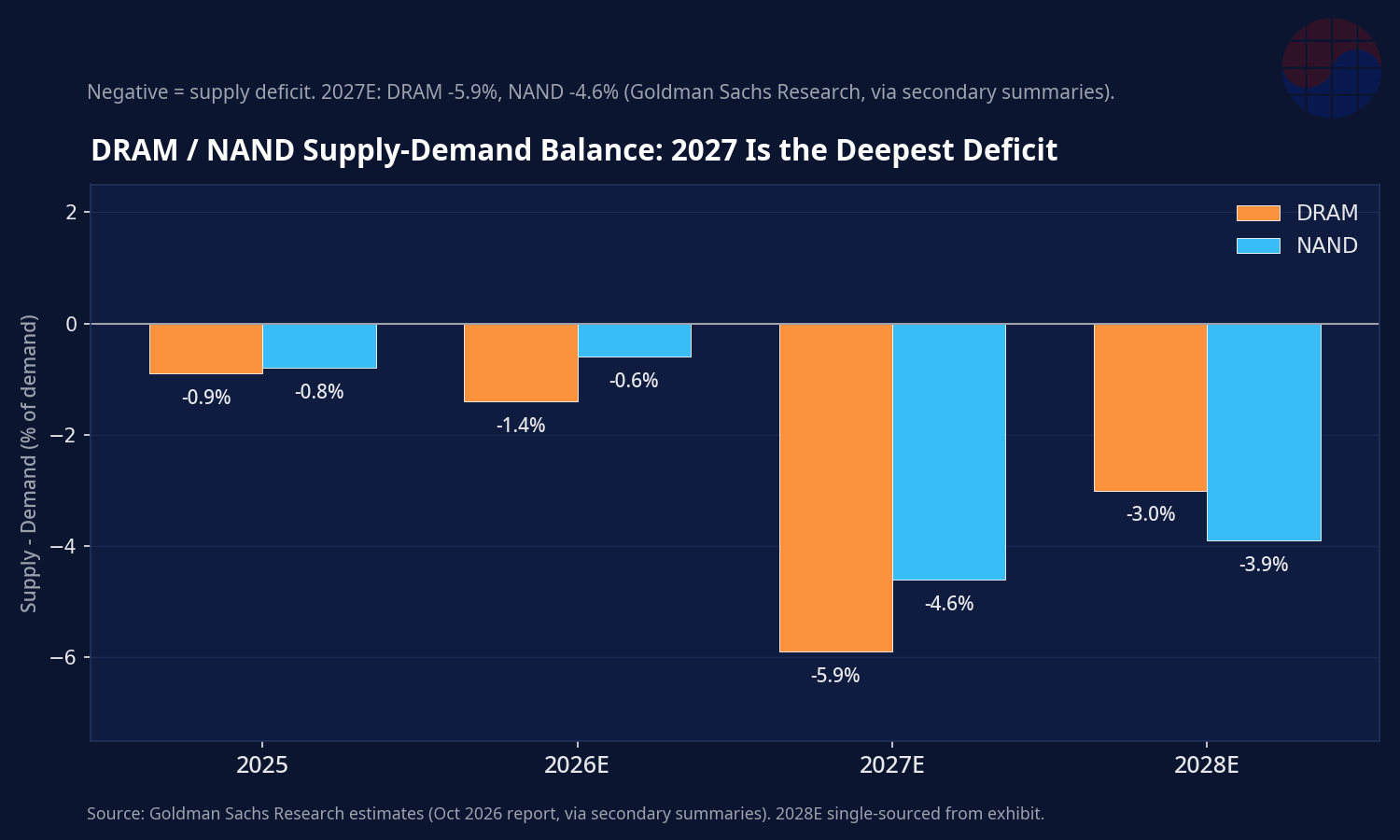
The shape tells the story. Mild deficits in 2025 (-0.9%/-0.8%) and 2026 (-1.4%/-0.6%) fall off a cliff in 2027, then fail to recover in 2028 (-3.0%/-3.9%). Not a V, not a U — closer to an L: down hard, then slowly up.
Why 2027 specifically? On the demand side, AI server memory is exploding; on the supply side, capacity additions cannot keep up. Per KB Securities, the share of general DRAM capacity excluding HBM falls from 73% in 2025 to 59% in 2027 — fab capacity is being sucked into HBM, squeezing conventional DRAM. Less supply means higher prices: a tailwind formula for Samsung Electronics, the world's No. 1 DRAM maker. (Maeil Business Newspaper)
Episode 2. Why It Is Structural: Three Reasons
Goldman Sachs' "this time is different" rests on three pillars.
First, visibility into AI server demand. Past cycles rode PC and smartphone replacement waves — hard to forecast. Today is different. AI datacenter memory demand shows up directly in hyperscaler capex plans. Server memory — conventional DRAM, SOCAMM, HBM — already exceeds 50% of total DRAM demand in 2026–2027. When demand is visible, suppliers have less reason to fall into the overbuilding trap.
Second, constrained supply growth. The big three (Samsung, SK hynix, Micron) are holding "supply discipline" — running fabs below maximum utilization to defend pricing. Micron's capacity stays around 120,000–140,000 wafers per month through 2027, and SK hynix had already sold out its 2026 HBM production. New capacity takes time: a greenfield fab needs about three years to build.
Third, LTA rigidity. Long-term agreements are locking in volume and price simultaneously. Micron has secured more than $32 billion in customer commitments under LTAs; Kioxia is working toward 50% LTA coverage of its 2028 output. The longer contracts run, the duller the spot market's price signals get, and the narrower the cycle's amplitude. The old "game of chicken" — who blinks and expands first — is structurally harder to repeat.
Combined, the conclusion is one: the shortage runs through 2028, possibly beyond. SK hynix's CEO said in July 2026 that 2027 would be the worst year and demand would exceed supply beyond 2030; Samsung said the same month that 2027 would be worse than 2026 and tightness would last through 2028. Micron's CEO stated on the September 2026 earnings call that "in 2027 and 2028, memory supply and demand will be much tighter than this year."
Episode 3. The Token Math: 24x to 120 Quadrillion
Trace memory demand to its root and you find tokens. Goldman Sachs Research projects global token consumption rising 24-fold to 120 quadrillion per month by 2030, driven by autonomous AI agents. (TechRadar, PYMNTS)
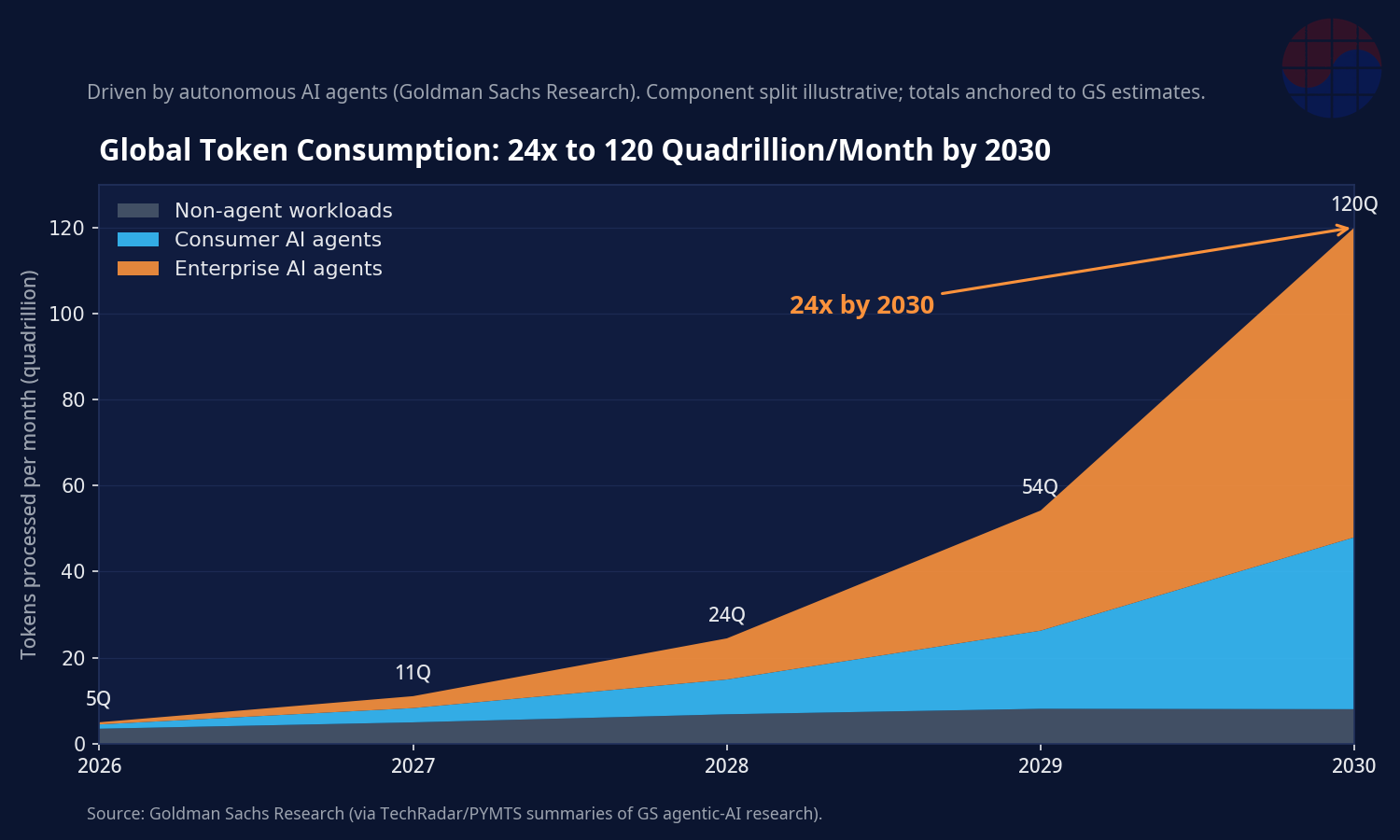
Why do agents devour tokens? Before producing one answer, an agent runs an inner monologue: interpret the request, pick tools, retrieve data, evaluate results, loop. The visible answer is a fraction of total tokens consumed. Per-token prices are falling — the Silicon Data index hit 97 cents per million tokens in early September, an all-time low — yet tokens per task are exploding. A McKinsey study found enterprise LLM spending tripled in 12 months.
What do tokens have to do with memory? Every inference token eats HBM bandwidth; an agent's context retention eats DRAM capacity. 24x tokens is a structural step-up in memory bit demand. It is also the backdrop for Goldman Sachs raising its 2027 HBM market forecast from $75 billion to $116 billion. The token economy is the memory economy.
Episode 4. Kioxia's 50%: The LTA Weapon
The most aggressive move this cycle comes, surprisingly, from Kioxia. The NAND pure-play is targeting 50% long-term-agreement coverage of its 2028 shipment volume. (Blocks & Files)
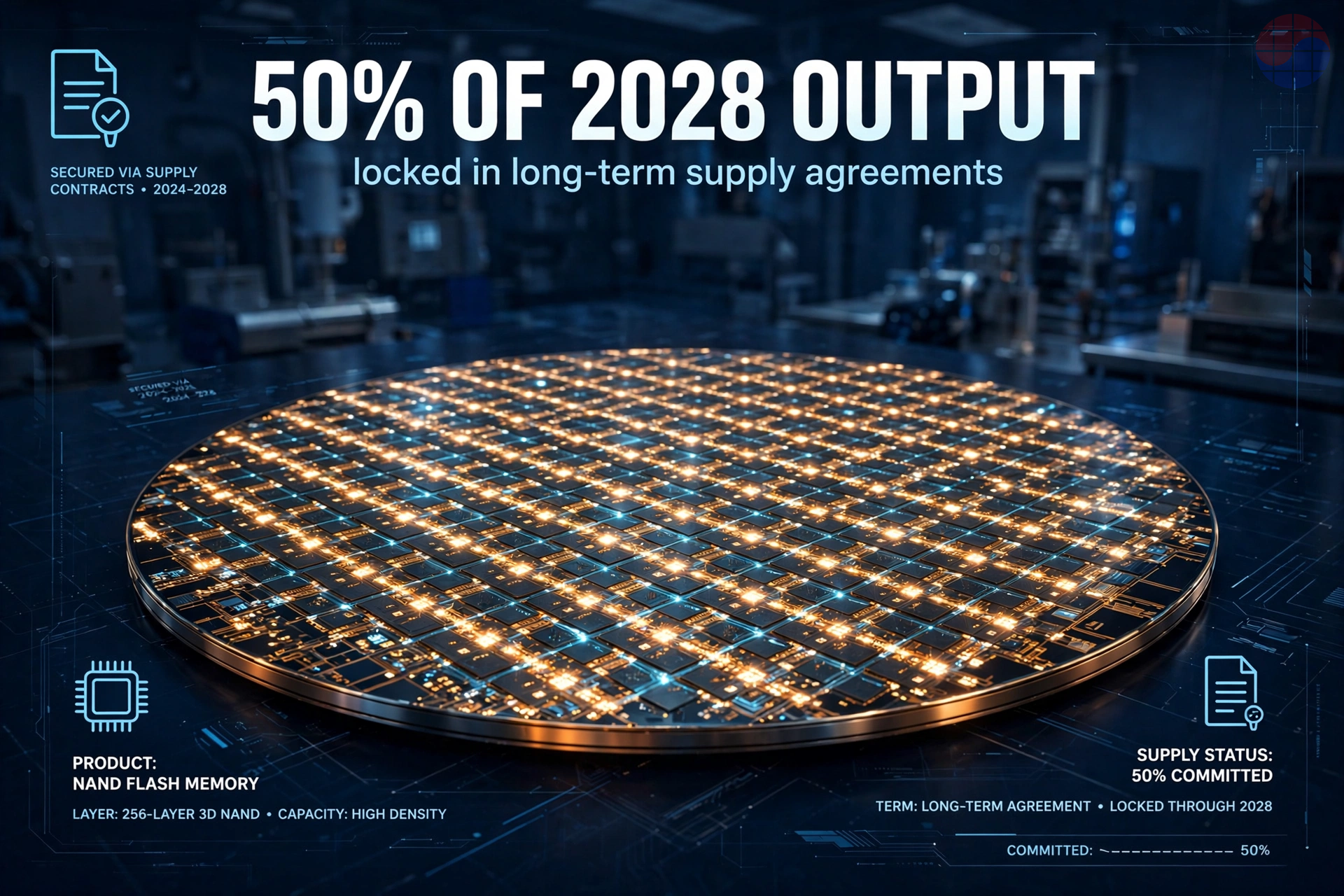
Back in February 2026, Kioxia confirmed its 2026 NAND production capacity was "fully locked in" by customer orders, with some hyperscale clients submitting long-term supply requests covering 2027–2028. It also extended its Yokkaichi joint-venture contract with Sandisk through the end of 2034. A 50% LTA ratio means half the revenue is protected if prices fall — and half the spot supply disappears if they rise. For the supplier, a volatility hedge; for the market, tightness cemented in place.
Goldman Sachs upgraded Kioxia from Hold to Buy with a higher price target, raising FY2027–2029 operating profit forecasts by 16–48% and projecting gross margins near 80%. Attaching a three-year high-profit outlook to a cyclical memory name is an unusually strong statement. (Specific target figures come from secondary summaries; the original report is client-only.)
Episode 5. Winners, Losers, and HBM
The beneficiary map:
Samsung Electronics: No. 1 in DRAM plus HBM4 leadership. KB Securities expects HBM selling prices up more than 100% YoY in 2027, with HBM4's share of Samsung's HBM revenue jumping from 40% this year to 80% next year. HBM4 is a 12-high stack at 36 GB — 288 Gb — per stack. As general DRAM capacity migrates to HBM (73% → 59%), conventional DRAM prices rise too: a double effect.
SK hynix: the HBM throne plus a Kioxia stake. With 2026 HBM sold out, it is the prime beneficiary of 2027 price hikes — and indirectly of NAND tightness through its Kioxia holding.
Micron: declared on its September 2026 earnings call that 2027–2028 will be "much tighter" than 2026. Over $32 billion in LTA commitments secures demand visibility. Operating at peak-cycle margins in the 70s.
Kioxia: the NAND shortage pure-play. Enterprise SSDs are crossing 60% of NAND revenue (year-end outlook), shifting the mix toward high-margin datacenter products.
The risks: slower adoption of consumer AI workflows is the key downside. Smartphone production is forecast down 15–20% YoY in 2026; notebook shipments fell about 10%. If AI stays inside datacenters and never reaches consumer devices, 40% of NAND demand (the consumer half) goes soft. Also note the dissent: TrendForce expects NAND supply to catch up with demand in 2027 — at odds with Goldman's -4.6%, so NAND deserves a cautious read.
The Korea Angle: Peak Pricing Power
For Korea's memory duo, this cycle is special. Once victims of the chicken game, they are now its architects. Samsung's general-DRAM capacity shift (73% → 59%) is an exercise of pricing power. SK hynix holds the HBM peak; Samsung holds DRAM plus HBM4.
The numbers: Goldman Sachs estimates conventional DRAM prices up about 176% YoY in 2026, with operating margins of 70–80% — rare territory even in semiconductor history. What matters for Korean investors is that this phase is being engineered as a three-year run, not a one-year spike: LTAs are layered in, expansions are delayed, token demand underwrites it.
Caution is still warranted. Buyer-side voices like Acer's CEO say "the shortage is already over," and there is a scenario (voiced by a former Samsung chip chief) of supply surging in late 2027 or early 2028. Structural conviction and a cycle top are one sheet of paper apart.
Chase's Take
I am an engineer at Synopsys — not a memory maker, but a maker of tools that verify the chips that use memory. So my view of this cycle is slightly skewed: when memory prices rise, my fabless customers' costs rise too.
Still, numbers are numbers. A -5.9% deficit is less an abstract forecast than a physical quantity you can back out from fab utilization and LTA coverage. And contract structures like 50% LTA coverage are a variable past cycles never had. The old game was "when prices rise, someone expands and kills it." The new game is "even when prices rise, contracts prevent expansion." When the rules change, old formulas give wrong answers.
One question for Korean engineers: do the fruits of a memory supercycle go only to shareholders? The jobs designing, verifying, and ramping 288 Gb HBM4 stacks are in Korea right now. Converting a cycle's upside into a career is a strategy too. When prices rise, fabs hire.
FAQ
Q1. Can I read the original Goldman Sachs report? The original is client-only Goldman Sachs research, not public. This piece's figures are cross-verified from secondary summaries of the October 1 report and industry coverage. Verify against the original before investing.
Q2. Are DRAM -5.9% and NAND -4.6% confirmed figures? No — they are 2027 estimates. Goldman Sachs revised its prior forecast (-2.5%) more than twice as deep; actual balances will vary with demand and expansion speed.
Q3. Does the 24x token forecast connect directly to memory? Indirectly but structurally: surging agent token consumption drives inference HBM bandwidth demand, which expands datacenter DRAM/NAND demand. Goldman Sachs raising its 2027 HBM market forecast from $75B to $116B is the same logic.
Q4. TrendForce disagrees on NAND? Yes. TrendForce expects NAND supply to catch up with demand in 2027 — at odds with Goldman's -4.6%. Read NAND cautiously; DRAM has broader consensus.
Disclaimer: this is not investment advice. Figures are estimates; always verify against official sources before deciding.