VLSI Korea
Goldman's Prime Desk, Dissected: Hedge Funds Undid All Their Post-2025 AI Buying in Five Days
Goldman Sachs prime desk data show hedge funds net sold AI stocks for five straight sessions, reversing all net buying since 2025, while memory stocks lost over $700B. Yet Goldman kept Buy ratings on Samsung and SK hynix.


30-Second Summary
- The conclusion first: positioning, not fundamentals, made this selloff. According to the Goldman Sachs prime brokerage note reported by Reuters on October 16, 2026, global long-short hedge funds net sold global AI stocks for five straight sessions from October 8 to 14 — a wave of selling that, by Goldman's count, reversed all of their net buying since the beginning of 2025.
- The losses were unusual in their breadth. Global fundamental long-short funds lost money every single day of the week to October 15, falling 2.9% for the week. Asia-focused stock pickers lost 6.8% in the first half of October alone, erasing more than half of the gains they had built from their late-June peak, when they were up more than 40% for the year.
- They sold what they owned; they did not bet against it. Long selling ran at roughly 3.5 times short selling. This was deleveraging, not a collapse of conviction. And yet long exposure to global AI stocks still sits at the 83rd percentile of the past three years, with leverage near five-year extremes — which is why Goldman's Vincent Lin reads the deleveraging as closer to its beginning than its end.
- In the same week, Goldman's research desk said the opposite. Memory stocks lost well over $700 billion of market value after October 10, yet Goldman maintained a Buy — and Conviction Buy status — on Samsung Electronics (target price KRW 490,000 for common shares) and a Buy on SK hynix (target price KRW 3,500,000), arguing that DRAM, NAND and HBM supply will be even tighter in 2027 than in 2026 and that the shortage persists through 2028.
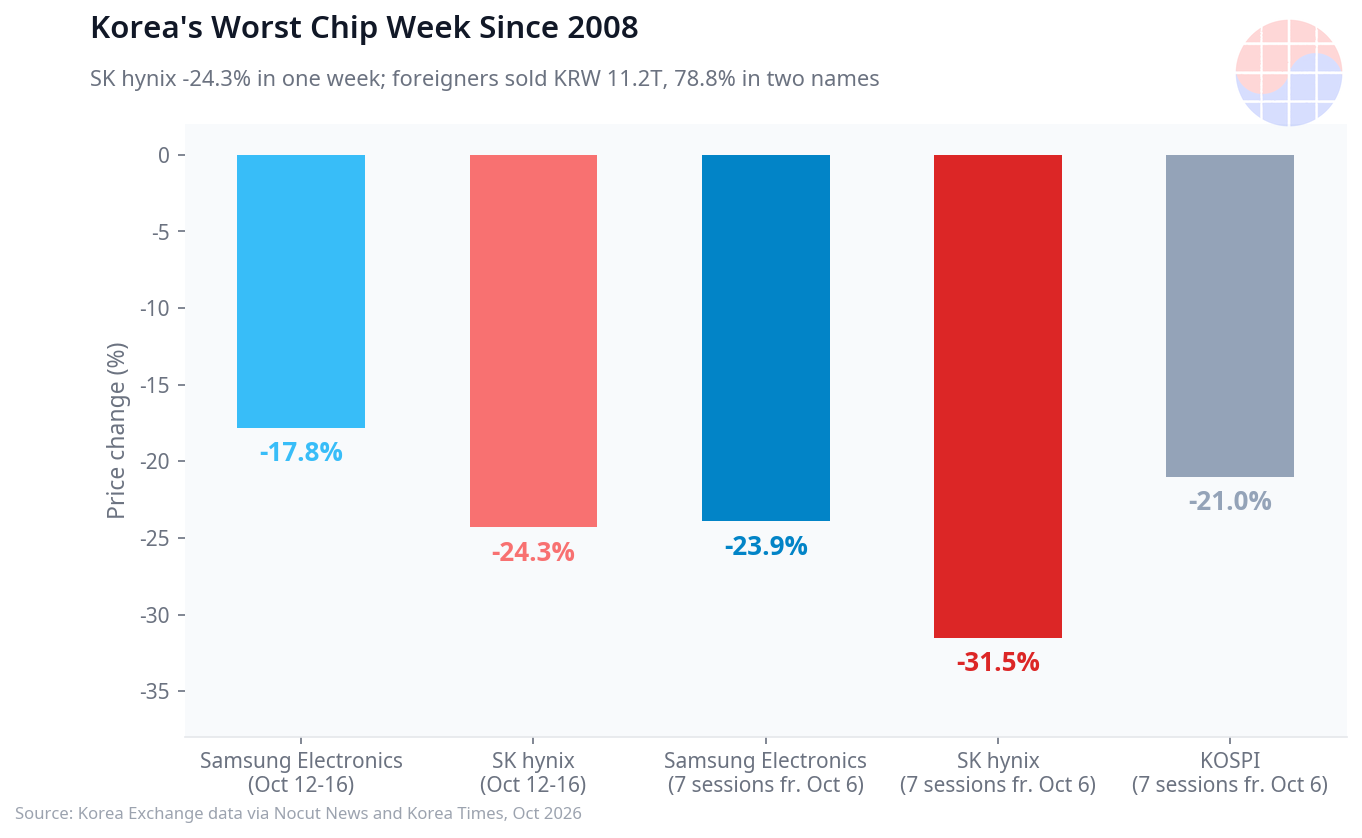
- Korea was the epicenter. In the week of October 12–16, Samsung Electronics fell 17.8% and SK hynix fell 24.3% — for SK hynix, the worst week since November 2008. Foreign investors net sold KRW 11.2068 trillion on the KOSPI that week, and 78.8% of it was concentrated in just those two stocks.
- Chase's Take: On the same Thursday, October 15, TSMC reported the largest quarterly profit in its history. The technology did not change that week. The hands holding it, financed with borrowed money, did.
All report figures in this article come from secondary coverage. The original reports are client-only and were not directly verified — original not verified. Every key figure carries a source, and no figure that could not be cross-checked is included.
Intro: The Earnings Were Fine. The Hands Were Not.
On Thursday, October 15, TSMC reported its third-quarter results. Revenue came in at US$46.72 billion, up 41.2% year over year. Net income reached NT$763.06 billion, up 68.7%. Both were records. On that same day, South Korea's KOSPI fell 8% to close at a six-month low, and Taiwan's market lost more than 3%.
Nothing about the earnings broke. What broke was the positioning. Goldman Sachs prime brokerage — the desk that lends hedge funds money and custodies their shares, and therefore knows with unusual precision who owns what, and how much of it was bought on margin — published a note that week that amounts to one of the coldest market diagnoses of 2026. This article dissects that note's numbers, and then sets them against the very different call made days later by Goldman's own research desk on Korean memory. Read together, the two notes describe the same market from opposite ends: one says the crowd is heading for the door; the other says the world outside the door is fine.
Episode 1: The Prime Note, Number by Number
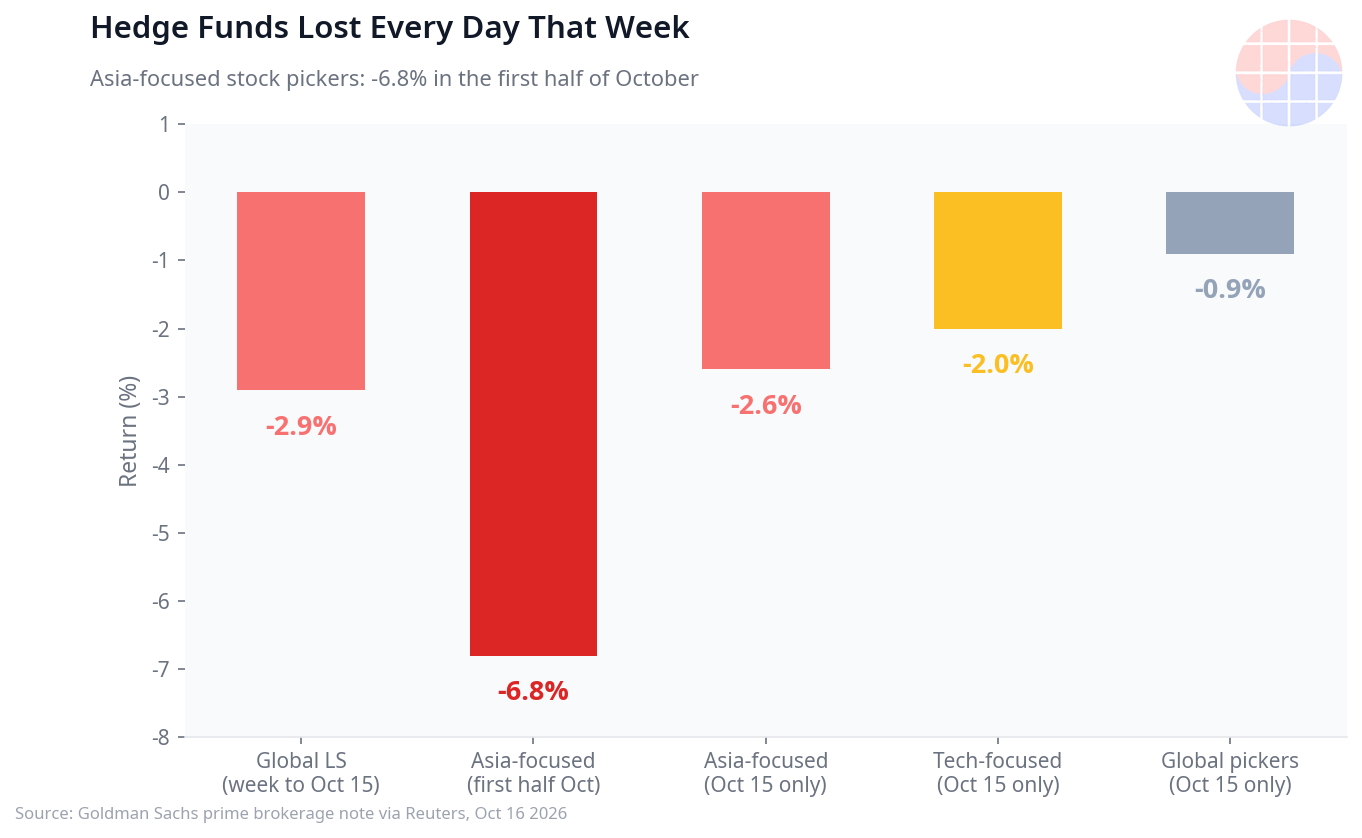
The prime note's core figures, as reported by Reuters on October 16 (Reuters), are six.
First, the losing streak. Global fundamental long-short funds — stock pickers — lost money every single day of the week to October 15, for a weekly return of -2.9%. They remain up 14.3% for the year. This is not a collapse; it is a give-back, executed at speed.
Second, Asia's drawdown. Asia-focused stock pickers lost 6.8% in the first half of October. From their late-June peak, when they were up more than 40% year to date, they have now surrendered more than half of those gains. On October 15 alone, global stock pickers fell 0.9%, Asia-focused managers fell 2.6%, tech-focused funds fell 2.0%, and systematic long-short and multi-strategy funds each declined roughly 1%.
Third, the rarity of the synchronized fall. Goldman noted that from COVID through the end of 2025, the three broad strategy groups never all fell more than 80 basis points on the same day. In 2026 it has already happened three times: February 4, July 28, and October 15. When strategies that are supposed to be different fall together, it usually means their books were not different at all.
Fourth, the size of the selling. Long-short managers net sold global AI stocks for five consecutive sessions, October 8 to 14. By Goldman's count, that selling reversed all of their net buying since the start of 2025 — nearly two years of accumulation unwound in a week. One of those sessions was the second-largest single-day net sale of AI stocks in the past year.
Fifth, the character of the selling. The ratio of long selling to short selling was about 3.5 to 1. Eight of the eleven US sectors were net sold, led by information technology and industrials. Funds were cutting what they owned rather than establishing new bearish bets — deleveraging, not shorting.
Sixth, it is still crowded. Even after that week, hedge funds' long exposure to global AI stocks sits at the 83rd percentile of the past three years, and leverage in the prime book remains near five-year extremes. That is the factual basis for Vincent Lin's judgment that the deleveraging looks closer to its beginning than to its end. The trigger, per the note's context, was hotter-than-expected US inflation data, which pushed rate-cut expectations out and made semiconductor and AI supply-chain stocks — the most leveraged expression of the AI trade — the first thing to sell.
Episode 2: $700 Billion Gone — and the Research Desk Pointing the Other Way
If the prime desk recorded the crowd's movement, the price tag of that movement is as follows. A basket of memory stocks — Samsung Electronics, SK hynix, Micron, SanDisk and Kioxia among them — lost well over $700 billion in combined market value after October 10, across seven trading sessions, with individual names down between 11% and 26%, per Yahoo Finance figures reported on October 16. A broader basket of 61 semiconductor and storage stocks lost roughly $2.5 trillion. The iShares Semiconductor ETF fell for eight consecutive sessions, its longest losing streak since October 2008.
One cited trigger for the memory leg of the selloff was China. News that CXMT had made progress on a denser 4F² DRAM cell architecture, with a server memory product planned by the end of 2026, led the market to re-price the speed of China's catch-up in advanced DRAM.
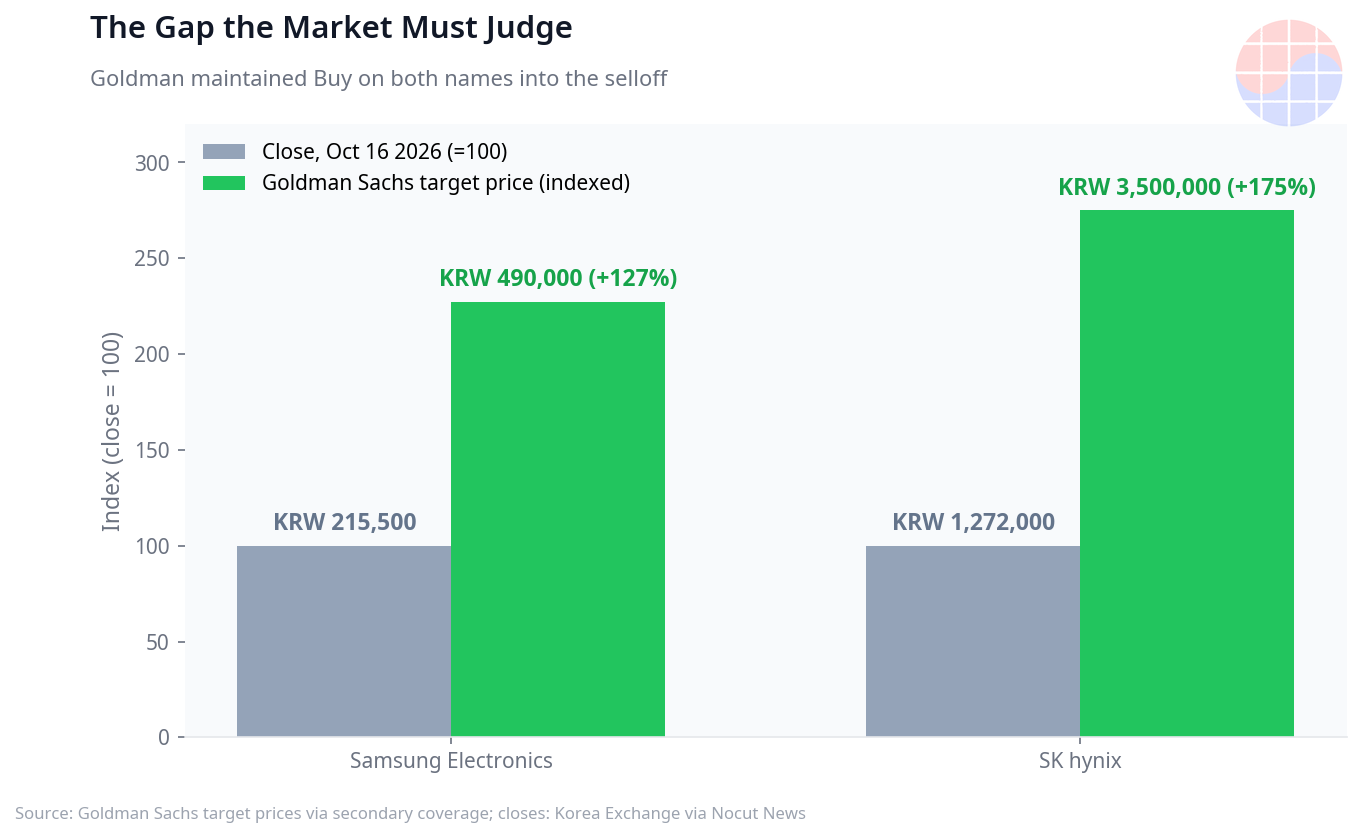
Goldman Sachs' research desk, however, answered with a Buy, not a retreat. Goldman maintained Samsung Electronics at Buy with Conviction Buy status, with target prices of KRW 490,000 for common shares and KRW 360,000 for preferred shares, and maintained SK hynix at Buy with a target price of KRW 3,500,000. The argument has three parts. First, supply of conventional DRAM, NAND flash and HBM will be tighter in 2027 than in 2026. Second, the shortage persists through 2028. Third, a cell-architecture milestone is not a supply event: CXMT would still need years to reach reliable mass-production yields and to clear the demanding qualification processes of hyperscaler customers before it could contest the HBM market in volume.
| Company | Rating | Target price |
|---|---|---|
| Samsung Electronics (common shares) | Conviction Buy | KRW 490,000 |
| Samsung Electronics (preferred shares) | Conviction Buy | KRW 360,000 |
| SK hynix | Buy | KRW 3,500,000 |
The two desks are not contradicting each other. The prime desk answers the question "who is selling?" The research desk answers "what remains true?" In a market where price is being set by positioning, both statements can be correct at the same time — and that is precisely what makes this phase dangerous to navigate with only one of them.
Episode 3: Winners, Losers, and the Korean Angle
The loser was Korean memory beta. Korea Exchange data show that in the week of October 12–16, Samsung Electronics fell 17.8%, from KRW 262,000 to KRW 215,500, while SK hynix fell 24.3%, from KRW 1,681,000 to KRW 1,272,000 (Nocut News). For SK hynix, that is the steepest weekly decline since the third week of November 2008, during the global financial crisis. Over the seven sessions from October 6, the falls were 23.9% for Samsung and 31.5% for SK hynix, with the KOSPI itself down 21%, or 1,449.52 points.
The concentration of foreign selling is the story. Foreign investors net sold KRW 11.2068 trillion of KOSPI shares that week. Samsung accounted for KRW 3.4763 trillion of it and SK hynix for KRW 5.3565 trillion — 78.8% of all foreign selling in two tickers. Foreign ownership fell to 45.98% in Samsung, the lowest since July 2009, and to 48.85% in SK hynix, the lowest since December 2021. This was not a verdict on either company's order book; it was a reduction of Korean semiconductor exposure as an asset class.
Domestic analysts made the same point from the other side. As the Korea Times reported on October 16, KB Securities called the decline an excessive correction driven by a lack of buying support and weakened sentiment rather than any deterioration in fundamentals, while SK Securities argued the memory shortage will deepen more than previously expected and HBM prices will rise next year (Korea Times).
The next verdict is earnings. SK hynix reports third-quarter results on October 28 and Samsung Electronics on October 29. The gap between Goldman's target prices and Friday's closes — roughly +127% for Samsung and +175% for SK hynix — is itself the market's open question. Whether earnings close that gap, or positioning widens it first, will be decided in large part by how quickly an 83rd-percentile AI long book comes down.
Chase's Take
Working inside this industry, the number from this note that stayed with me is not -2.9%. It is 3.5 to 1. Nobody shorted the AI trade into oblivion. They sold what they owned. The conviction did not break — the financing did, and everyone reached for the same narrow door at the same time.
Anyone who has watched semiconductor cycles knows the two kinds of declines feel different. A decline driven by changing demand forecasts is slow, contested, and full of rallies. A decline driven by positioning is fast, indiscriminate, and usually ends before the fundamentals have moved at all. This one looks like the second kind — with one uncomfortable caveat the prime desk itself supplied: exposure is still at the 83rd percentile. The first wave passing is not the same as the crowd having left.
On the memory call, Goldman's research view matches what I see from the floor. HBM qualification runs on a calendar measured in years, not quarters, and yield is proven on a production line, not in a conference presentation. CXMT's cell progress is real news. It is not 2027 supply news.
So the market now runs on three clocks at three speeds. Short-term price belongs to the hedge funds' hands. Medium-term price belongs to the October 28–29 earnings prints. Long-term price belongs to 2027 supply. We are, right now, in the stretch where all three clocks disagree.
FAQ
What exactly did the Goldman Sachs prime note say?
That global long-short hedge funds net sold AI stocks for five straight sessions from October 8 to 14, reversing all net buying since the start of 2025, and lost 2.9% in the week to October 15, with Asia-focused funds down 6.8% for the first half of October. The original note is client-only; this article is based on Reuters and other secondary coverage.
Was this selloff caused by deteriorating fundamentals?
Not on the evidence of that week. TSMC posted record results — revenue up 41.2% and net income up 68.7% year over year — on October 15, the worst day of the selloff. The prime note describes a positioning unwind triggered by hotter US inflation data, with long selling running at about 3.5 times short selling.
Why did Goldman keep Buy ratings on Samsung and SK hynix?
Because its research desk expects DRAM, NAND and HBM supply to be tighter in 2027 than in 2026, with the shortage lasting through 2028, and judges that CXMT needs years to reach production yields and customer qualification. Target prices are KRW 490,000 for Samsung common shares and KRW 3,500,000 for SK hynix.
What should investors watch next?
Three things: the pace at which hedge fund AI long exposure (83rd percentile of three years) and leverage decline; SK hynix's October 28 and Samsung's October 29 third-quarter results; and whether foreign ownership — 45.98% in Samsung and 48.85% in SK hynix — starts to recover.
This article is for information only and is not investment advice. Report figures are drawn from secondary coverage; the original reports were not directly verified. Investment decisions are your own responsibility.
📩 Subscribe to VLSI Korea
Get our daily semiconductor deep-dives delivered to your inbox first. Free to subscribe.