VLSI Korea
No Helium, No Chips: Spot Prices Tripled and a Third of World Supply Is Trapped
Helium spot prices tripled in 2026 and a third of world supply is trapped behind the Hormuz closure. Chips consume a fifth of the world's helium, and one US fab says 40-50% of its tools use it. Why a minor cost line became a binary production risk.


The AI chip bottleneck nobody modeled is not a lithography tool, not packaging capacity, and not HBM. It is a gas. Helium is a tiny line in a fab's cost structure, yet it behaves nothing like a normal input. When supply tightens, it does not simply make each wafer more expensive. It decides whether wafers move at all. Allocation does not lift your cost curve. It deletes your output.
That is the situation the industry entered in 2026. About one-third of global helium supply was trapped by the closure of the Strait of Hormuz in February 2026. In March 2026, strikes hit Ras Laffan in Qatar, the world's largest natural gas facility and a major helium source. Spot prices have since tripled, according to CBS 60 Minutes (Oct 18, 2026 broadcast). One US fab is already on allocation from one of its suppliers. A university lab has been cut to half of last year's usage. These are operating conditions, reported as of Oct 20, 2026 — not forecasts.
The Numbers: A Concentrated Market Under Stress
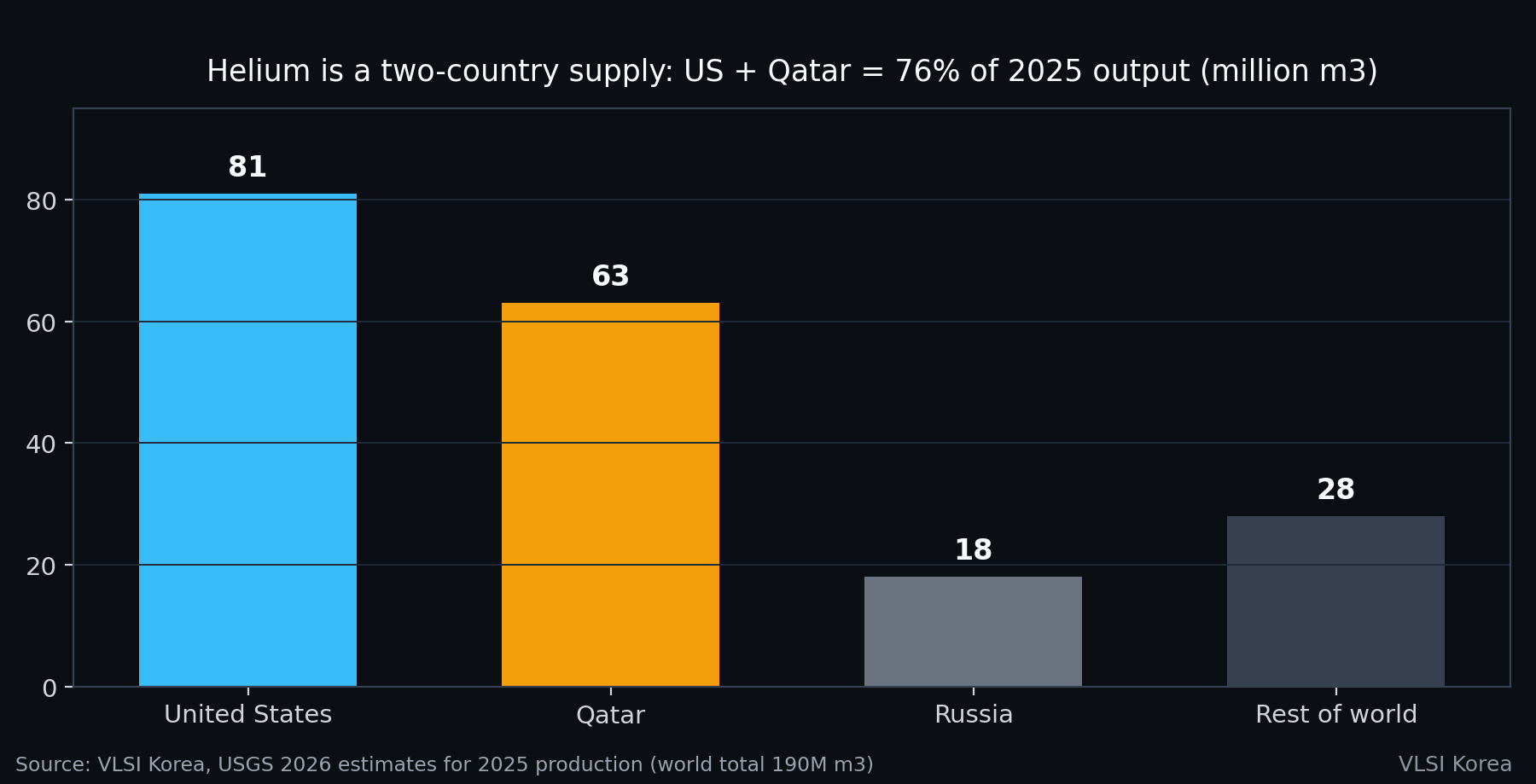
USGS 2026 estimates put world helium production in 2025 at 190 million cubic meters. The United States produced 81 million cubic meters, about 43%. Qatar produced 63 million cubic meters, about 33%. Russia produced 18 million cubic meters. The US and Qatar together supplied about 76% of the world's helium — and the third source was already constrained, because the US and EU import ban on Russian helium continued into 2025.
The semiconductor industry consumes about one-fifth of world helium, a figure cited in CBS 60 Minutes (Oct 18, 2026 broadcast).
After the February 2026 Hormuz closure, the March 2026 strikes hit Ras Laffan. Qatar said full restoration would take at least three years, and no helium-carrying ships are leaving Qatar. Qatar's revenue fell 42% in the first half, the Emir of Qatar told the Shura Council last week.
| Item | Figure | As of / Source |
|---|---|---|
| World production, 2025 | 190 million m3 | USGS 2026 estimates |
| US production, 2025 | 81 million m3 (43%) | USGS 2026 estimates |
| Qatar production, 2025 | 63 million m3 (33%) | USGS 2026 estimates |
| US + Qatar combined share | 76% | USGS 2026 estimates |
| Russia production, 2025 | 18 million m3 | USGS 2026 estimates |
| Semiconductor share of world use | About 20% | CBS 60 Minutes (Oct 18, 2026 broadcast) |
| Supply trapped by Hormuz closure | About one-third | Feb 2026 |
| Spot price change, 2026 | Tripled | CBS 60 Minutes (Oct 18, 2026 broadcast) |
| US export change since war began | Up 70% | CBS 60 Minutes (Oct 18, 2026 broadcast) |
| Ras Laffan restoration | At least 3 years | Qatar statement, Mar 2026 |
Price confirms the physical shortage. Spot prices have tripled in 2026, according to Rich Brooke, a former industrial gas executive now working as a consultant, on CBS 60 Minutes (Oct 18, 2026 broadcast). US helium exports are up 70% since the war began, mostly to chipmaking countries. A July report said China also banned helium exports. Storage is no hidden buffer: the caverns — two in the US and one in Germany — are now being drawn down, and the amounts are secret.
Why Helium Is Irreplaceable in a Fab
Helium's value comes from physics, not preference. It is the coldest liquid on Earth, boiling at about -269 degrees Celsius, or about -452 degrees Fahrenheit. As Brooke put it on CBS 60 Minutes (Oct 18, 2026 broadcast): "Nothing else boils that low." For processes needing extreme, stable low temperatures, there is no second candidate.
As general fab practice, helium is used for cooling, for keeping process environments clean and stable to prevent wafer defects, and for leak detection. None of these is optional: cooling holds recipe temperatures, a stable environment protects yields when one particle can kill a die, and leak detection protects the vacuum and gas systems the line depends on. Remove helium and many steps do not run at all.
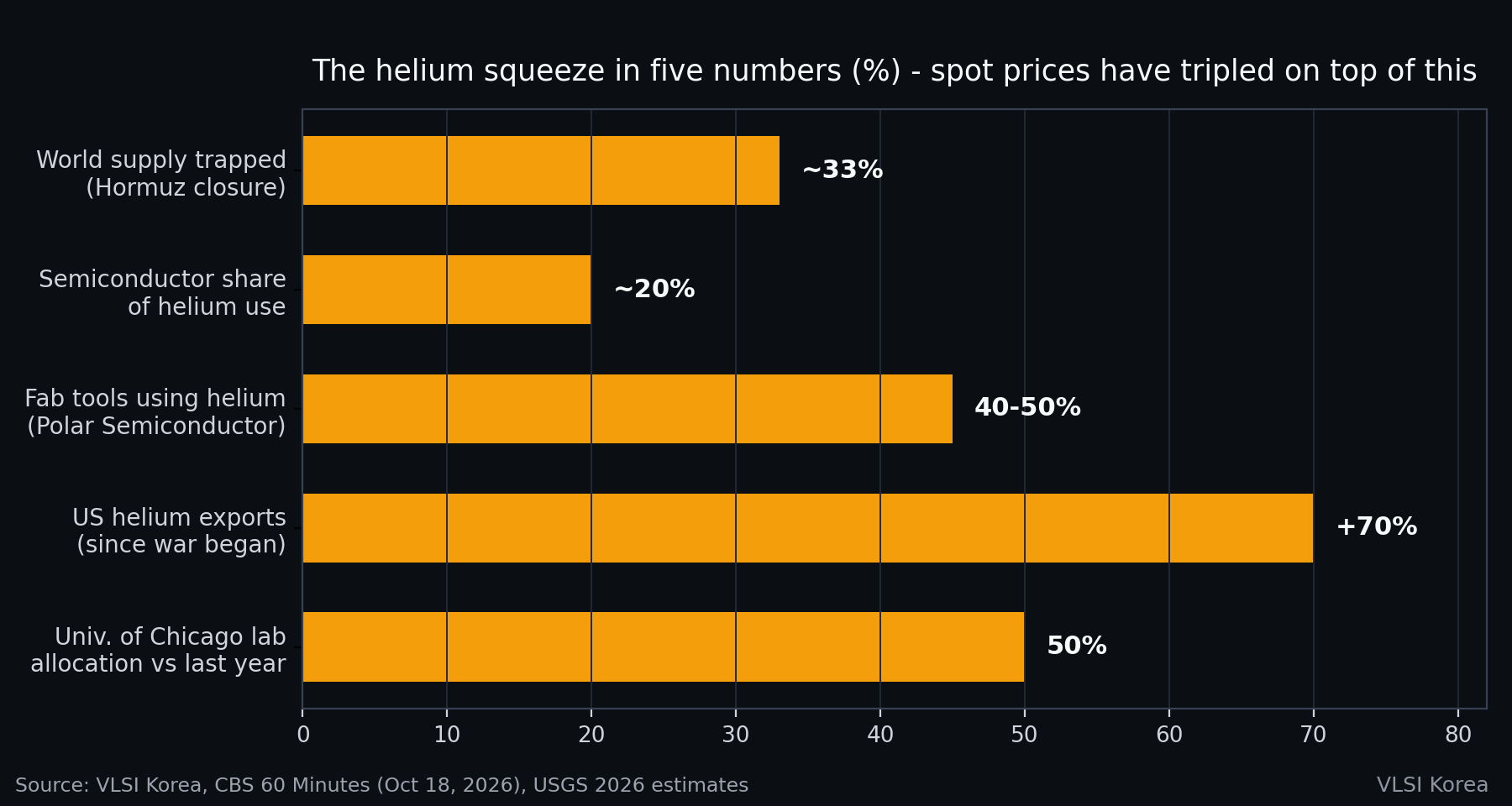
At Polar Semiconductor in Minnesota, president and chief operating officer Surya Iyer said 40 to 50% of the machines in its fab use helium in some way, and hundreds of process steps involve helium. Helium is not confined to one exotic corner of the flow; it is woven through the flow itself. Iyer said one of Polar's three suppliers has put the company on allocation, and that without helium the fab would have to shut down entirely. Polar plans to double capacity to 140 million chips per month — making its exposure larger at exactly the wrong moment.
The squeeze reaches beyond fabs. At a University of Chicago laboratory, researcher Joe Sachleben described an allocation that cut the lab to 50% of last year's usage. The lab keeps NMR magnets at -452 degrees Fahrenheit, pouring in about 100 liters every couple of months. When a lab and a production fab use the same word — allocation — the shortage has moved from the spot market into daily operations.
The Business Problem: Helium Fails Every Procurement Test
Through an MBA lens, helium fails every test a procurement team relies on. First, supply is concentrated: two countries account for 76% of production, based on USGS 2026 estimates, and the third source is largely closed to US and European buyers. Second, there are zero substitutes for its core uses, so short-run demand is almost perfectly inelastic: fabs need the same volume at three times the price, or they stop. Third, pricing is opaque. Six major suppliers account for most sales, with no transparent public benchmark. When sellers are few and buyers desperate, allocation replaces price as the real mechanism — and the seller decides it. Fourth, logistics are perishable: helium boils off in transit, so it cannot be stockpiled like metal or shipped slowly without loss. Distance and lanes, including Hormuz, are part of the supply itself.
Fifth, and most important, helium is a byproduct of natural gas. Supply does not respond to helium price signals. No producer drills a gas field because helium tripled. Output rises and falls with natural gas decisions made for entirely different reasons. A normal market self-corrects when high prices call forth new supply. This market, by construction, cannot — at least not quickly.
Qualification makes it harder still. Fab gases are qualified inputs, not commodities to swap freely. Traditionally, there have been only two qualified sources for chipmakers — Qatar and Exxon in the US — according to Brooke on CBS 60 Minutes (Oct 18, 2026 broadcast). When Qatar went down, chipmakers in Korea, Taiwan, and Singapore turned to US supply. Anyone who has worked in signoff or process qualification recognizes the pattern: a yield baseline is built over hundreds of steps, over months and years, and the gas flowing through those steps is part of that baseline. Switching or requalifying a source is like requalifying a PDK. You do not swap it mid-production because a spot cargo is available. You test, correlate, and re-baseline — while the line still has to ship.
What Fabs Do Now: From Cost Saving to Survival
Helium recovery and recycling systems move first. Recovery used to be a cost-saving project, judged on payback against a cheap, stable price. That math is obsolete. Under allocation and tripled spot prices, recovery is survival capex: every cubic meter recovered does not depend on a shipping lane, a damaged gas complex, or a supplier's rationing list. Expect recovery to be specified into new fab designs from the start, and retrofitted where the process allows.
Long-term contracts and on-site storage gain strategic value for the same reason. A contract that looked expensive in a loose market is cheap insurance in an allocated one, and storage becomes a buffer measured in days of production protected.
The pain will not be evenly shared. Allocation hits smaller fabs and labs first. The largest chipmakers have the scale, multi-region contracts, and political weight to secure US export supply, already up 70%, mostly to chipmaking countries. Smaller players have none of those levers. A prolonged shortage becomes a consolidation force: capacity survives where helium contracts survive.
New supply is years away. Pulsar Helium's Topaz Project in Minnesota covers seven wells over a 100-square-mile area. Its president, Cliff Cain, briefed the Pentagon and describes helium as a single critical point of failure. A project still in development does not relieve a shortage this quarter or this year. Meanwhile the US and German storage caverns are being drawn down. Buffers buy time. They do not create supply.
Watchlist: Six Falsifiable Signals
- Hormuz helium shipments: do shipments through the Strait of Hormuz resume within the next three months, or not? As Brooke framed it on CBS 60 Minutes (Oct 18, 2026 broadcast): tell me Hormuz, and I will tell you helium.
- Ras Laffan restoration: does Qatar's timeline stay at at least three years to full operation, improve, or slip?
- Further allocation notices: do more fabs or labs report allocation, following Polar Semiconductor and the University of Chicago lab?
- Spot price direction: after tripling in 2026, do spot prices keep rising, plateau, or retreat?
- Recovery-system capex: does helium recovery spending appear explicitly in fab plans and earnings calls?
- New supply reaching market: does Topaz or another source move from project to delivered volume — on a timeline of years, not months?
If shipments resume and allocation notices stop, the crisis case weakens. If allocation spreads while prices stay tripled, the gas — not the tool, not the wafer — is the binding constraint on chip output.
FAQ
Why can't fabs just use a different gas instead of helium?
For its core uses, there is no substitute. Helium is the coldest liquid on Earth, boiling at about -269 degrees Celsius (about -452 degrees Fahrenheit), and nothing else boils that low, as cited in CBS 60 Minutes (Oct 18, 2026 broadcast). Fabs also rely on it for cooling, for keeping process environments clean and stable to prevent wafer defects, and for leak detection. No other gas reproduces that combination.
How much of the world's helium does chipmaking use?
About one-fifth, or 20%, of world helium is consumed by the semiconductor industry, a figure cited in CBS 60 Minutes (Oct 18, 2026 broadcast). Against USGS 2026 estimates of 190 million cubic meters produced in 2025, chipmakers are a large, inflexible demand block: they cannot cut usage without cutting output.
Why can't chipmakers just buy helium from a new supplier?
Because fab gases are qualified inputs. Traditionally there have been only two qualified sources for chipmakers — Qatar and Exxon in the US — according to CBS 60 Minutes (Oct 18, 2026 broadcast). A yield baseline is built over hundreds of process steps with a specific qualified supply. Changing that source means requalification, and doing it mid-production during a shortage risks the output the purchase was meant to protect.
How long will the shortage last?
The verified timelines point to years, not months. Qatar said Ras Laffan would take at least three years to restore to full operation after the March 2026 strikes. New supply such as Topaz is still in development, and storage caverns in the US and Germany are being drawn down rather than refilled. Unless Hormuz shipments resume sooner than expected, allocation and elevated prices should be expected to persist well beyond 2026.
Disclosure
This article is analysis, not investment advice. It is based solely on the reports and figures cited above, as of Oct 20, 2026, including CBS 60 Minutes (Oct 18, 2026 broadcast) and USGS 2026 estimates. The extent of the damage at Ras Laffan is not officially confirmed, and production, price, and restoration figures may be revised as fuller information becomes available.
📩 Subscribe to VLSI Korea
Get our daily semiconductor deep-dives delivered to your inbox first. Free to subscribe.