VLSI Korea
ISLPED 2026 Review: What the Awards and Keynotes Reveal About Low-Power AI
We read the award abstracts and keynote materials, then compare two prior editions to identify the real low-power AI shift.


Answer first: The meaningful change at ISLPED 2026 is not that one keyword appeared in more paper titles. Across the 2024 data-movement agenda and the 2025 emphasis on sparsity, quantization and compute in memory, the 2026 Best Papers landed on a reliable sub-8-bit format, dynamic voltage-drop prediction, and nonlinear functions executed in memory. Memory-centric computing is a persistent three-year theme. The newer signal is a demand to prove that those ideas survive precision, signoff, variability, software and integration boundaries.
VLSI Korea view: ISLPED 2026 is no longer asking only whether computation can move closer to memory. It is asking whether the resulting system still closes on accuracy, power integrity, calibration, software and manufacturability.
ISLPED 2026 ran from August 5 to 7 at Northwestern University. Dates and first-party links for the next semiconductor conferences, CFPs and company technology events are available in VLSI Calendar.
This review does not turn the program booklet into a story. It compares the official 2024, 2025 and 2026 programs and awards, reads the public abstracts for the 2026 winners, and reads the three public keynote abstracts. Session attendance, room fill and replay views were not published. Attendance evidence unavailable: the "important sessions" below are selected by awards, public technical evidence and decision value, not claimed popularity.
1. The three-year shift: not quantization one year and memory the next
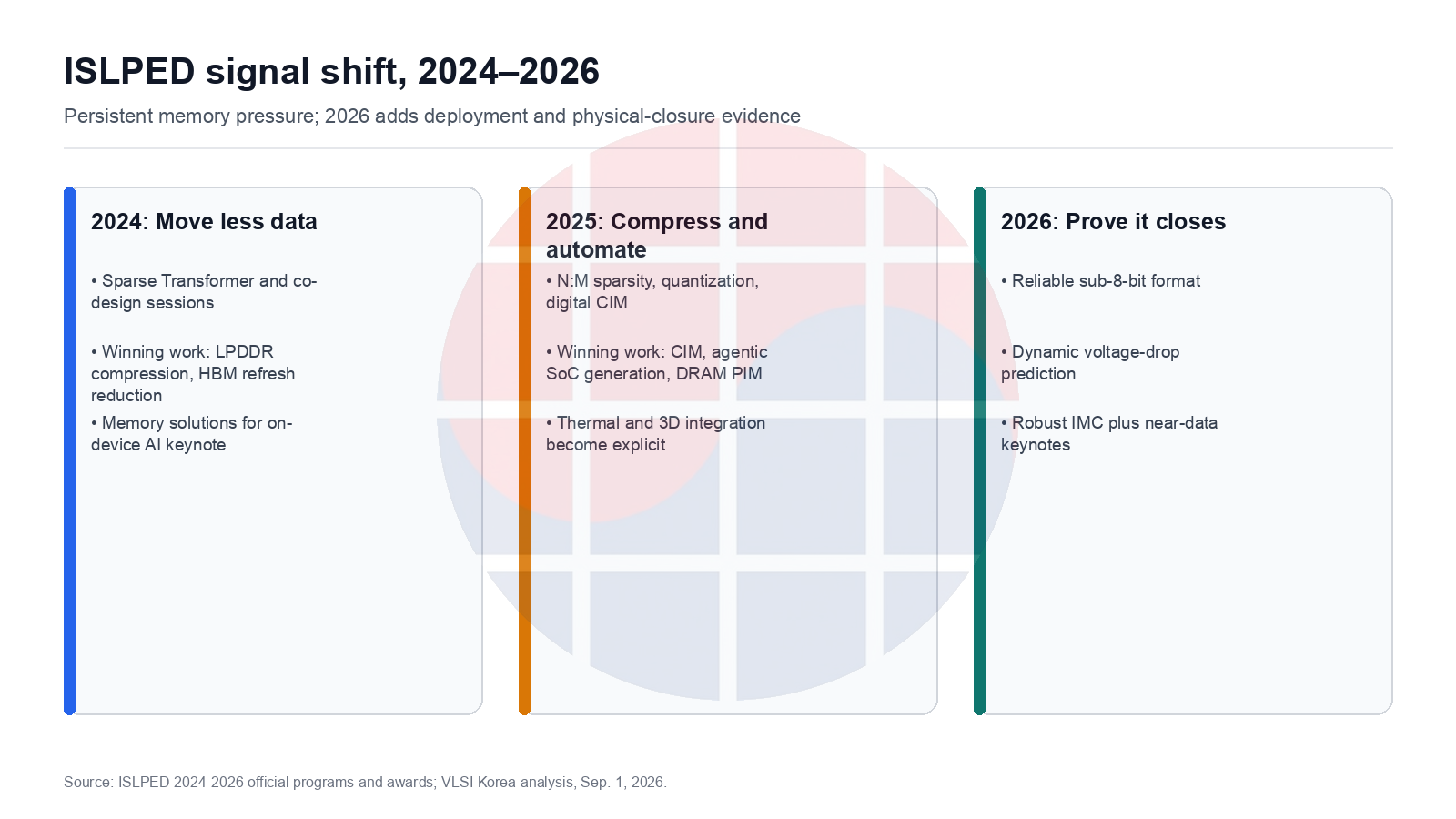
A simple "2025 was quantization, 2026 is memory hierarchy" narrative is only half right. The 2026 Track 1 Best Paper, L2Mersit, is a scaling-free sub-8-bit data format. One oral session is explicitly titled Data-Efficient and Precision-Optimized AI Accelerators. Precision work did not disappear.
Memory did not suddenly arrive in 2026 either. In the official 2024 awards, Track 1 winner LOCo addressed LPDDR compression and Track 2 winner Sparrow ECC reduced HBM refresh energy. A keynote covered memory solutions for on-device AI, while dedicated sessions covered next-generation memory and data movement.
The 2025 edition made model compression and automation unusually explicit: an N:M sparsity digital CIM accelerator, partial-sum quantization, ternary and binary inference, TruncQuant and mixed-precision RISC-V all appeared. The winners were an N:M sparsity CIM design, a multi-agent SoC generation method and a DRAM PIM accelerator for privacy-preserving machine learning.
What changes in 2026 is the validation boundary. The three award winners sit at format, signoff and in-memory functions, each asking whether local efficiency remains valid inside a real system. Session titles also move reliability, physical closure and sensing to the foreground: Robust and Efficient In-Memory Computing; ML-Driven Analysis and Optimization for Physical Design Signoff; and Efficient Sensing and Neuromorphic Accelerators.
The useful three-year reading is therefore: 2024 prioritized moving less data; 2025 combined sparsity, quantization, CIM and automation; 2026 increasingly asks whether those optimizations survive power integrity, range, noise, software and device integration. Memory movement and precision are both persistent. Deployment proof is the stronger new signal.
2. The three Best Papers: what they did and why each matters
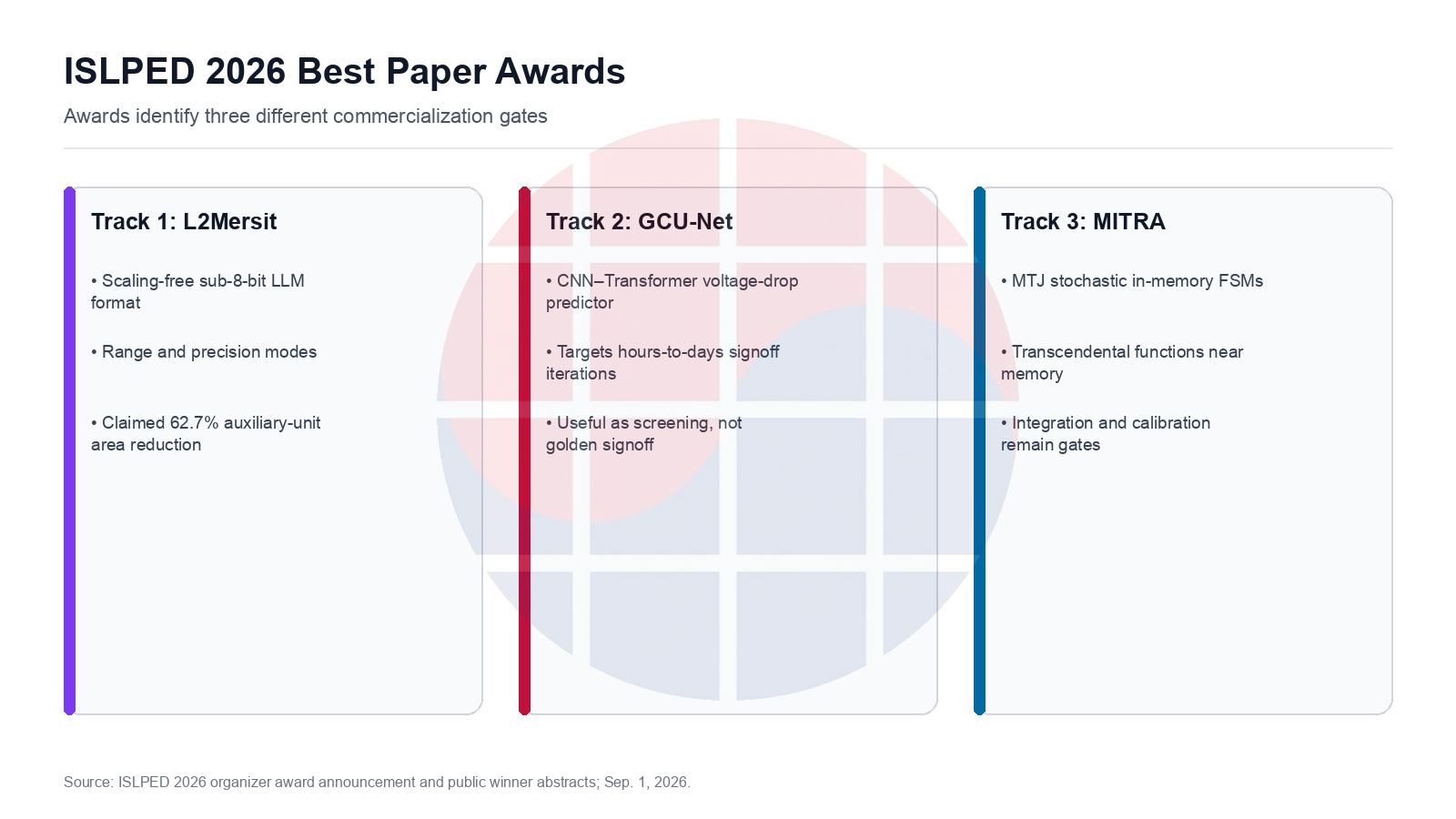
Track 1, L2Mersit: Myeongjin Kim, Hyeonseong Kim, Ik Joon Chang and Seungkyu Choi propose a scaling-free, range-adjustable exponent-encoded sub-8-bit format for on-device LLMs. The publicly indexed abstract describes range-expanded and precision-enhanced modes that adapt to activation distributions while avoiding on-the-fly scaling and related auxiliary operations.
The abstract reports the best accuracy among the tested 6-bit exponent formats and a 62.7% area reduction in the auxiliary hardware for low-precision computing. That is not a 62.7% reduction in total chip area. Format conversion, accumulators, memory interfaces, model-specific perplexity and end-to-end energy still determine the system benefit.
The industrial question is not simply how many bits can be removed. It is whether a format can tolerate changing activation distributions without creating scale-management cost elsewhere. For an edge NPU or on-device LLM platform, the format touches the compiler, kernel library, memory layout, model export path and accuracy qualification. Adoption depends on that full chain.
Track 2, GCU-Net: Freddy Gabbay and Mohammad Omri combine CNN and Transformer components for dynamic voltage-drop prediction. The public proceedings abstract describes 43 input channels covering static power, temporal activity, layout features and PDN metal density, evaluated on CircuitNet-N28. It reports 0.0386 mV MAE, 0.9073 SSIM, 0.8776 hotspot F1, 2.6 times faster inference and four times faster training than the compared Vision Transformer approach.
This does not mean a machine-learning predictor has replaced a golden signoff engine. It means public benchmark evidence supports faster screening and early iteration. Production adoption still needs proprietary-design domain shift, vector coverage, package and board interactions, PVT corners, aging, golden-solver correlation and a false-negative policy. The credible first buyer is an implementation team trying to reduce expensive runs, not a team deleting final signoff.
Track 3, MITRA: Farzad Razi, Mehran Moghadam, M. Hassan Najafi, Sercan Aygun and Marc Riedel combine compact finite-state machines and stochastic bit-stream processing in MTJ structures. The University of Minnesota award summary explains how the architecture targets transcendental functions such as sine, cosine, logarithm, exponential and sigmoid near memory.
MITRA matters because it extends PIM beyond matrix multiplication. It does not remove the hard questions: MTJ endurance and write energy, device variation, FinFET periphery, stochastic latency, CMOS integration and software mapping. An award validates the research contribution, not production readiness.
Together, the winners reject a shallow "accelerators won" conclusion. A number format, an EDA power-integrity predictor and an emerging-memory compute architecture won separate tracks. ISLPED's low-power problem is increasingly the joint closure of data representation, physical validity and compute placement.
3. Keynotes and industry participation: the public messages and the missing record
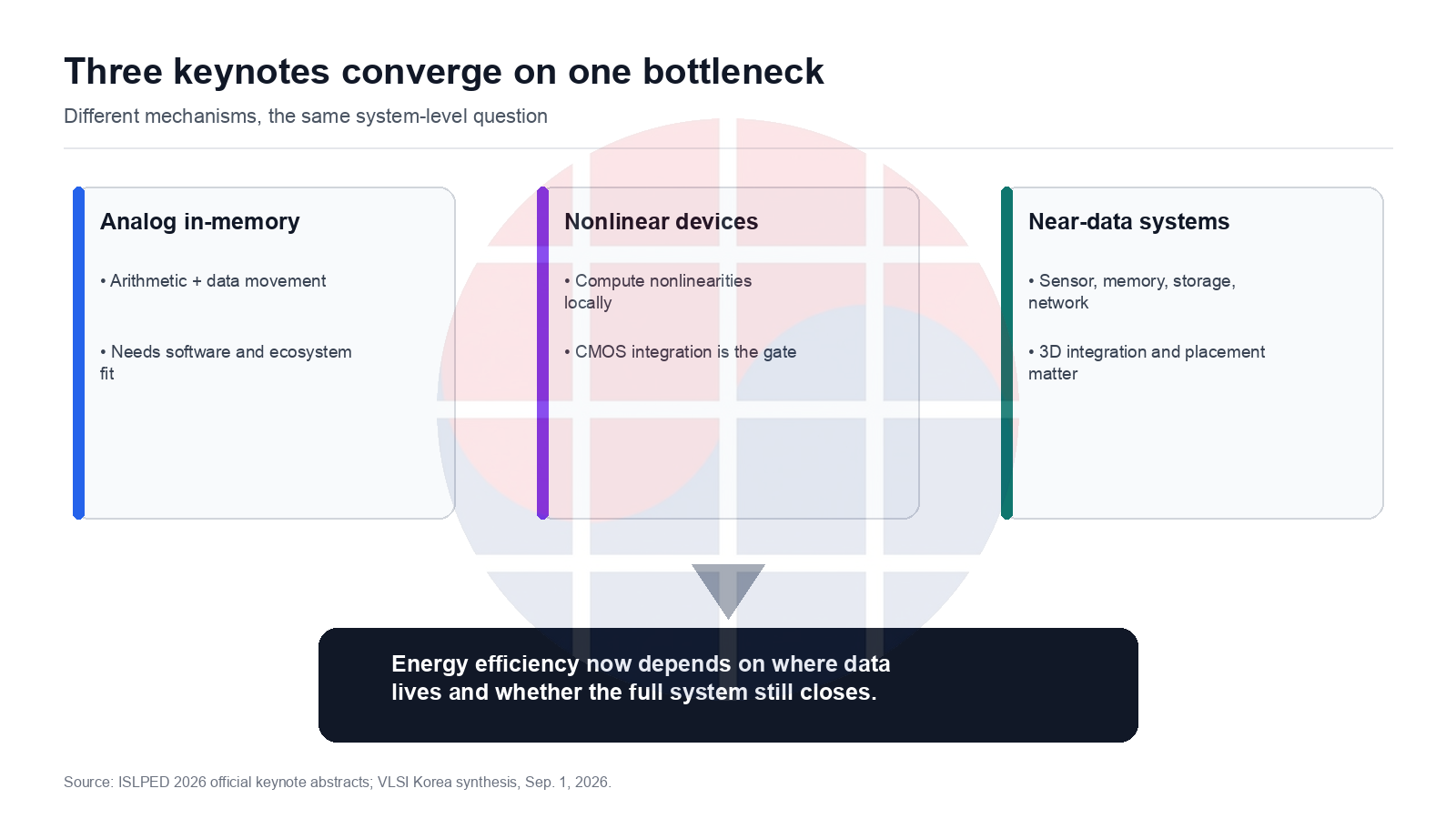
Naveen Verma, Princeton University and EnCharge AI: In-Memory Computing for Next-Generation AI argues that analog IMC can attack arithmetic efficiency and data movement together. The official keynote abstract is careful about the system boundary: device, circuit, architecture, algorithm and software must align, and adoption cannot break the larger ecosystem. The main message is scalable system architecture, not a standalone analog macro.
Wilfred G. van der Wiel, University of Twente and University of Münster: Reconfigurable Nonlinear Computing in Silicon moves nonlinear transformations into physical devices rather than accelerating only linear matrix operations. The abstract names speech recognition, physical Kolmogorov-Arnold Networks and the space-charge mechanism. A "CMOS-compatible route" is a research direction, not proof of foundry integration, yield or a qualified product.
Hoshik Kim, SK hynix: Near-Data Computing: The Energy Imperative argues that energy, not only performance, has become the limiting variable. The public abstract separates in-sensor, in-memory, in-storage and in-network processing, and points to near-memory processing and 3D architectures. The industrial message is broader than a memory cell: data placement, controllers, 3D integration and heterogeneous systems determine whether energy falls.
Industry also appears through AMD and Intel chair or panel roles, Hamid Shojaei of Cadence on the Accelerating Silicon Innovation with GenAI panel, and IBM and STMicroelectronics affiliations. But the official archive did not expose a panel recap, slide deck or recording during this review. It would be wrong to invent a Cadence workflow claim or an AMD roadmap from the program listing. The public evidence proves participation and roles only.
This distinction is the difference between conference reporting and brochure narration. A program tells readers who was scheduled to appear. It does not prove what was said, what result was measured or what product was disclosed. Industry claims require a public company page, slide, recording, documentation or equivalent technical record.
4. What to watch: four high-decision-value session clusters
Session 1A, ML-Driven Physical Design Signoff: GCU-Net shared the session with minimum implant area repair, thermal-warpage analysis and backside clock-signal co-optimization. The cluster matters because AI for EDA is moving from isolated placement optimization toward PDN, manufacturing rules, package warpage and backside delivery. A backend engineer should inspect the golden reference, unseen corners, false negatives and ECO handoff, not only average prediction accuracy.
Session 2B, Robust and Efficient In-Memory Computing: ReRAM fault remapping, hyperdimensional projection, analog-CIM noise mapping and MITRA appeared together. The important question is no longer whether CIM can execute an operation. It is whether faults, noise, dataflow and nonlinear functions fit an architecture contract. For a memory engineer, periphery, calibration, mapping and software visibility are more decision-relevant than a technology label.
Session 2A, Data-Efficient and Precision-Optimized AI Accelerators: L2Mersit, data truncation, a Gaussian Splatting accelerator and ADC-less analog tiling show that precision remains central in 2026. Their coexistence can also signal fragmentation rather than convergence. If compilers and deployment paths cannot establish common formats, local hardware efficiency returns as integration cost.
Sessions 3B and 5A, edge power orchestration and sensing: the public PowerFlow-DNN preprint formulates end-to-end power-state scheduling, while event-camera and in-sensor work tries to suppress data before arithmetic. An edge team should use joules per completed task, including sensor duty cycle, wake-up, rail transitions, memory traffic and radio, rather than kernel MAC energy.
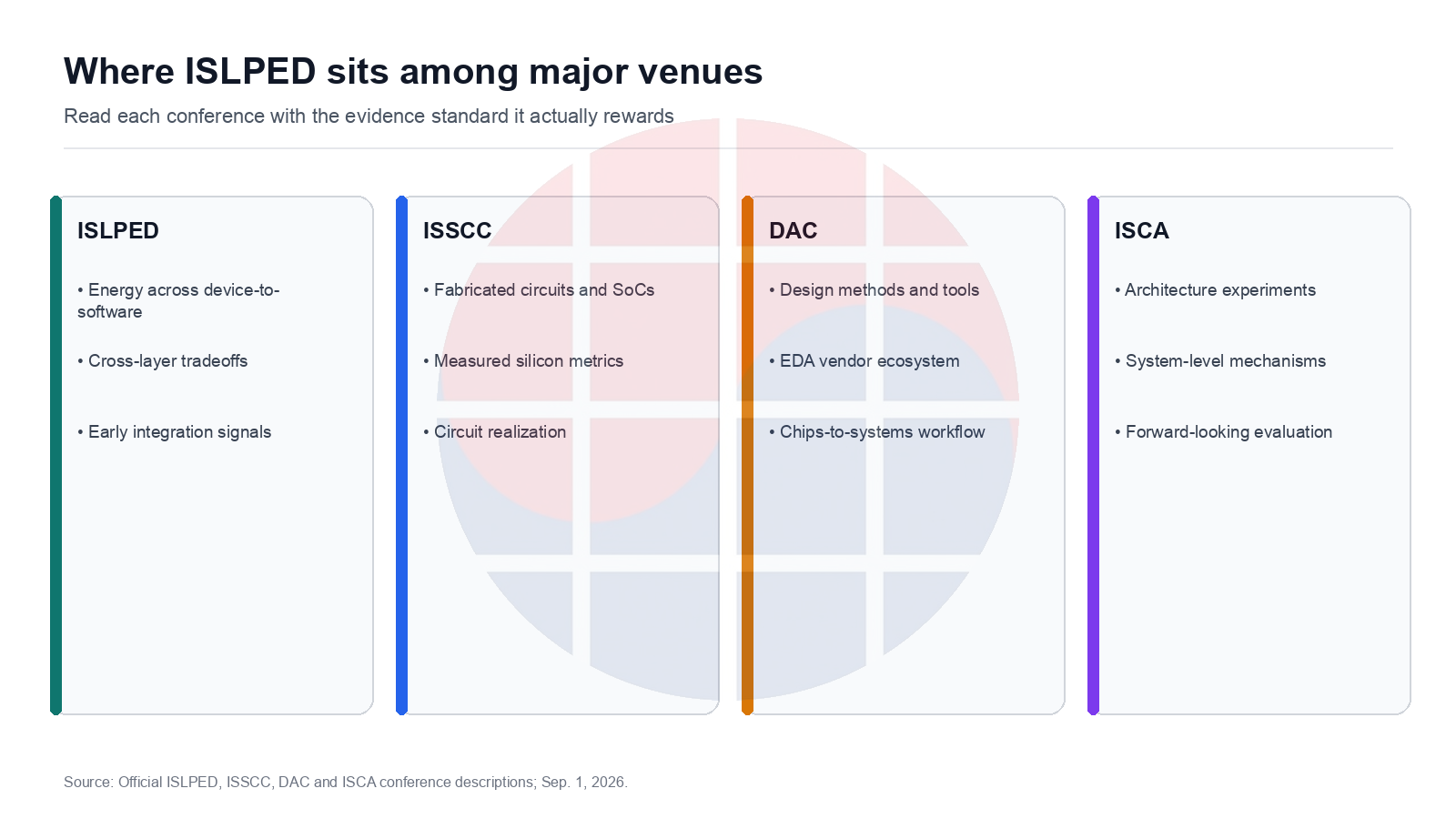
Venue positioning helps interpret the evidence. ISSCC emphasizes advances in fabricated circuits and SoCs and is closer to measured-silicon realization. DAC spans design methods, tools, vendors and chips-to-systems workflows. ISCA centers new architecture ideas and experimental results. ISLPED's distinctive value is to expose device, circuit, tool, architecture and software boundaries early through the common objective of energy.
5. Decisions for engineers, students and product teams
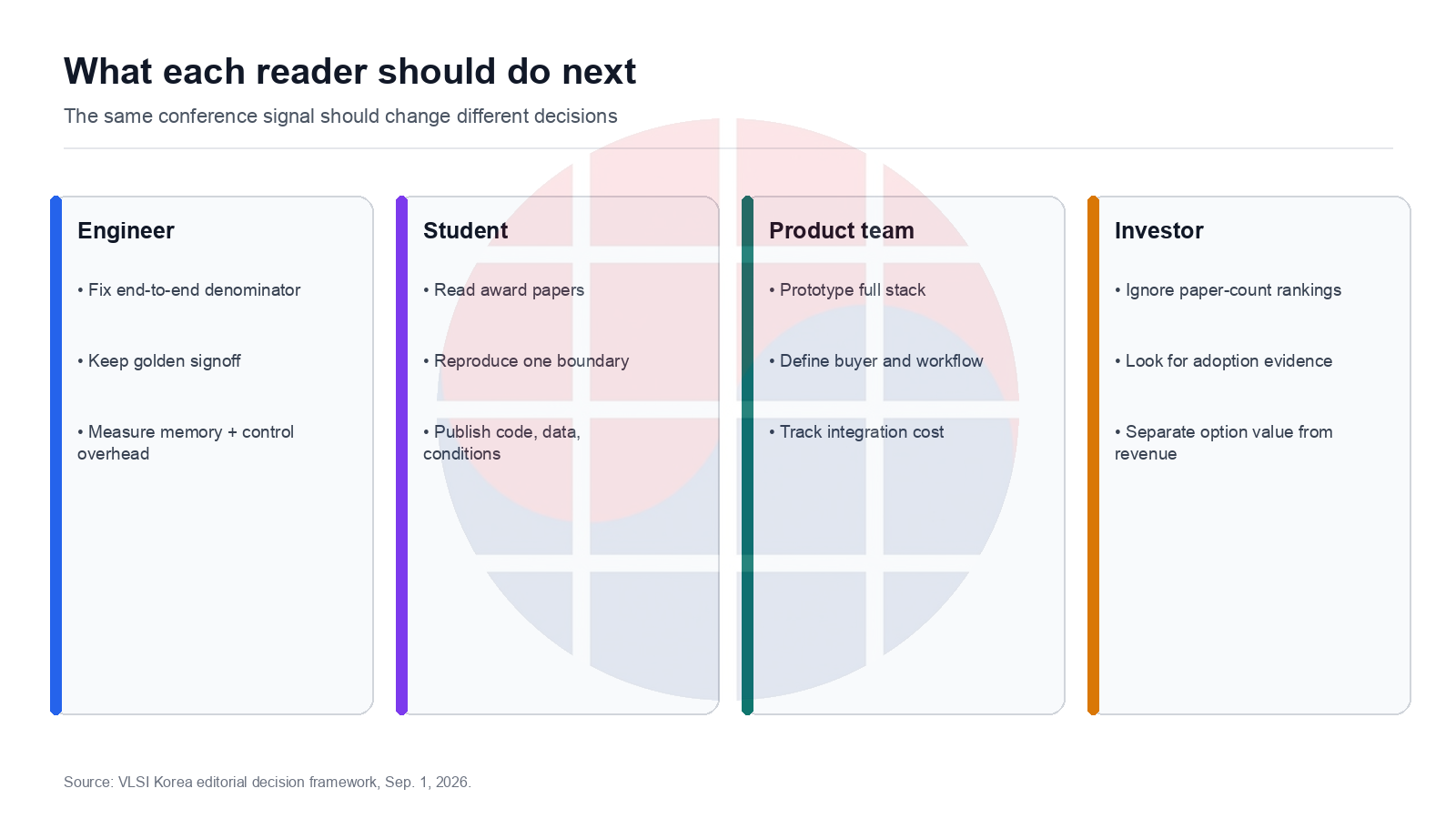
Engineer: first, freeze the denominator. Compare an accelerator with end-to-end model accuracy, memory, control, sensor and host overhead, not kernel TOPS/W alone. Second, position an ML signoff predictor as a recommendation or screening layer while retaining golden signoff and coverage policy. Third, budget ADC, calibration, remapping, endurance, thermal and software cost before accepting a CIM or PIM array-efficiency claim.
Student or researcher: deeply reproducing three award papers and one public manuscript is more useful than scanning 79 titles. For L2Mersit, test activation distributions and perplexity limits. For GCU-Net, test domain shift and hotspot false negatives. For MITRA, isolate device variation or peripheral overhead. A well-documented counterexample with code, data and conditions is more valuable to industry than a title-level trend map.
Product or technology-strategy team: replace "many papers exist" with "we can kill the integration risk quickly." A memory-centric compute prototype needs a named buyer, clear controller and compiler ownership, and a qualification owner. A signoff-AI product is defined by which commercial-flow runs it reduces and which liabilities remain, not only inference speed.
Korea lens: the Track 1 award went to researchers from Kyung Hee University and Yonsei University. POSTECH work covered implant-area repair, UNIST work covered backside clock co-optimization, and Korean teams appeared across CIM and edge accelerators. The next step is not a national paper-count ranking. It is public benchmarks, silicon, compilers and PDK-independent validation assets that connect Korea's memory and implementation strengths to repeatable integration.
6. Industry and investment implications: capabilities before company winners
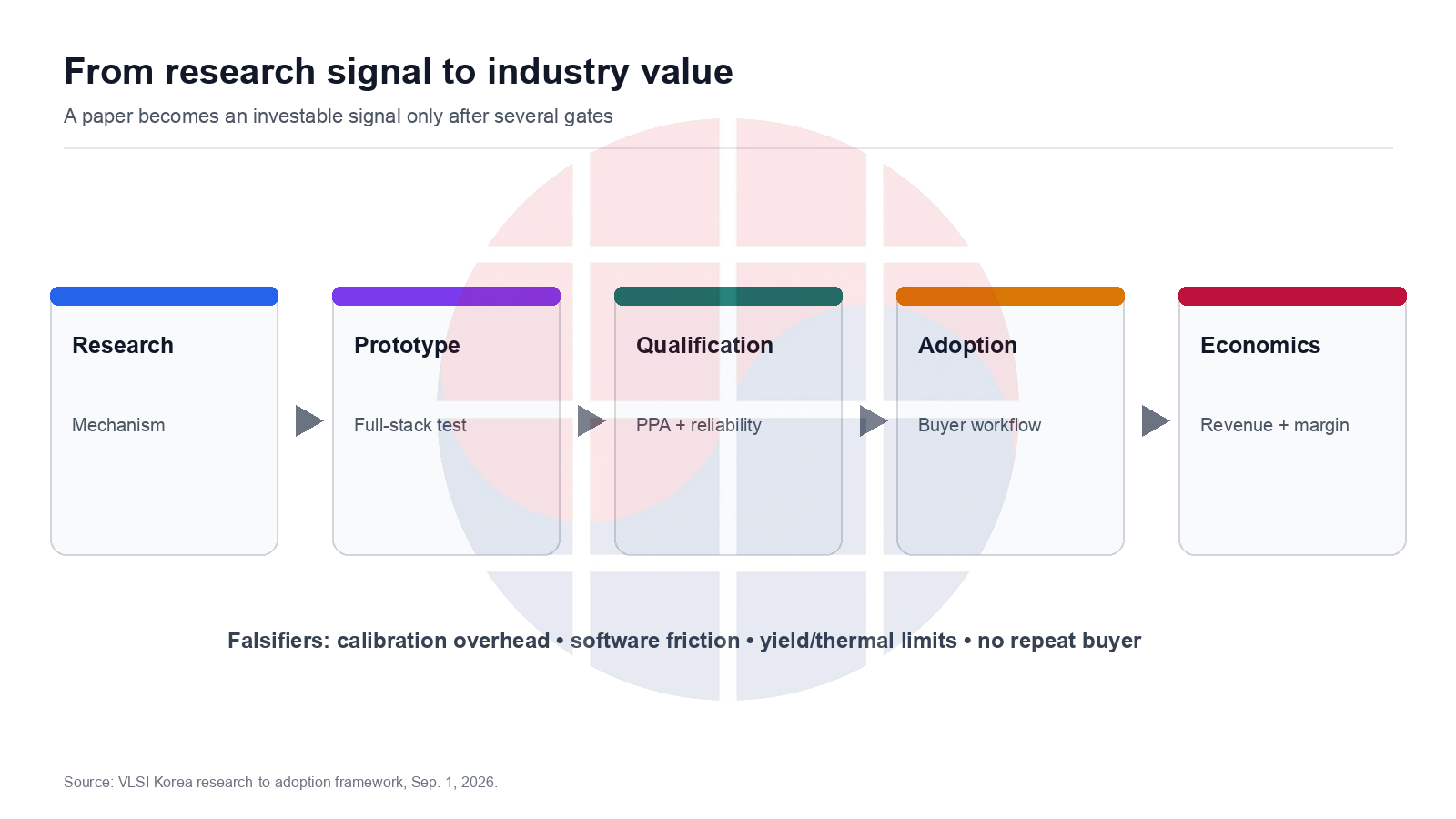
Potential winner one: the EDA layer with signoff data and workflow control. The GCU-Net award supports the value of ML surrogates that reduce physical-verification iteration cost. A platform with design databases, solver correlation, customer flows and a liability boundary has an adoption advantage over a model trained only on a public benchmark. The economic evidence to watch is tool integration, runtime reduction, false-negative policy and repeat usage or renewal, not paper volume.
Potential winner two: memory-system integration, not one memory cell. The three-year ISLPED sequence includes LPDDR compression, HBM refresh, DRAM PIM, ReRAM remapping, 3D DRAM PNM and MTJ compute. It does not crown one technology. It increases the option value of capabilities that combine controllers, compilers, data placement, packaging, thermal and test into a repeatable product.
Potential winner three: full-stack edge deployment. Low-bit formats, specialized accelerators and near-sensor processing can become stranded when models and workloads change. Teams that own, or can reliably partner across, hardware, compiler, runtime, model optimization and application benchmarks are better positioned. A single-kernel IP block is more exposed to integration cost and workload churn.
What an investor should defer: choosing a public-company revenue winner from ISLPED paper counts. A program can reveal two-to-five-year technical options, but it does not prove customer qualification, tapeout, yield, software adoption, contracts or shipments. Investment analysis should look for later hiring, patents, prototypes, partnerships, design wins, capex or product disclosures that connect research to an adoption buyer.
Thesis breakers: the deployment-proof thesis weakens if public papers and silicon data show that calibration, conversion and control erase arithmetic savings; if ML predictors miss hotspots on unseen designs; or if low-bit accuracy is narrowly model-specific. It strengthens when vendor-tool integration, repeat customers, measured end-to-end energy and public reproducibility appear.
7. Evidence ladder, method and next check
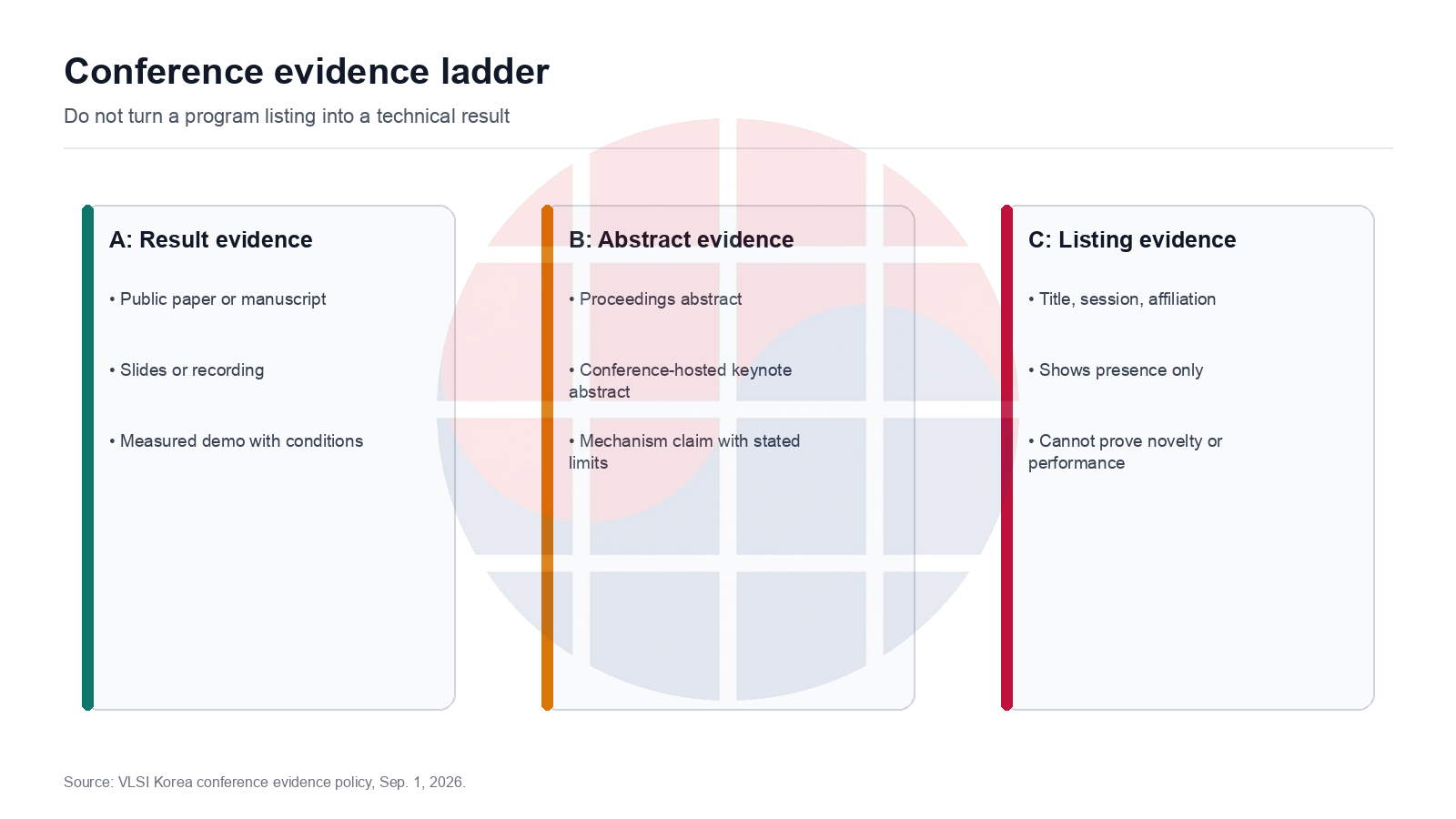
Evidence A: public paper, author manuscript, slide, recording or measured demo. Evidence B: proceedings abstract or conference-hosted keynote abstract. Evidence C: program title, affiliation or session listing. This review explains winner mechanisms only from A or B evidence. Cadence, AMD, Intel and other company participation remains within the C boundary where no public technical record was found.
The 2024-2026 comparison does not force paper counts into a false common denominator. Poster scope, special-session structure and abstract availability differ by edition. Instead it classifies signals from award winners, keynotes, dedicated oral sessions and public abstracts as persistent, new, fading or evidence-insufficient. Memory movement and precision are persistent; award-level attention to physical closure and robustness is the stronger 2026 signal.
The complete 2026 program remains preserved as a deterministic 79-entry ledger for completeness auditing. Counts such as 40 research papers or 28 title-keyword accelerator matches are not the reader conclusion. They are used only to detect omissions and support follow-up research. Download the full ISLPED 2026 public-entry ledger CSV.
Next evidence check: on September 30, 2026, review the official archive, author manuscripts, panel recap, public slides and recordings. Priority questions are model-by-model L2Mersit results, GCU-Net domain shift, and MITRA device and peripheral assumptions. Track the next edition and related events through VLSI Calendar's semiconductor conference and CFP schedule.
Sources: ISLPED 2026 final program; official keynote abstracts; ISLPED 2024 awards; ISLPED 2025 awards and program; MITRA institutional summary; GCU-Net abstract; L2Mersit abstract metadata.
Disclosure
This article is provided for informational purposes only and does not constitute a recommendation to buy or sell any security. Figures and factual statements are based on publicly available sources, including company filings, news reports, and market research, and may contain errors in the source material or in the preparation of this article. The author may own shares in companies mentioned. All investment decisions and their outcomes are the reader's responsibility.