VLSI Korea
Samsung Posts Record Q3 Profit as OpenAI Revenue Report Sinks Chip Stocks
A working semiconductor engineer's daily global silicon briefing — Samsung and TSMC earnings beats, the OpenAI-revenue chip selloff, GF silicon interposers, Hyper NA, plus a semiconductor stock roundup


🆓 Free article · Anyone can read this article for free
Daily Silicon for Friday, October 9, 2026. Samsung posted its best quarter since 2022 — and the stock fell. A Financial Times report on OpenAI's annualized revenue sent the entire AI value chain down in a single session. Record fundamentals, cold market reaction: a day that captured the semiconductor market's current temperature gap.
Executive Summary
- Samsung Q3 preliminary results: operating profit KRW 12.1T (+31.8% YoY), revenue KRW 86T — a quarterly record. Beat consensus (~KRW 10T) by a wide margin, but shares fell 2.4% in a classic sell-the-news move.
- TSMC Q3 revenue: NT$1.49T (~$46.7B), +50% YoY, an all-time high. Beat the LSEG consensus of NT$1.46T. September alone brought NT$511.86B (+54.6% YoY).
- OpenAI revenue report: the FT reported OpenAI's annualized revenue at ~$50B, short of the ~$70B figure circulating a month ago. SOX dropped 3.7%; the Nasdaq 100 entered correction territory. Analysts call it an accounting difference, not a demand signal.
- GlobalFoundries x TSMC: five-year deal to build silicon interposers at GF's Malta, New York fab — the first US-based source for advanced-packaging interposers.
- ASML and Zeiss "Hyper NA": a peer-reviewed paper says a successor to High NA EUV could be ready in about 10 years, printing features down to 5nm.
01. Samsung Q3 Preliminary — Record Quarter, Cold Reception
TL;DR: Operating profit KRW 12.1T (+31.8% YoY), revenue KRW 86T — both quarterly records. Beat consensus by nearly KRW 2T. Shares still fell 2.4%.
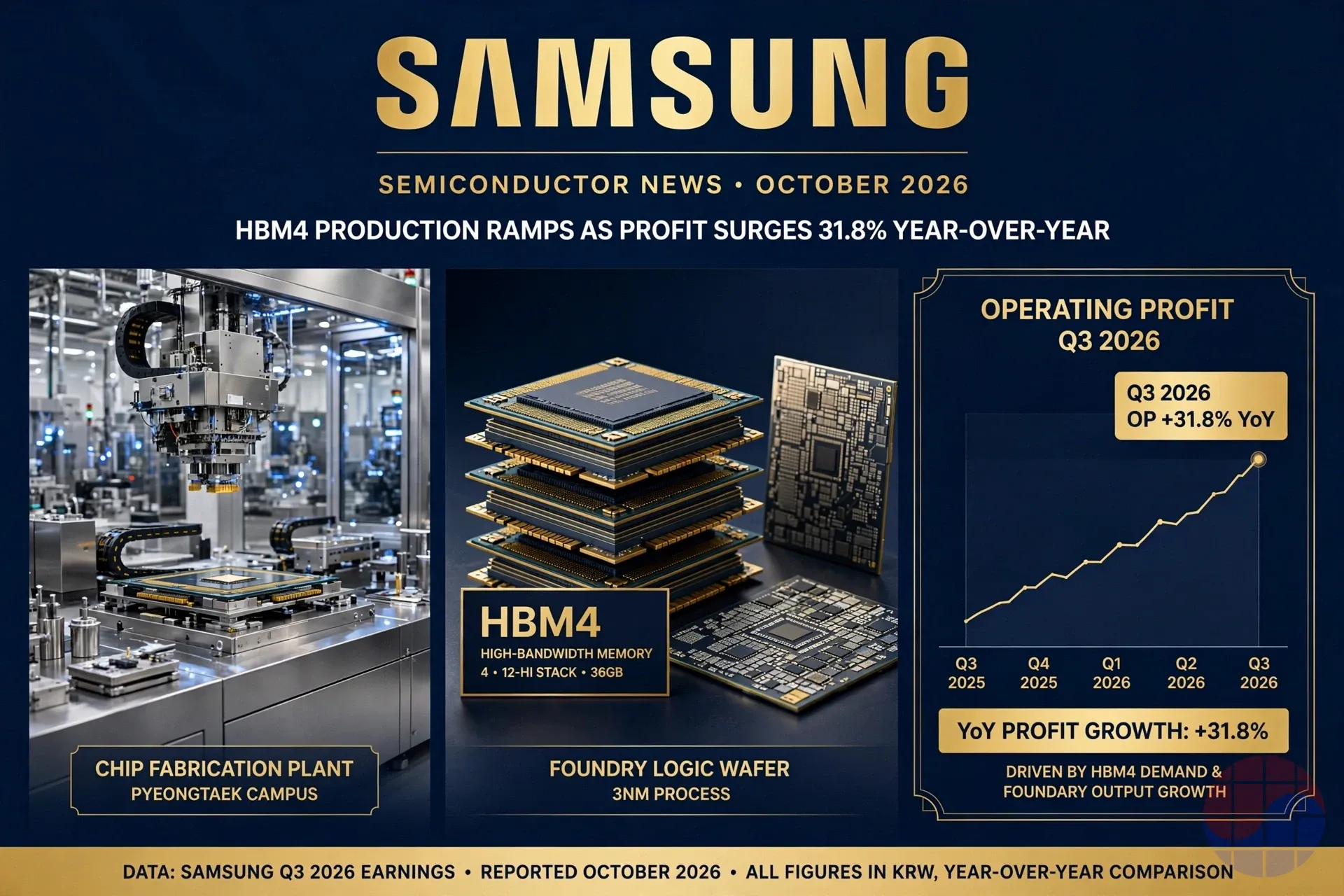
Samsung's Q3 preliminary results, announced October 8, were an unambiguous earnings surprise. Operating profit of KRW 12.1T crushed the analyst consensus of roughly KRW 10T, and revenue of KRW 86T set a quarterly record, powered by high-end memory for AI servers. The stock dropped 2.4% anyway. It happened before: in July, Samsung posted a record KRW 89.4T quarter and the stock fell nearly 7%. When expectations run ahead of the numbers, even a blowout becomes a sell-the-news event.
The more interesting detail is elsewhere. Reports the same day put Samsung's Q3 HBM4 revenue at more than triple the previous quarter, and analysts see a meaningful foundry turnaround beginning in earnest in Q3. Samsung's foundry is expanding collaboration with Nvidia, Tesla, Apple, Google, and Broadcom, with potential in-house AI chip work with Anthropic and physical-AI cooperation with AMD also in the spotlight. Whether Samsung can convert the memory supercycle into a foundry recovery is the stock's next catalyst.
Chase's Take: If the foundry red ink is genuinely starting to turn, this is a structural story beyond the memory cycle. It connects to the plan to build HBM4 base dies on Samsung's own 4nm foundry process — the trigger for repricing Samsung from "a memory company" to an AI full-stack play.
Source: Startup Fortune · NoCut News (incl. SK hynix Q3 consensus)
02. TSMC Q3 Revenue — Hard Data on AI Demand
TL;DR: Q3 revenue NT$1.49T (~$46.7B), +50% YoY, an all-time high. Beat the LSEG SmartEstimate consensus of NT$1.46T drawn from 19 analysts.
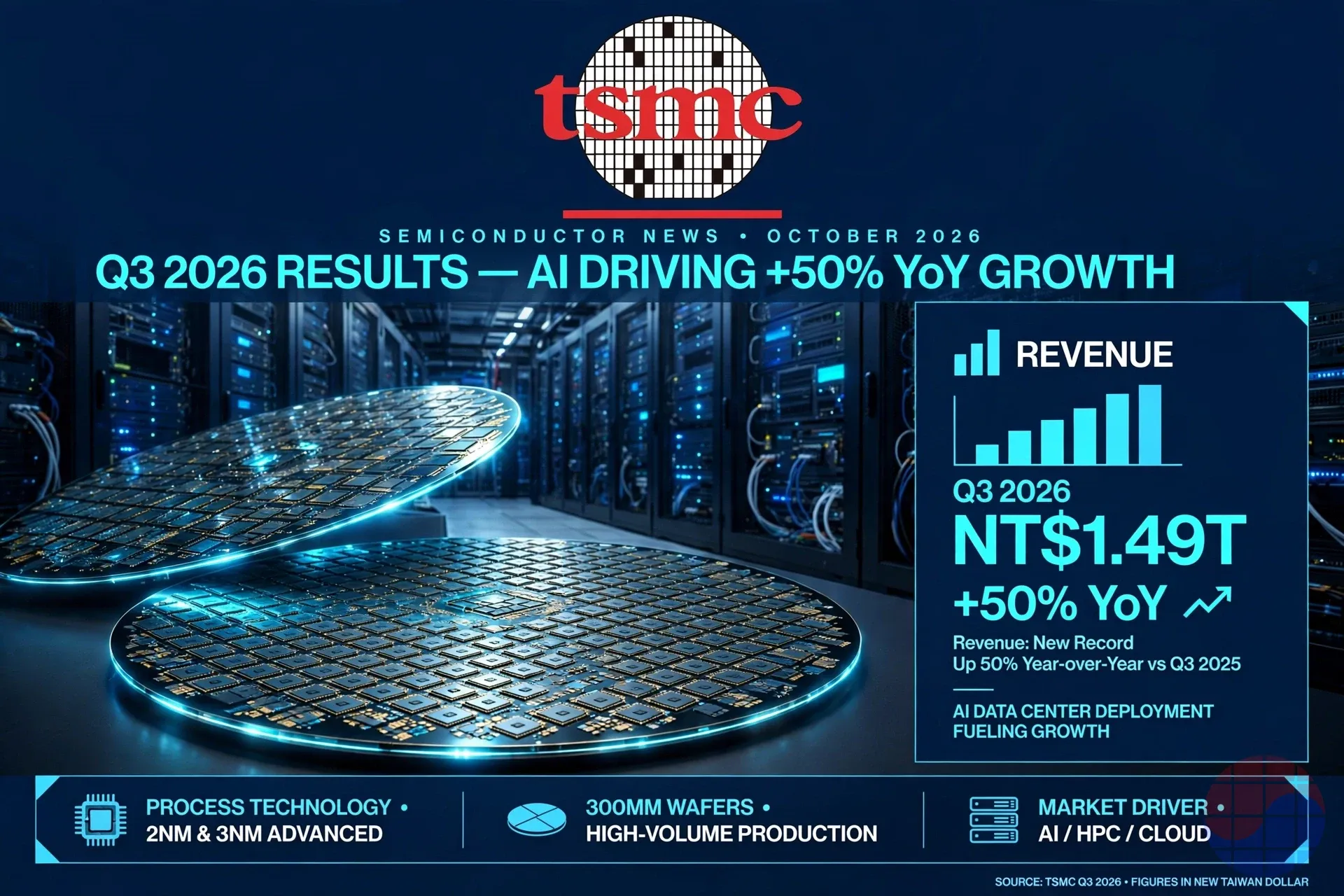
TSMC's Q3 revenue, reported October 8, hit NT$1.49T — roughly $46.7 billion. September alone delivered NT$511.86B, up 54.6% year over year, and the first nine months of 2026 totaled NT$3,898.73B, up 41.1% from the same stretch of 2025.
Why the number matters: TSMC's monthly filings are among the few hard data points showing whether AI infrastructure spending is actually converting into chip revenue. Not guidance, not a hyperscaler's capex plan — chips built, shipped, and billed. With the AI bubble debate raging, the quarter is a useful corrective: demand for the logic chips doing the computing is not fading. The next hard data points land October 14 (ASML earnings) and October 15 (TSMC's full Q3 earnings call).
Chase's Take: Memory is reportedly sold out through 2027, and logic isn't rolling over either. The AI demand-slowdown thesis is nowhere to be found in TSMC's books. Watch the 2027 capex guidance on the October 15 call.
Source: Reuters · Startup Fortune
03. The OpenAI Revenue Report — One Headline, Sector-Wide Selloff
TL;DR: The FT reported OpenAI told investors its annualized revenue was ~$50B at the end of September, below the ~$70B figure reported a month earlier. SOX sank 3.7%; the Nasdaq 100 entered correction.
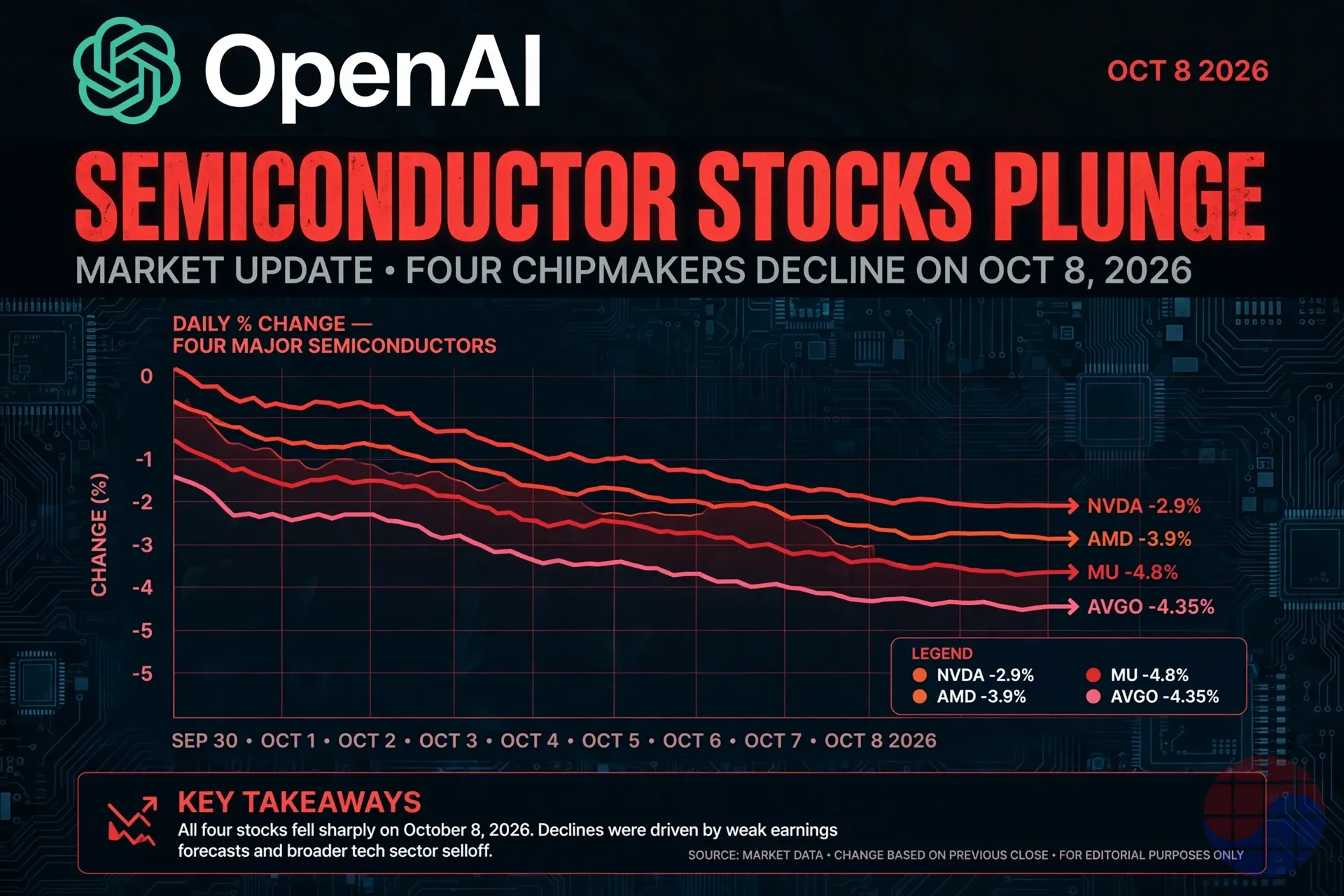
What moved the US market on October 8 wasn't earnings — it was a single Financial Times report. OpenAI's annualized revenue (a short-period figure multiplied to a full-year run rate) was reportedly reaching ~$50B toward the end of September, about $20B short of the ~$70B projection from a month earlier. As the AI boom's biggest chip customer and demand bellwether, the ChatGPT maker moves the whole chain: Nvidia -2.9%, AMD -3.9%, Broadcom -4.35%, Micron -4.8%, SanDisk -4.9%, Intel -5.3%, SK hynix ADRs -4.35%. The Philadelphia Semiconductor Index sank 3.7% on the day; the SOXX ETF's 3.4% slide was its worst since September 14. The Nasdaq 100 fell more than 10% from its record high — correction territory.
Analysts, though, say the reaction is overblown: OpenAI is simply accounting for revenue differently, and the report says nothing about AI demand itself. Overnight trading backed that up — Nvidia +0.5%, SOXX +0.03%. In a market stretched this far, even ambiguous news becomes a sell trigger — same dynamic as the Samsung case in story 01.
Chase's Take: A market that reads "$50B annualized revenue" as weakness is itself the anomaly. The problem isn't OpenAI's fundamentals — it's that AI value-chain multiples are stretched tight enough to move 3–5% on a headline. That's a positioning problem, not evidence of demand collapse.
Source: Morningstar · Stocktwits · WSJ
04. GlobalFoundries to Build Silicon Interposers for TSMC — Five-Year Deal
TL;DR: GlobalFoundries will manufacture silicon interposers for TSMC at its Malta, New York fab — the first US-based source of interposers for advanced packaging. Volume ramp targeted for H1 2028.
GlobalFoundries announced October 8 that it will make silicon interposers — the component sitting beneath processors and memory chips inside advanced AI packages, letting them communicate at high speed — for TSMC at its Malta, New York facility. Under the five-year agreement, GF will expand capacity at Malta, which becomes the first US-based source of silicon interposers used in advanced chip-packaging technologies. Volume production is expected to begin ramping in the first half of 2028. GF shares rose about 4% in premarket trading on the news.
Chase's Take: The market is finally pricing in that advanced packaging is the real bottleneck in AI chip production. The next front of the CoWoS capacity war is the interposer. A US-based source adds a geopolitical premium — time to look at GF again through the onshoring lens.
Source: Reuters
05. ASML and Zeiss "Hyper NA" — A Blueprint for Post-EUV Lithography
TL;DR: Engineers at ASML and Zeiss say in a peer-reviewed paper that "Hyper NA," a successor to High NA EUV, could be ready in about 10 years — printing features as small as 5nm.
Reuters reported October 8 on a paper in the October issue of the Journal of Micro/Nanopatterning, Materials and Metrology. ASML and optics partner Carl Zeiss describe "Hyper NA," a next-generation tool that would print circuitry more than a third smaller than today's High NA EUV machines — features as small as 5nm — while reusing much of the existing technology. Zeiss can already make mirrors precise enough, and ASML's current light source "can be reused as is." ASML has begun developing the machine but has not committed to producing it.
For context: Intel has begun using High NA in production; Samsung and SK hynix plan to follow in 2028, TSMC in 2030. Hyper NA is the generation after that — a mid-2030s roadmap.
Chase's Take: That a paper on a 10-years-out tool passes peer review says a lot about how mature the EUV ecosystem has become. Debating the next generation before High NA has finished ramping means lithography is still the limiting factor in scaling — and that ASML's moat extends into the 2030s.
Source: Reuters via Q1019
06. Samsung Expands Pay to Keep Chip Talent — Foundry Lags
TL;DR: Samsung is expanding compensation to retain chip talent, with foundry engineers under the most pressure to leave.
MoneyToday reports Samsung Electronics is boosting pay to stop chip talent from walking out — expanded stock-based compensation, a 10-year DS performance-bonus framework, and billions of dollars' worth of shares committed to employee programs. One employee reportedly turned down a package including self-development leave, doctoral-study support, a KRW 30M retention incentive, and an additional KRW 100M non-compete payment before leaving for a competitor.
The pressure centers on foundry. Memory and foundry increasingly overlap in AI chips: HBM4 uses a logic base die built on advanced foundry processes. Samsung plans to make its own HBM4 base dies on its 4nm foundry process, while SK hynix partnered with TSMC. Foundry engineers are now critical not just to the contract-chip business but to HBM competitiveness itself. Samsung's DS union is preparing to revisit how loss-making units are treated in the bonus formula in the next bargaining round.
Chase's Take: The fact that HBM4's base die is a logic process changed the talent market. Foundry engineers' market value now moves with the memory cycle. If Samsung wants a real foundry turnaround, keeping people comes before adding equipment.
Source: MoneyToday via Samsung Gadget Hacks
07. US Chip Tariffs Squeeze Korea for More Investment
TL;DR: Commerce Secretary Howard Lutnick claims Taiwan agreed to move up to 40% of its semiconductor capacity to the US — and Washington is using that deal to pressure Korea to invest more.
Per the Korea JoongAng Daily, Lutnick said Taiwan agreed to shift as much as 40% of semiconductor production capacity to the United States. While plants are under construction, companies can export tariff-free volumes of up to 2.5x their new production capacity, falling to 1.5x after completion. Samsung and SK hynix are already building facilities worth billions to tens of billions of dollars in Texas and Indiana.
But memory and logic have different structures. For TSMC's non-memory chips, fabs near big US customers make sense. For DRAM and NAND — Samsung and SK hynix's mainstay — economies of scale from large manufacturing clusters are the core of cost competitiveness. Moving the whole memory ecosystem to the US means enormous infrastructure costs and higher labor expenses, ultimately raising server and data-center build costs for US companies themselves.
Chase's Take: Tariffs are a negotiating card; they don't change the economics of a memory fab. Reproducing the Korean memory cluster's efficiency in the US is a decade-long project. Near term, expect "investment announcements" traded for tariff exemptions — big numbers, slow actual moves.
Source: Korea JoongAng Daily
08. AMD's Lisa Su in Seoul — "Semiconductors Are a Team Sport"
TL;DR: AMD CEO Lisa Su visited Seoul on October 7, calling Samsung and SK hynix "key AI partners." She voiced satisfaction with HBM4 performance; a Samsung foundry partnership is on the table.
Speaking at the AMD Gamer Day press briefing in Yongsan, Su said: "AMD has no choice but to rely on the South Korean supply chain. Samsung Electronics and SK hynix are critical partners in achieving AMD's AI data center strategy." During the trip she met SK hynix CEO Kwak Noh-jung and Samsung DS Division head Jun Young-hyun before flying back to the US the same evening.
Su said long-term partnerships have secured AMD stable memory supply despite the tightening market, and expressed satisfaction with HBM4 performance — fitting for the company that pioneered HBM. A Samsung foundry partnership is also in play, and AMD plans an AI Center of Excellence in Korea, hiring hundreds of researchers under an MOU with the science ministry.
Chase's Take: AMD's message is clear — the AI accelerator war against Nvidia will be decided in the HBM supply battle. Floating the Samsung foundry card is a hedge against TSMC dependence. For Korea, the buyer count just went from one (Nvidia) to two — that's negotiating leverage.
Source: Herald Business · Asianet Newsable
09. Samsung and SK Hynix Veterans at CXMT — 26 of 27 Already Gone
TL;DR: 27 senior engineers from Samsung and SK hynix worked at CXMT, China's biggest DRAM maker. Public profiles show only one remains.
An analysis by lawmaker Choi Soo-jin's office (People Power Party, National Assembly science and ICT committee) of LinkedIn and other public career records, released for this week's parliamentary audit, found at least 27 Samsung and SK hynix veterans went on to work at CXMT. Together they spent 415.9 years at the two companies — 15.4 years on average, including six principal/executive-level staff with 20+ years in mass production. Eight were in circuit design, seven in process integration — "enough to run a whole chip factory," as Dong-A Ilbo put it. Engineers with HBM design experience moved too.
The routes were deliberate: 15 of the 27 detoured through equipment/materials suppliers, foreign firms, or universities first — likely to work around one-to-two-year non-compete agreements. Headhunter offers ran 60–100% pay increases with three-to-five-year guaranteed employment, housing, and school support. Of the 27, only one is still at CXMT.
Chase's Take: That 26 left is CXMT's retention problem — but from a technology-leakage view, what happened already happened. The HBM-experienced moves hurt most: China's next target isn't conventional DRAM, it's HBM. A case study in the gap between "national core technology" designation and actual talent defense.
Source: AIStockWire (Rep. Choi Soo-jin audit materials)
10. Applied Materials x Intel — Expanded Next-Gen Collaboration
TL;DR: Applied Materials and Intel expanded collaboration on next-generation transistors, interconnects, and advanced packaging for AI chips, linking AMAT's $5B EPIC Center with Intel's Oregon R&D campus.
This week's equipment news: Applied Materials and Intel will deepen work on next-gen transistors, interconnects, and advanced packaging. AMAT's $5 billion EPIC Center in California connects with Intel's Oregon R&D campus. UCLA Engineering is also joining the EPIC Center to accelerate commercialization of semiconductor research.
AMAT's latest quarter showed revenue of $9.12B (+24.8% YoY) and EPS of $3.50, both beats, with Q4 2026 EPS guidance of $3.82–$4.22. Consensus price target sits around $640.20. Counterweights: valuation after a 143.9% one-year run, and insider selling (CAO Adam Sanders sold 725 shares to cover tax withholding on vested equity).
Chase's Take: "Co-R&D" between equipment makers and IDMs is the new normal. In a transistor-architecture transition (GAA to CFET), the equipment vendor's process recipe is the moat — Intel pairing with AMAT is the natural move. The next WFE cycle comes from advanced-packaging capacity expansion anyway.
Source: MarketBeat
Semiconductor Stock Roundup (US regular session close, Oct 8)
One line for the day: fundamentals were record-setting; prices were ice cold. Samsung and TSMC both surprised to the upside, yet a single OpenAI headline shaved 3–5% off the entire AI value chain.
| Name | Oct 8 change | Note |
|---|---|---|
| SOX (Philadelphia Semiconductor Index) | -3.7% | Worst day since Sept 14 |
| SOXX (iShares Semiconductor ETF) | -3.4% | Worst slide since Sept 14; +0.03% overnight |
| Intel (INTC) | -5.3% | Steepest drop despite AI server-CPU tailwind |
| SanDisk (SNDK) | -4.9% | Memory-rally pullback |
| Micron (MU) | -4.8% | Pullback despite sold-out HBM story |
| Broadcom (AVGO) | -4.35% | OpenAI custom-chip design partner |
| SK hynix ADR | -4.35% | Fell alongside despite Samsung's beat |
| AMD | -3.9% | Down on the day of Lisa Su's Seoul visit |
| TSMC ADR (TSM) | -3.0% | Down despite +54.6% September sales |
| NVIDIA | -2.9% | +0.5% in overnight trading |
| Samsung Electronics (005930) | -2.4% | Sell-the-news on a record quarter |
| ASML | -1.6% (Oct 7) | Closed $1,804.96; earnings Oct 14 |
| Nasdaq 100 | >10% off high | In correction territory |
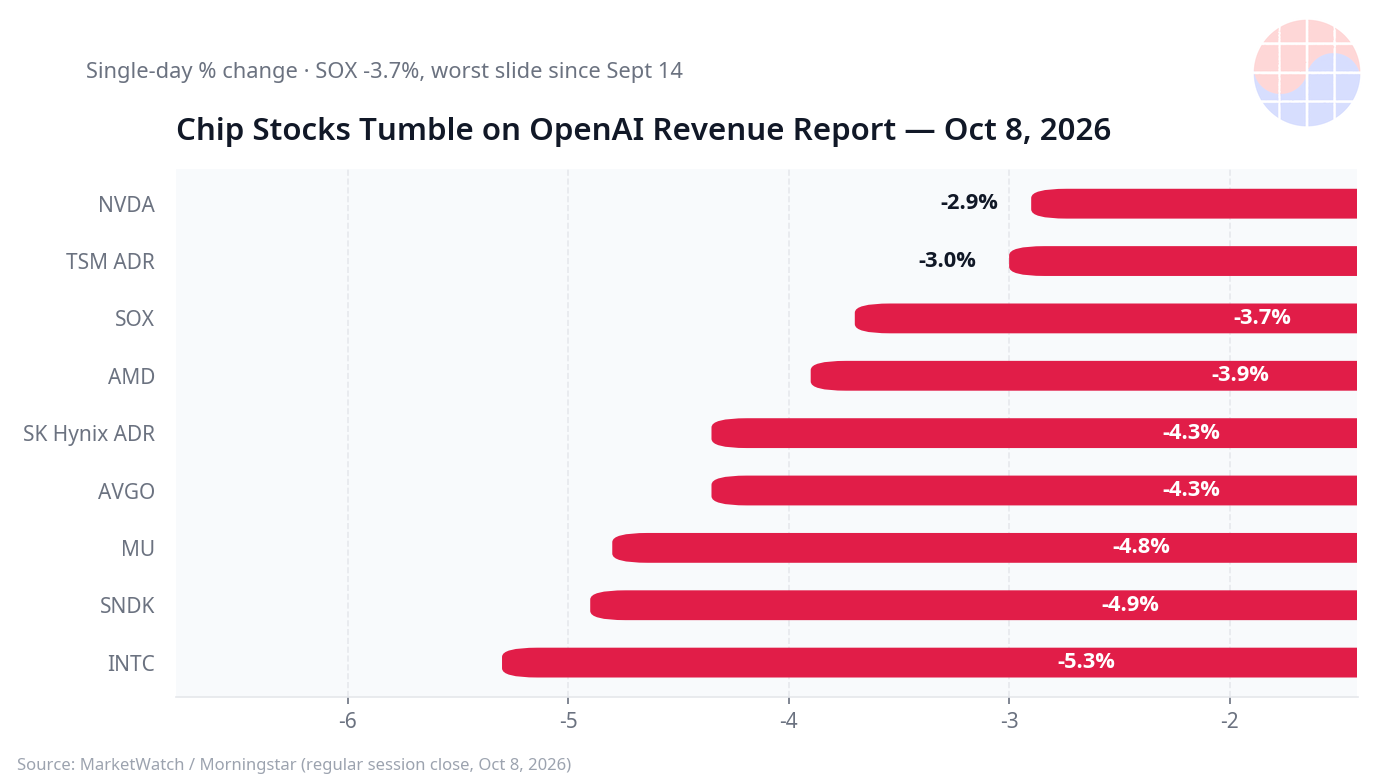
Price data: MarketWatch, Morningstar, WSJ, NDTV Profit (US regular-session closes, Oct 8, 2026)
FAQ
Why does Samsung's Q3 matter?
Operating profit of KRW 12.1T is Samsung's best quarter since 2022 and beat consensus (~KRW 10T) by nearly KRW 2T. High-end memory for AI servers drove the result, and HBM4 revenue more than tripled quarter over quarter — a sign the memory supercycle is intact. A potential foundry turnaround adds a structural angle.
Why did the OpenAI revenue report hit chip stocks?
OpenAI is the AI value chain's biggest chip customer and demand bellwether. The FT reported annualized revenue of ~$50B at end-September, below the ~$70B figure from a month earlier, raising questions about AI investment payback. SOX fell 3.7%. Analysts, however, call it an accounting-method difference and an overreaction.
What is a silicon interposer?
A silicon substrate beneath AI processors and memory chips (like HBM) that lets them communicate at high speed — a key component of advanced packaging. GlobalFoundries will build them for TSMC at its Malta, New York fab.
When is Hyper NA coming?
Per the ASML–Zeiss peer-reviewed paper, in about 10 years — the mid-2030s. It would print features as small as 5nm as the successor to High NA EUV, but ASML has not committed to producing it yet.
* Figures and schedules follow each cited source as of publication; earnings and prices are preliminary/closing values at the time of reporting. See the Sources links for originals.
Frequently Asked Questions
What were Samsung's Q3 2026 preliminary results?
Samsung's Q3 preliminary results, announced October 8, showed operating profit of KRW 12.1T, up 31.8% year over year, and revenue of KRW 86T, both quarterly records. The result beat consensus of roughly KRW 10T by nearly KRW 2T, yet shares still fell 2.4%.
What was TSMC's Q3 2026 revenue?
TSMC's Q3 revenue, reported October 8, was NT$1.49T, roughly $46.7 billion, up 50% year over year and an all-time high. September alone delivered NT$511.86B, up 54.6%, and the first nine months totaled NT$3,898.73B, up 41.1%.
What will GlobalFoundries manufacture for TSMC in New York?
GlobalFoundries will manufacture silicon interposers for TSMC at its Malta, New York fab, the first US-based source of interposers for advanced packaging. Volume ramp is targeted for the first half of 2028.
What is Hyper NA EUV and when could it be ready?
Engineers at ASML and Zeiss say in a peer-reviewed paper that Hyper NA, a successor to High NA EUV, could be ready in about 10 years, printing features as small as 5nm. It is a research outlook, not a product schedule.
What did AMD's CEO say during her Seoul visit?
AMD CEO Lisa Su visited Seoul on October 7, calling Samsung and SK hynix key AI partners and voicing satisfaction with HBM4 performance. A Samsung foundry partnership was described as on the table.
Related reading
- TSMC Eyes Sixth Straight Record Profit; Intel, Qualcomm Hike CPU Prices…
- Lam Research Posts Record $8.22B Revenue, Texas Instruments Beats Too —…
- CXMT Q3 Revenue Up 7x, SOX Down 11% in a Week, TSMC Record Profit — 9…
- Black Thursday: KOSPI circuit breaker, TSMC record profit, AI capex…
- OpenAI's ~$50B Revenue Miss Rattles Chip Stocks; Nvidia Eyes Reflection…