VLSI Korea
CXMT Q3 Revenue Up 7x, SOX Down 11% in a Week, TSMC Record Profit — 9 Reads for October 18
Finance Minister Lee: chip boom "at least through 2027"; CXMT Q3 revenue up 7x, world No. 4 in DRAM; SOX down 8 straight sessions; CoreWeave AI-debt debate; KOSPI rebounds; September chip exports a record $60.3B; TSMC record Q3; China's 15W EUV limits. 9 reads for Oct 18.


Saturday's (October 17) semiconductor news boils down to one word: divergence. Korea's finance minister said in Bangkok that the chip boom will run "at least through 2027," but the same week the Philadelphia Semiconductor Index fell for eight straight sessions — its longest streak since 2008. Korea's September chip exports topped $60 billion for the first time ever, while Samsung Electronics and SK hynix lost a combined 678 trillion won in market cap in the same month. China's CXMT saw third-quarter revenue jump 7x to become the world's No. 4 DRAM maker, and China unveiled a 15W-class EUV light-source prototype. It was a week when the real economy and the market, boom forecasts and falling stocks, moved in opposite directions. Here are 9 reads worth your time.
9 reads worth your time
1. Finance Minister Lee: "Semiconductor boom, at least through 2027" — CNBC, IMF Bangkok meetings
CNBC via Scoop, 2026-10-17 · Binance Square, 2026-10-17
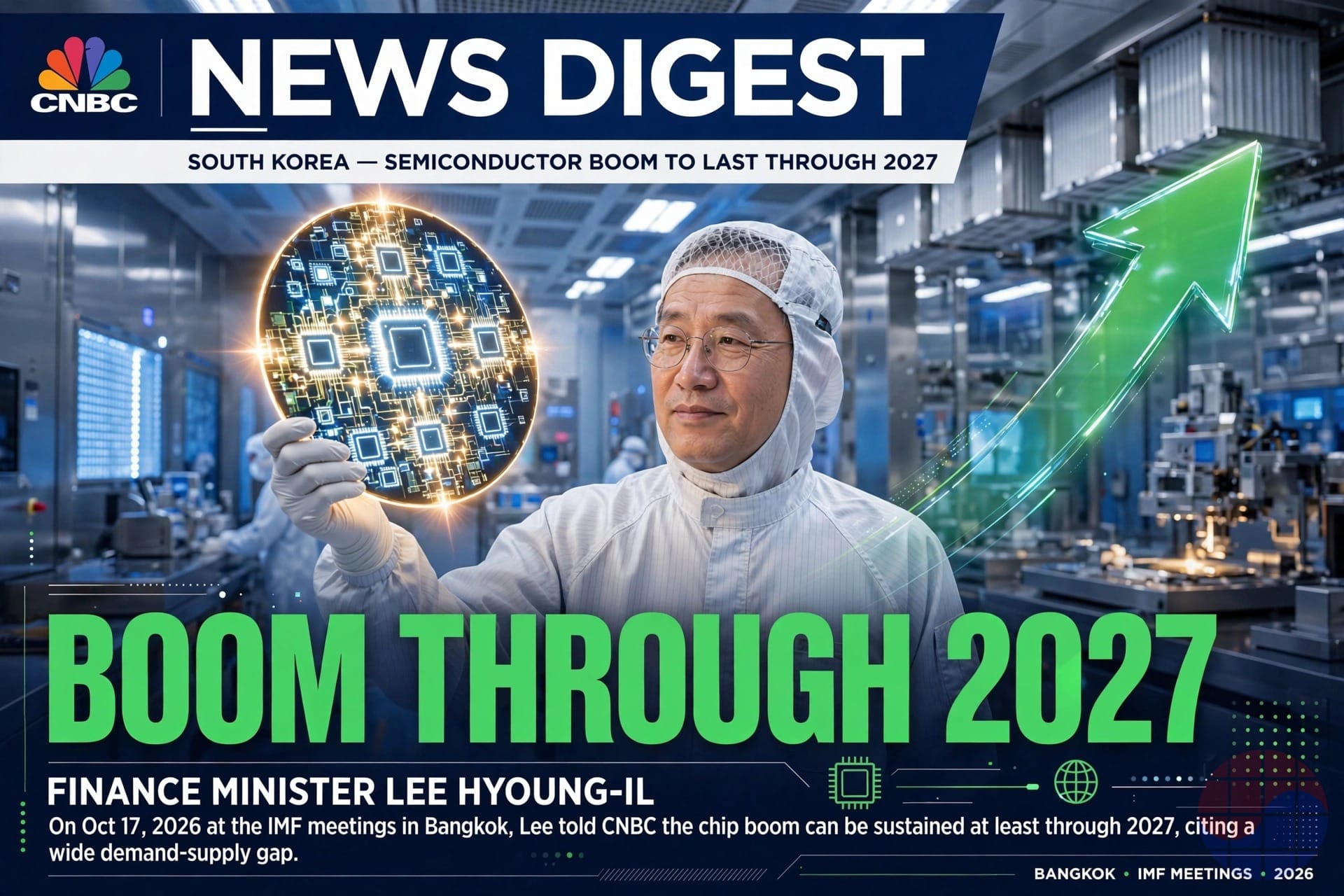
- Finance Minister Lee Hyoung-il told CNBC on October 17, on the sidelines of the IMF–World Bank annual meetings in Bangkok, Thailand: "As of now, I believe we can sustain this growth through next year (2027)."
- His reasoning is the demand–supply gap. "The gap between semiconductor demand and supply remains very wide, and supply is still expanding," he said.
- He also acknowledged that chip stocks have driven much of Korea's market volatility this year. The KOSPI, led by Samsung and SK hynix, fell 7.57% on October 15, triggering a trading halt.
- He also mentioned the tax windfall. Tax revenue is expected to beat initial forecasts this year, with the chip boom strengthening Korea's fiscal position.
Chase's take: Finance ministers are usually cautious in public forecasts, so the phrase "at least through 2027" is worth noting. But read the other side of the statement too. "Supply is expanding" also means memory capacity additions could pressure prices. A sustained boom and late-cycle entry are two sides of the same sentence.
2. China's CXMT Q3 revenue up 7x… rises to world No. 4 in DRAM, chasing "Samsungnix" hard
Korea Economic Daily, 2026-10-17
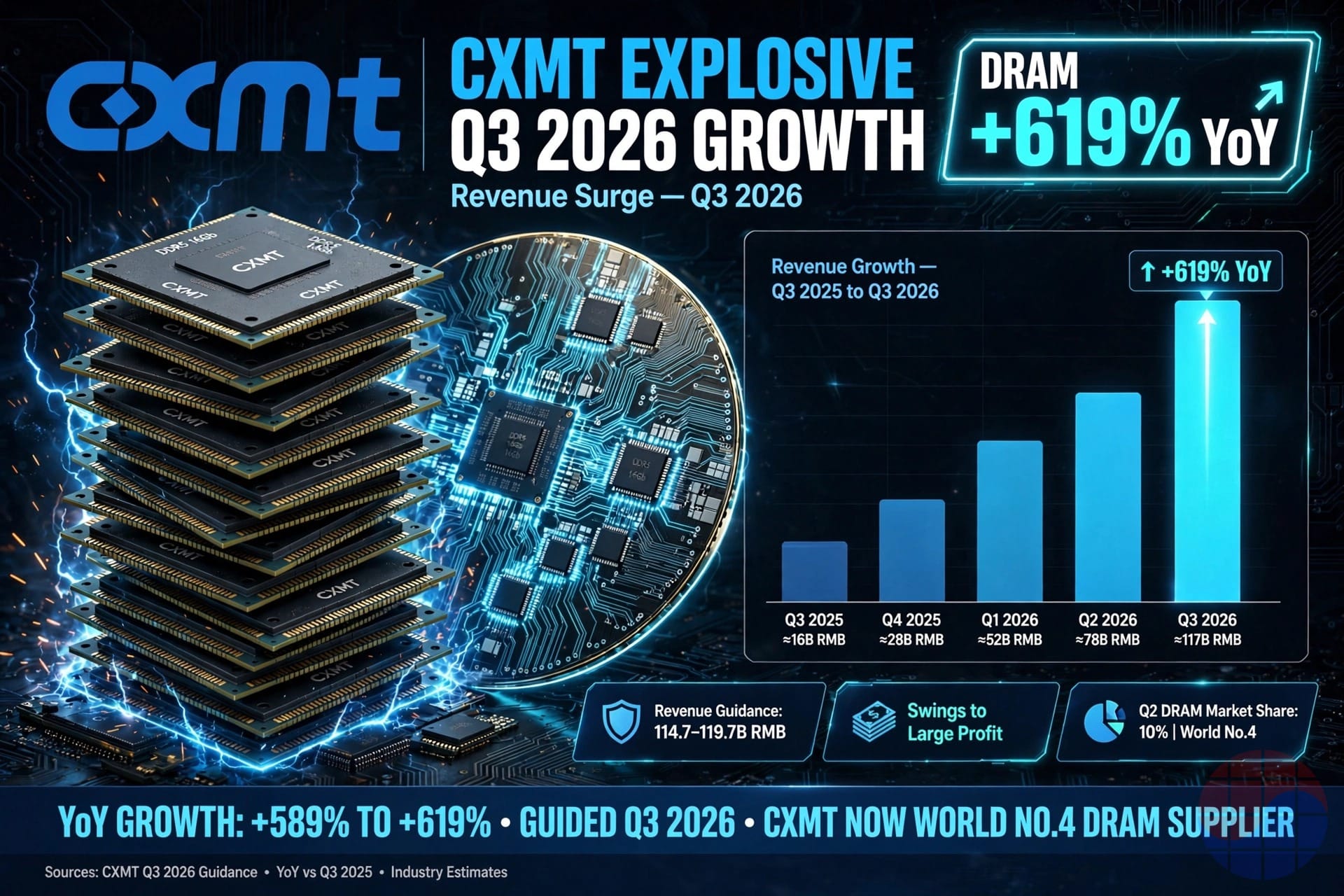
- ChangXin Memory Technologies (CXMT) said in an earnings outlook filed October 16 that third-quarter revenue is estimated at 114.7–119.7 billion yuan (about 22.9–23.9 trillion won). That is 589–619% above the same period last year, and 15–20% above the prior quarter.
- The profitability turnaround is even more dramatic. The projected Q3 net profit is 53.4–54.9 billion yuan (about 10.6–10.9 trillion won), the opposite of a loss a year ago. Cumulative January–September revenue is 265.0–270.0 billion yuan, up 726–742% year over year.
- According to market researcher Counterpoint Research, CXMT's revenue-based DRAM share reached 10% in Q2 this year, up 6 percentage points from 4% a year earlier. That makes it the world's No. 4, behind Samsung Electronics (38%), SK hynix (25%), and Micron (24%).
- CXMT raised 66.6 billion yuan (about 13.2 trillion won) in its July listing on China's STAR Market, and its market cap stood at about 3.06 trillion yuan (about 610 trillion won) as of the October 16 close — the largest on mainland China's stock market.
- CXMT explained that "since the second half of last year, surging AI compute demand has kept DRAM supply short of demand and pushed prices sharply higher," adding that "capacity expansion and process improvements raised per-wafer output and utilization."
Chase's take: A company that posted a loss a year ago now earns 10 trillion won in quarterly net profit — "can't keep it on the shelves" is not an exaggeration. In the short term this is demand evidence supporting strong memory prices, but over the medium term it is a threat. CXMT's capacity expansion is the seed of the post-2027 oversupply debate. Korea's line to defend is clear: not commodity DRAM, but HBM and advanced processes.
3. SOX falls 8 straight sessions, longest since 2008… down 11% in a week
AIStockWire, 2026-10-17 · Clien weekly US market recap, 2026-10-17
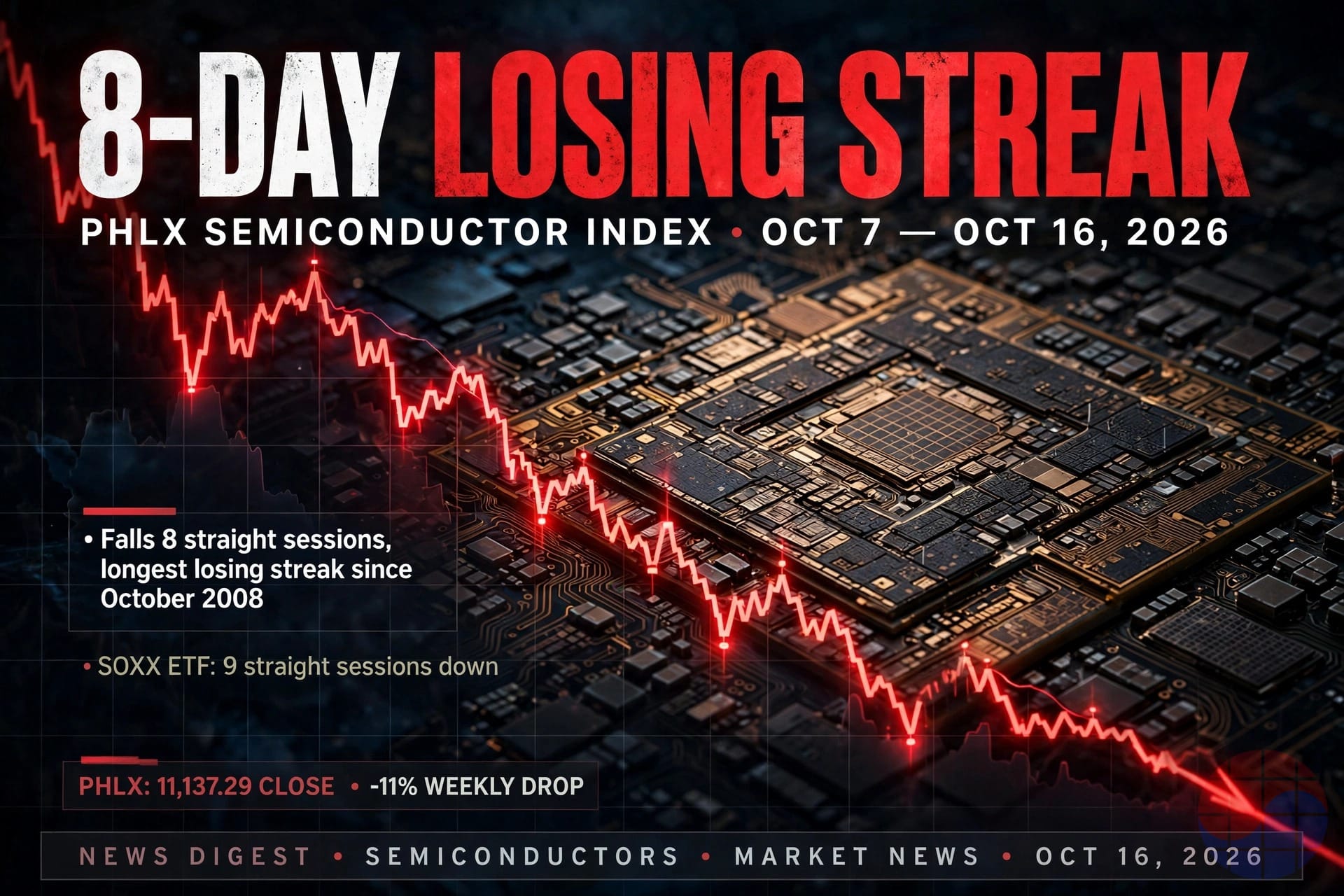
- The Philadelphia Semiconductor Index (SOX) fell for eight straight trading sessions from October 7 to 16 — its longest losing streak since October 2008. The iShares Semiconductor ETF (SOXX) fell nine straight sessions, tying its longest streak since listing in 2001.
- The SOX closed at 11,137.29 on October 16. That is 23.9% below its all-time closing high of 14,634.72 on June 22, but still 57.2% above the start of the year.
- The weekly drop was steep. Monday −2.67%, Tuesday −0.23%, Wednesday −4.30%, Thursday −0.88%, Friday −3.83%, for a combined weekly loss of more than 11%. The Nasdaq fell 4.48% and the S&P 500 1.95% the same week, while the Dow rose 0.67%. Money rotated out of semiconductors into financials, consumer staples, and health care.
- The VIX volatility index jumped 21.88% on Friday to move above 20. Goldman Sachs noted that hedge funds net-sold AI-related stocks for five straight sessions from October 8 to 14, with a single day's net selling the second-largest in the past year. Liquidation of existing holdings outpaced new short selling by 3.5 to 1.
- AIStockWire pointed out that, on forward earnings estimates, Nvidia, Broadcom, and Micron trade at valuations similar to Cisco's after the dot-com bust.
Chase's take: Look at the quality of the decline. The fact that unwinding — "selling what they held" — outpaced short selling by 3.5 to 1 suggests this is leverage coming off, not a collapse of conviction. A 24% pullback from the high hurts, but set against a 57% gain year to date, there is a case for viewing this as overheating being cooled. The real question is one: is demand breaking, or is the money supply tightening?
4. CoreWeave at the center of "AI debt" fears… Jensen Huang says "no backstop needed" vs bond market's 63% default bet
Japan Times/Reuters, 2026-10-16 · AIStockWire, 2026-10-16 · Mondeum Capital, 2026-10-16
- Nvidia CEO Jensen Huang told Bloomberg at an event in Stockholm on October 15: "CoreWeave's health is getting better every day. Its cost of capital is actually going down," saying Nvidia has no need to prop up CoreWeave. Nvidia is CoreWeave's second-largest shareholder with about a 10% stake, and a $6.3 billion order contract signed in September 2025 includes a clause for Nvidia to buy unsold capacity through April 2032.
- The bond market sees the exact opposite. CoreWeave's 2031 bonds yield more than 16%, and the 5-year CDS (credit default swap) spiked intraday to 1,194.5bp, implying a 63% default probability over five years. A year ago it was about 30%. S&P rates the company speculative-grade B.
- The numbers are heavy. Total debt and lease obligations of about $50–52 billion, Q2 2026 capex of $6.42 billion against operating cash flow of just $679 million. Net interest expense more than doubled in a year, from $267 million to $640 million. The counterargument is an order backlog exceeding $100 billion.
- The stock swung wildly. After a 15.46% plunge on Wednesday, it rebounded 5.9% on Thursday on Huang's remarks, then fell 6.1% again on Friday to close at $65.43. Cathie Wood's ARK bought 188,665 shares for $12.4 million on Wednesday. Nebius (−4.5%) and IREN (−3.8%) fell alongside that day.
- CoreWeave says its backlog alone can cover all its debt, with no need for customer renewals or new leases. BNP Paribas, with a $169 target price, noted the company must show it can service its debt from its own cash flows.
Chase's take: The gap between the equity market (Huang's optimism) and the bond market (the 63% default bet) is the whole story of this week's AI trade. The direction this gap narrows will set next week's direction. One thing is clear: the axis of debate is not "demand" but "financing." As Wedbush's Dan Ives put it, until hyperscaler capex cuts or GPU rental declines appear, it is hard to bet on a demand collapse.
5. KOSPI rebounds after 8 sessions… up 2.05%, foreigners net-buy Samsung for the first time in 13 days
Newsis, 2026-10-16 · Chosun Biz, 2026-10-16
- The KOSPI closed at 5,668.05 on October 16, up 113.83 points (2.05%) from the prior session. It had fallen for seven straight sessions from October 6 to 15, dropping more than 20% and erasing about 1,200 trillion won, before rising for the first time in eight sessions. It rose more than 4% intraday, breaking above 5,800, before profit-taking pared the gains.
- Samsung Electronics closed up 2.62% at 215,500 won; SK hynix rose 0.79% to 1,272,000 won. The KOSDAQ jumped 4.46%, triggering a buy-side sidecar.
- Foreign flows split. Samsung Electronics turned to a net buy of 181.9 billion won — the first net-buying day in 13 trading sessions since September 23. SK hynix, by contrast, was a net sell of 73 billion won, its 16th straight net-selling session since September 21. The selling volume, however, shrank sharply from 1.1847 trillion won the day before.
- Individuals net-sold more than 480 billion won, using the rebound as an exit, while foreigners net-bought more than 340 billion won on the KOSPI. The won-dollar rate fell 13.2 won to 1,331.4.
- Wall Street was divided. Goldman Sachs attributed the sharp drop not to a fundamental breakdown but to a supply vacuum — the end of buybacks, foreign selling, and forced hedge-fund liquidations — and kept its 12-month KOSPI target at 12,000. JPMorgan raised its 2027 hyperscaler capex growth outlook from 50% to 70% and recommended overweighting Korean memory. Morgan Stanley, meanwhile, warned that the National Pension Service's domestic equity weight stood at 24.9% at end-July, well above the year-end target of 20.8%, limiting further buying firepower.
- Valuations are at historic lows. Samsung's 12-month forward PER is 3.39x and SK hynix's 2.92x, far below Micron (5.2x) and TSMC (18.15x); the KOSPI overall trades at 4.29x, the lowest since 2000.
Chase's take: The world's largest memory companies at 2–3x PER — on the numbers alone you'd want to hit buy. But cheap valuations can be a trap until flows turn. The split — foreigners buying Samsung while selling SK hynix for a 16th straight day — is next week's watch point. With SK hynix's flow shield gone after its buyback ended, its October 28 Q3 earnings could be the trigger.
6. Record-profit semiconductors, yet crashing… September exports at $60.3B vs 678 trillion won in market cap erased
- Korea's economy holds two different income statements. September total exports exceeded $120 billion for the first time in a month ($120.9 billion), and semiconductor exports hit $60.3 billion — the first time above $60 billion. That is up 262.8% year over year, with chips accounting for 80.3% of ICT exports ($75.1 billion).
- The stock market walked the other way. Samsung Electronics and SK hynix fell 17% and 24% respectively in a week, bringing October declines to 21.8% and 28.9%. The two stocks lost 678 trillion won in market cap this month, and foreigners net-sold 8.8 trillion won in just the two names. Analysts estimate the two companies' combined Q3 operating profit at around 190 trillion won.
- There were two triggers. One: CXMT's next-generation 4F² DRAM reveal cracked the technology-gap narrative that had supported memory prices, shaking DRAM spot prices. The other: Wall Street warnings about AI investment built on debt sent the Nasdaq down 2.2% and chip stocks down with it. China's September chip exports surged 136%, Nvidia's share of China's AI chip market fell to 34%, and Huawei has caught up to 28%.
- Authorities moved too. Financial Services Commission Chairman Lee Eok-won said at an emergency meeting on October 15: "Stay vigilant even at small volatility," vowing zero tolerance for false rumors, price manipulation, and illegal short selling. The government maintains that fundamentals are solid, citing the IMF's upward revision of Korea's growth outlook to 3.3%.
Chase's take: "The real economy is on, but the market is off" is exactly right. But whether this gap is a buying opportunity or a warning is decided by flows. The moment foreigners stop their 8.8-trillion-won selling, that is the bottom signal. The hard number of $60.3 billion in September exports can support the downside going into Q4 earnings season.
7. TSMC's record Q3… net profit NT$76.3B, strong Q4 guidance too
- TSMC reported Q3 earnings on October 15. Net profit was NT$763.06 billion (about 34 trillion won) on revenue of NT$1,494.24 billion, up 50.9% year over year. Net profit growth was 68.7%, and EPS was NT$29.43.
- Advanced processes accounted for 79% of total wafer revenue — evidence that AI accelerator demand is tilting the foundry mix toward the advanced side.
- Q4 guidance is also strong: revenue of $52.3–54.3 billion, gross margin of 65–67%, and operating margin of 56.5–58.5%.
Chase's take: The No. 1 foundry's numbers show the "reality" of AI demand. A 79% advanced-process share and mid-60s margin guidance mean supply bottlenecks are strengthening TSMC's pricing power. Two sides of the same coin as the TSMC bottleneck concern covered yesterday: a bottleneck is a risk to customers, but margin to TSMC.
8. China unveils 15W EUV prototype… Tom's Hardware: "3–5 years to commercialization, Korea's tech gap holds"
- Chinese startup Landao Silex (founded 2024 by Tsinghua alumni) unveiled a 15W-class EUV light-source prototype at the China International Industry Fair. It claims a 1,000W drive laser, energy conversion efficiency above 2%, more than 100 hours of continuous operation, and 90% localization of core components.
- Tom's Hardware's analysis is sobering. The equipment was not actually operating, and commercialization will take at least 3–5 years, it said. The 15W output is not the 250W-class commercial source ASML introduced in 2018–2019, but at the level of Cymer's early prototypes from 2012.
- The biggest blind spot is where it is measured. While ASML measures usable output at the intermediate focus after the collector mirror, Landao appears to have reported output at the plasma generation point. Actual delivery to the lithography process falls below 15W. China also lacks the domestic supply chain for the core components a finished scanner needs, such as high-precision multilayer mirrors and overlay control.
- The implications for Korea cut both ways. Samsung Electronics and SK hynix are consolidating their yield advantage in ASML-tool-based HBM and 10nm-class DRAM, while SMIC is forcing 7nm through DUV multi-patterning with high defect rates and cost limits. On the other hand, Chinese government subsidies pouring into 14nm-and-below commodity processes could pressure average selling prices in the mid-to-low-end market.
Chase's take: The single number, 15W, reveals that China's EUV self-sufficiency is in an early stage. In the short term this actually strengthens Korea's technology moat. But the volume push from subsidized commodity processes is a separate threat. Advanced (the fortress to defend) and commodity (the wave to weather) must be read separately.
9. AI infrastructure money debate… Broadcom's Tan: "biggest constraint is capital" vs demand still solid
Clien weekly US market recap, 2026-10-17
- "Money," not "demand," framed this week's decline. Broadcom CEO Hock Tan said the AI industry's biggest constraint is not chips or power but capital, and Intel CEO Lip-Bu Tan also pointed to high capital costs and uncertain returns on investment.
- Gartner estimates AI infrastructure could cost about $7 trillion by 2030, while data center revenue may fall short of $3.6 trillion. Morgan Stanley warned of downgrade pressure, noting Oracle's 10-year bond yield rose about 150bp in the second half alone. Goldman Sachs counted more than $106 billion in project-finance bond issuance for data center–type projects this year — about 3x last year's level.
- The rebuttals are no weaker. Wedbush's Dan Ives said "rates are a funding issue, not a demand issue," saying he would change his view only on signs of hyperscaler investment cuts, contract cancellations, or GPU rental declines. JPMorgan actually raised its 2027 hyperscaler capex growth outlook from 50% to 70%.
- Macro data was also mixed. September US CPI came in at 3.7% year over year, above expectations, with core up 0.3% month over month; PPI rose 1.3% month over month, more than double the 0.6% expected. Fed Chair Warsh told the IMF he would not pre-announce the direction for the remaining meetings. The probability of an October rate hold exceeds 70%.
Chase's take: One week, summarized: demand (earnings, exports, guidance) is strong; financing (bonds, CDS, leverage) is shaky. The real risk scenario is not demand collapse but investment delayed "because money got expensive." The early-warning indicators for that scenario are three: downward revisions to hyperscaler capex guidance, falling GPU rental rates, and neocloud contract cancellations. None of the three has appeared yet.
Semiconductor stock roundup
| Stock/Index | Move (as of Oct 16–17) |
|---|---|
| SOX (Philadelphia Semiconductor Index) | Closed at 11,137.29. 8 straight down sessions (longest since 2008), weekly drop of 11%+. 23.9% below the high, 57.2% above year start |
| KOSPI | 5,668.05 (+2.05%, Oct 16). Rebound after 7 straight down sessions, first gain in 8 sessions |
| Samsung Electronics | 215,500 won (+2.62%, Oct 16). Weekly −17%, October cumulative −21.8%. Foreigners turn net buyers after 13 sessions (181.9 billion won) |
| SK hynix | 1,272,000 won (+0.79%, Oct 16). Weekly −24%, October cumulative −28.9%. Foreigners net-sell for 16 straight sessions |
| TSMC | Record Q3 earnings. Net profit NT$763.06 billion, revenue NT$1,494.24 billion (+50.9% YoY). Q4 revenue guidance $52.3–54.3 billion |
| Nvidia | Jensen Huang: "CoreWeave needs no backstop" (Oct 15). Holds about 10% of CoreWeave |
| CoreWeave | $65.43 (−6.1%, Oct 16). Bond yield 16%+, CDS 1,194.5bp. ARK buys 189K shares |
| CXMT | Q3 revenue guidance 114.7–119.7 billion yuan (+589–619% YoY). Market cap about 610 trillion won, No. 1 in mainland China |
| Korea chip exports | September $60.3 billion (+262.8% YoY), first-ever break above $60 billion |
Footnote: figures and dates cited in this article are based on public reports and may differ from real-time prices.