VLSI Korea
Samsung to Use TSMC 3nm for Nvidia NVHBM Base Dies — 8 Stories to Read on October 19
Samsung reportedly adopting TSMC 3nm for Nvidia NVHBM base dies, TSMC's $46.7B quarter and 58% Q4 growth guidance, ASML's record quarter, and the earnings test ahead for chip stocks — 8 stories to read on October 19.


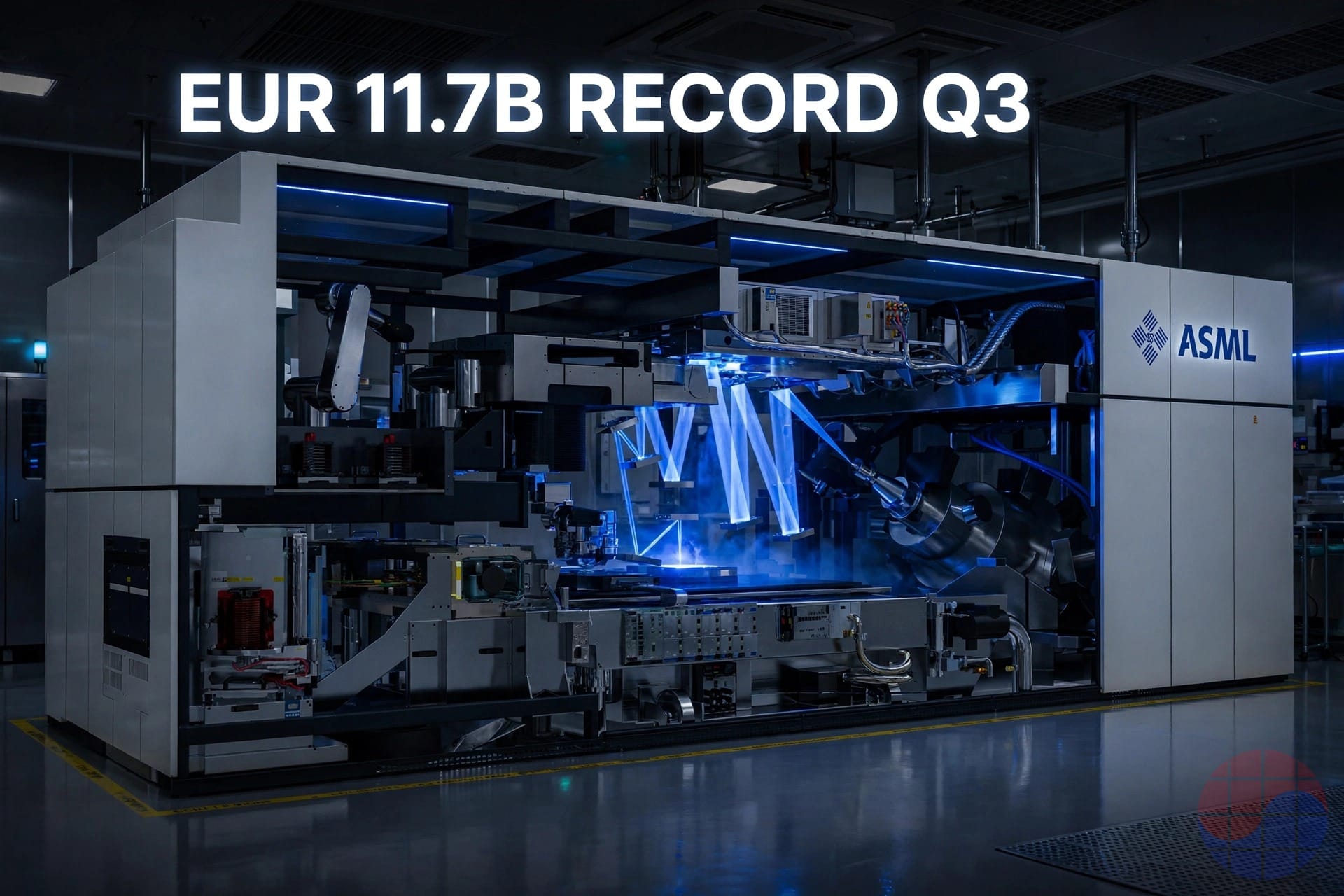
The conclusion first. On October 18, 2026, Samsung Electronics reportedly agreed to build the base die of Nvidia's next-generation custom HBM, NVHBM, on TSMC's 3nm process. It would be the first Samsung-TSMC partnership at the HBM manufacturing stage. The same weekend, TSMC confirmed Q3 revenue of $46.7 billion and Q4 guidance implying 58% growth, and ASML posted record Q3 sales of EUR 11.7 billion. Demand on paper is strong. What is shaking is share prices and financing. This week, earnings starting with Lam Research on October 21 test that gap. Here are 8 stories worth reading today.
8 Stories Worth Reading Today
1. Samsung to Use TSMC 3nm for Nvidia's NVHBM Base Die
Seoul Economic Daily (English), 2026-10-18 · Reuters via CNA, 2026-10-18
- Seoul Economic Daily reported on October 18, citing industry sources, that Samsung will produce the base die for Nvidia's NVHBM on TSMC's 3nm process. Samsung has until now made both the core die and the base die in-house under a turnkey model.
- Nvidia made the same request to all three suppliers — Samsung, SK hynix and Micron: base dies on TSMC 3nm, core dies standardized on the sixth-generation 1c DRAM process. Different manufacturing methods across suppliers create performance variation from a single design and force separate validation for each supplier.
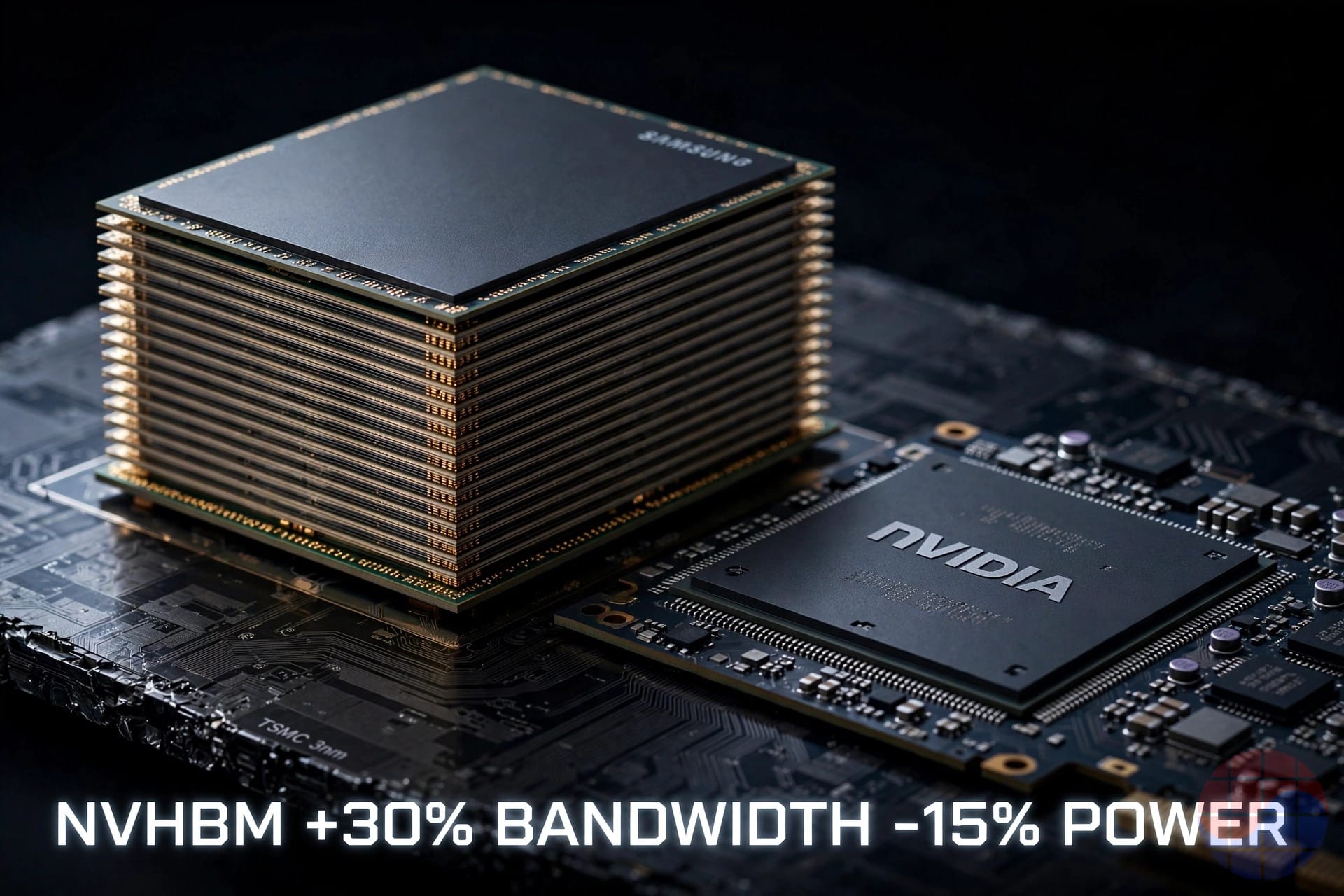
- NVHBM, unveiled in August 2026, moves Nvidia's memory controller into the base die. Nvidia cites up to 30% more bandwidth, up to 15% lower HBM power and up to 25% more area on the XPU compute die versus standard HBM4E. The first partner is Amazon's Annapurna Labs, starting with Trainium4.
- Samsung's move is limited in scope. Standard HBM and custom products for other customers such as AMD keep the turnkey model. Samsung's standard HBM4 and HBM4E use Samsung Foundry 4nm base dies and 1c core dies. HBM4 is in mass production and HBM4E is in mass-production validation.
- Samsung is also reportedly assessing its own foundry as a backup source for NVHBM base dies if TSMC capacity falls short. None of the three companies has commented on the record.
Chase's take: The story is not "Samsung lost." Once the memory controller moved into the base die, the base die became a logic process, not a memory process. In STA and signoff terms, whoever owns the validation criteria sets the standard for the whole stack. Nvidia wants validation unified, not a supplier swap. Samsung's real question is not the 3nm base-die volume — it is whether it keeps the design leverage to bring base dies back in-house in the next generation.
2. TSMC Q3 Revenue $46.7B, Net Income Up 68.7% — Q4 Guidance Implies 58% Growth
TSMC official release, 2026-10-15 · Motley Fool, 2026-10-18
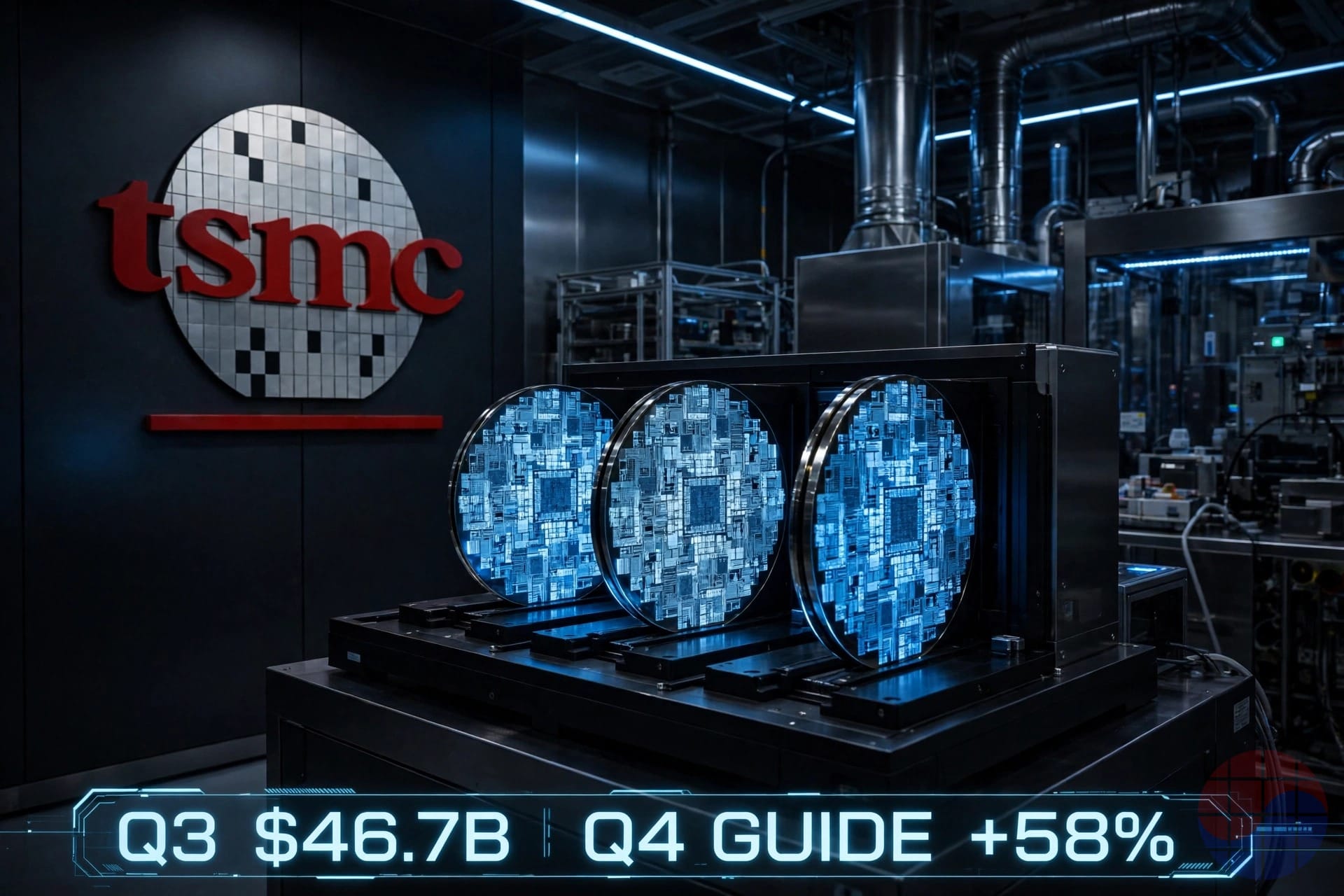
- TSMC's Q3 2026 revenue was NT$1,494.24 billion ($46.72 billion), up 50.9% year over year in NT dollar terms, and net income rose 68.7% to NT$763.06 billion. EPS was NT$29.43, or $4.60 per ADR unit.
- The process mix proves the demand. Advanced technologies at 7nm and below made up 79% of wafer revenue: 3nm at 33%, 5nm at 28%, 2nm at 8% and 7nm at 10%. HPC was 68% of revenue, up 22% quarter over quarter.
- Margins were a 66.4% gross margin, a 58.7% operating margin and a 51.1% net margin. Gross margin eased 1.3 points quarter over quarter on N2 ramp costs, while operating margin beat the top of guidance.
- Q4 guidance is $52.3 billion to $54.3 billion in revenue, roughly 58% growth year over year at the midpoint, with gross margin of 65% to 67% and operating margin of 56.5% to 58.5%. The 2026 capex plan of $60 billion to $64 billion was reiterated.
- CEO C.C. Wei said AI accelerator demand still far exceeds supply capacity. Full-year revenue growth is now tracking around 44% in US dollar terms. Smartphone, at 21% of revenue, is the soft spot as component prices pressure consumer demand.
Chase's take: One thing these numbers say clearly: in the AI demand debate, foundry order books do not lie. A 79% advanced-node mix and 58% Q4 growth guidance collide head-on with the "demand has rolled over" stock narrative. Watch the margin direction. How far N2 ramp and overseas fab costs press the mid-60s gross margin decides TSMC's pricing power in 2027.
3. ASML Posts Record Q3 Sales of EUR 11.7B — Customer Orders Now Reach Toward 2029-2030
Pulse2, 2026-10-14 · Zacks, 2026-10-15
- ASML's Q3 2026 net sales reached a record EUR 11.662 billion. Net income was EUR 4.960 billion, EPS was EUR 12.95 and gross margin rose to 57.5% from 54.0% in Q2.
- ASML sold 113 new lithography systems, up from 86 in Q2, plus 8 used systems. Installed Base Management sales of EUR 3.289 billion beat guidance by about EUR 400 million and drove the margin upside.
- Demand visibility is stronger than the quarter itself. Management said customer demand exceeds supply through 2028, some customers have expressed interest in orders for 2029 and 2030, new customer down payments reached EUR 5.7 billion and quarterly free cash flow was EUR 11.4 billion.
- The response is expansion. The plan to raise low-NA EUV and DUV immersion capacity by 30% in 2027 is on track, and ASML is studying an even larger expansion for 2028. Q4 guidance is EUR 14.2 billion to EUR 15.2 billion in sales at a gross margin of around 57%.
- Full-year guidance was raised for a third time: 2026 sales of EUR 44 billion to EUR 45 billion, EUV growth above 45% and memory revenue up about 75% in 2026.
Chase's take: When an equipment maker's order book reaches toward 2030, customers have committed to at least four years of capacity war. The most important number in ASML's release is not sales — it is upgrade revenue. Customers are squeezing productivity out of installed tools because new tools are not available. That is the most honest gauge of how deep the bottleneck runs.
4. Earnings Are the Test This Week — Lam Research Reports October 21 After a 17% Weekly Decline
- Lam Research closed at $263.94 on October 16, down 4.87% on the day and 17.22% on the week. Western Digital fell 16.43% on the week, Micron 14.59% and Intel 14.18%, while the Philadelphia Semiconductor Index fell 11.41%.
- Lam reports its September quarter after the close on October 21. Analysts expect EPS of $2.17, up 72% from $1.26 a year earlier. Company guidance centered on $8.1 billion in revenue, plus or minus $400 million, and adjusted EPS around $2.15.
- Texas Instruments reports the same evening, with expected EPS of $2.39. Western Digital follows on October 22 with expected EPS of $3.97, and Intel reports on October 29.
- In the prior quarter Lam posted revenue of $6.722 billion, up about 30% year over year. NAND revenue doubled quarter over quarter, advanced packaging revenue is expected to grow more than 70% in calendar 2026, and China was 34% of fiscal 2026 revenue.
Chase's take: If last week's decline was a financing scare, this week's earnings are the first data that tests it. In Lam's print, watch the WFE outlook and China commentary more than the quarterly number. If equipment orders hold, last week was a positioning event. If orders slip, the scare becomes substance. Equipment answers before memory does.
5. KeyBanc Says Intel Foundry Won Contracts From Broadcom, Google, Microsoft and Nvidia — Apple Evaluating 14A
- KeyBanc analysts returned from an Asia trip with a strongly positive view of Intel Foundry, with order volume skewed toward 14A rather than 18A-P.
- The reported wins: networking switches for Broadcom, server CPUs for Google and Microsoft, and gaming GPUs for Nvidia. Apple was described as evaluating a multi-generation, multi-series contract for M-series and A-series chips on 14A.
- Amazon, Anthropic and the SpaceX/Tesla Terafab are still evaluating 18A-P and 14A, with most expected to favor 14A.
- 14A is a 1.4nm-class process with PowerDirect backside power delivery, which moves power wiring to the back of the wafer to free front-side routing for signals, cut resistance and raise density.
Chase's take: This is analyst channel checking, not an Intel confirmation — do not treat it as fact. But the direction is worth reading. The foundry contest is shifting from yield numbers to who lands the next tape-out. If Apple is genuinely evaluating 14A, customer hedging against a TSMC-only world has started in earnest. Verify it on Intel's October 29 call, in external foundry revenue and guidance.
6. Earnings Doubled in a Year — The Other Side of the Semiconductor Bubble Debate
Investor's Handbook (Medium), 2026-10-17
- The piece opens with an analogy: a ski resort sold out for three straight winters, fully booked this season too, whose shares fall on a long-range forecast of a warm winter three seasons out. Chip stocks, it argues, are living through a version of that.
- The numbers run against the prices. In the year to October 14, 2026, SMH returned 70% while the earnings of its holdings roughly doubled. SOXX returned 87% with earnings up slightly more. Even as prices climbed, SMH's trailing P/E fell from 38x to 32x.
- Over the same year, S&P 500 earnings rose about a third. Semiconductor earnings growth far outpaced the broader market — the core of the argument.
- The piece is clear about the decline's drivers too: the Philadelphia Semiconductor Index fell about 10% in six sessions to October 14, memory makers fell further, and China concerns, 2028 supply questions and a hotter inflation print revived rate-hike worries.
Chase's take: The most common trap in bubble debates is watching price and ignoring earnings. A sector whose P/E fell while earnings doubled is hard to call a bubble. But the logic holds only while earnings keep compounding at that pace. That is why this earnings season matters. The moment the earnings slope bends, the same numbers read in reverse.
7. The Shadow of Korea's Memory Boom — "One Engine, No Backup"
Jace Kim (Medium), 2026-10-18 · Shashi Bellamkonda, 2026-10-18
- The analysis starts from mid-October's collision. Three days after China's CXMT outlined plans for a high-density server DRAM module by year-end, Samsung shares fell 7.39% and SK hynix fell 10.09% on October 13, and the KOSPI dropped about 5.5% in a session.
- The piece does not treat CXMT's success as established. Reliable mass production, product specifications, yields and commercial scale remain unanswered. The stock reaction reads as competitive anxiety, profit-taking and uncertainty over the AI cycle — not a verdict that the technology gap has collapsed.
- The real problem is structural. Korea has become exceptionally successful at memory, but that success can deepen dependence on a single industry instead of funding new growth sources. Record chip profits can obscure that vulnerability.
- A second analysis makes the same distinction. Demand signals are intact: hyperscalers keep ordering advanced memory and accelerators, and HBM stays constrained. What is shaking is financing. Higher rates raise the capital cost of multi-year data center projects, and leveraged AI infrastructure bonds are already under pressure. Broadcom CEO Hock Tan said on October 12 that capital itself is now the binding constraint.
Chase's take: Both pieces land on the right conclusion. This selloff is not evidence of collapsing demand — it exposed the fragility of a one-engine structure. Korea's answer is not to abandon memory. It is the speed at which HBM profits get converted into a second engine — system semiconductors, foundry, EDA and design automation. With exports and profits at record highs, now is the only window with room to make that conversion.
8. Broadcom Stacks Custom Chip Deals — Alphabet for Five Years, Meta Through 2029, OpenAI at 10GW
- Broadcom locked in a string of custom chip deals this year: a five-year custom chip deal with Alphabet, an extended Meta partnership through 2029, and a deal to provide OpenAI with 10 gigawatts of custom AI accelerators.
- The assessment is simple. Broadcom is not betting on one customer. It is becoming the design partner hyperscalers and AI labs call first when they want their own chip instead of a generic GPU.
- The scale behind it is large. Broadcom's AI semiconductor revenue reached $16.7 billion, up 221%, while Nvidia's data center revenue hit $89.0 billion, up 117% — though the two figures use different reporting bases and are not directly comparable.
- Prices moved separately from the story. Broadcom fell 4.53% to $328.75 on October 16, and AMD fell 5.96% to around $540. AMD has shipped its MI400 series, with the MI500 due in 2027 and the MI600 in 2028.
Chase's take: In custom silicon, the real moat is not design skill — it is depth inside a customer's roadmap. Holding Alphabet, Meta and OpenAI at once means Broadcom already sees three multi-generation tape-out calendars. The risk sits in the same place. As customer concentration rises, the day a customer builds its own design team, volume shakes all at once. The moat and the concentration risk are the same coin.
Semiconductor Stock Roundup
Basis: US closes on October 16, 2026, and Korean closes on October 16. Markets were closed over the October 17-18 weekend.
| Stock / Index | Move (as of October 16 close) |
|---|---|
| SOX (Philadelphia Semiconductor Index) | 11,137.29. Eight straight declines, the longest streak since 2008. Down more than 11% on the week, -23.9% from its record, +57.2% year to date |
| SOXX (iShares Semiconductor ETF) | $493.39, -4.14% on the day. Down about 16% from $589.45 on October 6, about -25% from its 52-week high, +64.12% year to date |
| Nvidia (NVDA) | -1.43% on the day, the smallest decline among index constituents |
| AMD | -5.95% on the day, around $540. MI400 shipping, MI500 due in 2027 |
| Intel (INTC) | -5.79% on the day, -14.18% on the week. Earnings on October 29 |
| Micron (MU) | -5.63% on the day, -14.59% on the week |
| Broadcom (AVGO) | $328.75, -4.53% on the day |
| Lam Research (LRCX) | $263.94, -4.87% on the day, -17.22% on the week. Earnings on October 21 |
| KLA (KLAC) / Applied Materials (AMAT) | -5.00% / -4.82% on the day |
| TSMC (TSM) | ADR around $412.61 on October 16, -2.28%. Q3 revenue $46.72B, Q4 guidance $52.3B-$54.3B |
| ASML | Q3 sales EUR 11.662B, net income EUR 4.960B, gross margin 57.5% |
| Samsung Electronics | KRW 215,500, +2.62% on October 16. Foreigners turned net buyers for the first time in 13 sessions |
| SK hynix | KRW 1,272,000, +0.79% on October 16. Earnings due October 28 |
| KOSPI | 5,668.05, +2.05% on October 16, its first rise in eight sessions |
This week's calendar: Lam Research and Texas Instruments earnings (October 21), Western Digital earnings (October 22), SK hynix earnings (October 28), Intel earnings (October 29).
Share prices and results in this article are as reported in each cited article and official company releases, dated October 14-18, 2026. NVHBM details are based on Seoul Economic Daily reporting and Nvidia's product description; the companies involved have not yet confirmed them on the record.
📩 Subscribe to VLSI Korea
Get our daily semiconductor deep-dives delivered to your inbox first. Free to subscribe.