VLSI Korea
AI PCs are tempting. The purchase still needs a reason.
What IFA local AI announcements mean for notebook costs, unified memory and request routing, and why useful workloads still have to justify the purchase.


🆓 Free article · Anyone can read this article for free
DAILY SILICON · 2026.09.05
New PC announcements have a way of clearing desk space. Nothing has moved, but there is already a small vacancy beside the monitor in your head.
Then comes the harder part. What would you ask it to do every day? Opening a few more browser tabs probably will not explain the price.
This IFA makes the question more concrete: compact computers with substantial memory, and software that sends AI work to other PCs. Meanwhile, notebook makers are redoing their cost calculations because of those same memory components.
One Big Thing · More features, more expensive parts
The revealing number in TrendForce's 9/4 release is 68%. Its representative notebook analysis estimates that CPU, DRAM and SSD together rose from about 45% of total bill of materials in 2025 Q1 to 68% in 2026 Q3.
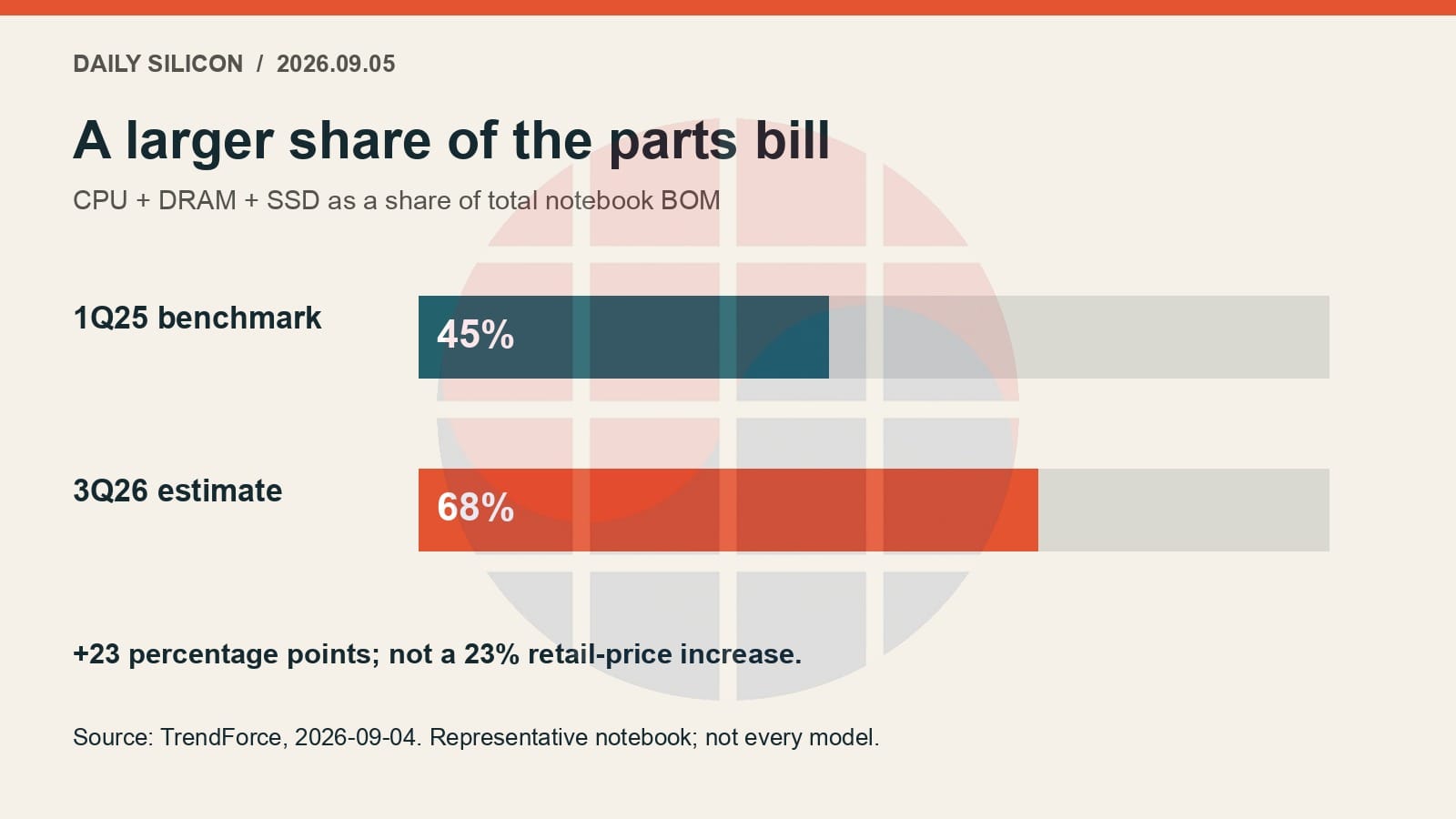
That is an increase of about 23 percentage points. It is neither memory alone nor a share of the retail price. Treating this change as a consumer price increase would answer a different question.
For the PC maker, keeping the specification means absorbing more cost or asking the buyer to pay more. The buyer can postpone replacing the machine. Reducing memory is another option, but that makes a local-AI sales pitch harder to deliver: larger models need room to work.
Adding AI features and adding reasons to buy are separate jobs. Someone who processes meeting notes every day and someone who generates an image on weekends have different reasons to accept the extra cost.
TrendForce forecasts a 9.4% year-on-year decline in worldwide notebook shipments in 2026. That is a forecast, not a completed annual result. It can coexist with improving CPU availability. Making a component easier to obtain does not automatically bring forward the customer's replacement date.
Signals · A small box still has memory boundaries
Lenovo's 9/3 announcement puts up to 128GB of unified memory in the 1.6L ThinkCentre X Ultra. The specifications list up to 96GB for graphics, allocated from that unified memory.
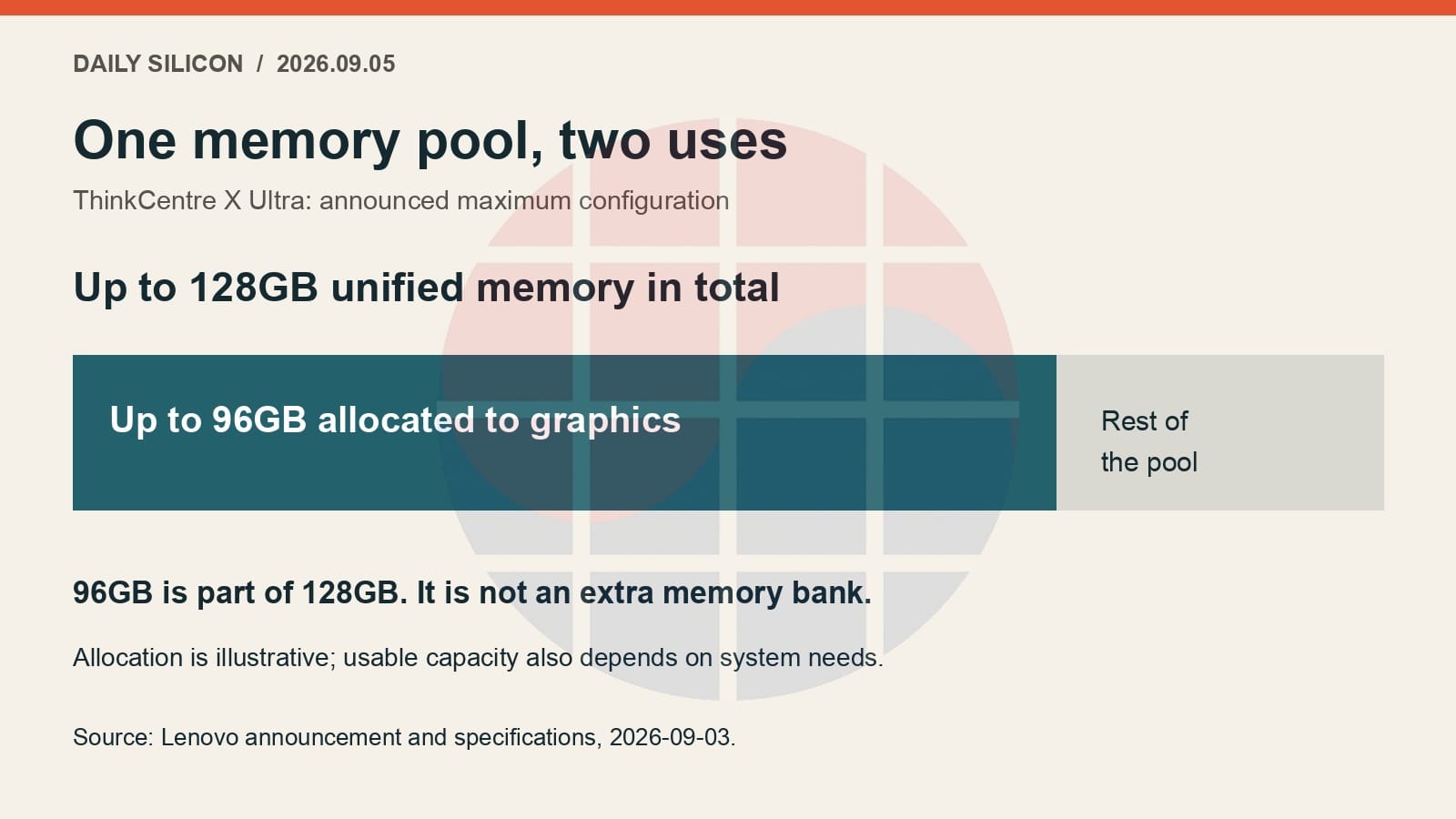
Do not add 96GB to 128GB. This is a question of allocating the same space. Choosing a model also means allowing for runtime memory and the other applications using the machine.
More memory is welcome. But fitting a model and getting a response quickly enough are different requirements. An overnight batch can tolerate delays that would make a live conversation frustrating.
Lenovo gives availability starting in 2026/11 and an expected starting price of €3,100. Pricing varies by market and configuration; that is not the price of the maximum-memory configuration or a Korean retail quote. These are announced product conditions, not an independent review.
Could the PC you already own take another shift?
There is also a way to give existing PCs more work. NVIDIA's 9/3 PAIR announcement describes discovering compatible computers on a local network and routing independent inference requests to systems with capacity.
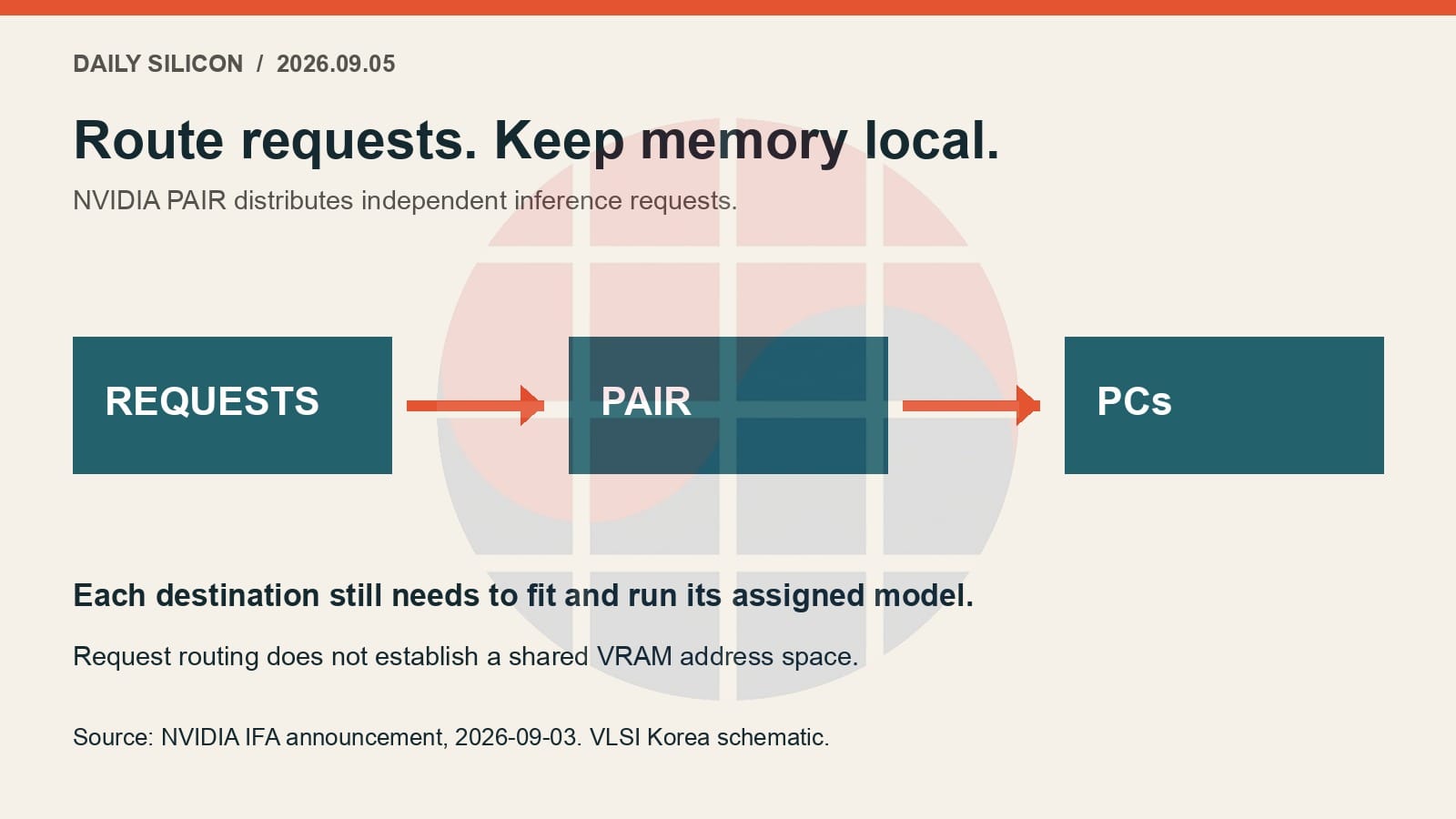
Summarizing separate batches of documents is an illustrative use for this arrangement. It does not mean a model that cannot fit on a PC automatically borrows another PC's VRAM. NVIDIA is describing where independent requests go.
Getting more use from existing hardware is appealing. Still, leaving a computer switched on does not establish the economics. Electricity, setup, maintenance time and actual throughput belong in the comparison. You have already paid for the PC; you have not prepaid every cost of using it.
Watch Next · After specifications, measure the work
These announcements expand the PC's role from opening documents to handling delegated work. The buying decision should follow. Time to finish a familiar task, plus time to check the result, can be more useful than a peak-performance number.
VLSI Korea view: Work out whether the new PC cuts waiting time, operating costs, or both. If it saves time and money, that is a welcome upgrade.
What we want next is post-launch testing with the same model and settings, sustained operation, and actual prices for each configuration. The compact box already looks appealing. The everyday workload still has to explain its price.
Sources · Method · Updates
The linked original sources were checked on 2026/9/5 KST. Specifications and launch dates are company announcements, not independent measurements. Notebook cost and shipment figures are TrendForce estimates and forecasts. The 23-percentage-point change is calculated as 68% minus 45%.
SILICON MARKET and ±5% Silicon Movers are omitted from this edition: a complete universe with verified latest local closing prices was not available. This does not mean no qualifying moves occurred.
Updates: initial publication. AI assisted public-source research, drafting and figures; a separate AI reviewer checked facts and wording. This does not claim pre-publication human review. Figures are original VLSI Korea diagrams, not product photographs.
Disclosure
This article is provided for informational purposes only and does not constitute a recommendation to buy or sell any security. Figures and factual statements are based on publicly available sources, including company filings, news reports, and market research, and may contain errors in the source material or in the preparation of this article. The author may own shares in companies mentioned. All investment decisions and their outcomes are the reader's responsibility.
Frequently Asked Questions
How did core components change as a share of notebook cost?
TrendForce's September 4 analysis estimates CPU, DRAM and SSD together rose from about 45% of a representative notebook's total bill of materials in 2025 Q1 to 68% in 2026 Q3. That is an increase of about 23 percentage points, and it is a share of the parts bill, not of the retail price.
What does TrendForce forecast for 2026 notebook shipments?
TrendForce forecasts a 9.4% year-on-year decline in worldwide notebook shipments in 2026. It is a forecast, not a completed annual result.
How much memory does Lenovo's ThinkCentre X Ultra offer?
Lenovo's September 3 announcement puts up to 128GB of unified memory in the 1.6L ThinkCentre X Ultra, with up to 96GB for graphics allocated from that same pool. Availability starts in November 2026 with an expected starting price of €3,100, which is not the price of the maximum-memory configuration.
What does NVIDIA PAIR do with PCs you already own?
NVIDIA's September 3 PAIR announcement describes discovering compatible computers on a local network and routing independent inference requests to systems with capacity. It does not mean a model that cannot fit on one PC automatically borrows another PC's VRAM.
Related reading
- Asahi Linux on M3: installation is open, GPU and sleep are not ready
- TSMC Q3 Earnings Today at 3 PM KST: NT$1.49T Revenue Confirmed, N2 Ramp…
- Daily Silicon Sep 6: PoCL, Developer PCs and GPU Articles
- NVIDIA PAIR: Can the PCs you already own shorten the AI queue?
- Daily Silicon: Premarket +6%, Next Inflection Points Are AMAT and NVDA…