VLSI Korea
NVIDIA PAIR: Can the PCs you already own shorten the AI queue?
How NVIDIA PAIR routes local AI requests across PCs, why it does not pool VRAM, and what its 18-minute versus 8:48 company demo actually compares.


🆓 Free article · Anyone can read this article for free
The laptop on the desk is busy. The gaming PC in the next room is quiet. Give an AI several jobs and the replies pile up on the laptop. Before looking up the price of another computer, it is tempting to look into the next room.
Switching both machines on does not automatically make them a team. Something has to decide which machine gets which request. That is the job NVIDIA described for PAIR, its Personal AI Router, announced on 9/3: distributing independent AI inference requests among compatible computers on a local network.
First, find work that can actually be divided
Imagine reading and summarizing several reports independently. Requests that do not need each other's results have room to run on separate machines at the same time. If the next analysis needs the previous conclusion, the dependency remains. More computers cannot remove the order in which those steps must happen.
NVIDIA's technical explanation assigns each request to one eligible node. Ollama or LM Studio performs the inference. PAIR does not combine GPU memory into one large pool or automatically divide one model's computation across machines.
The useful first question is where the requested model is ready to run. A node needs the relevant model and inference engine before it can take that request. Several desks do not help much if all the necessary material is available at only one of them.
18 minutes became 8 minutes 48 seconds. Read the conditions too.
In NVIDIA's example, the same five-subagent Hermes workload averaged 18 minutes on one RTX Spark laptop and 8 minutes 48 seconds with three devices: an RTX Spark laptop, a DGX Spark and an RTX 5090 system.
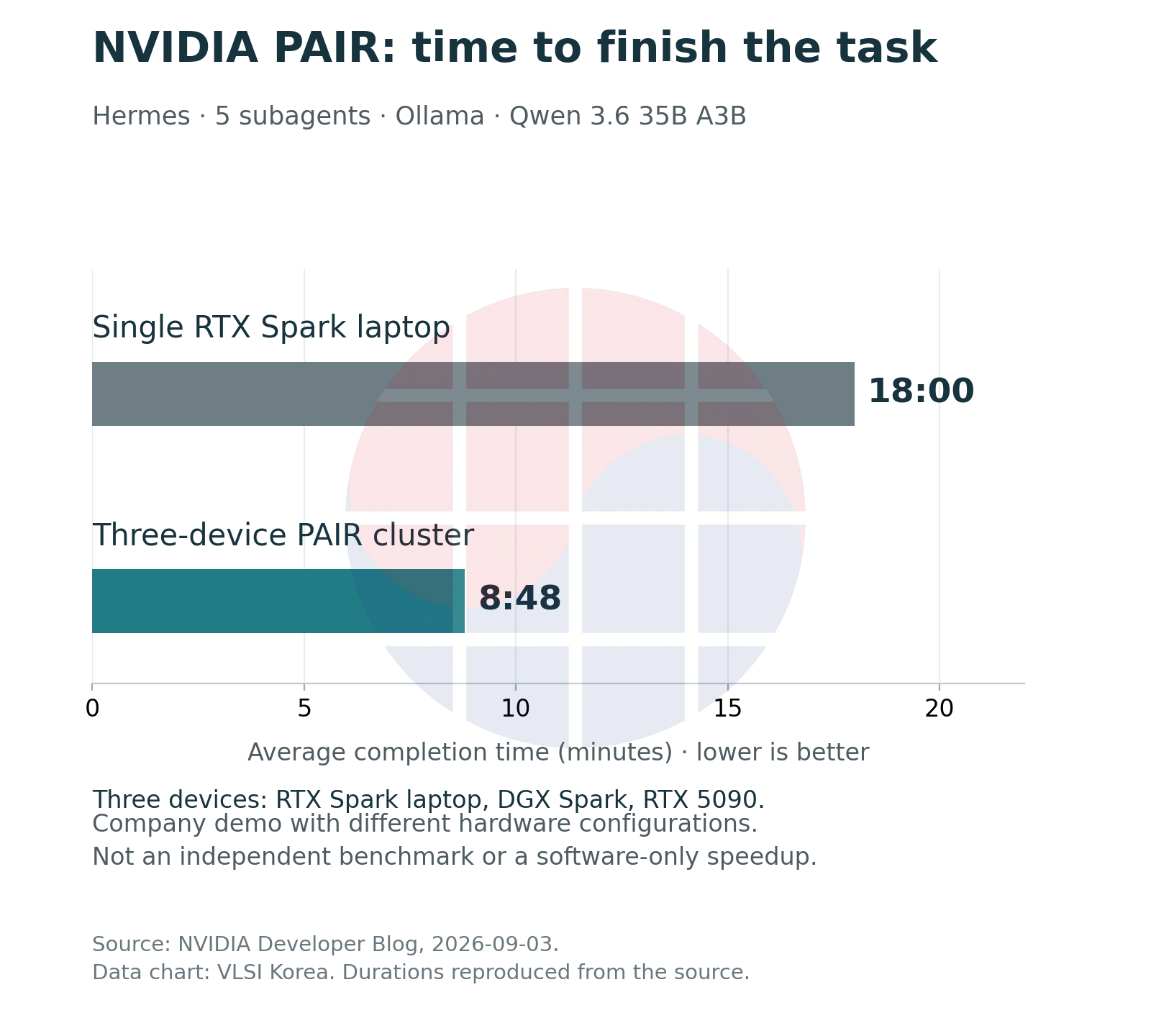
That is 9 minutes 12 seconds less, or approximately a 51.1% reduction in completion time. It is a company demonstration under a particular configuration, not an independent general benchmark. Different additional hardware contributes to the result, so it cannot isolate a software-only PAIR improvement. Nor does it promise to halve every AI task.
The more useful experiment for a buyer uses their own work. Whether it is document organization or code review, measure both completion time and the time spent fixing the output. A quick answer that takes a long time to repair does not give you your lunch break back.
A chip vendor also wants you to use computers you already own
The public repository describes the Windows, macOS and Linux beta and its Ollama and LM Studio connections. NVIDIA lists GeForce RTX 20 Series and newer, supported RTX PRO systems, DGX Spark and Apple M4 or newer silicon. That does not mean every old PC in the house is eligible.
The buyer's and seller's incentives are interesting here. If compatible equipment already at home can reduce waiting, a buyer might delay a purchase. More frequent use of local AI could also make larger memory capacities and faster hardware attractive. Usage and actual purchases will tell us which effect matters more. An announcement cannot settle the sales outcome.
Having paid for the equipment already is an advantage. Electricity and administration still lie ahead. Sleep settings, model updates and available capacity when somebody starts a game are practical household variables.
Before choosing another machine, find out why the current ones are waiting. Slow computation and work directed to one busy destination call for different remedies.
The next number worth seeing is a week's usage record. Does everyday work queue less, is the output useful, and is the setup tolerable to maintain? If those three conditions hold, the quiet computer next door has found something worthwhile to do.
Sources · Method · Updates
NVIDIA's announcement, technical documentation and public repository were checked on 2026.09.05 KST. Support and demo figures are company statements, not our measurements. The time reduction is (1,080−528)÷1,080×100, rounded. The purchasing and operating interpretation and report example are VLSI Korea's own explanation.
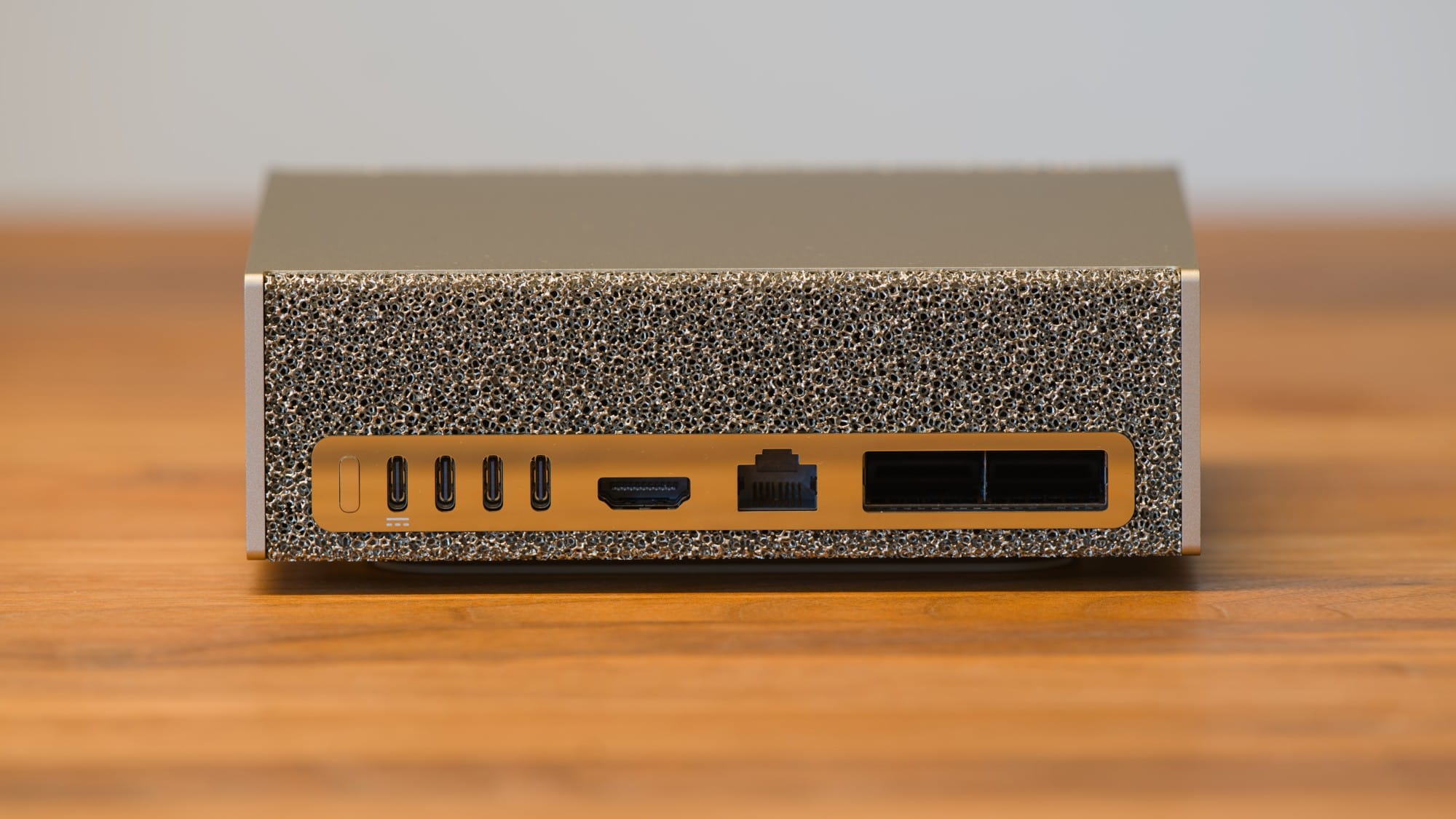
The cover and body use real DGX Spark photographs taken by Daniel Lu on 2026-05-16. They illustrate a supported PAIR device, not an IFA scene or a running demonstration. They are attributed, licensed and resized only.
This special edition focuses on PAIR. Silicon Market and ±5% Movers are omitted because a complete market dataset was not verified. Update: 2026.09.05, revised the title and emphasis and added a chart of the company demo’s completion times. AI assisted research and writing, with a separate AI reviewer checking facts, language and photographs. This does not imply human pre-publication review.
Disclosure
This article is provided for informational purposes only and does not constitute a recommendation to buy or sell any security. Figures and factual statements are based on publicly available sources, including company filings, news reports, and market research, and may contain errors in the source material or in the preparation of this article. The author may own shares in companies mentioned. All investment decisions and their outcomes are the reader's responsibility.
Frequently Asked Questions
What does NVIDIA PAIR do?
PAIR distributes independent AI inference requests among compatible computers on a local network. Each request is assigned to one eligible node, where Ollama or LM Studio performs the inference.
Does PAIR pool GPU memory across machines?
No. PAIR does not combine GPU memory into one large pool or automatically divide one model's computation across machines.
What did NVIDIA's PAIR demo show?
The same five-subagent workload averaged 18 minutes on one RTX Spark laptop and 8 minutes 48 seconds with three devices, a 51.1% reduction. It is a company demonstration under a particular configuration, not an independent benchmark.
Which systems does PAIR support?
Support lists GeForce RTX 20 Series and newer, supported RTX PRO systems, DGX Spark, and Apple M4 or newer silicon. The public repository describes a Windows, macOS, and Linux beta.
Related reading
- PoCL 7.2: What changes when you run OpenCL on RISC-V?
- TSMC Eyes Sixth Straight Record Profit; Intel, Qualcomm Hike CPU Prices…
- NVIDIA DLSS 5 is in NBA 2K27. Does your GPU need replacing?
- Samsung to Use TSMC 3nm for Nvidia NVHBM Base Dies — 8 Stories to Read…
- OpenAI's ~$50B Revenue Miss Rattles Chip Stocks; Nvidia Eyes Reflection…