VLSI Korea
Semiconductor Equipment Pay Compared: Entry Is a Tie, KLA Pulls Ahead at Senior — $189,168 vs $164,206
Entry software pay at equipment makers is tied — KLA $123,553, Applied $121,610, Tokyo Electron US $115,947. The gap opens at Senior: KLA $189,168 vs Applied $164,206 (+15.2%). Lam has no level data, so it appears only via its 26.3% stock share.


Semiconductor Equipment Pay Compared: Entry Is a Tie, KLA Pulls Ahead at Senior — $189,168 vs $164,206
Silicon Levels, equipment edition. Conclusion first: entry-level software engineer pay at semiconductor equipment companies is effectively tied — KLA $123,553, Applied Materials $121,610, Tokyo Electron US $115,947 (Levels.fyi, US median total compensation). The gap opens with seniority. At the Senior rung, KLA's $189,168 is 15.2% above Applied's $164,206, and at Principal, KLA's $288,000 is 10.2% above Applied's $261,250. Lam Research publishes no level-by-level data, so it stays out of the rung rankings and appears only through a separate, labeled fact: stock is 26.3% of its software pay mix. ASML's Netherlands figures (euros) are never mixed into the US ranking. All figures come from Levels.fyi and US Department of Labor H-1B filings, checked on October 21–22, 2026.
30-Second Summary
- Same rule as the rest of the series. Each company's level names are normalized to standard rungs (Entry / Mid / Senior / Staff / Principal) in a published mapping table, and only the same rung is ever compared. A company with no data at a rung is never filled in with another rung.
- The Entry rung is a tie zone. KLA P1 $123,553, Applied SWE I $121,610, Tokyo Electron US L3 $115,947. Even first to third spans only $7,606.
- The split starts at Senior. KLA P3 $189,168 vs Applied SWE III $164,206 — a $24,962 gap, 15.2%.
- KLA stays ahead at the top. Staff: KLA $225,965 vs Applied $213,625 (+5.8%). Principal: KLA $288,000 vs Applied $261,250 (+10.2%).
- Hardware entry is also tied. Applied HWE I $111,938 and ASML US L6 $111,983 differ by $45. At Senior, Applied's $173,224 is above ASML US's $158,539.
- Lam Research is the equity company. No level medians exist, but in its software submission mix, stock is $50,000 a year — 26.3% of total pay. Applied software's stock share is 4.0%. Lam's sample is thin, though: 66 submissions.
- The ladders are flat. Entry-to-top multiples: Applied hardware 2.64x, KLA software 2.33x, Applied software 2.15x, ASML US hardware 1.96x — below the 3.0–3.5x entry-to-Staff range published for Big Tech on Levels.fyi.
Read the Basis Before the Numbers
Equipment pay comparisons break in the same three places as design-company comparisons: mixing bases, mixing levels, and mixing regions.
First, total compensation and base salary are different numbers. The main comparison here is Levels.fyi total compensation (base + stock + bonus) medians. H-1B filings report base salary only, so they appear in their own section.
Second, level names differ by company — and by job family inside the same company. KLA's P3 is a 5–6-year Senior in software but a 3–5-year rung in hardware. Same name, different rung: it does not get compared. That is why KLA hardware P4 ($215,383) is excluded from the Senior ranking in this article.
Third, ASML's sample lives in a different country. ASML software's default Levels.fyi sample is the Netherlands, in euros; no US software sample was captured. The Dutch figures appear only in their own block.
Mapping table — Software Engineer
| Standard rung | Applied Materials | KLA | ASML (Netherlands) | Lam Research | Tokyo Electron (US) |
|---|---|---|---|---|---|
| Entry | SWE I — $121,610 | P1 — $123,553 | L6 — EUR 83,404 | No data | L3 — $115,947 |
| Mid | SWE II — $159,283 | P2 — $158,355 | L7 — EUR 103,902 | No data | No data |
| Senior | SWE III — $164,206 | P3 — $189,168 | L8 — EUR 127,269 | No data | No data |
| Staff | SWE IV — $213,625 | P4 — $225,965 | L9 — excluded (see below) | No data | No data |
| Principal | SWE V — $261,250 | P5 — $288,000 | No data | No data | No data |
ASML Netherlands L9's median, EUR 108,055, is lower than L8's EUR 127,269 — a sample-composition anomaly. L9 is never drawn as the top rung.
Mapping table — Hardware Engineer (US)
| Standard rung | Applied Materials | KLA | ASML (US) | Lam Research | Tokyo Electron (US) |
|---|---|---|---|---|---|
| Entry | HWE I — $111,938 | P2 — $150,000 | L6 — $111,983 | No data | No data |
| Mid | HWE II — $120,558 | P3 — $170,569 | L7 — $129,500 | No data | No data |
| Senior | HWE III — $173,224 | P4 — $215,383 (excluded) | L8 — $158,539 | No data | No data |
| Staff | HWE IV — $212,189 | P5 — $245,000 | L9 — $219,990 | No data | No data |
| Principal | HWE V — $295,000 | No data | No data | No data | No data |
KLA hardware's P-numbers sit in different experience bands than KLA software's. P4's dollar figure lands in Senior territory, but under this series' rule — compare rungs, not numbers — it is flagged and excluded from the headline ranking.
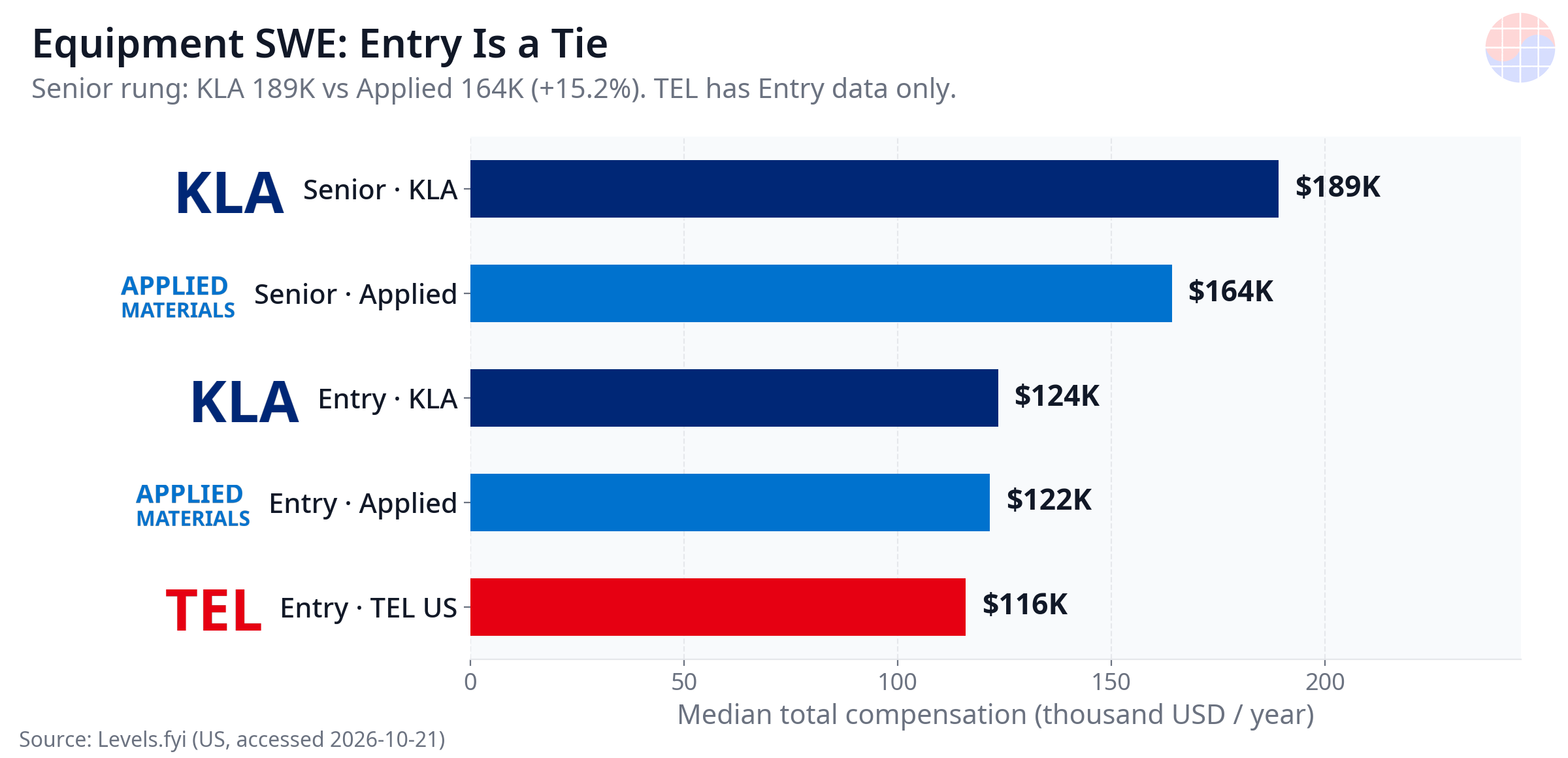
Figure 1: Software Engineer Entry and Senior rungs. The three Entry values are a tie zone; at Senior, KLA is 15.2% ahead. Source: Levels.fyi (US, accessed 2026-10-21).
The Software Ladder: Same Start, Different Slope
Entry. KLA P1 $123,553, Applied SWE I $121,610, Tokyo Electron US L3 $115,947. The market price of a new equipment software engineer barely depends on which of the three logos is on the offer letter. Tokyo Electron has only this rung published, so it drops out of every higher-rung comparison.
Mid. Applied SWE II $159,283, KLA P2 $158,355 — a $928 difference. Still a tie.
Senior. This is where it opens. KLA P3 $189,168, Applied SWE III $164,206: $24,962 apart at the same 5–6-year rung.
Staff. KLA P4 $225,965 vs Applied SWE IV $213,625 (+5.8%).
Principal. KLA P5 $288,000 vs Applied SWE V $261,250 (+10.2%).
On overall medians the two also look close — KLA $190,000 (245 submissions) vs Applied $186,300 (176). Split by rung, the story sharpens: Entry and Mid are tied, and from Senior onward KLA opens a gap and holds it to the top of the published ladder.
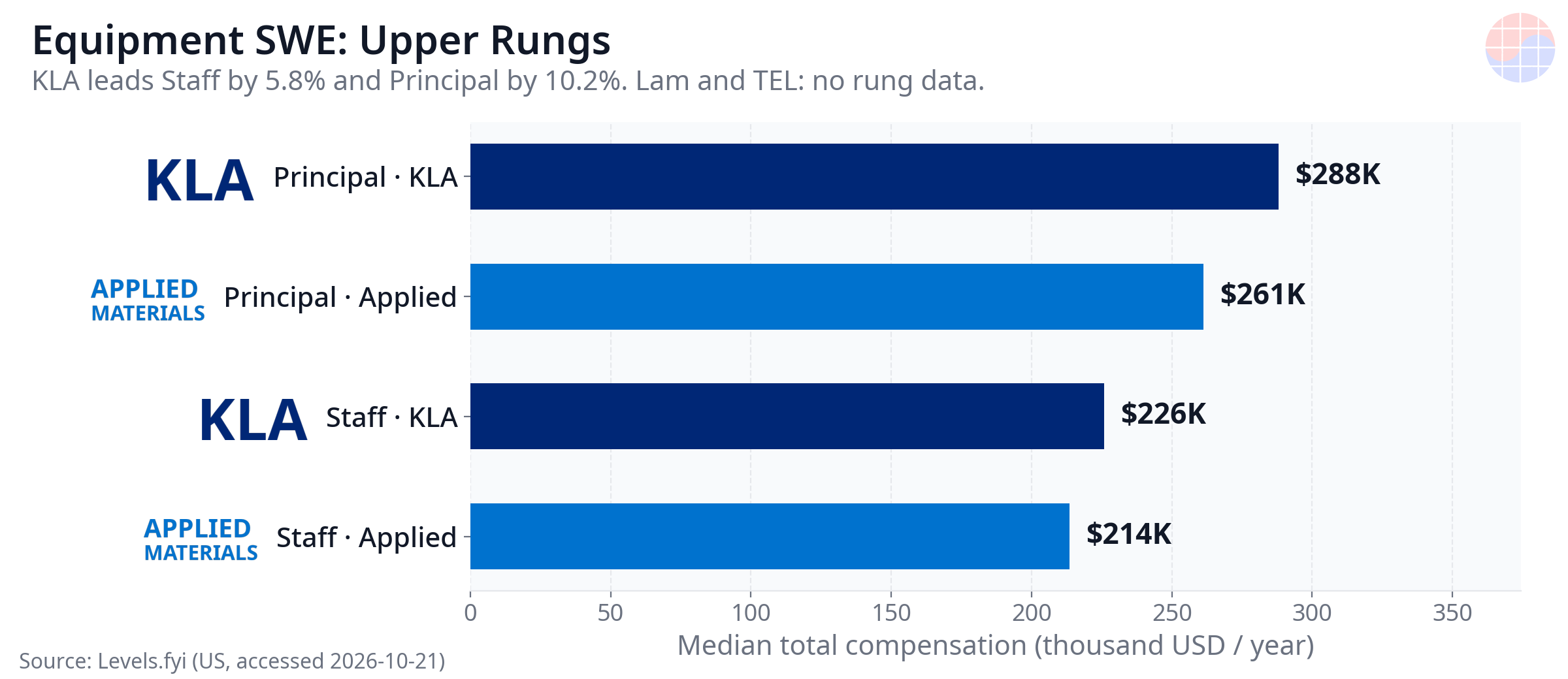
Figure 2: Software Engineer Staff and Principal rungs. Lam Research and Tokyo Electron publish no data at these rungs. Source: Levels.fyi (US, accessed 2026-10-21).
The Hardware Ladder: an Entry Gap of $45
Hardware and equipment engineering is the core craft of these companies.
Entry. Applied HWE I $111,938 and ASML US L6 $111,983 — $45 apart. A statistical tie as clean as they come.
Senior. Applied HWE III $173,224 vs ASML US L8 $158,539. ASML sits 8.5% below Applied at the same rung. Same pattern as software: tied at Entry, split at Senior.
KLA hardware P4 pays $215,383 but is not ranked. At KLA, hardware P4 is a 5–6-year band, while software P4 is a 10–11-year Staff band. Ranking it as "Senior" on dollars alone would break the one rule this series runs on, so it is shown in the mapping table with a flag instead. For reference, KLA hardware's published ladder runs P2 $150,000 → P5 $245,000 — but its Entry-equivalent starts one rung higher than the others', so it never enters a same-rung table here.
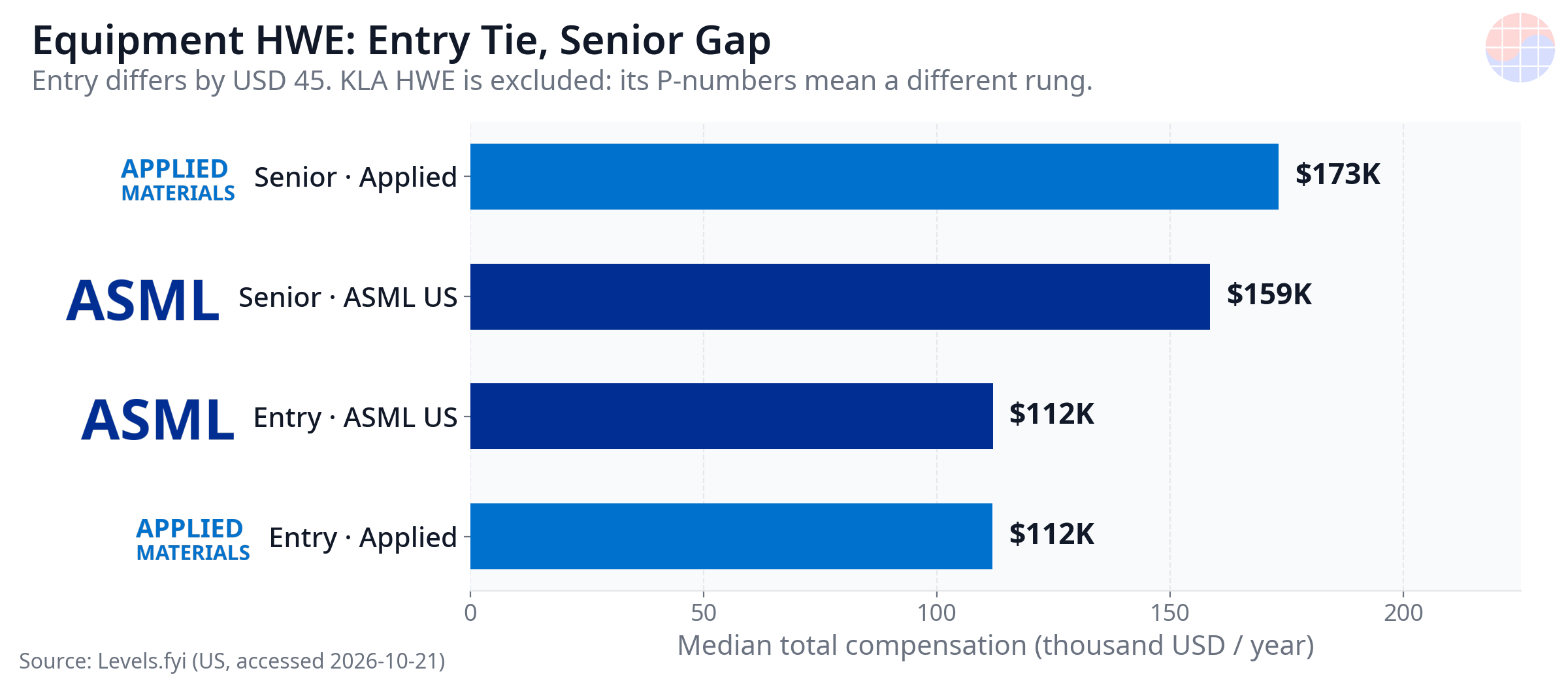
Figure 3: Hardware Engineer Entry and Senior rungs (US). KLA hardware is excluded: its P-numbers denote a different rung. Source: Levels.fyi (US, accessed 2026-10-21).
Lam Research, in Its Own Section: the Equity Company
Lam publishes no level-by-level medians on Levels.fyi, so Lam cannot enter any rung ranking. Two labeled context figures are all that can be said responsibly:
- Hardware overall median $232,000 (126 submissions) — the highest overall hardware median of the five companies. An overall median mixes every rung, so it is context, not a ranking.
- Software stock share of 26.3%. Lam's software submission mix is base $140,000, stock $50,000, on a $190,000 overall median. Applied software's stock share, on the same mix basis, is 4.0% ($7,500). KLA software is 10.5%.
Same total, different machine. Lam's $190K overall software median ties KLA's $190K, but a far larger slice of Lam's rides on the share price, while Applied's pay is almost entirely cash. One caveat, stated plainly: Lam's software sample is 66 submissions, the thinnest of the five. Treat the 26.3% as a directional signal, not a precise constant.
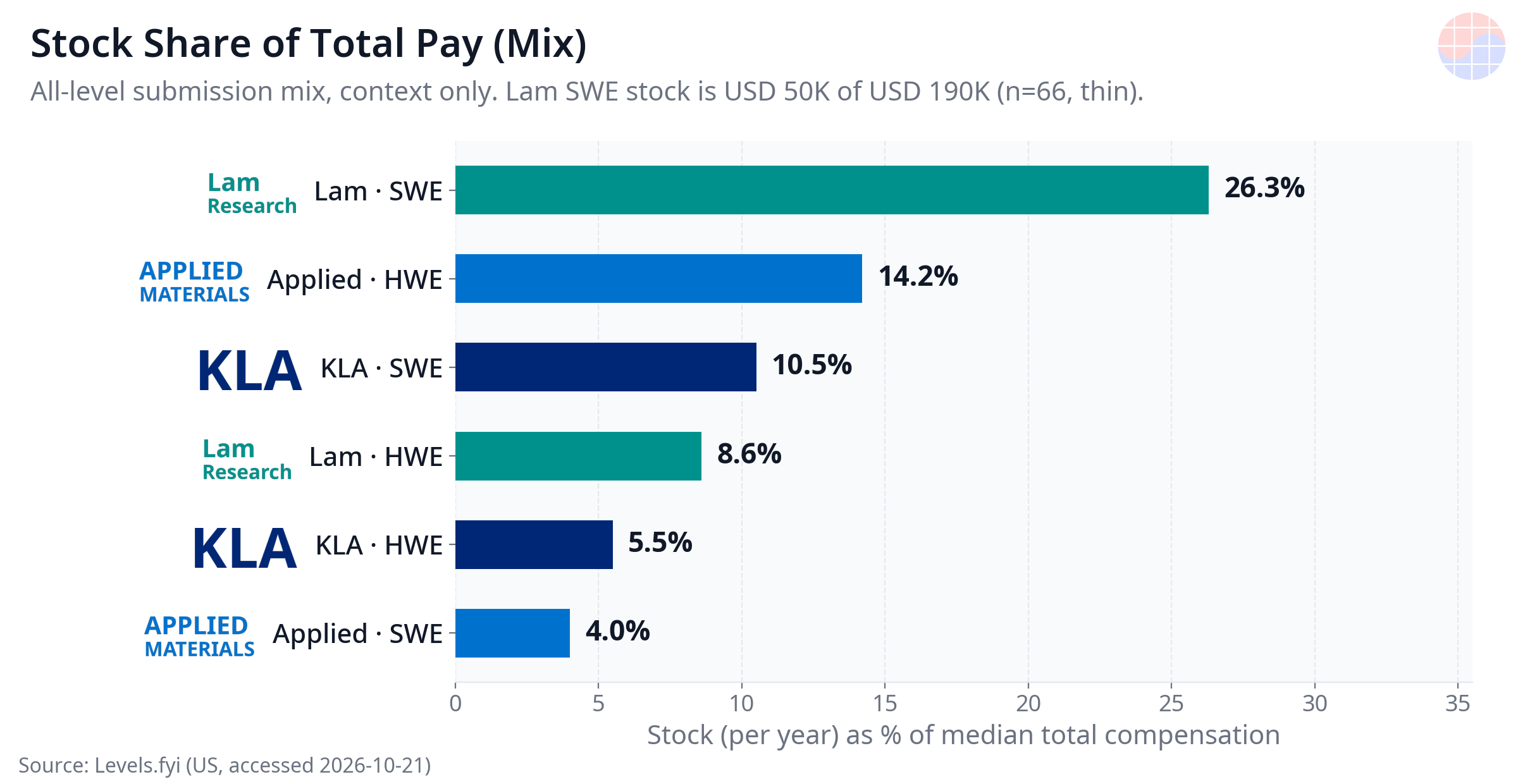
Figure 4: Stock as a share of total pay, all-level submission mix — context only, not a rung comparison. Lam SWE n=66, thin. Source: Levels.fyi (US, accessed 2026-10-21).
ASML Netherlands, in Its Own Block (Euros)
ASML software's home sample is Dutch: 324 submissions, overall median EUR 111,252. The ladder runs L6 EUR 83,404 → L7 EUR 103,902 → L8 EUR 127,269.
L9 is EUR 108,055 — below L8. Whether it is a small-sample artifact or a mix effect cannot be determined from the published page, so this article neither charts nor ranks L9 as a top rung.
Do not line the Dutch ladder up against the US table: different currency, different labor market, different tax and pension structure. The only honest statement is the shape: in the Netherlands sample, Entry to Senior is about 1.53x.
The same rule applies to Tokyo Electron's home number. TEL's Japan securities report (fiscal year ending March 2025), as cited by a secondary analysis, puts the parent-company average at JPY 13.54 million (average age 43.5, average tenure 14.9 years). That is a Japan-parent, all-employee average — not an engineer figure, and not a US figure — so it is recorded here as a labeled reference only, never trended against other years or placed on a US axis.
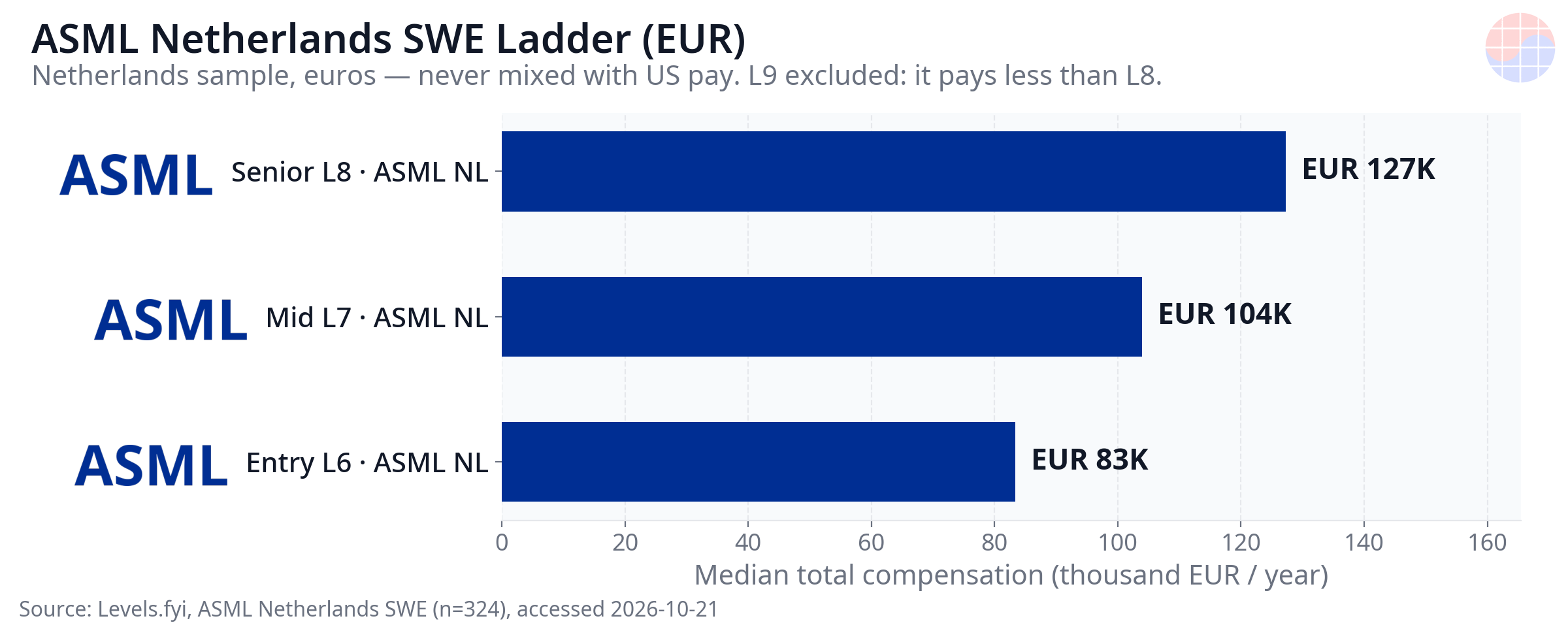
Figure 5: ASML Netherlands software ladder, euros. Never mixed with US pay. L9 excluded: it pays less than L8 in the published sample. Source: Levels.fyi, ASML Netherlands SWE (n=324), accessed 2026-10-21.
Base Salary Only: the H-1B Table
On base salary alone, all five US employers can stand in one table. These are all-title medians from LCA filings — stock and bonus excluded, every job family mixed in — so read them as each company's US base-pay floor, nothing more.
- KLA Corporation: $140,000 (n=1,745)
- Applied Materials, Inc.: $130,000 (n=4,053)
- Lam Research Corporation: $121,000 (n=1,940)
- Tokyo Electron America, Inc.: $120,000 (n=61 — thin)
- ASML US, LLC: $96,408 (n=696)
ASML US's low position has a stated cause: its US hiring skews toward field-service roles, which drags an all-title median down. TEL America's 61 cases are too few to lean on.
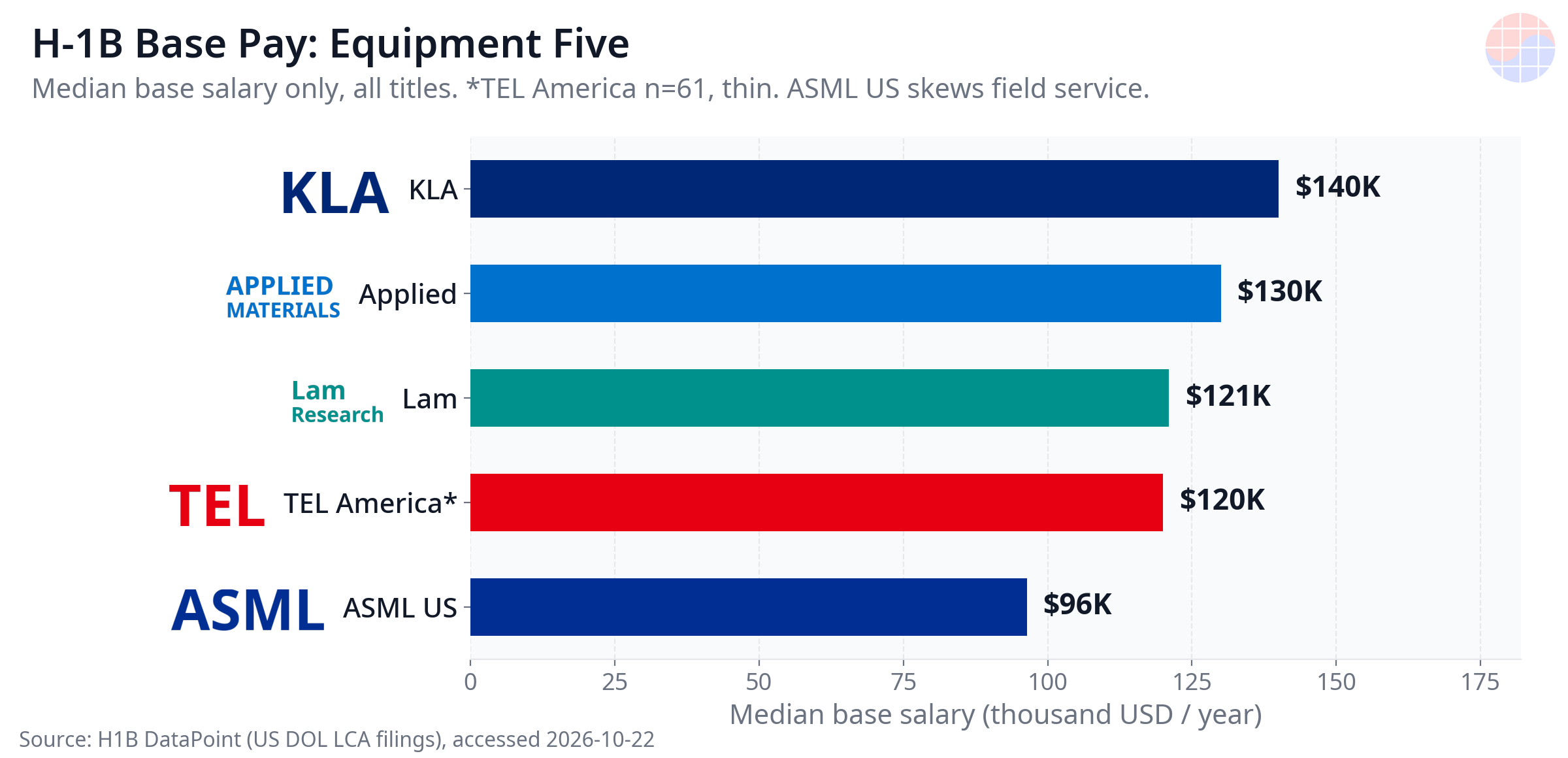
Figure 6: H-1B median base salary, all titles. Base only — not comparable to the total-compensation figures above. Source: H1B DataPoint (US DOL LCA filings), accessed 2026-10-22.
Multiples: Flat Ladders, Like the Rest of the Chain
Multiples are an in-company comparison, so they are valid — with the arrival rung labeled:
- Applied hardware: Entry $111,938 → Principal $295,000 = 2.64x
- KLA software: Entry $123,553 → Principal $288,000 = 2.33x
- Applied software: Entry $121,610 → Principal $261,250 = 2.15x
- ASML US hardware: Entry $111,983 → Staff $219,990 = 1.96x
- (Reference) KLA hardware: P2 $150,000 → P5 $245,000 = 1.63x, over a ladder whose Entry-equivalent starts higher
Every one of these sits below the 3.0–3.5x entry-to-Staff range published for Big Tech on Levels.fyi. EDA software showed the same shape in this series' first installment. Across the semiconductor supply chain — tools, design software, equipment — pay rises with promotion, but it does not triple inside the published rungs. The starting line and the company you pick move the number more than the climb does.
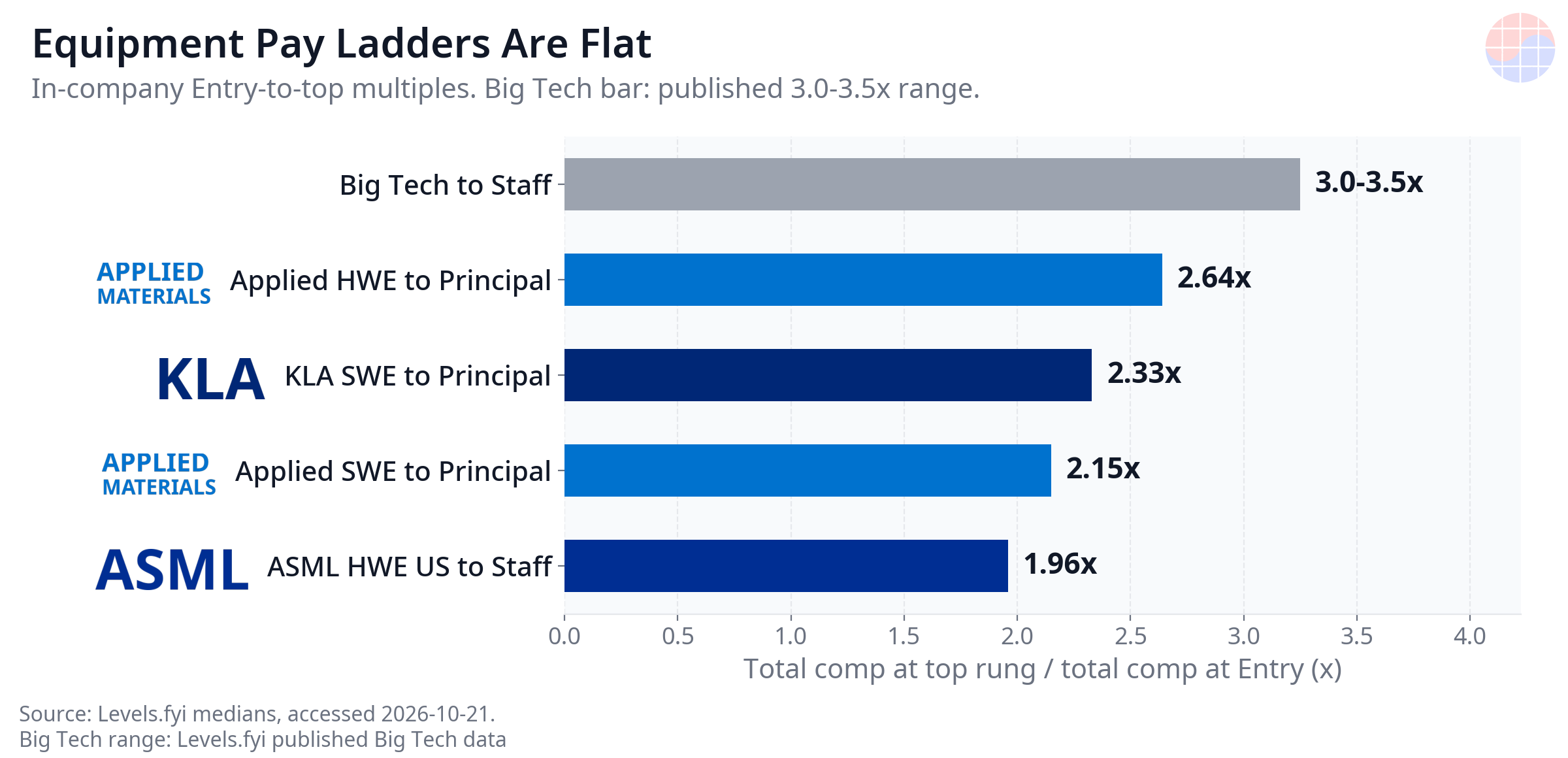
Figure 7: Entry-to-top multiples inside each company, arrival rung in the label. The Big Tech bar is the published 3.0–3.5x range. Source: Levels.fyi medians, accessed 2026-10-21; Big Tech range from Levels.fyi published Big Tech data.
So Who Pays the Most?
By basis, and only within the same rung:
Total comp, software, same rung: KLA, at every published rung. Entry $123,553 (tie zone), Senior $189,168, Staff $225,965, Principal $288,000.
Total comp, hardware, same rung: at Senior, Applied $173,224 over ASML US $158,539. At Entry the two are tied ($111,938 vs $111,983).
Base salary, all titles (H-1B): KLA $140,000, Applied $130,000, Lam $121,000, TEL America $120,000, ASML US $96,408.
Equity exposure: Lam, by a wide margin — 26.3% of its software pay mix is stock, vs Applied software's 4.0%.
Not answerable from public data: Lam at any specific rung, Tokyo Electron above Entry, ASML US software at any rung. Any ranking that fills those cells in is inventing them.
What This Means for Engineers in Korea
Every figure here is a US (or, in the labeled blocks, Netherlands/Japan) figure. Converting them straight into Korean salaries would be wrong — taxes, housing, healthcare, pensions, and bonus customs all differ.
Three portable lessons remain. First, in equipment, the entry offer barely differs by company; the divergence is a seniority story, so the company choice matters more at year five than at year one. Second, the structure differs even when the total ties: cash-heavy Applied and equity-heavy Lam are different bets on the same $190K. Third, when a company's data is missing at your rung, the correct cell is "no data" — in this industry, the loudest salary claims are usually the ones filling gaps with other rungs' numbers.
Sources and Limits
All figures are collected here once. Levels.fyi US Software Engineer medians, accessed 2026-10-21: Applied Materials (https://www.levels.fyi/companies/applied-materials/salaries/software-engineer, n=176), KLA (https://www.levels.fyi/companies/kla/salaries/software-engineer, n=245), Lam Research (https://www.levels.fyi/companies/lam-research/salaries/software-engineer, n=66, no level breakdown published), Tokyo Electron (https://www.levels.fyi/companies/tokyo-electron/salaries/software-engineer, Entry L3 only). Hardware Engineer: Applied Materials (https://www.levels.fyi/companies/applied-materials/salaries/hardware-engineer, n=191), KLA (https://www.levels.fyi/companies/kla/salaries/hardware-engineer, n=56), Lam Research (https://www.levels.fyi/companies/lam-research/salaries/hardware-engineer, n=126, no level breakdown), ASML (https://www.levels.fyi/companies/asml/salaries/hardware-engineer, US n=74). ASML Software defaults to the Netherlands sample (https://www.levels.fyi/companies/asml/salaries/software-engineer, n=324, EUR). H-1B medians are all-title base salaries from H1B DataPoint employer pages (KLA Corporation; Applied Materials, Inc.; Lam Research Corporation; Tokyo Electron America, Inc., n=61; ASML US, LLC), accessed 2026-10-22. Tokyo Electron's Japan average (JPY 13.54M, FY ending March 2025) is a parent-company, all-employee figure from its securities report as cited by a secondary source (https://note.com/hip_sedum4970/n/nc99be0258faf); the original filing was not read directly, years are not trended, and the figure is never placed on a US axis. Limits: Levels.fyi is self-reported data, not a company-wide average; Lam's software sample (n=66) and TEL America's H-1B count (n=61) are thin; ASML Netherlands L9 (EUR 108,055 < L8) is excluded as an anomaly; KLA hardware P-numbers denote different experience bands than KLA software's and are flagged wherever they appear; no per-employee average compensation figure that can be cited was found in ASML's annual-report disclosures; Korean pay data is not included in this article.
Polishing your application: Once the pay data helps you pick a target company, the next step is the application itself. For global semiconductor roles, a clean English resume and cover letter matter — an English editing service such as Wordvice AI can help refine them. Purchases through this link may generate a commission.
FAQ
Q1. Which equipment company pays software engineers the most? At the same rung, KLA — at every published rung. Senior is KLA P3 $189,168 vs Applied SWE III $164,206 (+15.2%), and Principal is KLA P5 $288,000 vs Applied SWE V $261,250 (+10.2%). Lam Research and ASML US publish no US software rung data, so they cannot be placed in this ranking.
Q2. Which company is best for a new graduate? On pay alone, it barely matters: the Entry rung is a tie zone — KLA $123,553, Applied $121,610, Tokyo Electron US $115,947. The pay difference between these companies is a story that starts at the Senior rung, not at the first offer.
Q3. Why is Lam Research missing from the rankings? Because Lam publishes no level-by-level medians on Levels.fyi. What exists is context: a hardware overall median of $232,000 (n=126, all rungs mixed) and a software pay mix whose stock share is 26.3% ($50,000 of a $190,000 overall median, n=66 — a thin sample). Putting Lam into a Senior or Staff ranking would require inventing the number.
Q4. Is ASML pay lower than US equipment pay? It cannot be compared on one axis. ASML software's published sample is the Netherlands in euros (Senior L8 EUR 127,269, n=324), while its US hardware Senior (L8) is $158,539. Currency, region, and job family all differ. Note also that ASML Netherlands L9 (EUR 108,055) prints below L8 in the sample, so L9 is not used as a top rung here.
One Last Question
If entry pay is the same everywhere, would you choose an equipment company on its Senior-rung ceiling, on its equity share, or on the technology itself? And at your company, does the pay gap really open at Senior — or somewhere else?
Silicon Levels is VLSI Korea's series comparing semiconductor pay on public data. One rule: same rung, same basis, or it does not get compared.
Silicon Levels series — EDA Pay Ladder · Memory Average Pay, Compared · Fabless Senior Pay Ranking · Foundry Pay, Compared · Materials Pay Transparency
📩 Subscribe to VLSI Korea
Get our daily semiconductor deep-dives delivered to your inbox first. Free to subscribe.