VLSI Korea
SEDEX 2026 Opens Tomorrow: HBM4E, HBF Debut, and 5 Things to Watch in Seoul
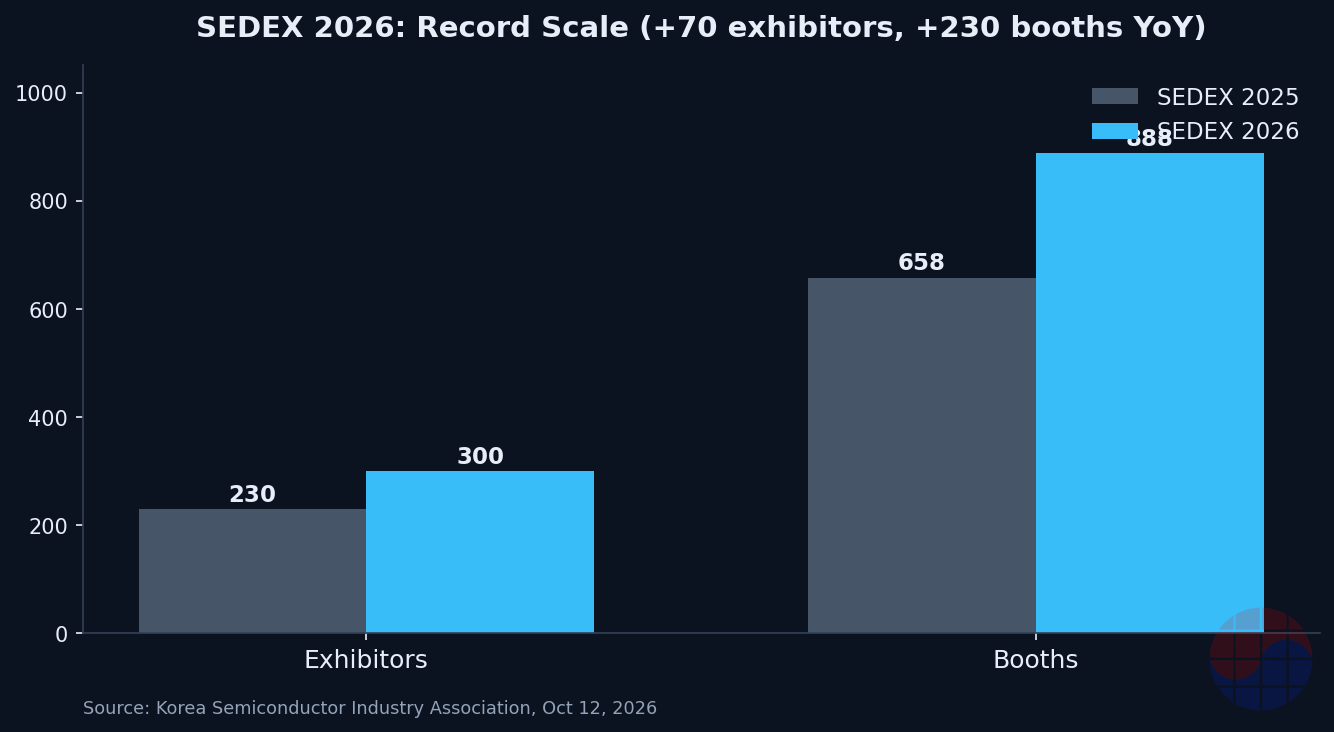
SEDEX 2026 opens Oct 14 at COEX Seoul - the largest edition ever (300 exhibitors, 888 booths). SK hynix unveils 7th-gen HBM4E and HBF for the first time. Five storylines to track.


🆓 Free article · Anyone can read this article for free
SEDEX 2026 Opens Tomorrow: HBM4E, HBF Debut, and 5 Things to Watch in Seoul
The 30-Second Version
- The 28th SEDEX (Semiconductor Exhibition Korea) 2026 opens October 14 (Wed) through October 16 (Fri), 2026, at COEX Halls C and D in Seoul. It is hosted by Korea's Ministry of Trade, Industry and Energy and organized by the Korea Semiconductor Industry Association and the Korea Semiconductor Research Association.
- It is the largest edition ever: 300 exhibitors and 888 booths, up 70 companies and 230 booths from 2025. This year's theme is "Into the Era of Silicon Intelligence."
- The headline act is SK hynix's first public unveiling of HBM4E, the 7th-generation HBM, and HBF (high-bandwidth flash) — a NAND-based, wide-interface memory technology for AI servers.
- Samsung Electronics will exhibit under the message of "AI system design," spanning HBM, mobile image sensors, mobile processors, automotive-grade semiconductors, foundry solutions, and 3D memory architectures.
- Bottom line: SEDEX 2026 is where Korea's semiconductor industry declares where it intends to hold the lead for the next three years, in the middle of an AI memory supercycle. Worth tracking for investors, job seekers, and industry analysts alike, on-site or through follow-up coverage.
Background: Why SEDEX Matters
SEDEX is Korea's only dedicated semiconductor exhibition, now in its 28th year. According to the organizers' announcement (as of October 13, 2026), this edition sets all-time records for both exhibitor count and booth count: 300 companies, 888 booths — 70 more companies and 230 more booths than in 2025.
The composition matters more than the raw numbers. The two memory giants, Samsung Electronics and SK hynix, anchor the floor with large booths, while the full domestic supply chain shows up alongside them: equipment, materials, and parts vendors as well as design houses, IP companies, and fabless startups. The exhibitor list (as of October 13, 2026) includes Hanmi Semiconductor (TC bonders), Semes, Jusung Engineering, PSK, KC Tech, Dongjin Semichem, and Miko on the equipment/materials side, plus Asicland (design house), Chips&Media, and OpenEdges Technology (IP).
SEDEX is also a conference, not just a trade floor. October 14 brings an international R&D conference on advanced semiconductor packaging; October 15 hosts a JEDEC global standards forum; October 15–16 feature the 9th Semiconductor Industry-Academia Exchange Workshop and a job fair (18 companies, 433 pre-registered job seekers); and October 16 closes with a session titled "Semiconductors Powering Humanoids." Product showcases, technology standards, and talent pipelines are all negotiated in the same three days.
Deep Dive: 5 Things to Watch at COEX
1. The HBM4E and HBF Debut — Reading the Memory Roadmap
The single biggest storyline is SK hynix's first-ever public showing of HBM4E and HBF (per the company's exhibition preview, as of October 13, 2026).
HBM4E is the 7th generation of high-bandwidth memory. Each HBM generation has delivered a step-function increase in per-stack I/O count and bandwidth, and HBM4E is expected to demonstrate the next step. Detailed specifications will need confirmation once unveiled on October 14, but the direction is unambiguous: with per-accelerator memory bandwidth requirements climbing steeply every year, memory vendors compete on who ships the next HBM generation first — and who ramps it stably.
The more intriguing reveal is HBF (high-bandwidth flash): stacked NAND flash engineered for wide data transfer, aimed at AI servers. The key point is the NAND foundation, as opposed to the DRAM foundation of HBM. NAND offers lower cost per bit and non-volatility, but loses on latency and endurance. HBF targets exactly the gap in that tradeoff. As AI inference workloads scale, a new memory tier is emerging for data that needs bandwidth but not full DRAM performance — model weight storage, hierarchical KV-cache placement — and HBF is positioned for that tier.
From a memory specialist's perspective, HBF's success hinges on two questions. First, can the controller and system software hide NAND's weaknesses well enough? Second, can it demonstrate enough total-cost-of-ownership advantage to justify hyperscalers re-architecting their memory hierarchy? This unveiling is the first step of technology validation; the real verdict will come from customer qualification results in late 2026 through 2027.
For Korea, the symbolism is significant. The HBM race is effectively a three-way contest among Samsung, SK hynix, and Micron — and whoever shows the next-generation roadmap first captures the narrative of leadership. Unveiling both HBM4E and HBF on home turf at SEDEX reads as SK hynix declaring its memory leadership ambitions in public.
2. Samsung's "AI System Design" — An Evolving Foundry Message
Samsung Electronics has framed its entire exhibition around "AI system design" (per its exhibition preview, as of October 13, 2026). The lineup spans HBM, mobile image sensors, mobile processors, high-reliability automotive semiconductors, foundry solutions, and 3D memory architectures.
The notable thing is how the lineup is composed. This is not a spec-sheet contest of individual components; it is a single story about system-level design capability across memory, logic, and sensors. That message plays directly to the structural strength of an IDM (integrated device manufacturer) — very few companies in the world can credibly tell it.
Placing "foundry solutions" in the same space as HBM and 3D memory architectures is telling. Foundry competition in the AI era is expanding beyond process-node yield battles into how HBM and logic dies are integrated into a single system (advanced packaging, 2.5D/3D integration). Samsung, with memory and foundry under one roof, holds a structural advantage in that fight. Whether SEDEX becomes the stage where it imprints that advantage on customers and investors is the thing to watch.
3. The Equipment and Materials Front — Supply-Chain Independence
Behind the memory giants' flagship booths, the real measure of industrial stamina is the equipment and materials contingent. This year's exhibitor list is packed: Hanmi Semiconductor (TC bonders), Semes, Jusung Engineering, PSK, KC Tech, Dongjin Semichem, Miko, Exicon, and others (as of October 13, 2026).
The TC bonder (thermo-compression bonder) deserves special attention — it is the critical tool for stacking DRAM dies in HBM. HBM manufacturing capability is, in a very real sense, a function of bonding precision and throughput. Hanmi's booth is a barometer for where Korean equipment stands in the HBM supply chain.
The presence of a design house (Asicland) and IP vendors (Chips&Media, OpenEdges Technology) is equally worth noting. These companies form the midsection of the fabless ecosystem, and their showing indicates how far Korea's chip-design capabilities have matured beyond the memory-centric portfolio. It is a window into whether the system-semiconductor ecosystem is thickening.
For Korea, this front carries strategic weight beyond import substitution. With U.S.–China technology competition and supply-chain realignment ongoing, self-sufficiency in equipment and materials translates directly into strategic autonomy for the Korean semiconductor industry. SEDEX is effectively the only domestic stage where that autonomy can be surveyed at a glance.
4. Advanced Packaging and JEDEC Standards — Where Technology Gets Decided
The conference program matters as much as the exhibition. October 14 hosts the International R&D Conference on Advanced Semiconductor Packaging; October 15 brings the JEDEC Global Standards Forum.
Advanced packaging is currently the hottest technology battleground in semiconductors. As physical scaling approaches its limits, the center of gravity for performance gains is shifting from transistor shrink to packaging (2.5D/3D integration, chiplets) — and HBM itself is advanced packaging's flagship product. The R&D directions presented at this conference will hint at the packaging technology roadmap for the next three to five years.
The JEDEC forum carries even more direct stakes. HBM interface and operating specifications are defined as JEDEC standards, and the outcomes shape both the memory vendors' product designs and their customers' system designs. What the contested issues are in the HBM4E-generation standardization — and what voice Korean companies carry at the standards table — is the point to watch.
A note from a signoff-timing (STA) specialist's perspective: as 3D-stacked structures go mainstream, timing closure and thermal/power-integrity complexity grows exponentially. Behind every packaging and standards discussion, EDA tools and design methodologies must evolve in lockstep, and bottlenecks there ultimately gate product launch schedules. Worth checking whether methodology-focused presentations surface at the conference.
5. Physical AI and Humanoids — The Next Demand Pool Emerges
The October 16 session "Semiconductors Powering Humanoids" and the opening-day keynote lineup reveal where SEDEX sees the next demand pool forming.
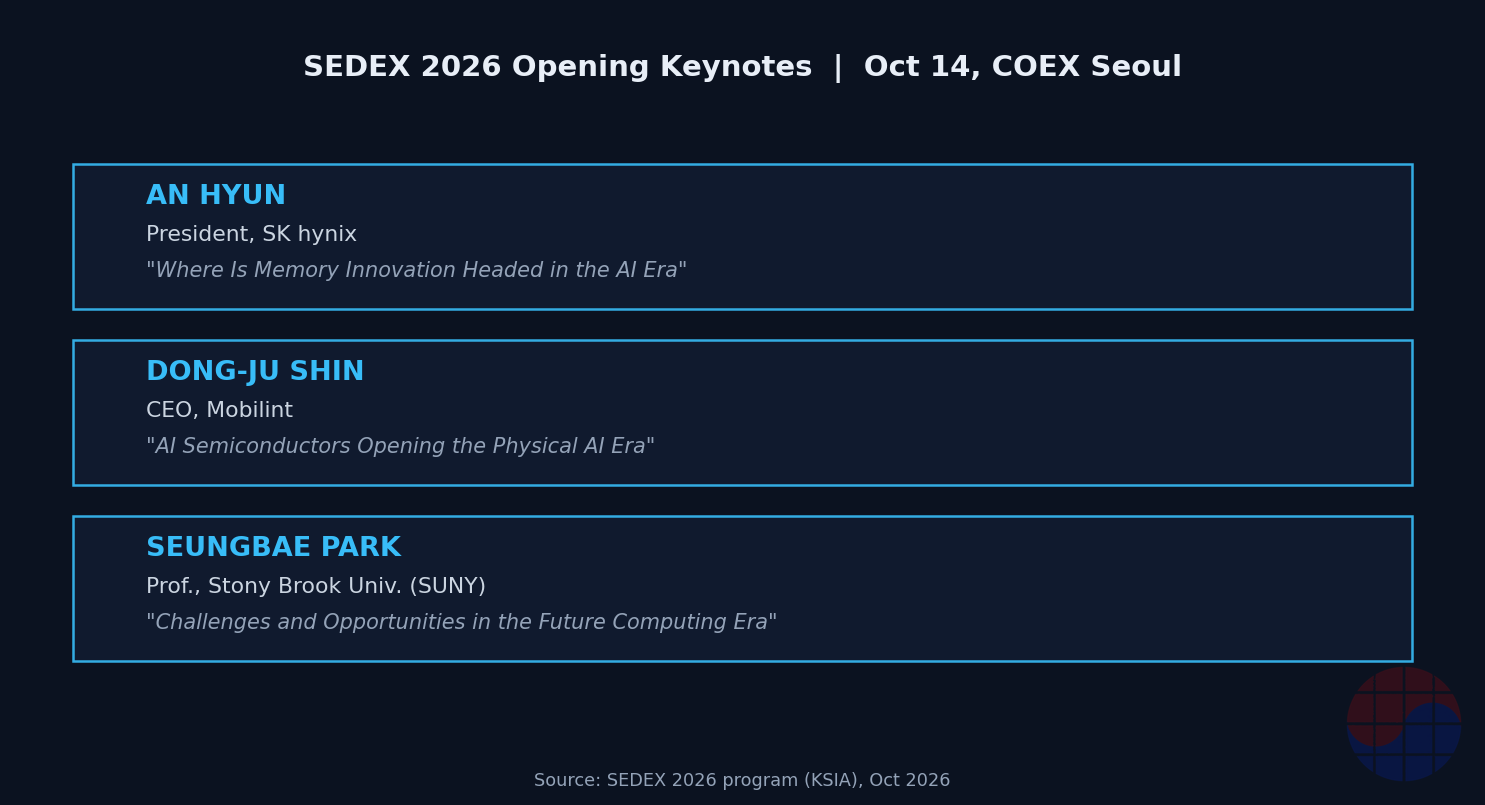
The October 14 keynotes feature three speakers: SK hynix CEO Hyun Ahn ("Questioning the Direction of Memory Innovation in the AI Era"), Mobilint CEO Dongjoo Shin ("Opening the Physical AI Era with AI Semiconductors"), and SUNY professor Seungbae Park ("Challenges and Opportunities in the Future Computing Era") — per the program guide as of October 13, 2026.
The keyword here is physical AI. Beyond AI inside data centers, AI in the physical world — robots, humanoids — is emerging as the next semiconductor demand driver. Mobilint, a Korean fabless company building AI inference NPUs, suggests the "edge AI semiconductor" angle in CEO Shin's keynote. A single humanoid needs vision sensors, edge inference chips, motor-control MCUs, and power semiconductors — a completely different chip mix from data-center GPUs, and a new window of opportunity for Korea's system-semiconductor companies.
From an investment standpoint, this is still closer to "theme" than to revenue. Meaningful humanoid-semiconductor revenue is years away. But the fact that SEDEX programmed it as a standalone session is itself a signal of where the domestic industry is looking for its five-year demand horizon.
Chase's Take: Korea's Strategic Position, Read from the Show Floor
One question runs through all five storylines: where does Korea's semiconductor industry stand in the AI-era value chain?
First, memory remains Korea's absolute stronghold. The HBM4E and HBF debuts are a declaration of intent to extend that lead into the next generation. But memory is a cyclical industry, and that must not be forgotten: investment decisions made at the top of a supercycle become the burden of the next downturn — a repeating pattern in this industry's history. New memory-tier plays like HBF should also be read as portfolio diversification, reducing dependence on a single product line in HBM.
Second, Samsung's "AI system design" message is a positioning play aimed at the IDM's structural edge. Few companies on earth combine foundry, memory, and system LSI under one roof. Even where it trails in process-node races, the strategic choice is to compete on system-level integration. For that strategy to work, hyperscaler design wins must follow — and SEDEX is the persuasion stage.
Third, the thickness of the equipment/materials and fabless ecosystem will decide Korea's next decade. Behind the memory giants' headline numbers, unless core tools like TC bonders and the design-house/IP layer stand on their own, supply-chain risk remains. Three hundred exhibitors is an encouraging signal that the ecosystem's breadth is expanding.
Fourth, the talent pipeline. The October 15–16 job fair draws 18 companies and 433 pre-registered job seekers (as of October 13, 2026). With the industry's talent shortage persisting, SEDEX doubling as a hiring venue testifies to continued hiring demand. For engineers weighing a PhD or a career move, it is a networking opportunity not to be missed.
Taken together, SEDEX 2026 is a checkpoint for "Korea semiconductors' current address": memory leadership extended (HBM4E/HBF), the IDM's system strategy (Samsung), supply-chain self-sufficiency (equipment and materials), a voice at the standards table (JEDEC/packaging), and exploration of the next demand pool (physical AI). All five arrows point the same way — toward ownership of the AI era.
Implications: For Investors, Managers, and Careers
For investors. The HBM4E/HBF unveiling is an event to confirm the warmth of the memory capex cycle. Use it as a checkpoint for order momentum in back-end equipment tied to HBM stacking yields, such as TC bonders. But trade-show announcements carry a marketing tint — cross-verify any real investment call against Q4 2026 earnings-season capex guidance and customer qualification news. The physical-AI/humanoid theme is still years from revenue contribution; favor companies with actual edge-AI chip and power-semiconductor design wins over pure theme plays.
For managers. Samsung's "AI system design" message is instructive: the axis of semiconductor competition is shifting from individual device performance to system-level integration. If you run a fabless or design-house business, this is the moment to audit your portfolio through the lens of selling "system solutions," not "a chip." JEDEC standards outcomes feed directly into product roadmaps, so R&D planning teams should track the standards forum's results closely.
For engineers weighing careers. The October 15–16 job fair (18 companies, 433 job seekers) is a rare window into current hiring demand across memory, equipment/materials, and fabless segments — all in one place. Free pre-registration closed October 12; on-site registration is available for KRW 20,000 (per the October 13, 2026 notice).
FAQ
Q1. When and where is SEDEX 2026? A. October 14 (Wed) through October 16 (Fri), 2026, at COEX Halls C and D in Seoul. Hosted by Korea's Ministry of Trade, Industry and Energy; organized by the Korea Semiconductor Industry Association and the Korea Semiconductor Research Association (as of October 13, 2026).
Q2. What are HBM4E and HBF? A. HBM4E is the 7th-generation HBM that SK hynix is unveiling for the first time at SEDEX 2026. HBF (high-bandwidth flash) is an AI-server memory technology that stacks NAND flash for wider data transfer — also being unveiled for the first time. It aims at a new memory tier for AI workloads, exploiting NAND's lower cost per bit versus DRAM-based HBM. Detailed specifications await the October 14 on-site reveal.
Q3. Can the general public attend? What is the admission fee? A. Free pre-registration closed on October 12. Visitors can still register on-site for KRW 20,000 (per the October 13, 2026 notice).
Q4. What should I look at at SEDEX for investment ideas? A. Three things. First, check the back-end equipment booths (TC bonders and the like) linked to the HBM4E/HBF unveilings for clues on order momentum. Second, follow the JEDEC standards forum and the advanced-packaging conference for the direction of the three-year technology roadmap. Third, use the physical-AI/humanoid session to identify areas with plausible near-term design wins, such as edge AI chips and power semiconductors. Trade-show announcements skew promotional, so cross-verify against quarterly capex guidance before making any real investment decision.
Exhibition details, figures, and schedules in this article are based on announcements from the organizers (Korea Semiconductor Industry Association / Korea Semiconductor Research Association) and exhibiting companies as of October 13, 2026. Programs are subject to change on-site.
Related reading