VLSI Korea
What Semiconductor Marketing Teams Do: EDA, Equipment, IDM, and Fabless
Compare the market requirements, roadmaps, launches, sales enablement, artifacts, and handoffs owned by semiconductor product marketing teams.


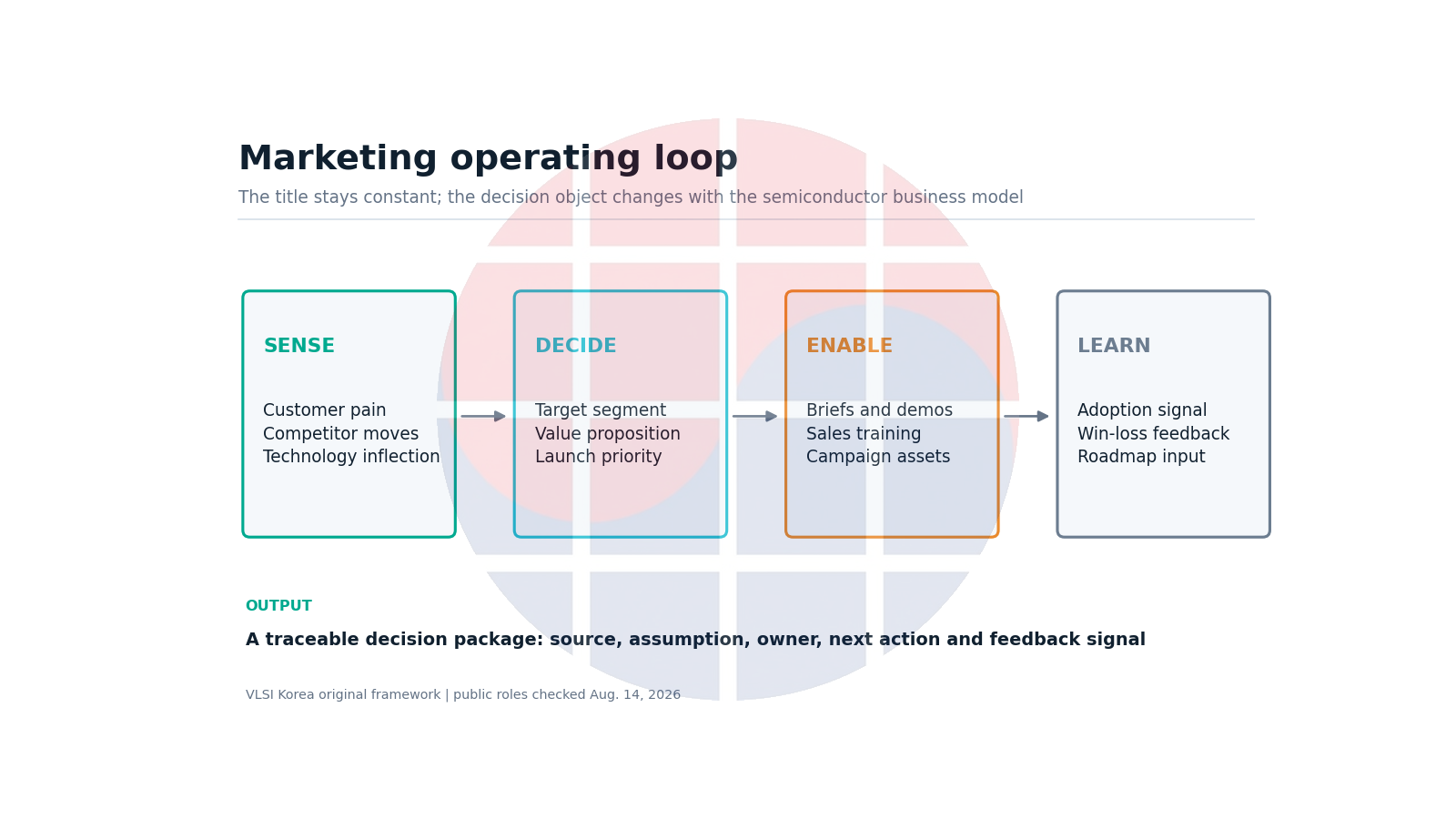
A semiconductor marketing team is closer to a product decision team than an advertising department. It reads customer design or process problems, chooses the market to pursue, converts technical differentiation into a defensible value proposition, and gives Sales and Field teams a common language. The decision object, however, changes sharply across EDA, equipment, IDM and fabless companies.
This guide compares public role descriptions and official materials from Cadence, Lam Research, Samsung Semiconductor Europe and AMD, checked on 2026-08-14. It does not infer a confidential organization chart or universal hiring practice.
1. Product Marketing, Product Management and Technical Marketing
Product Marketing generally owns market choice, positioning, launch and field enablement. Product Management is closer to requirements, roadmap and lifecycle priorities. Technical Marketing and Field Application Engineering sit closer to benchmarks, demonstrations, evaluations and qualification.
The boundaries overlap. A public Cadence Product Marketing role connects customer requirements to R&D and can touch packaging and pricing. AMD's Technical Product Marketing role translates architecture, workload, benchmark and TCO into go-to-market execution. The useful question is not the title alone. It is which decision the role owns and which artifact it leaves behind.
2. EDA and IP: sell the workflow outcome, not a feature list
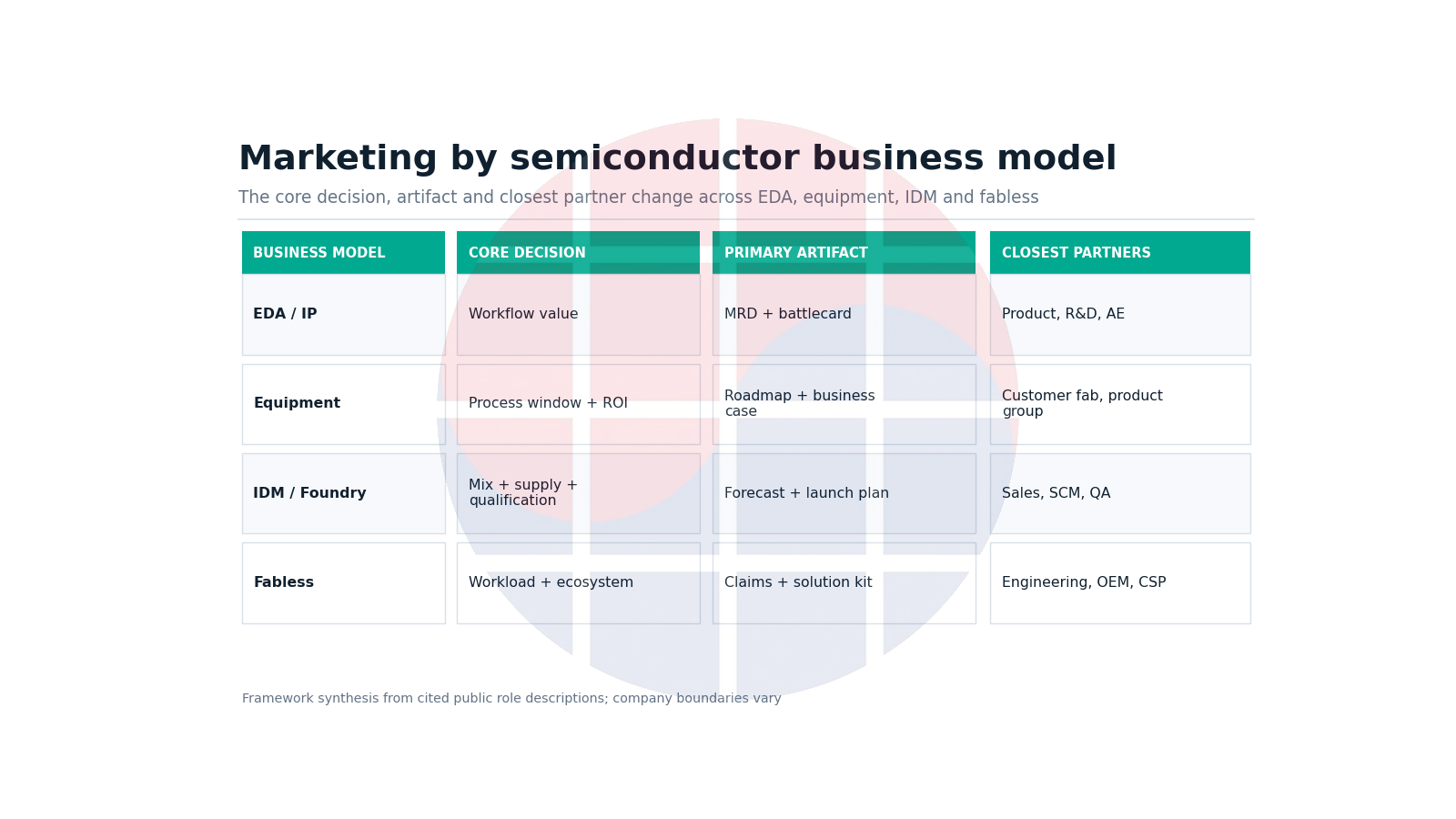
An EDA customer buys improvement in PPA, runtime, coverage, debug productivity and signoff risk across a design flow. Product Marketing must connect the different questions asked by chip architects, design leads, CAD teams, executives and procurement.
- Market requirements: define the target workflow and pain point around an advanced node, 3D-IC, AI accelerator or automotive program.
- Product input: convert customer evidence into an MRD, enhancement priority, packaging choice or pricing argument.
- Proof design: set the boundary for demo designs, beta engagements, competitive benchmarks and permitted claims.
- Field enablement: create solution briefs, battlecards, objection handling, launch decks and training.
Cadence's public Tensilica Platform Marketing posting combines roadmap, customer insight, GTM and field enablement. Its Clarity EM Product Marketing posting adds customer-to-R&D translation with ROI justification, beta programs, launch logistics and sales training.
3. Equipment: connect process requirements to equipment economics
The product unit is an etch, deposition, lithography or inspection system, plus upgrades and service. Customer requirements appear as fab metrics such as defect performance, overlay, selectivity, throughput, uptime and cost of ownership.
Lam Research's public Dielectric Films Product Marketing role covers product and commercial strategy for ALD and PECVD products. It connects customer process requirements, competitive position, roadmap, development spending, ROI, product introduction and market penetration. The job begins with which process window to solve and at what customer economics, not with a press release.
4. IDM and foundry: product mix, price, supply and qualification
Component marketing inside an IDM differs from consumer brand marketing. DRAM, NAND, image sensors, analog products and foundry capacity have technology generations and supply constraints. Market demand must therefore connect to product mix, regional forecast, pricing, inventory and customer qualification.
Samsung Semiconductor Europe's public Memory Product Marketing role senses EMEA demand and competitive activity, prepares sales statistics and market or application reports, and connects Sales, Technical Marketing, QA, the Korea organization, major customers and distributors. Its primary artifact is closer to a demand assumption that informs mix, pricing and supply than to campaign copy.
Foundry marketing adds PDK and IP ecosystems, node readiness, design enablement and tapeout pipeline. This is a VLSI Korea business-model inference from the interfaces that a foundry customer must validate, not a claim about one company's private reporting line.
5. Fabless: translate silicon into a platform and workload decision
A CPU, GPU or NPU is not adopted on silicon specifications alone. OEMs, cloud providers, ISVs, system integrators and channels must move together. Product Marketing links workload, software stack, benchmark, performance per watt, TCO and solution readiness into one GTM motion.
AMD's public Technical Product Marketing role for integrated systems covers architecture, performance and TCO narratives, benchmark requirements, competitive intelligence, vertical solutions, sales plays and program KPIs. Good marketing does not stop at “faster.” It states the workload, system configuration, metric and comparison boundary in which customer value appears.
6. The artifacts a marketing team produces
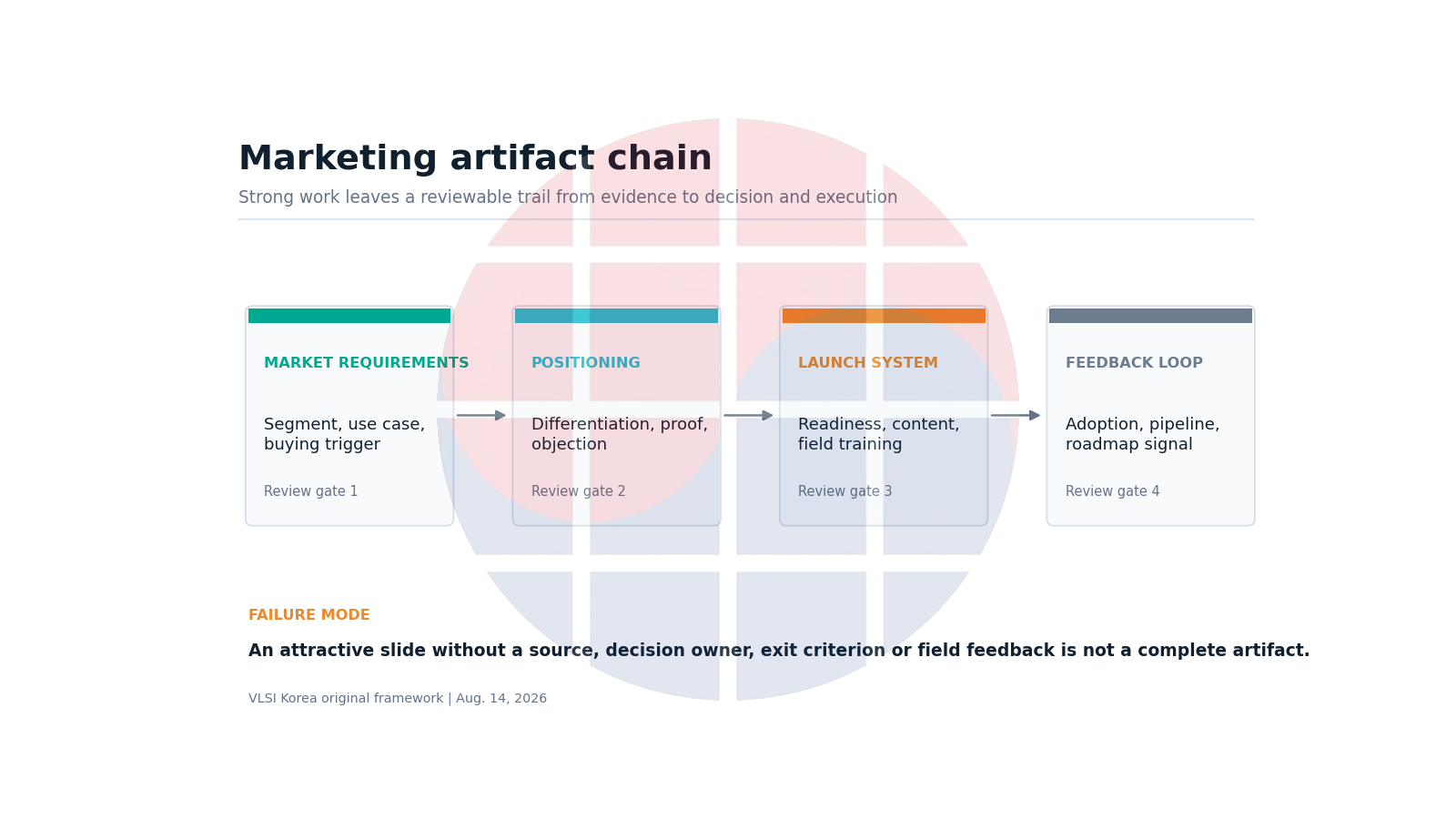
- Market requirements: target segment, user, pain point, buying trigger and market boundary.
- Positioning memo: alternatives, differentiation, proof, objections and prohibited claims.
- Launch readiness: product, demo, documentation, pricing, channel, training, owner and date.
- Sales enablement: pitch, battlecard, qualification questions, objections and customer proof.
- Feedback review: adoption, pipeline influence, win-loss reason and roadmap input.
Metrics also differ. EDA may emphasize evaluation and adoption; equipment, product penetration and installed-base opportunity; an IDM, mix, forecast and margin; a fabless company, design wins, platform adoption and pipeline influence. Public postings do not disclose every company's calculation rules, so this guide does not invent a universal ranking or numerical target.
7. What an engineer should show when moving into marketing
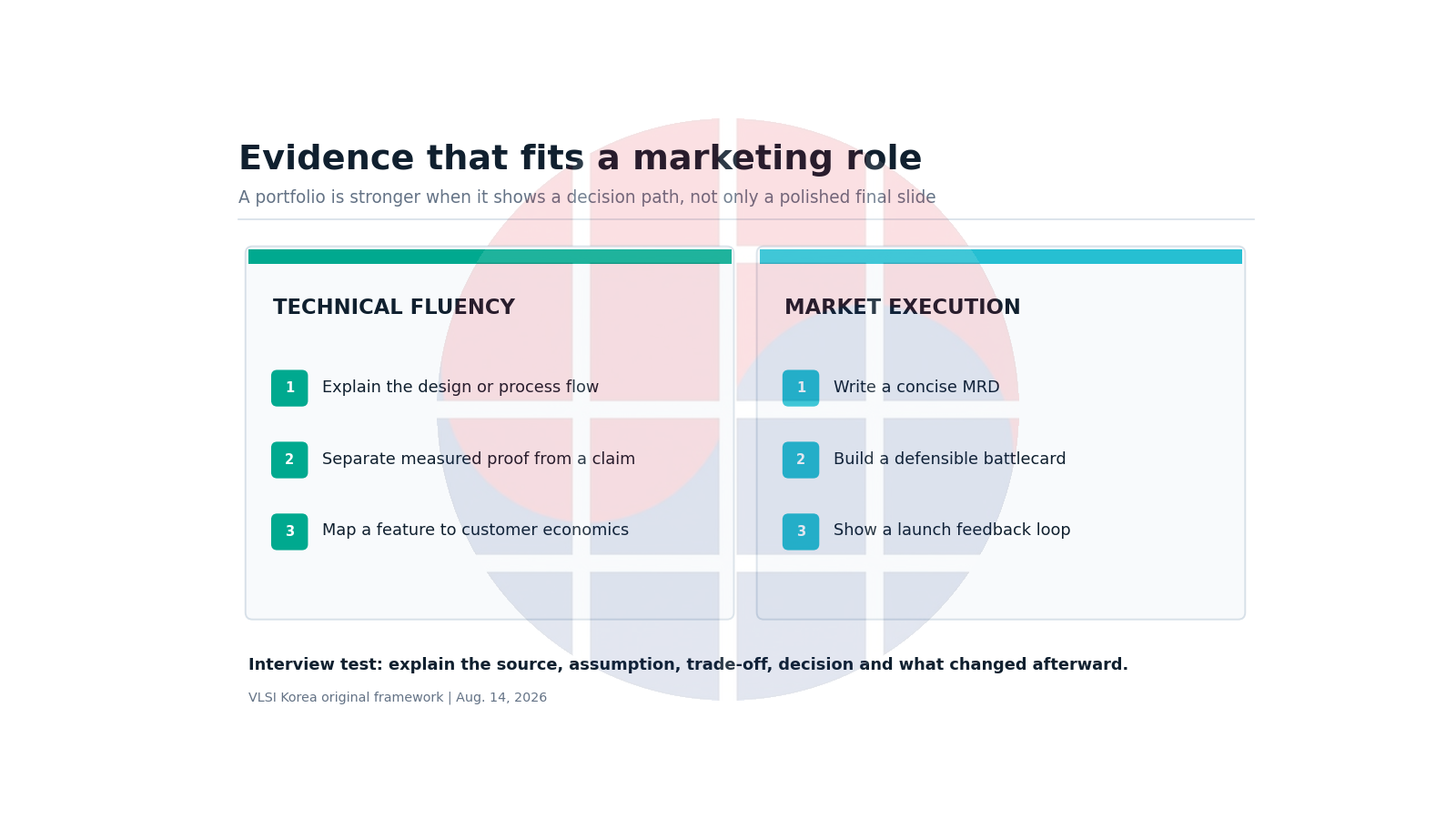
Do not submit a list of technologies alone. Show how you converted a technical fact into a market decision. A compact public-source portfolio can contain five pages:
- customer workflow and failure mode;
- market boundary and competitive alternatives;
- value proposition and proof;
- launch and field enablement plan;
- adoption signal and feedback loop.
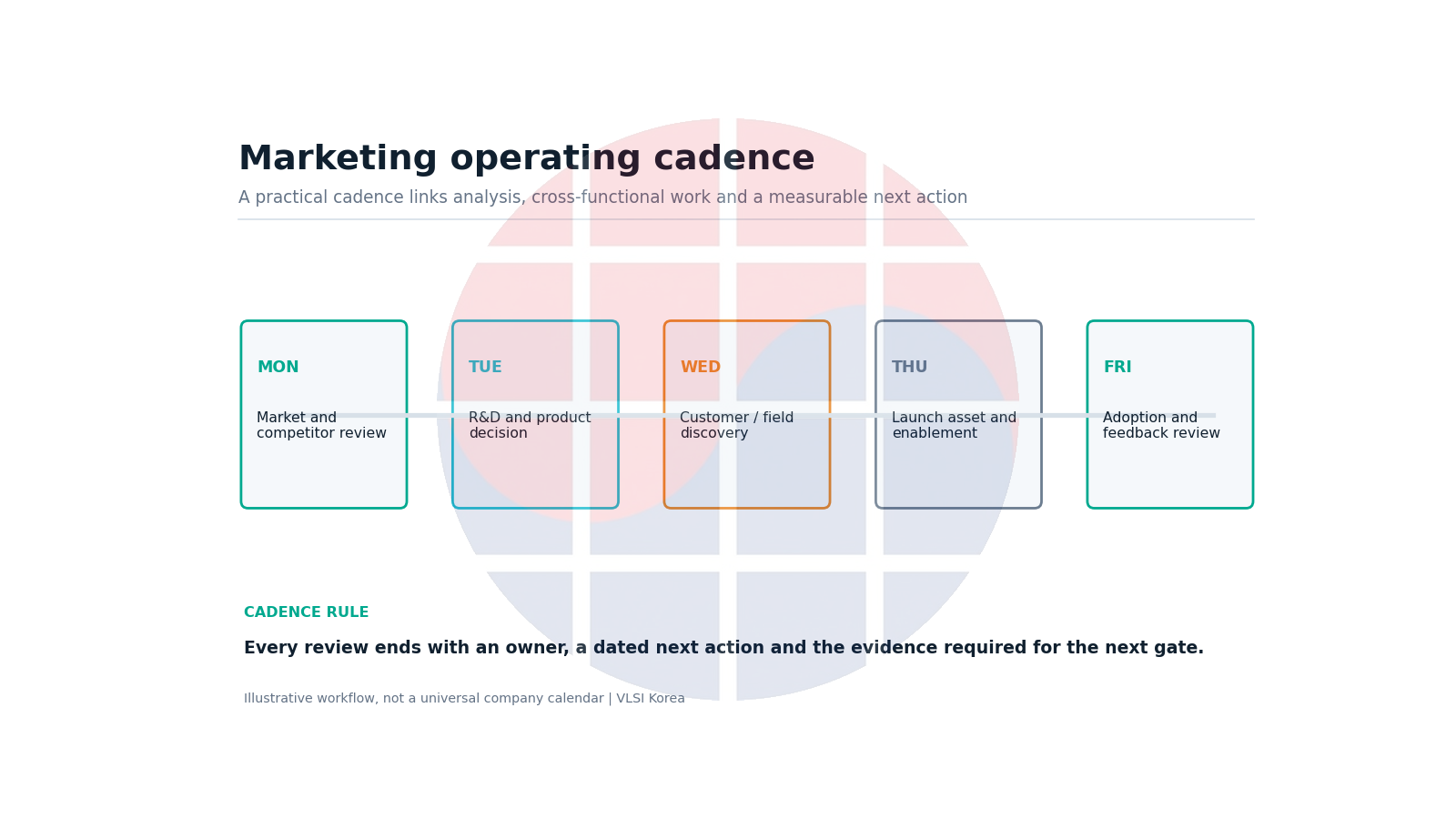
In an interview, explain the source, assumption, trade-off, decision owner and the evidence that would change your recommendation. A polished slide without a metric definition or proof boundary is a weak technical-marketing artifact.
Sources
- Cadence: Tensilica Platform Marketing, checked 2026-08-14
- Cadence: Product Marketing Manager, Clarity Electromagnetic, checked 2026-08-14
- Lam Research: Manager, Product Marketing, checked 2026-08-14
- Samsung Semiconductor Europe: Memory Product Marketing Manager, checked 2026-08-14
- AMD: Senior Technical Product Marketing Manager, Integrated Solutions, checked 2026-08-14
Editorial note: A public role description does not establish a fixed company-wide organization chart or operating model in every region. This guide synthesizes only the disclosed scope and the business-model mechanism.
More VLSI Korea team guides · VLSI Roadmap
This article is provided for informational purposes only and does not constitute a recommendation to buy or sell any security. Figures and factual statements are based on publicly available sources, including company filings, news reports, and market research, and may contain errors in the source material or in the preparation of this article. The author may own shares in companies mentioned. All investment decisions and their outcomes are the reader's responsibility.