VLSI Korea
What Semiconductor Sales Teams Do: EDA, Equipment, IDM, and Fabless
Compare EDA license sales, equipment accounts, memory qualification, fabless design wins, and the artifacts that move semiconductor deals forward.


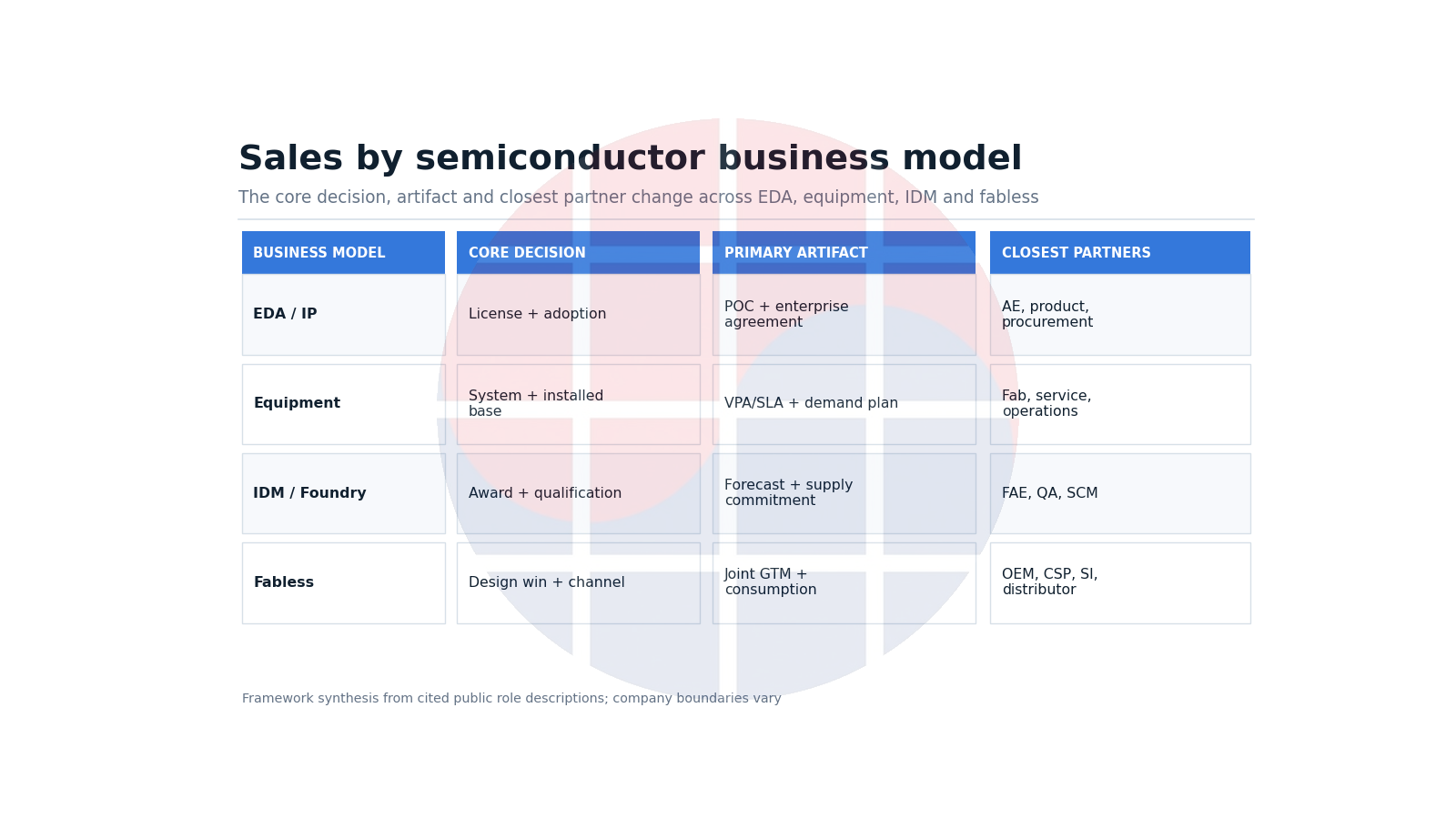
A semiconductor sales team does not merely explain a product. It closes the loop between technical validation, the customer's buying process, and a commercial commitment. EDA centers on licenses and workflow adoption, equipment on new systems and installed-base services, IDMs on qualification, pricing, and supply, and fabless companies on design wins and ecosystem adoption.
This guide compares public role descriptions and official materials from Synopsys, ASML, Samsung, and AMD, checked on Aug. 14, 2026. It does not infer undisclosed quotas, commissions, account revenue, or company-specific approval systems.
1. Account Executive, Product Sales, FAE, and Business Development
An Account Executive owns the account plan, stakeholders, commercial process, and forecast. Product Sales brings opportunity strategy and expertise for a particular tool or product line. A Field or Application Engineer reduces technical risk through evaluation, benchmarking, integration, and qualification. Business Development is closer to opening a new market, partnership, or commercial model.
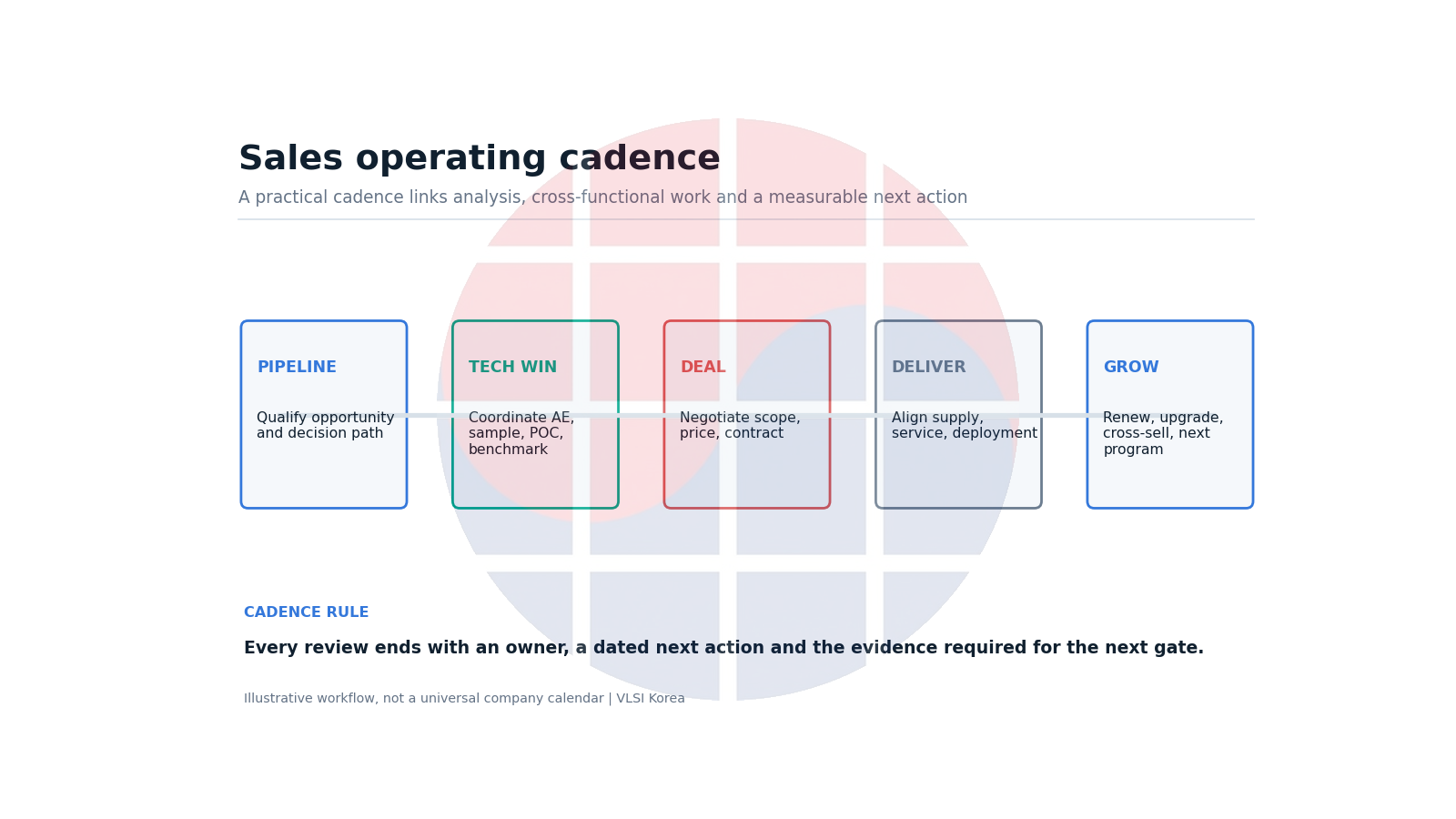
The roles overlap in practice, but every deal has to connect three streams. Can the product work technically? Can it pass procurement and legal review? Can the vendor deliver the promised supply, support, and roadmap? Sales brings the owners and dates for those streams into one plan.
2. EDA and IP sales: sell workflow adoption, not a demo
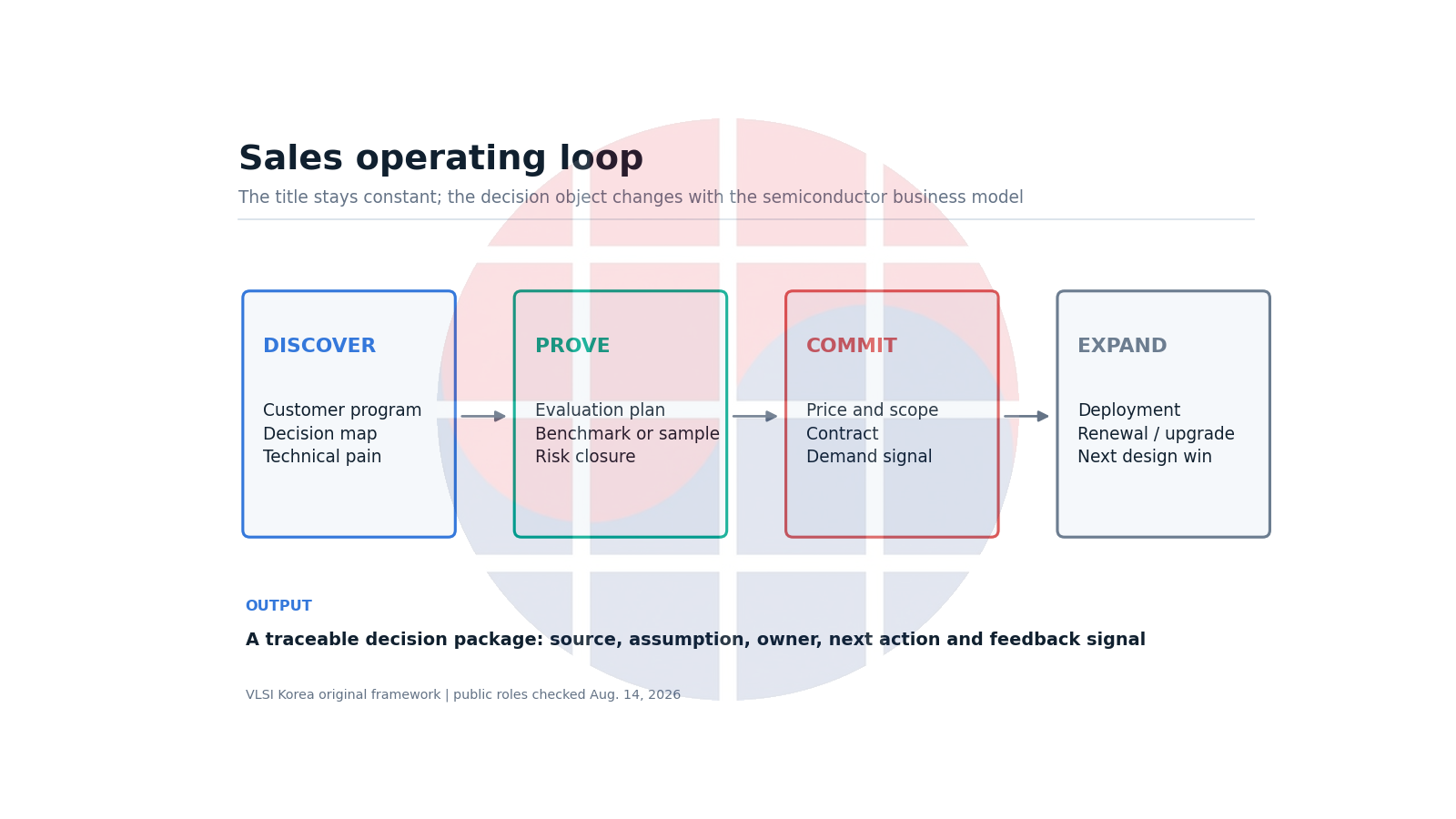
An EDA purchase does not end with a feature comparison. The customer evaluates a real design and constraints inside an RTL-to-GDS, verification, signoff, or system-analysis flow. It may test PPA, runtime, coverage, debug productivity, and migration risk. Product Sales connects technical discovery, proof, commercial proposal, and forecast with the Account Executive, Application Engineering, and R&D.
Synopsys' public EDA Product Sales role combines account strategy, the full sales cycle, customer-requirement discovery, proof-of-concept work with Application Engineering, forecasting, competitive context, and customer feedback. A strong account plan therefore answers concrete questions.
- Which project and tapeout milestone create the buying trigger?
- Who are the technical, economic, and procurement decision makers?
- Which design, metric, and baseline define a successful proof?
- What are the license scope, deployment, support, and renewal conditions?
3. Equipment sales: sell a tool and years of installed-base economics
An equipment account covers more than a new-system order. It tracks a fab's node and capacity plan, process of record, evaluation lots, facility readiness, delivery, installation, acceptance, and the service, spares, and upgrades that follow.
ASML's public Regional Account Manager role covers both new systems and Installed Base & Services. It includes volume purchase agreements, service-level agreements, long-range demand planning, forecasts, internal delivery coordination, customer profitability, and voice of the customer. Demand signals before signature and execution risks after signature therefore live in the same account plan.
Equipment-sales artifacts can include the account strategy, demand scenarios by fab, evaluation and acceptance milestones, commercial terms, delivery dependencies, an escalation map, and installed-base opportunities. Formats and decision rights vary by company, so this guide does not invent a universal process beyond the public evidence.
4. IDM and foundry sales: align award, qualification, price, and supply
Customer qualification and supply planning are central to memory, analog, image-sensor, and foundry-capacity transactions. Sales not only pursues an RFQ and product award. It also aligns samples, technical reviews, quality issues, price and contract, forecasts, and allocation across headquarters, factories, Quality, and Field Engineering.
Samsung's public Data Center Sales Manager role specifies long-term account strategy, product awards, price and contract negotiation, forecasting, and internal stakeholder coordination. A separate Memory FAE role identifies customer requirements and supports samples, qualification, quality, and the path to mass production. Read together, the postings show that the commercial and technical owners need one qualification timeline.
For a foundry, that structure also includes PDK and IP readiness, a shuttle or tapeout, yield ramp, and capacity reservation. This is VLSI Korea's business-model interpretation of the technical gates between purchase and production, not a description of a specific foundry's internal sales process.
5. Fabless sales: own platform adoption after the design win
A CPU, GPU, or accelerator customer does not buy a chip in isolation. OEMs, cloud providers, system integrators, distributors, resellers, ISVs, and the software ecosystem complete the solution. Strategic Account Sales therefore connects silicon specifications, the system roadmap, workloads, software readiness, joint go-to-market, and supply in a multi-year account strategy.
AMD's public Strategic Enterprise Account Executive role links long-term accounts, ecosystem partners, product adoption, and forecasting. Its Partner Sales role covers distributor and reseller planning, enablement, pipeline, and execution. Success in fabless sales has to move beyond the first design win into platform launch, deployment, and expansion.
6. The artifacts a sales team repeatedly produces
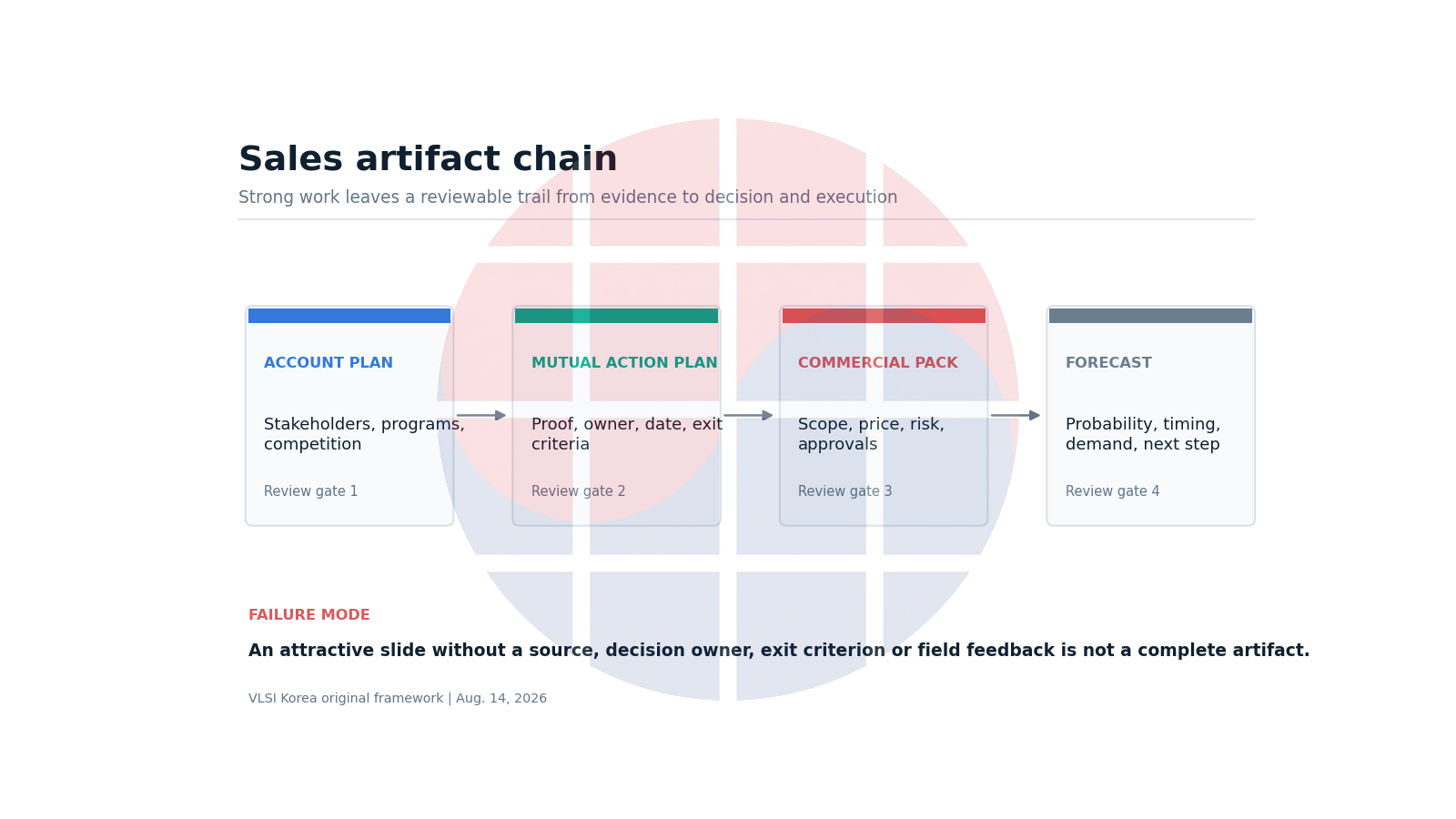
- Account plan: the customer's business and product roadmap, opportunities, stakeholders, competitive position, and actions.
- Qualification plan: use case, technical success metric, sample or evaluation asset, owner, and exit criterion.
- Mutual action plan: customer and supplier decisions, approvals, and delivery milestones on one schedule.
- Commercial package: configuration, volume or license scope, pricing logic, contract, service, and support assumptions.
- Forecast and risk review: stage evidence, customer commitment, supply dependencies, next action, and slip trigger.
- Expansion plan: renewal, upgrade, installed-base service, the next platform, or channel expansion.
Depending on the business model, KPIs may include booked revenue, consumption, product awards, design wins, renewals, forecast accuracy, gross margin, on-time delivery, or account penetration. Public postings do not disclose every formula and weight, so this guide does not present one universal KPI hierarchy.
7. Where an account motion fails
- Technical proof without a buying process: the benchmark is complete, but the budget owner, legal path, and procurement date are blank.
- Activity inflates the forecast: the team confuses meeting volume with customer commitment.
- Promises are detached from execution: Sales commits without confirming supply, application support, and roadmap ownership.
- The account depends on one champion: technical, economic, and procurement interests are absent from the stakeholder map.
- Nothing follows the order: deployment, acceptance, consumption, renewal, or the next-platform expansion has no owner.
Strong sales operations do not make an opportunity sound optimistic. They show the artifact and customer action that justify the current stage, and define in advance what would move the date or probability down.
8. What an engineer should show when moving into technical sales
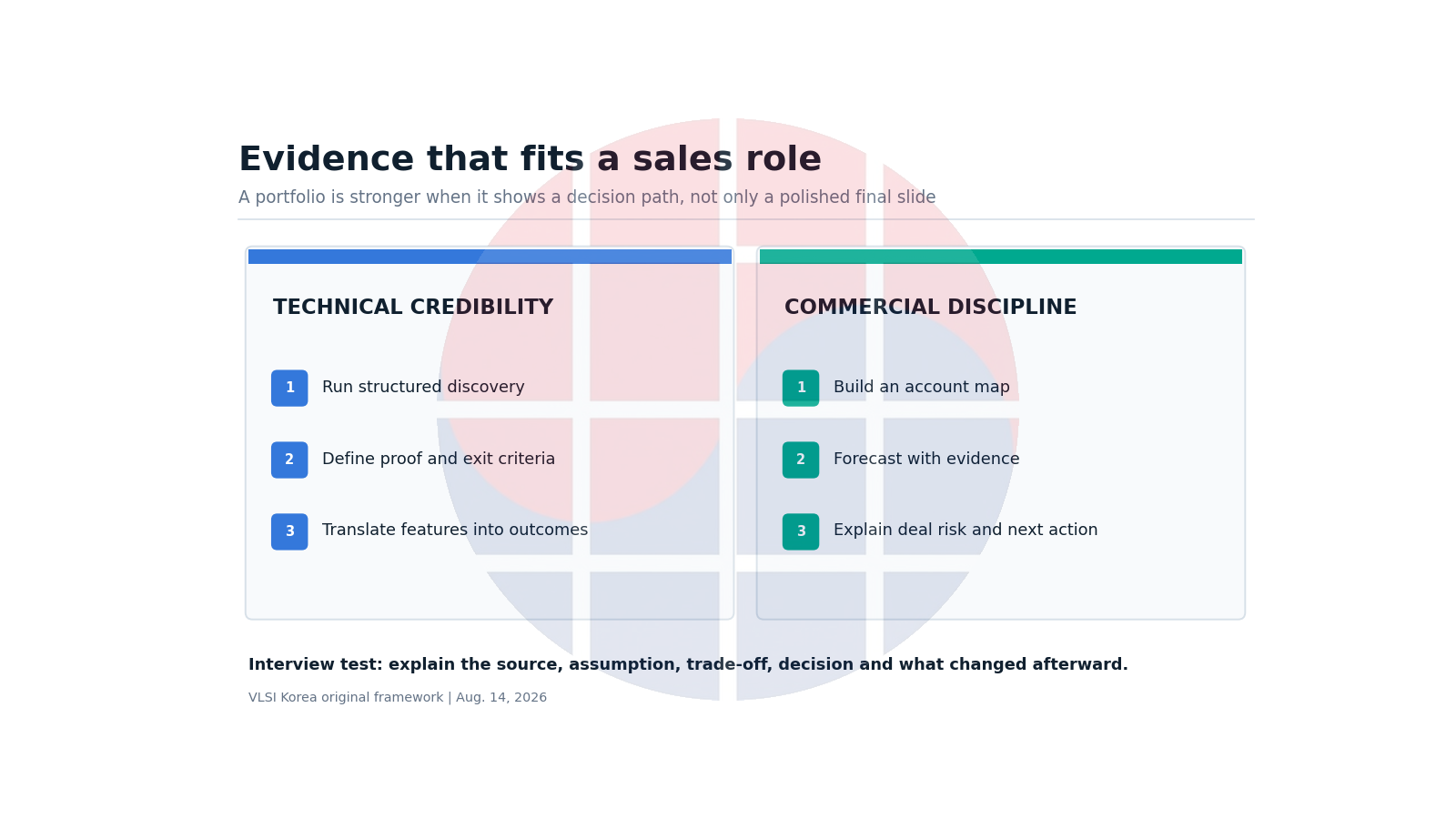
Product knowledge alone is not enough. Show that you can convert a customer problem into a proof and a commercial next step. Using only public information, you can choose a hypothetical account and build the following:
- the customer's product roadmap and buying trigger;
- a stakeholder map and discovery questions;
- an evaluation or qualification plan with success metrics;
- competitive alternatives, objections, and evidence boundaries; and
- a mutual action plan, forecast assumptions, and risk triggers.
Never put confidential customer data in a portfolio. In an interview, explain what you do not know, who would validate it, and how a failed proof would change the account plan.
Sources
- Synopsys: Principal Product Sales Manager, EDA Tools, checked 2026-08-14
- ASML: Regional Account Manager, checked 2026-08-14
- Samsung: Sales Manager, Data Center, checked 2026-08-14
- Samsung: Field Application Engineer, Memory, checked 2026-08-14
- AMD: Strategic Enterprise Account Executive, checked 2026-08-14
- AMD: Partner Sales Manager, checked 2026-08-14
Editorial note: A public role description is one posting at one point in time. This guide does not infer quotas, commissions, account revenue, or confidential customer information, and labels business-model mechanisms as VLSI Korea editorial interpretation.
More VLSI Korea team guides · VLSI Roadmap
This article is provided for informational purposes only and does not constitute a recommendation to buy or sell any security. Figures and factual statements are based on publicly available sources, including company filings, news reports, and market research, and may contain errors in the source material or in the preparation of this article. The author may own shares in companies mentioned. All investment decisions and their outcomes are the reader's responsibility.